x⁻⁴ is not −x⁴. A minus in an exponent makes a fraction, not a negative number, and those are two different ideas wearing one symbol. These free printable worksheets show the confusion written out and ask which answer is right.
There are only three places the minus can end up, and each is a real page of working: on the whole power, thrown away, or carried down into the fraction it just created. Seeing all three beside the correct answer is what separates them, because a student who has only ever been told the rule tends to remember that something flips without remembering what.
Why this sheet works
Half the questions run the rule backwards. Dividing one by a negative power gives a whole power again, so the answer is sometimes a fraction and sometimes not — which means the shape of the answer cannot be guessed and the rule has to be read each time.
How this one works
One question from this sheet, worked through a step at a time.
On Mia's paper: 1 ÷ (x⁶ · x⁻³) = 1/x⁹. Which line should replace it?
1 ÷ (x⁶ · x⁻³)
1 ÷ (x⁶ · x⁻³)=1 ÷ x³
1 ÷ (x⁶ · x⁻³)=1 ÷ x³
1 ÷ (x⁶ · x⁻³)=1/x³
1 ÷ (x⁶ · x⁻³)=1/x³
they wrote:1/x⁹
Do not check by reading their line. Somebody else's working is the most persuasive thing on the page, and rereading it is how you end up agreeing with it — do the step yourself first, then compare.
On your own, and writing the step nobody writes down: 1 ÷ (x⁶ · x⁻³) becomes 1 ÷ x³.
Tidy that up and it is 1/x³.
Now compare. They wrote 1/x⁹, and the minus in the exponent was ignored and the powers added — so the correct answer is 1/x³.
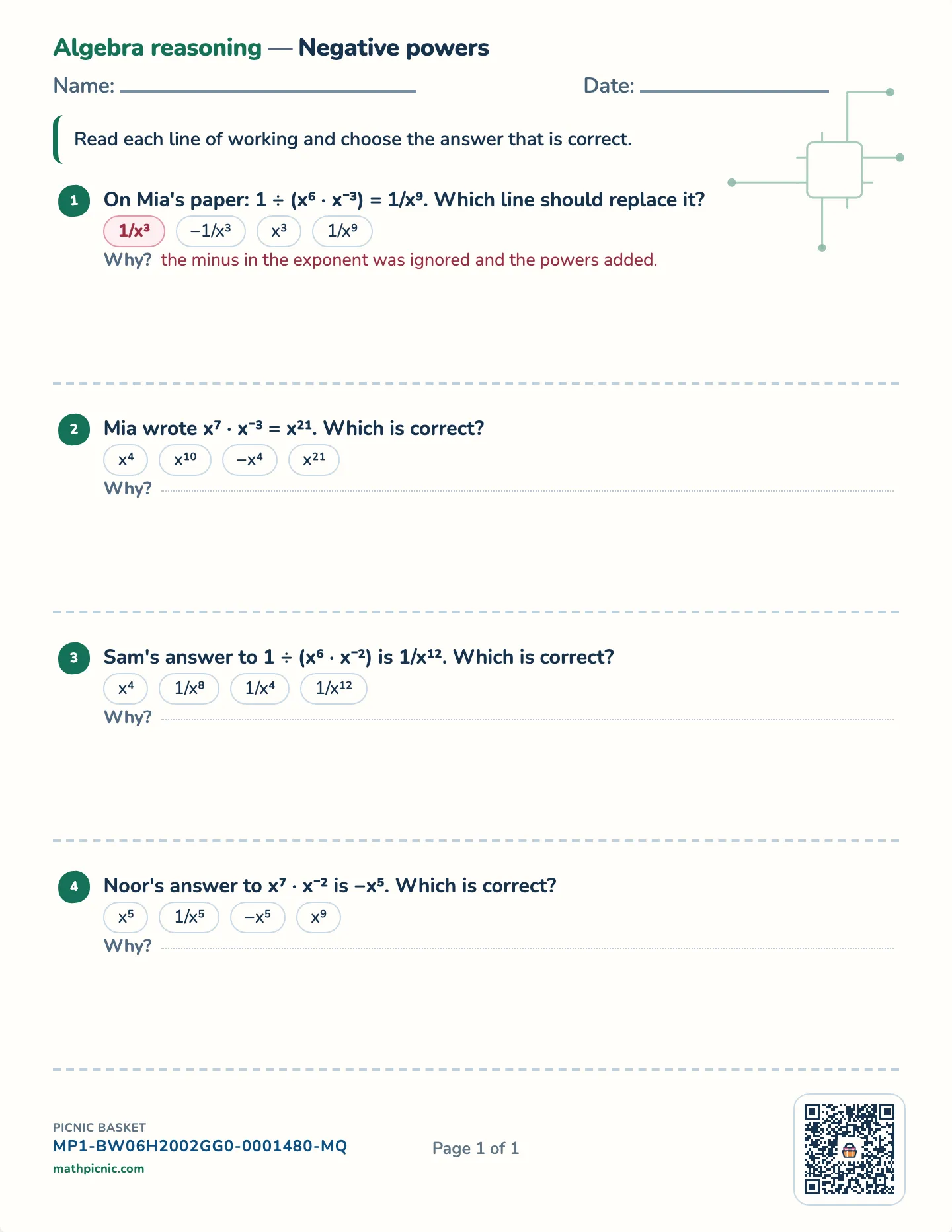
Read each line of working and choose the answer that is correct.
1On Mia's paper: 1 ÷ (x⁶ · x⁻³) = 1/x⁹. Which line should replace it?1/x³−1/x³x³1/x⁹Why?
2Mia wrote x⁷ · x⁻³ = x²¹. Which is correct?x⁴x¹⁰−x⁴x²¹Why?
3Sam's answer to 1 ÷ (x⁶ · x⁻²) is 1/x¹². Which is correct?x⁴1/x⁸1/x⁴1/x¹²Why?
4Noor's answer to x⁷ · x⁻² is −x⁵. Which is correct?x⁵1/x⁵−x⁵x⁹Why?
Algebra reasoning · Negative powersAnswer key
1. 1 ÷ (x⁶ · x⁻³) = 1/x³, not 1/x⁹ (the minus in the exponent was ignored and the powers added)2. x⁷ · x⁻³ = x⁴, not x²¹ (the two powers were multiplied instead of added)3. 1 ÷ (x⁶ · x⁻²) = 1/x⁴, not 1/x¹² (the two powers were multiplied instead of added)4. x⁷ · x⁻² = x⁵, not −x⁵ (the minus was moved onto the answer instead of into the exponent)