
Word problem worksheets
Not sure what comes next? Start with the first sheet that feels comfortable.
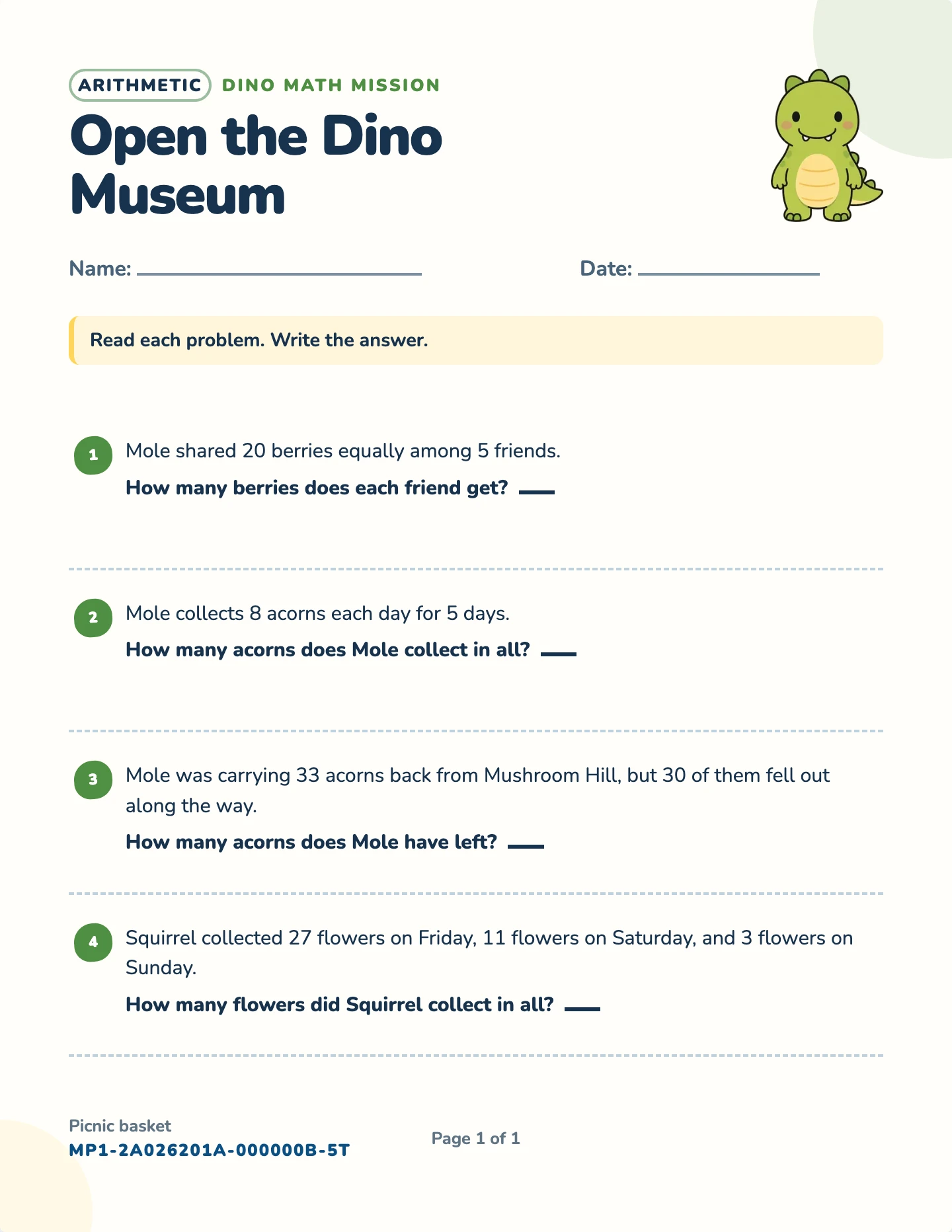
Addition word problems
Grade 1–2
Solve addition word problems by combining amounts
Customize this sheet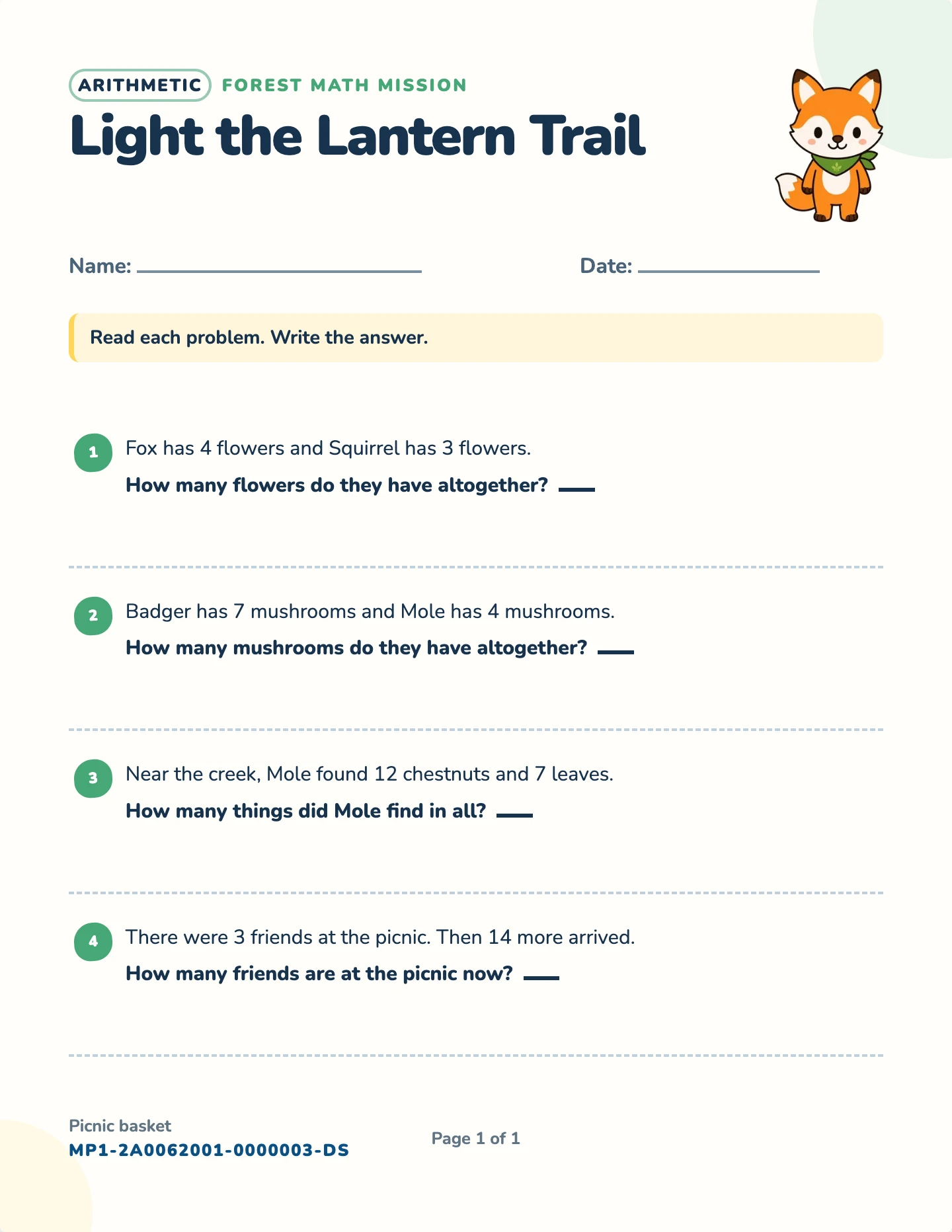
Nothing matches that. Try a skill, a number, or a grade.
In teaching order
Word problems worksheets, easiest first
Each sheet assumes the one above it is comfortable. Start where your child is, not at the top.- Addition word problems
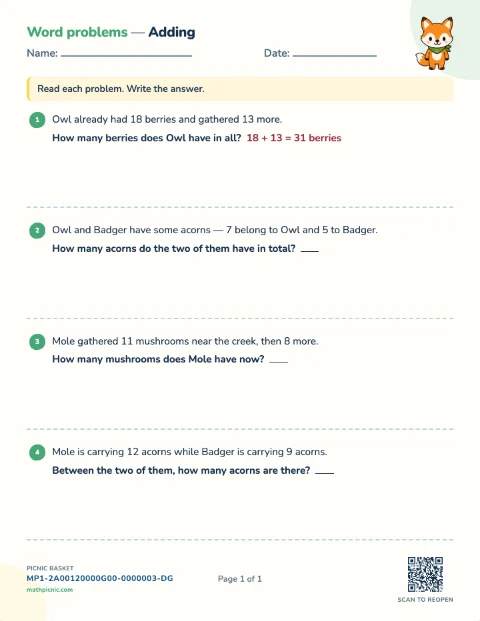 Print 7 friends + 4 more = __
 - Subtraction word problems
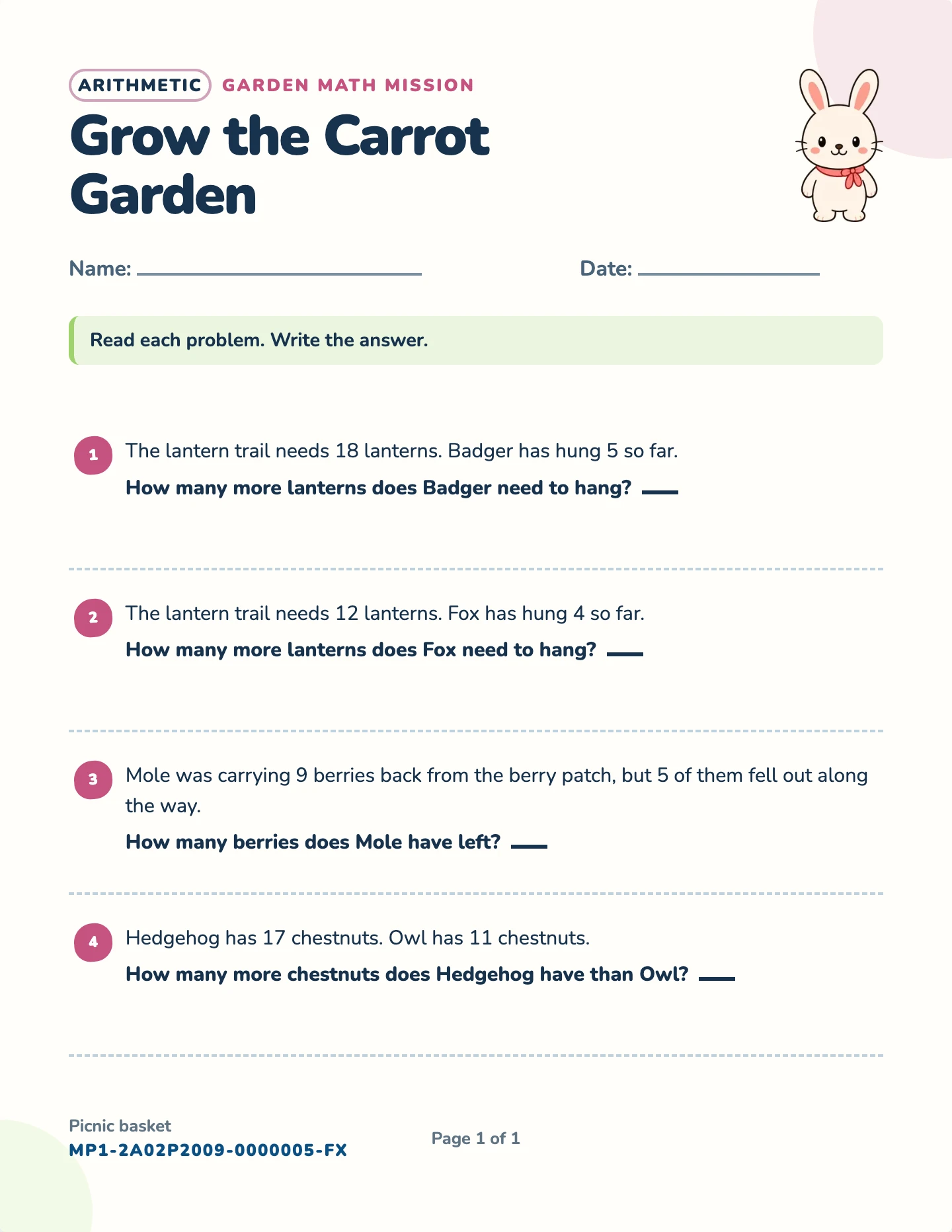
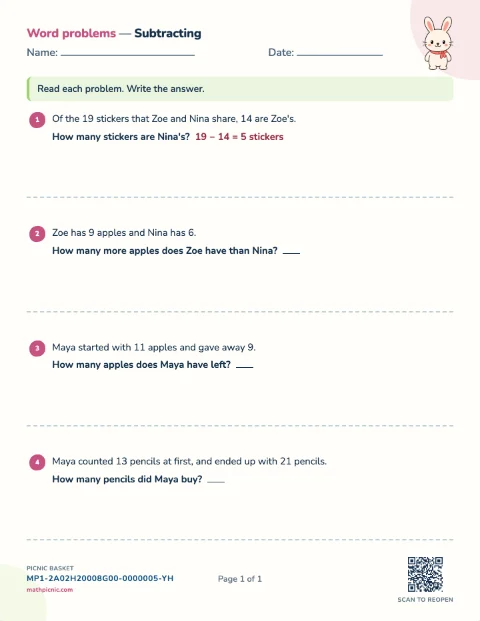 Print 18 − 5 = __ left
 - Multiplication word problems
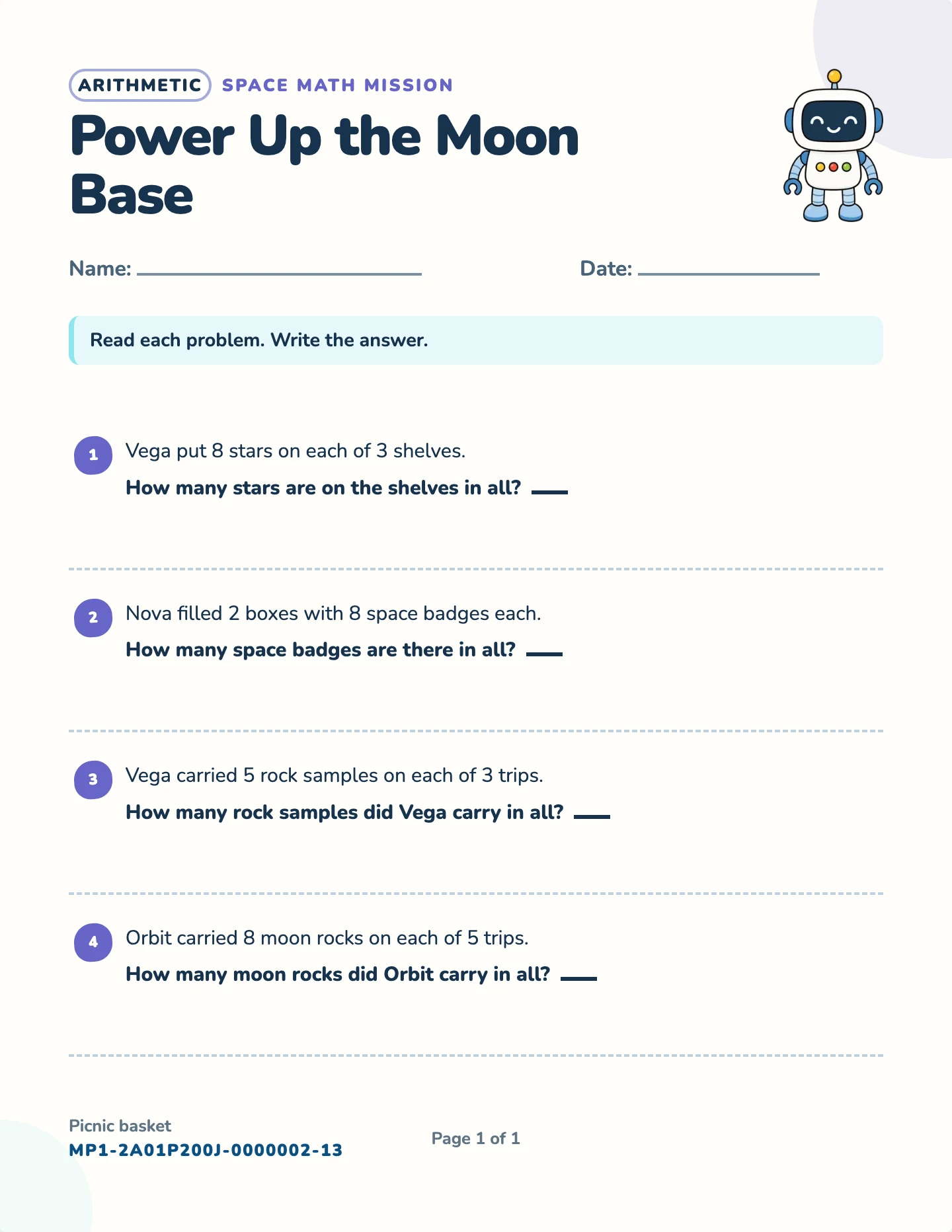
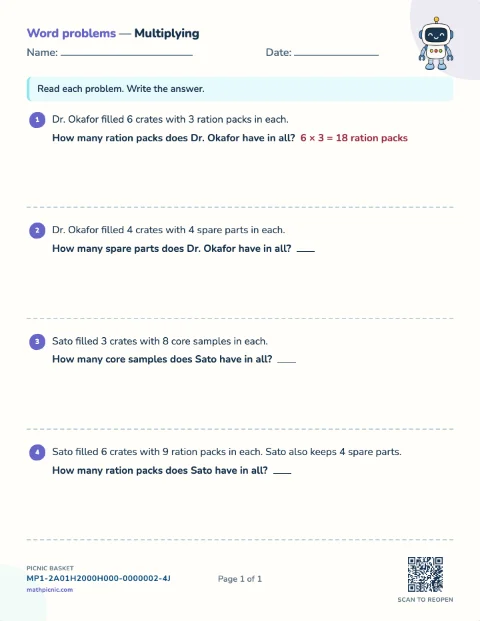 Print 3 shelves × 8 = __
 - Division word problems
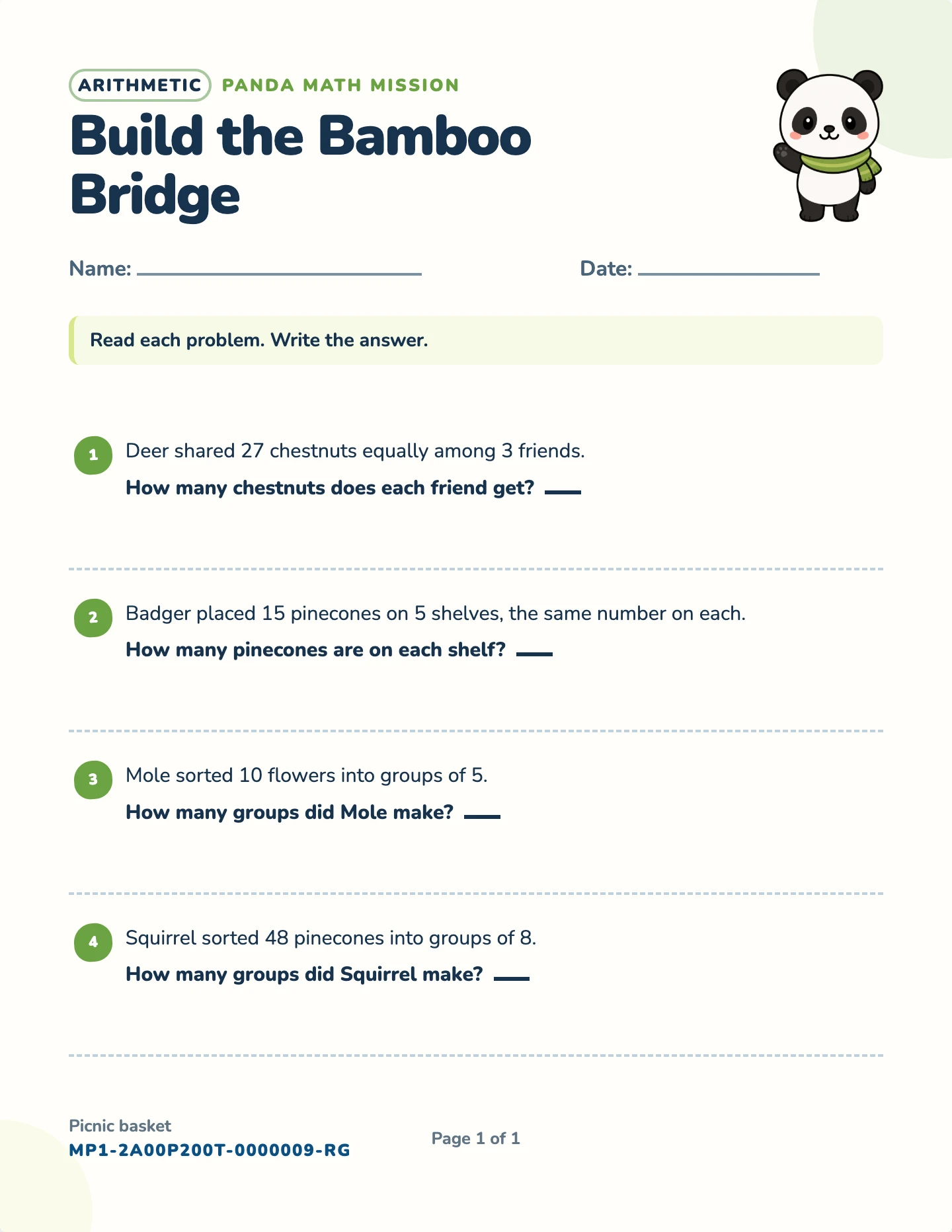
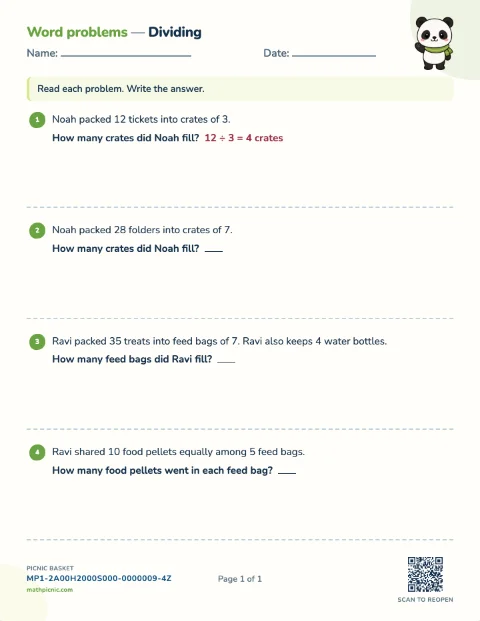 Print 24 shared by 3 = __
 - Mixed word problems
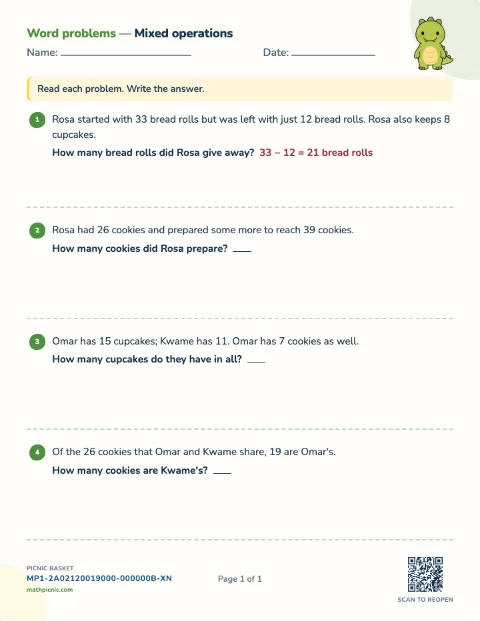 Print + − × ÷ in a story
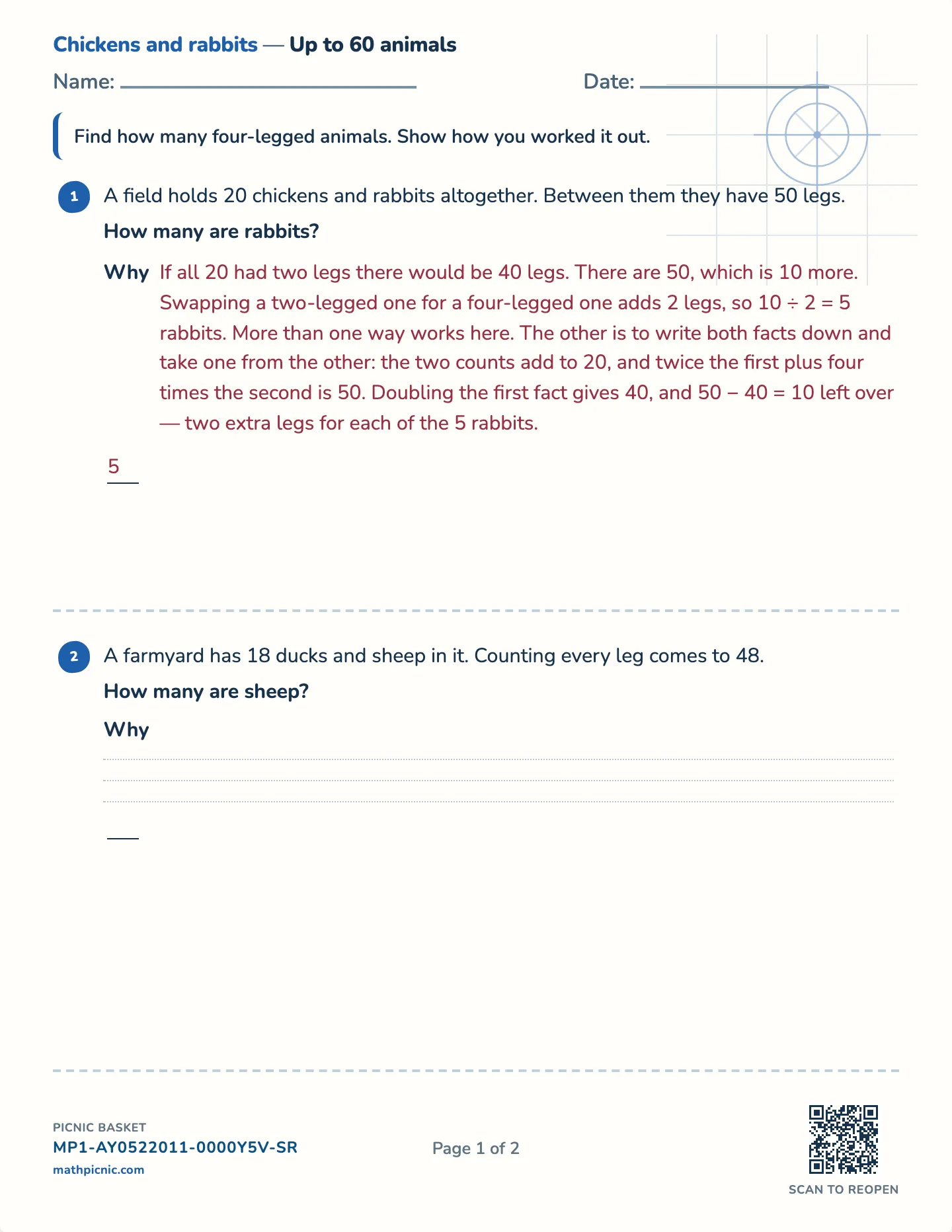
 - Chickens & rabbits
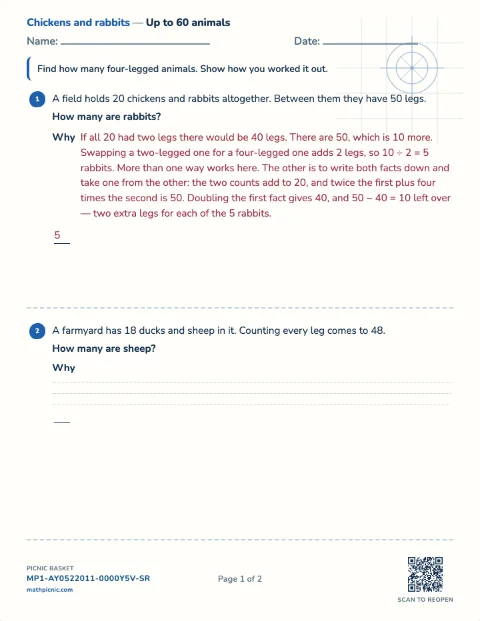 Print 13 heads, 44 legs → __ rabbits
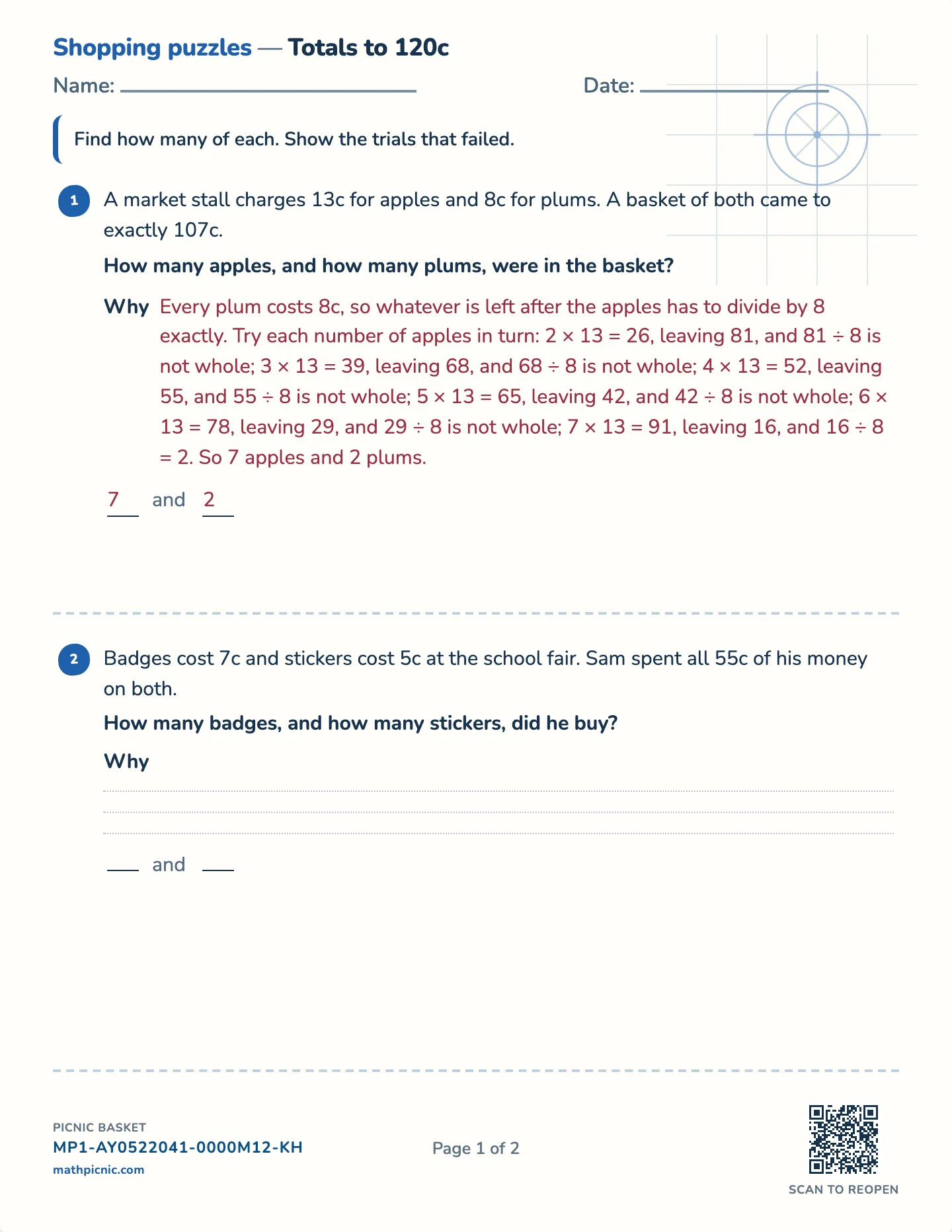
 - One equation, two unknowns
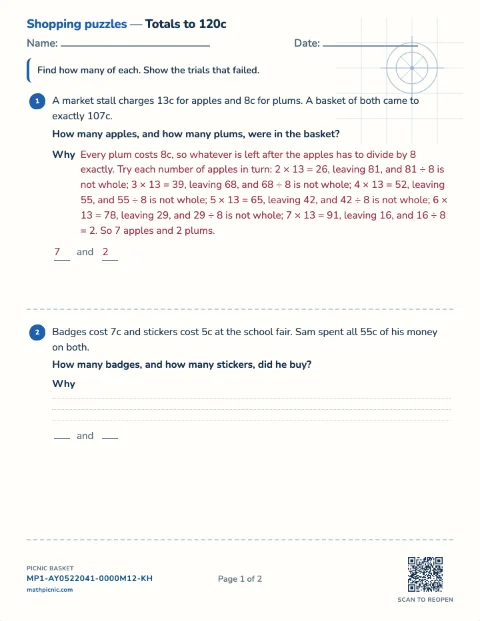 Print 15c and 8c → exactly 115c
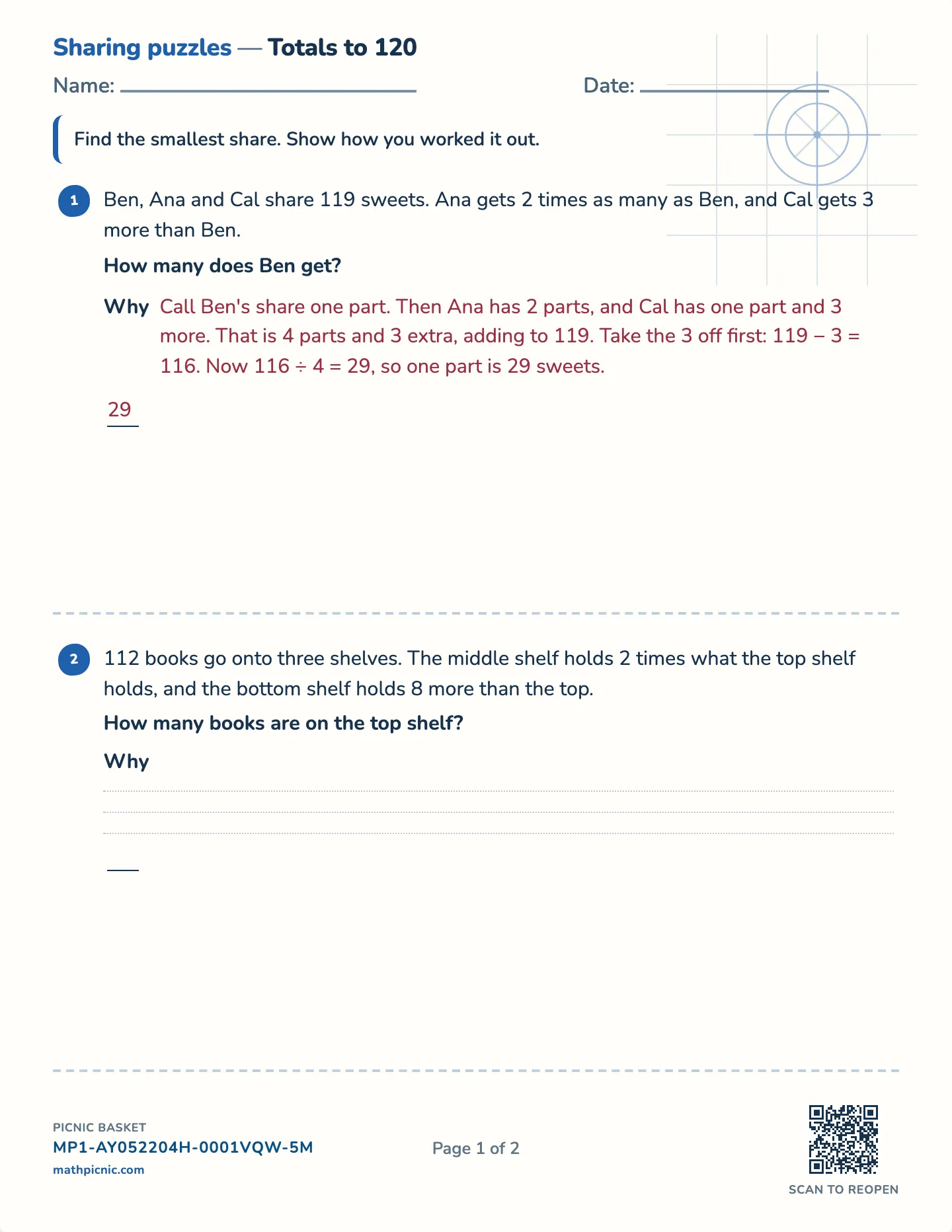
 - Three shares from one total
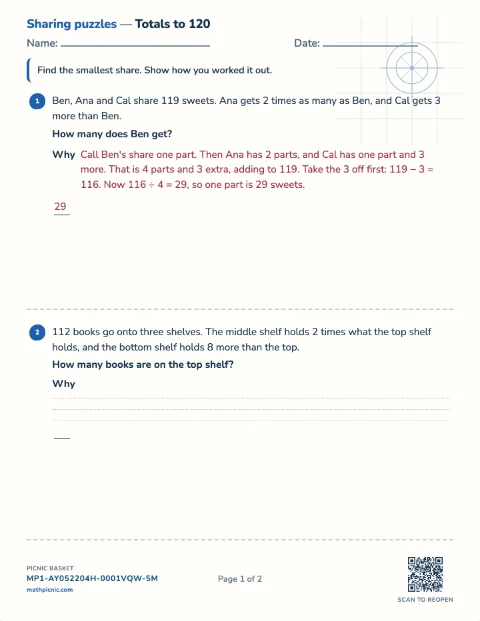 Print 92 sweets, 3× and 2 more → __
 - Counting pairs
 Print 12 people → __ handshakes
 - Counting diagonals
 Print 20-sided polygon → __ diagonals
 - Socks in the dark
 Print 3 colors → __ socks for a pair
 - Write your own question
 Print answer is "3 coins" → write the question
 - Things and the gaps between them
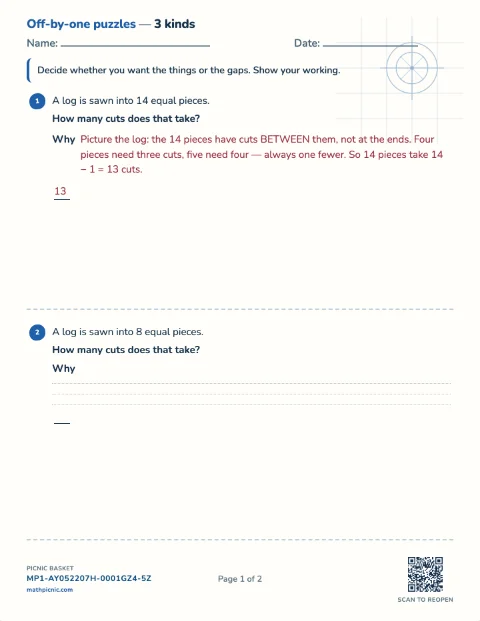 Print 5 pieces → __ cuts
 - The smudged sum
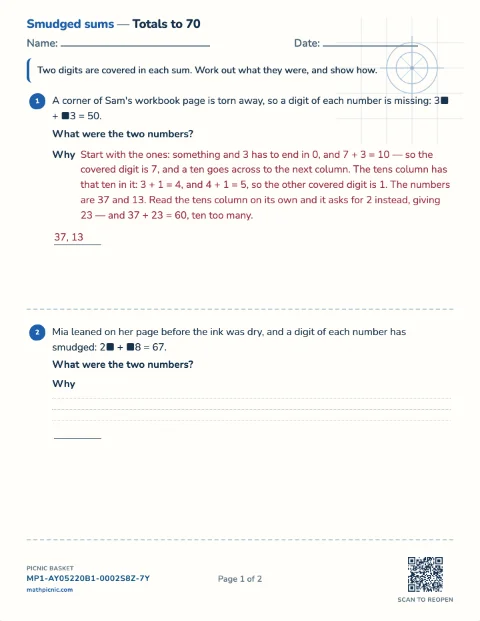 Print 4■ + ■7 = 61 → __ and __
 - Sum and difference puzzles
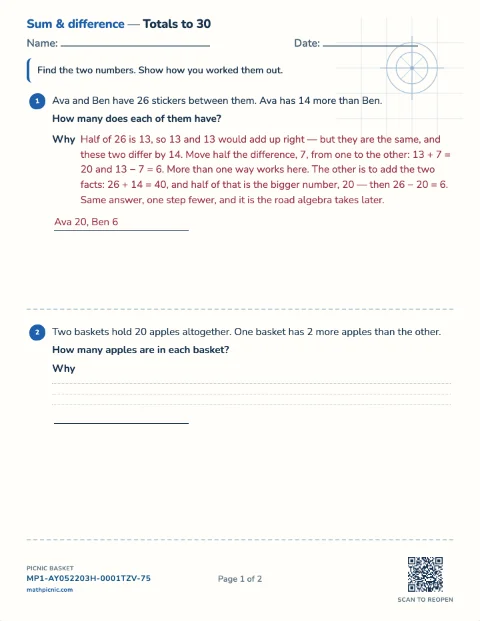 Print add to 20, differ by 6 → __ and __
 - What the leftover means
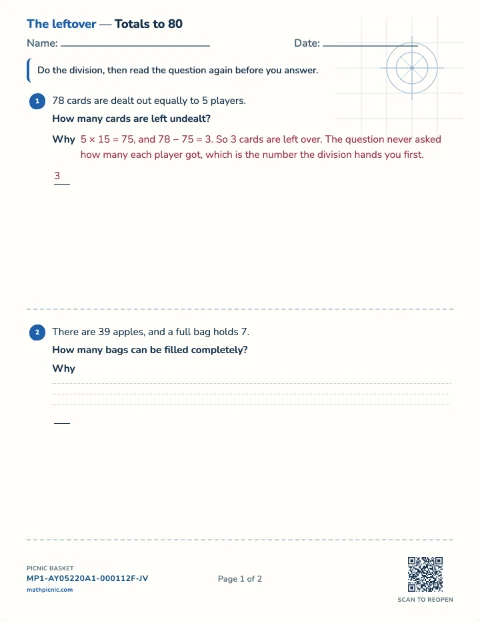 Print 19 eggs, boxes of 3 → __ boxes
 - A number from its remainders
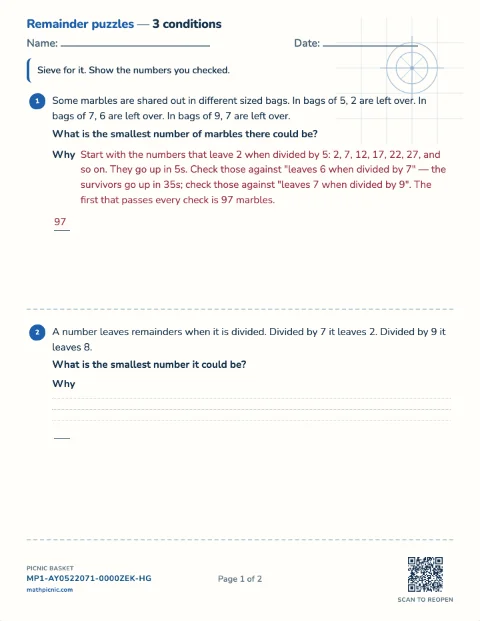 Print ÷3 rem 2, ÷5 rem 3, ÷7 rem 2 → __
 - The number that cannot change
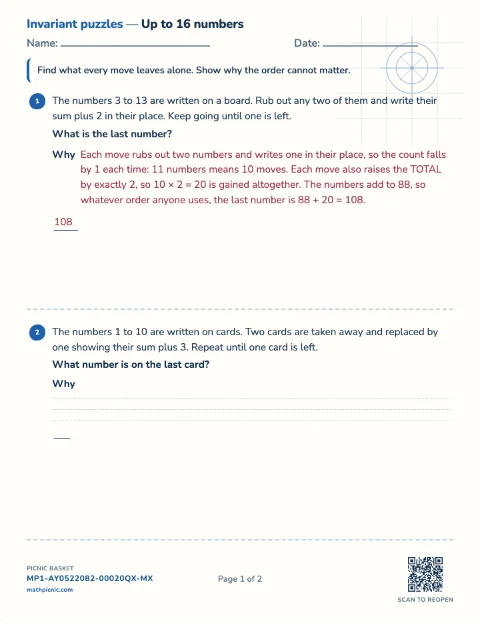 Print 1 to 5, sum minus 1 → __
 - What two facts settle
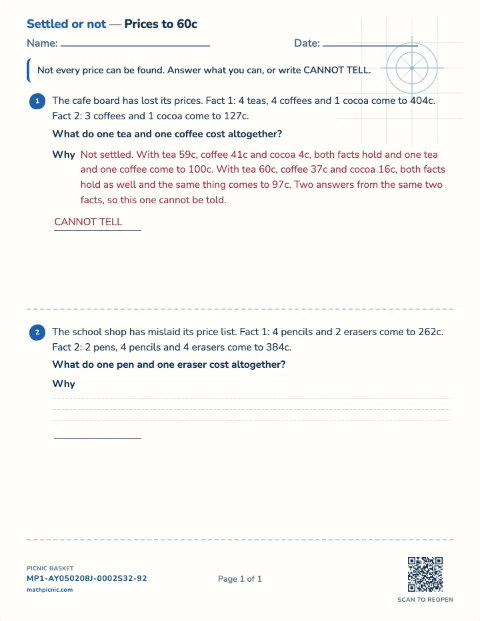 Print 3t + 2c + 1k = 96c → t + c + k = __
 - Numbers too big to compute
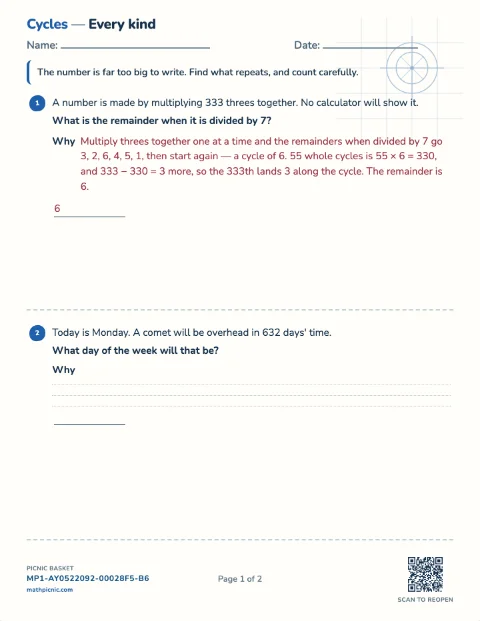 Print 100 sevens multiplied → last digit __
 - Can it be done at all?
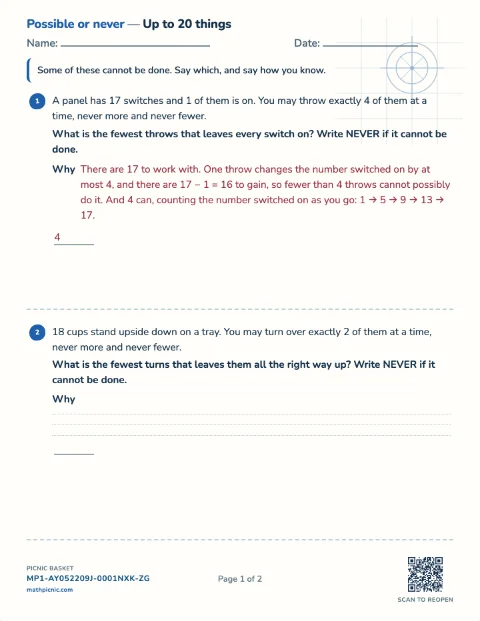 Print 11 cups, turn 2 at a time → NEVER
 - The gap between two squares
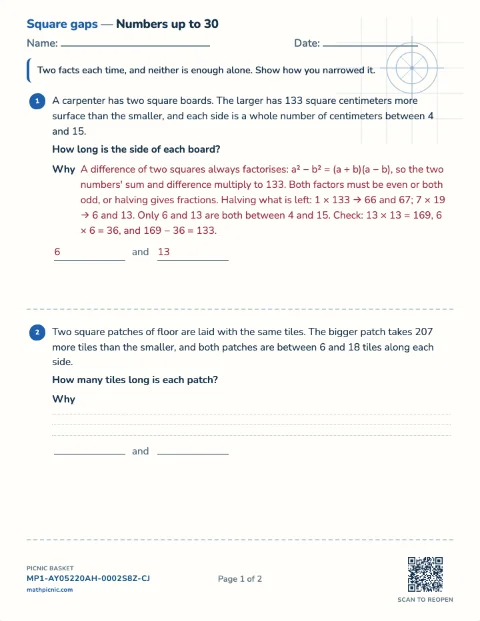 Print gap 96, both 10–33 → 14 and 10
 - The taking game
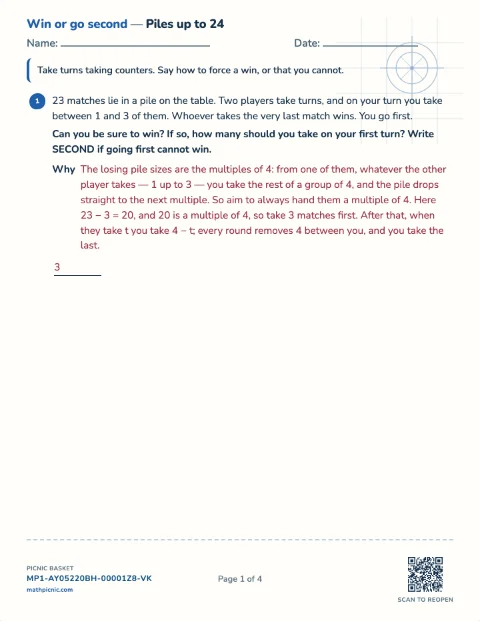 Print 20 counters, take 1–3 → take __ first
 - The hundred lockers
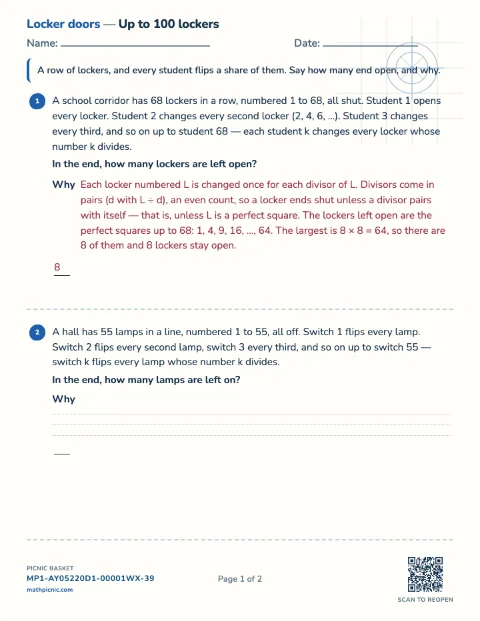 Print 100 lockers, flipped by their divisors → __ open
 - The painted cube
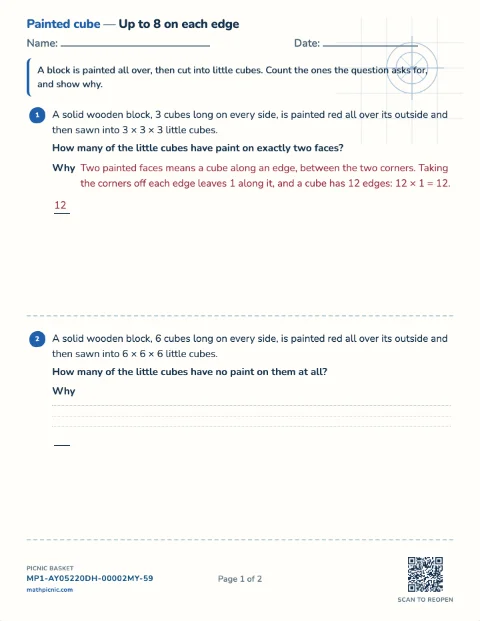 Print 5×5×5 painted, cut up → __ with 2 faces
 - Integer triangles
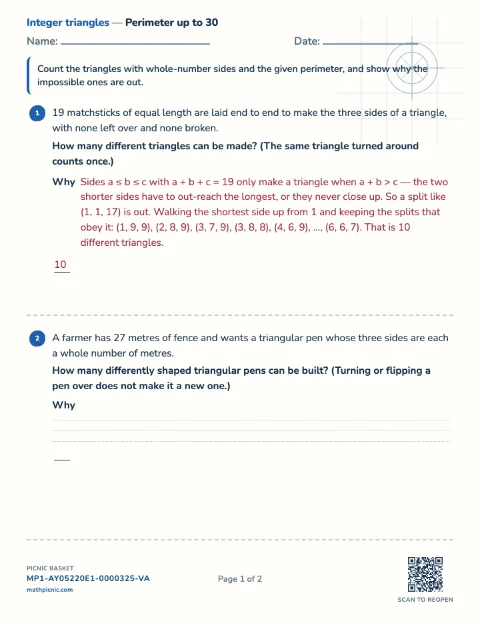 Print whole sides, perimeter 20 → __ triangles
 - The spider and the fly
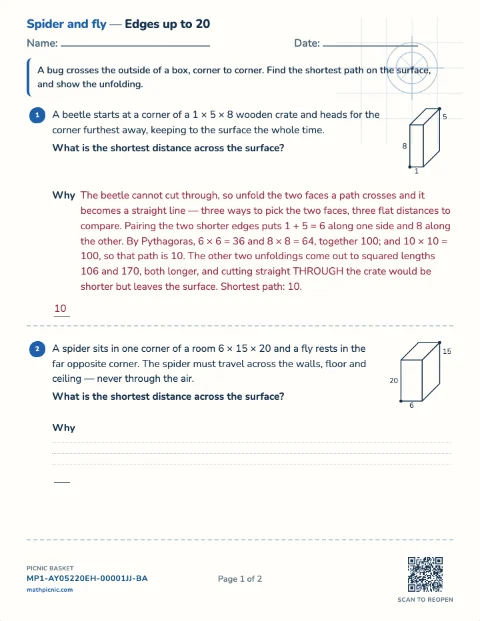 Print 3×5×6 box, corner to corner → __
 - A diagonal through a box
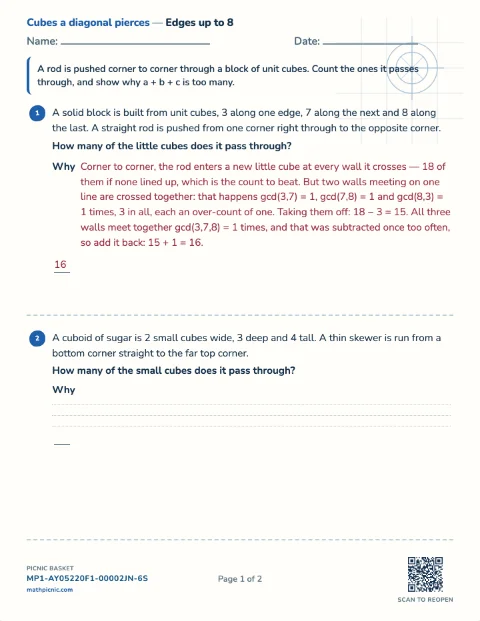 Print 3×5×6 block, corner to corner → __ cubes
 - Regions of a circle
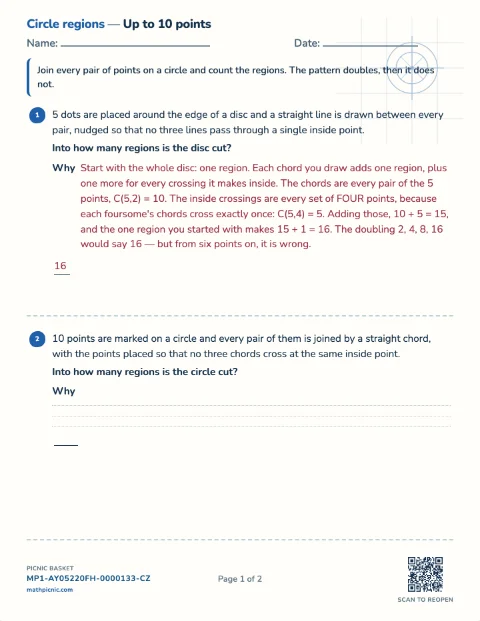 Print 6 points, all chords → __ regions
 - Cake numbers
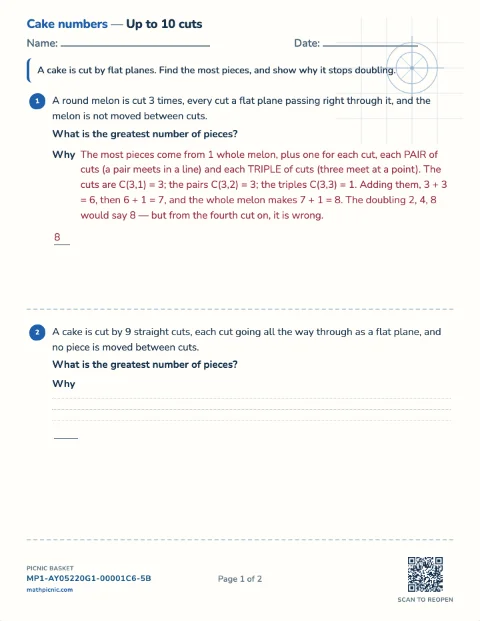 Print 4 flat cuts → __ pieces
 - The lazy caterer
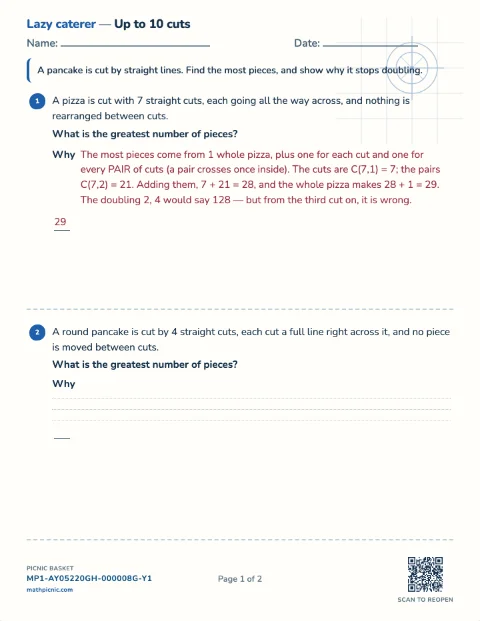 Print 3 straight cuts → __ pieces
 - Lattice paths
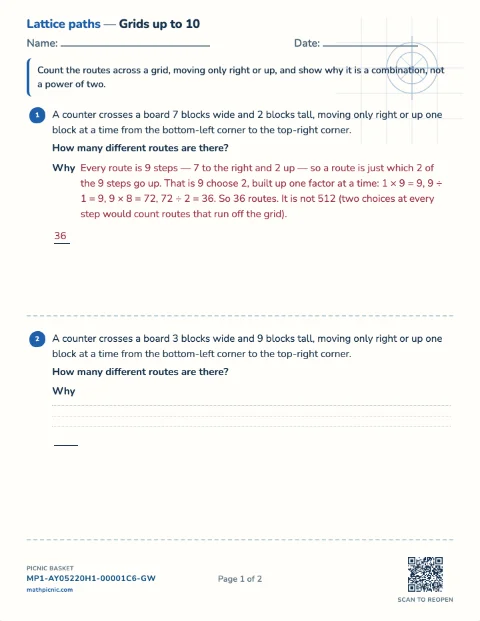 Print 3 × 7 grid → __ routes
 - Counting triangles in a grid
 Print 3 × 3 dot grid → __ triangles
 - Counting rectangles in a grid
 Print 4 × 4 dot grid → __ rectangles
 - Domino tilings
 Print 2 × 5 strip → __ tilings
 - Color it first
 Print 6×4, opposite corners cut → NO
 - Truth-tellers and liars
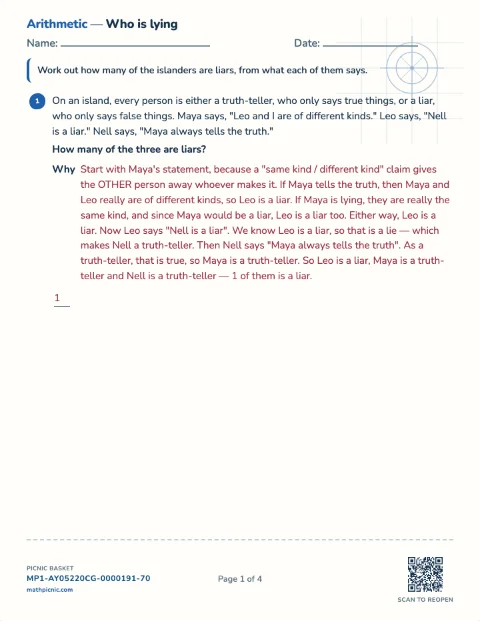 Print Ana: “Ben and I match” → __ liars
 - Two jugs and a tap
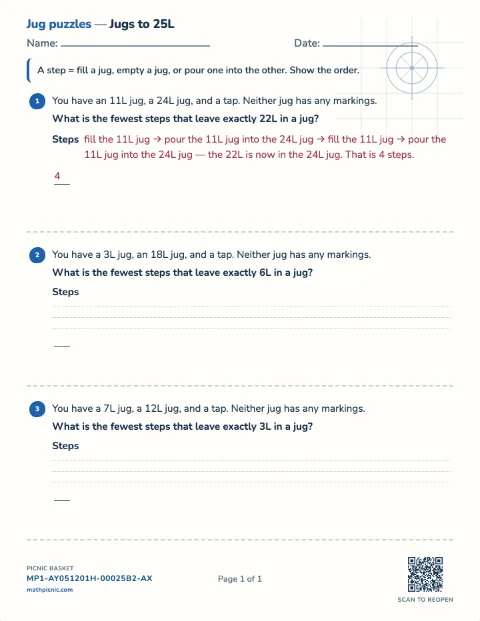 Print 6L and 11L → exactly 7L
 - Fewest coins
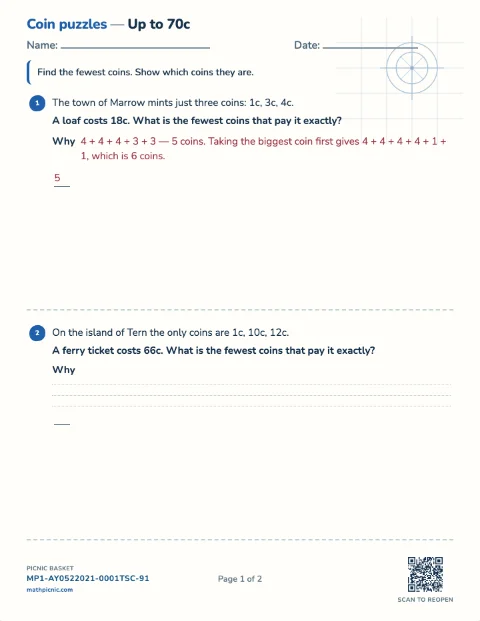 Print 1c, 4c, 6c → 8c in __ coins
 - Who am I? number puzzles
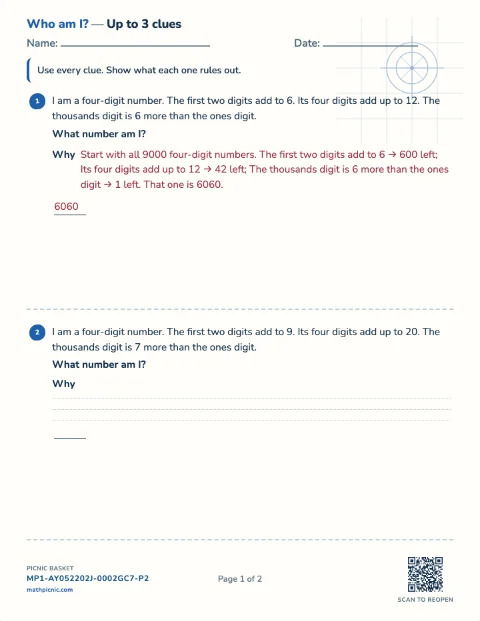 Print digits add to 16, multiple of 4 → ____
 - The fake coin
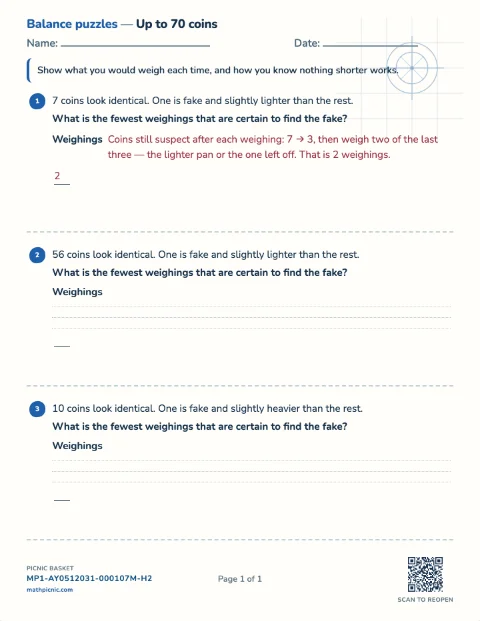 Print 9 coins, one light → __ weighings
 - Two-step word problems
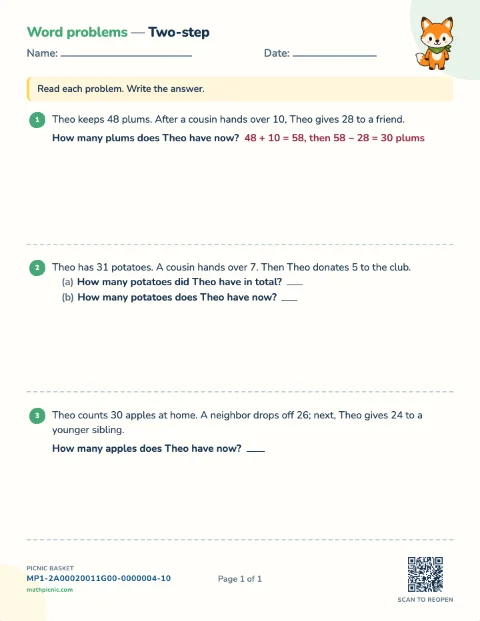 Print 6 × 7, then + 11 = __
 - Fraction word problems
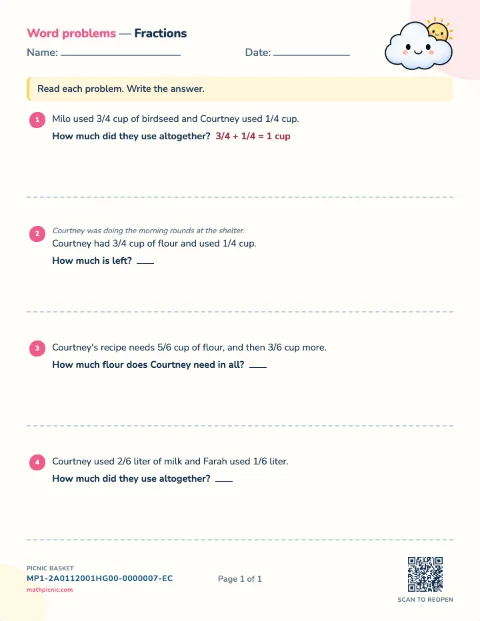 Print 3/8 − 2/8 = __
 - Decimal word problems
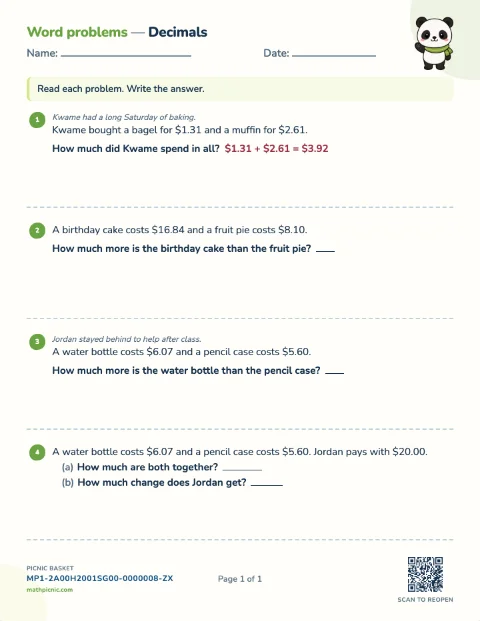 Print $2.75 + $2.25 = __
 - Equation word problems
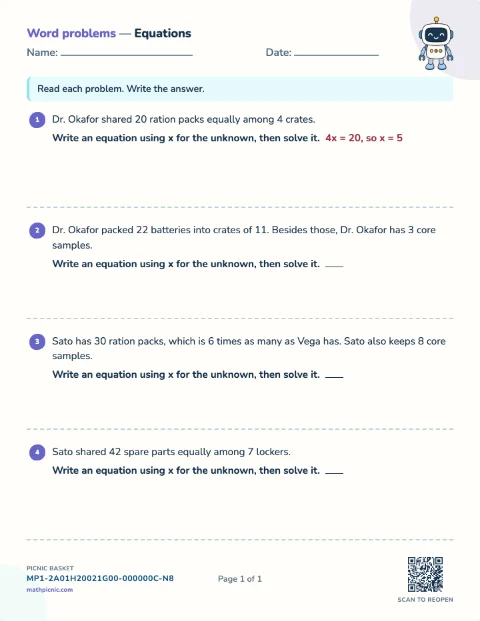 Print x + 12 = 27
 - Odd one out
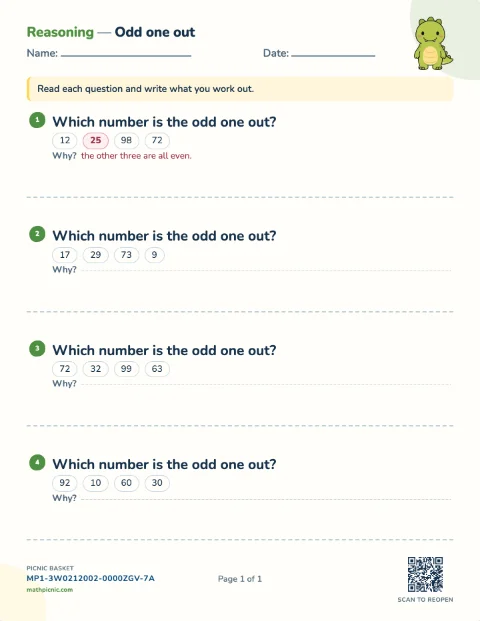 Print 12, 25, 98, 72
 - Spot the error
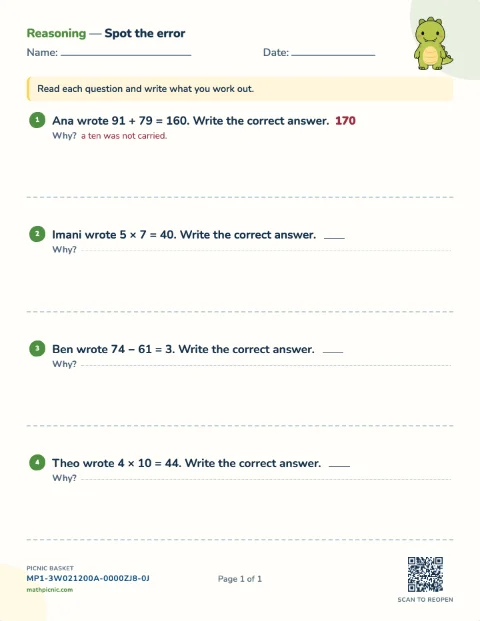 Print Ana wrote 91 + 79 = 160
 - Always, sometimes, never
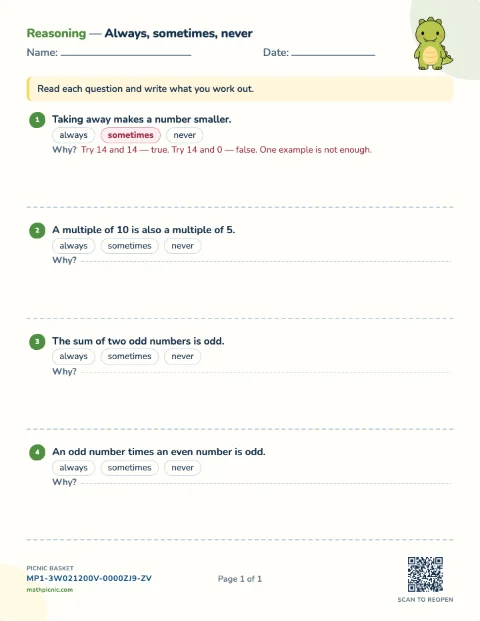 Print "Taking away makes it smaller"
 - Three-step word problems
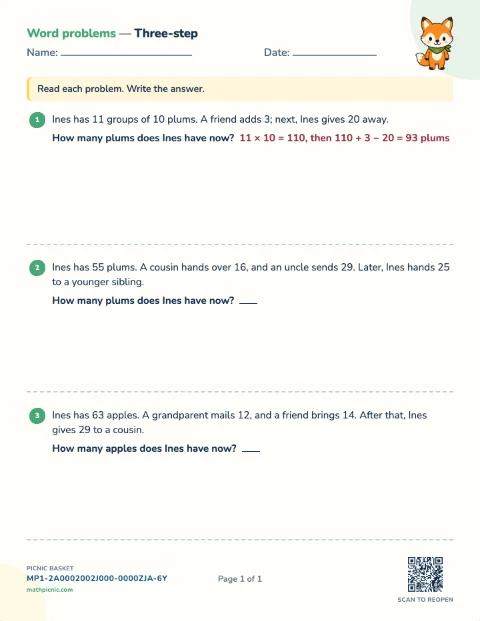 Print three steps, one answer
 - Geometry word problems
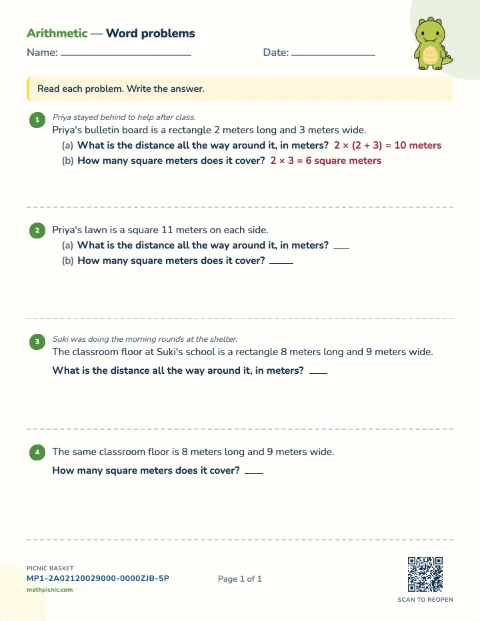 Print a rug 4 m by 11 m
 - Median, mode, and range word problems
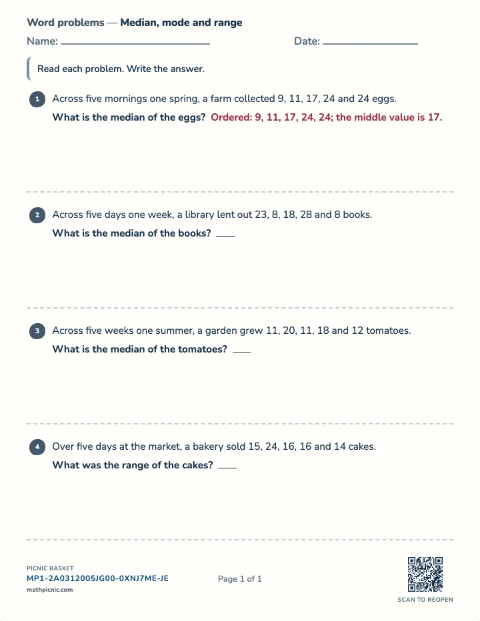 Print median of the set = __
 - Probability word problems
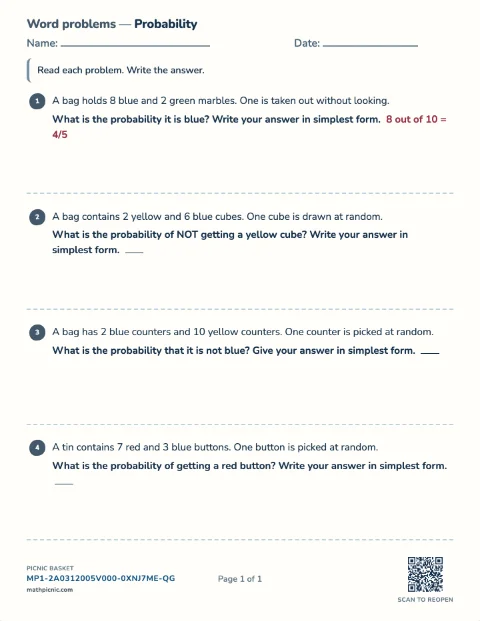 Print P(red) = __
 - Systems of equations word problems
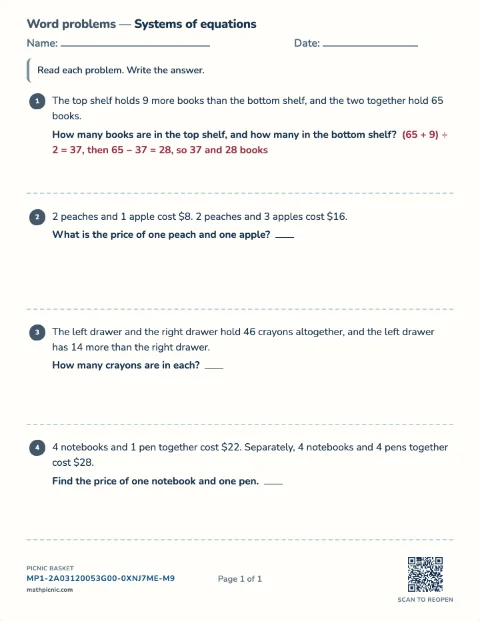 Print x + y = 30, x − y = 6
 - Quadratic equation word problems
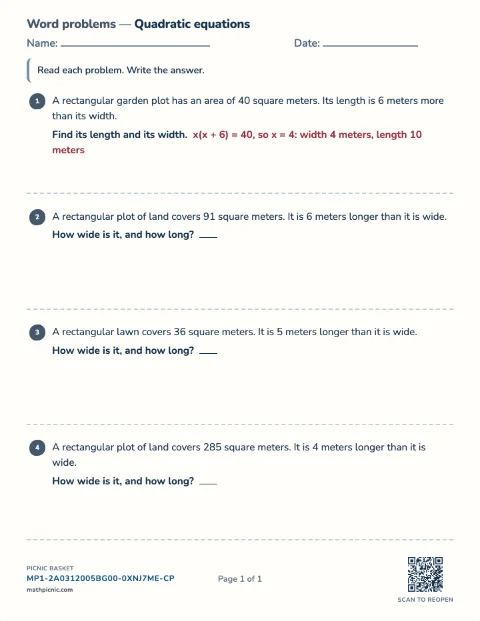 Print x(x + 4) = 96
A simple way through word problems
The difficulty of a good word problem should live in the reasoning, not the calculation. That is the principle behind every sheet here: numbers stay small and are written as numerals a child can lift straight off the page, so what makes a problem harder is a trickier situation — an unknown in an unusual place, a comparison, a second step — rather than bigger numbers. A child stuck on a word problem is almost never stuck on the adding; they are stuck on what the story is asking.
Why this order works
The skills build in a deliberate order. Addition and subtraction stories come first, then multiplication and division as equal groups shared or grouped, then mixed pages where the child has to choose the operation instead of being told it. Two-step problems are the real jump — the answer to the first calculation is not the answer to the question — and fraction word problems apply all of this to recipes, ribbon, and shared pizza once a child can compute with fractions.