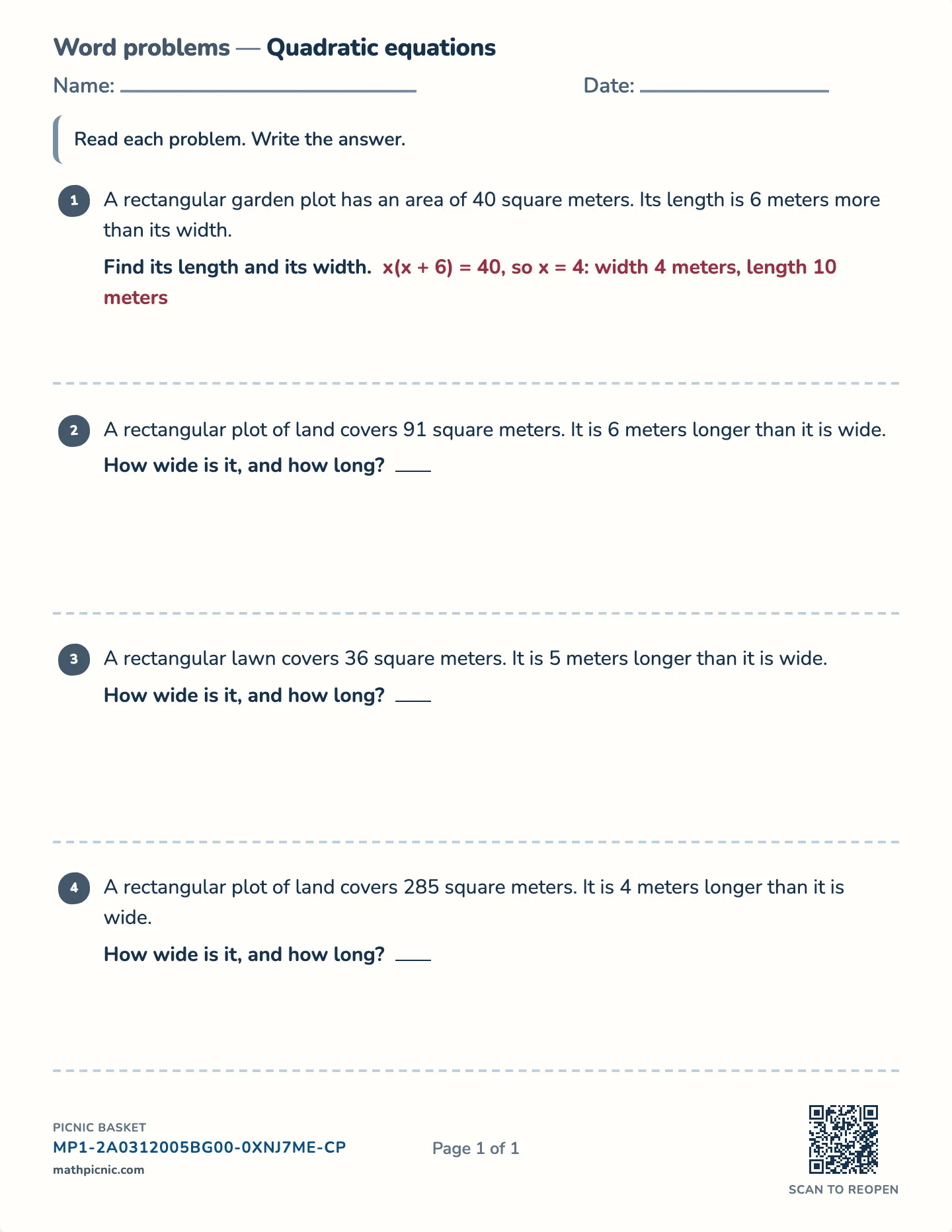
A quadratic turns up the moment a problem multiplies an unknown by itself — an area, or a product of two numbers a step apart. These free printable worksheets give those situations and ask a child to set up the equation and find the value.
Two shapes, both landing on whole answers. A rectangle is a few meters longer than it is wide with a given area, which is x times (x + k) equals the area; two consecutive numbers have a given product, which is x times (x + 1). Each is the everyday place a quadratic actually comes from, rather than an abstract square handed over with no reason to exist.
Why this sheet works
Every constant is built from a whole solution, so the equation always factors over the integers and the answer is a length a child can check — never 4.7 meters. Both shapes ask for both values by name, the width and the length or the two numbers, so a student sets up the equation, solves for one, and reads off the other.
How this one works
One question from this sheet, worked through a step at a time.
Find its length and its width.
A rectangular garden plot has an area of 40 square meters. Its length is 6 meters more than its width.
x(x + 6) = 40
4 × 10 = 40
asked:Find its length and its width.
width 4 meters, length 10 meters
Read it through. One unknown does two jobs — the width, and the length that is a few more than it — so writing "length = width + a few" turns the area into a QUADRATIC.
Set it up with x for the smaller value: x(x + 6) = 40.
Look for the whole number that fits — it is 4, because 4 × 10 = 40.
Answer what was asked — "Find its length and its width.": width 4 meters, length 10 meters.