
Algebra 1 worksheets
Not sure what comes next? Start with the first sheet that feels comfortable.
Multiplying and dividing in scientific notation
Grade 8
Multiply and divide in scientific notation, and renormalize the answer
Customize this sheet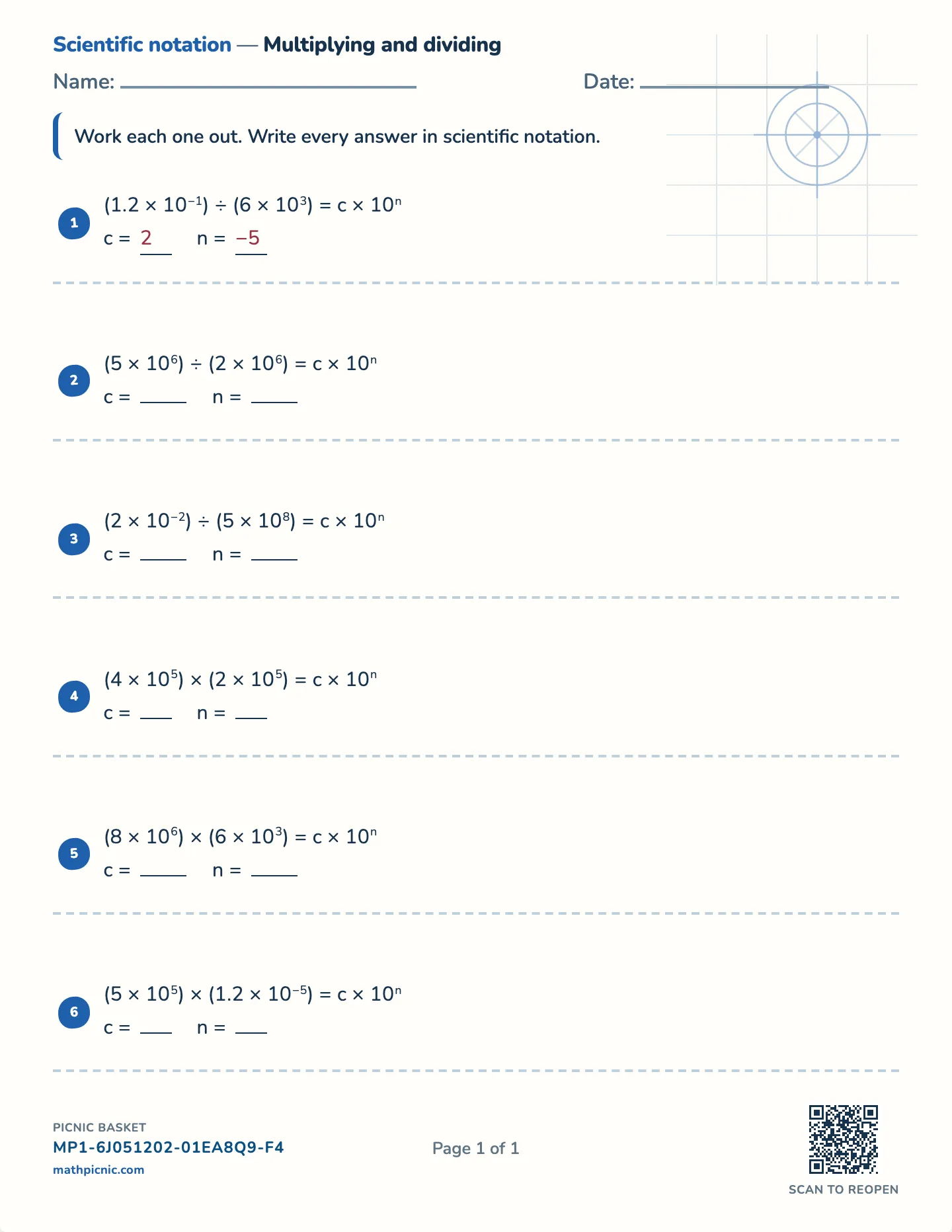
Nothing matches that. Try a skill, a number, or a grade.
In teaching order
Algebra 1 worksheets, easiest first
Each sheet assumes the one above it is comfortable. Start where your child is, not at the top.- Multiplying and dividing in scientific notation
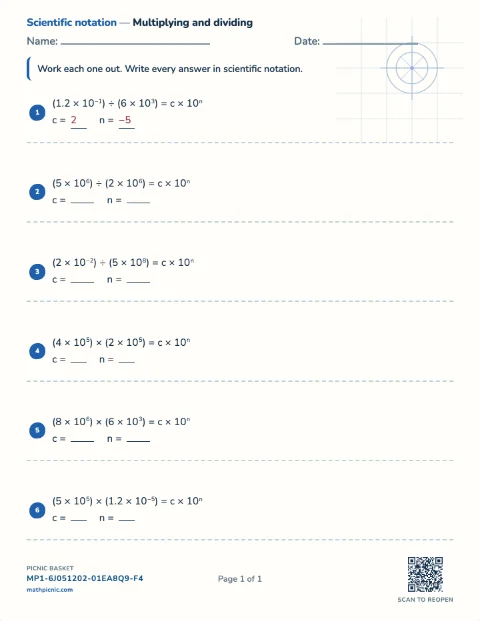 Print (5 × 10³) × (4 × 10²)
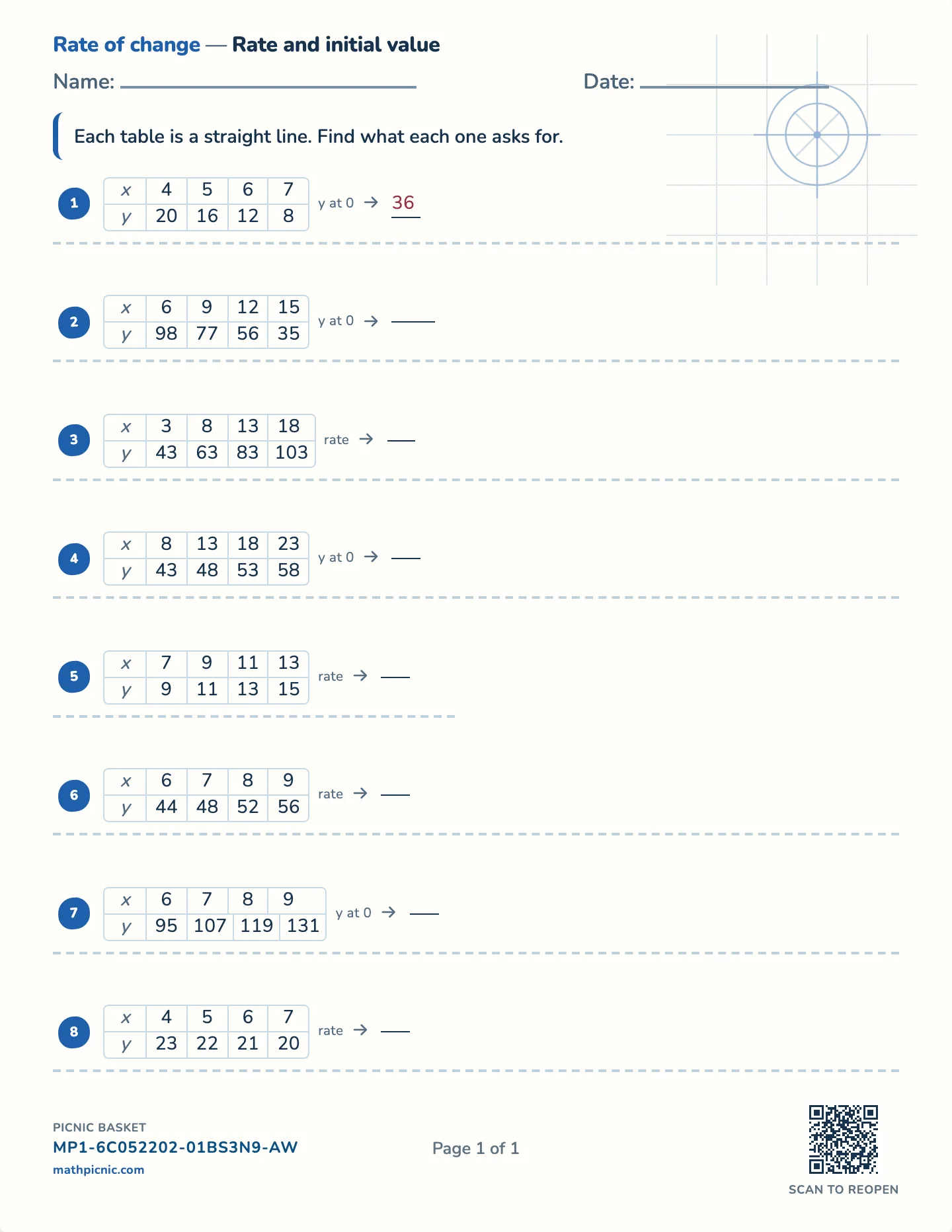
 - Rate of change from a table
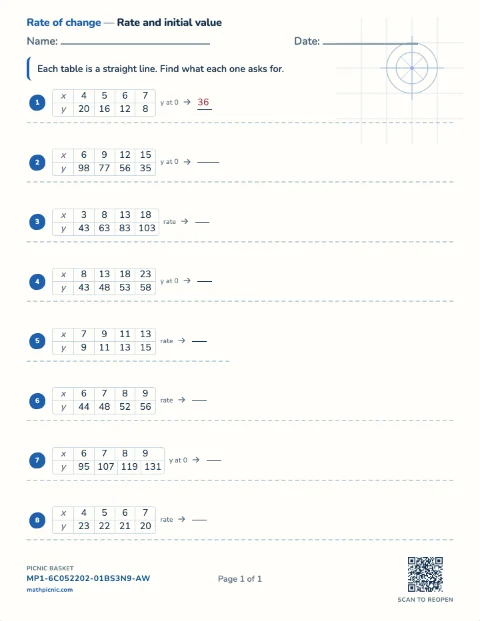 Print x: 2, 5, 8, 11 y: 9, 21, 33, 45
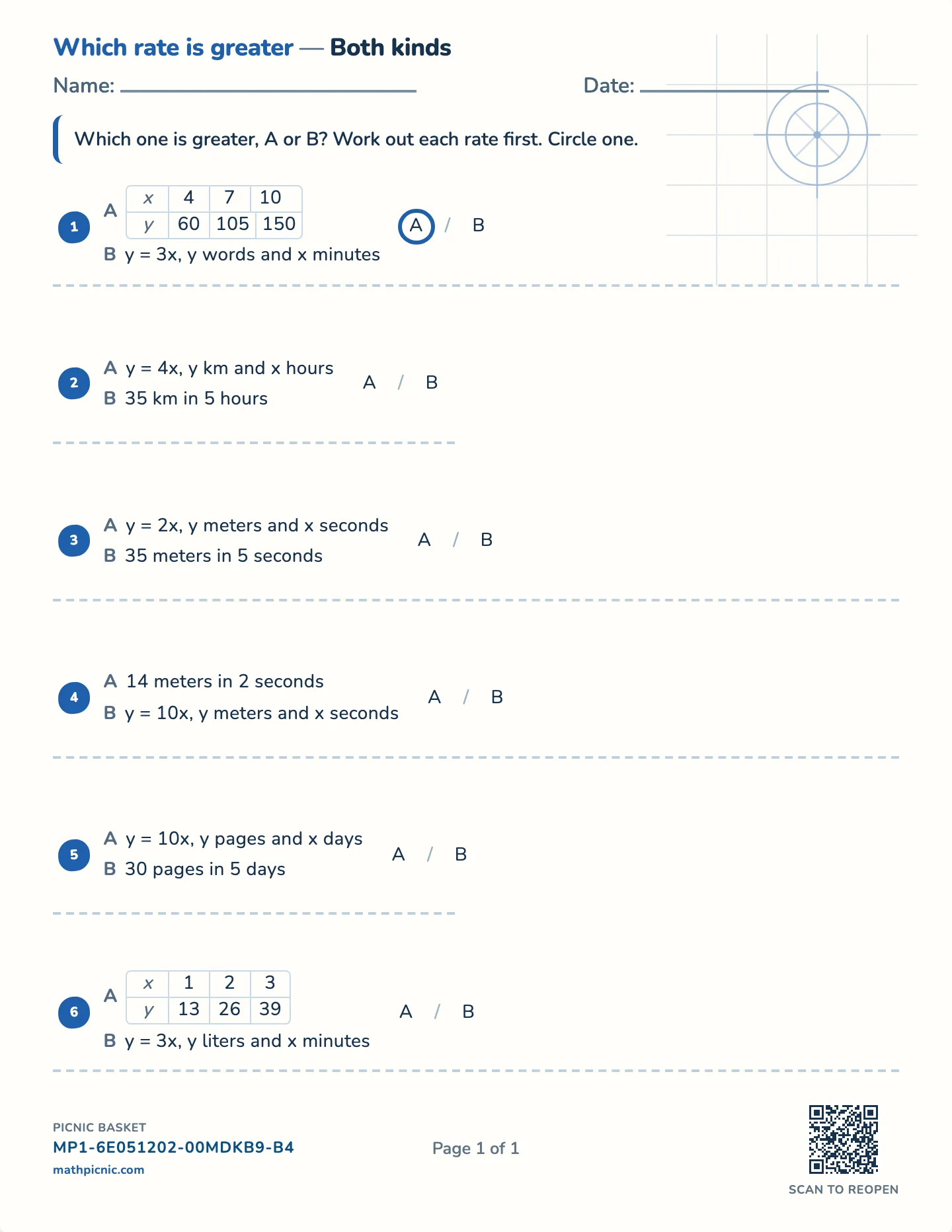
 - Which rate is greater?
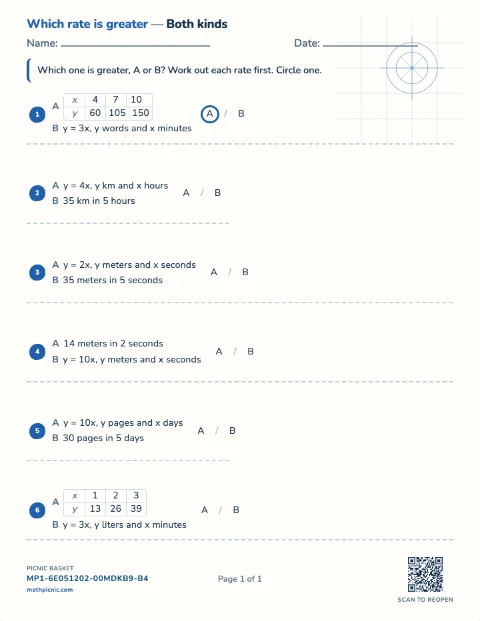 Print A y = 7x B 45 km in 9 hours
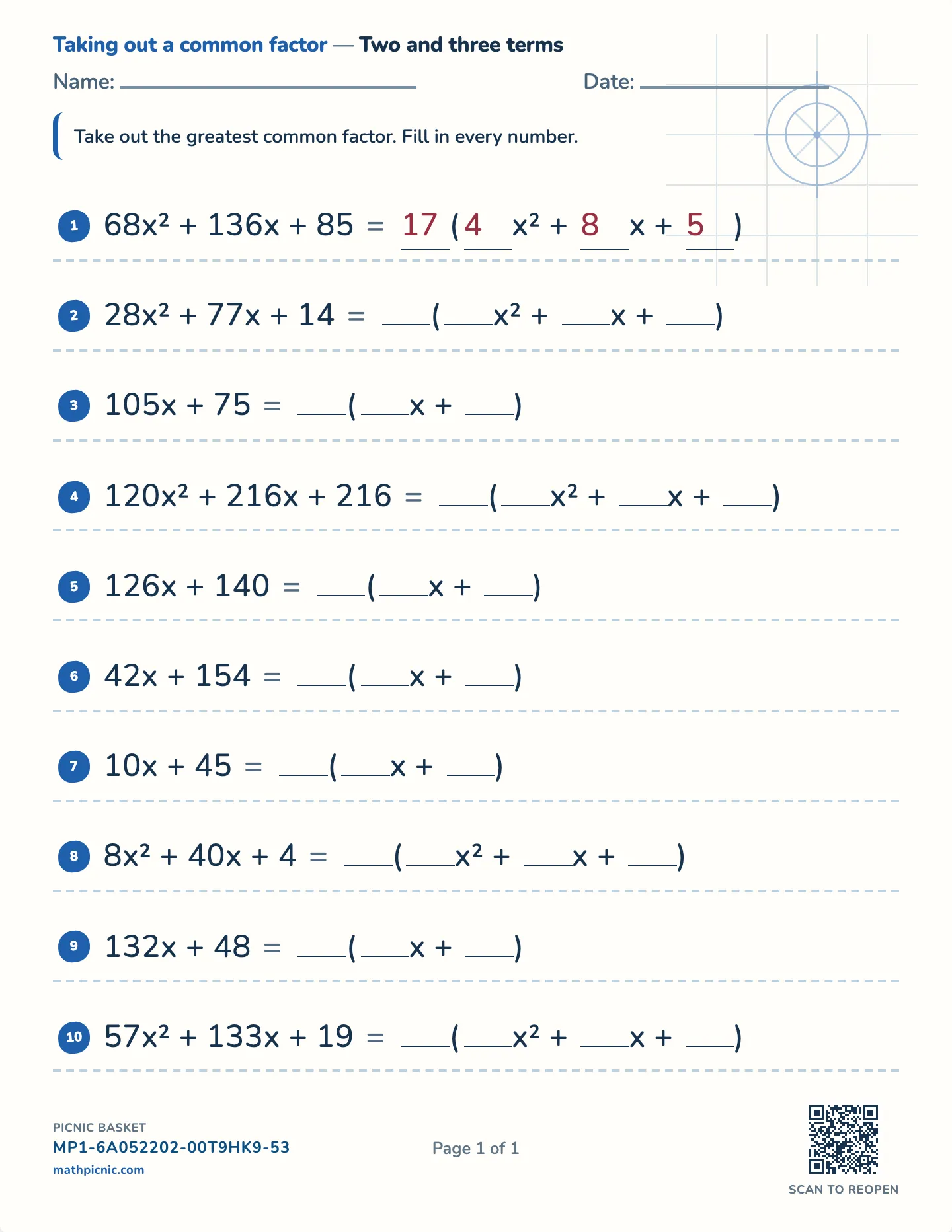
 - Taking out a common factor
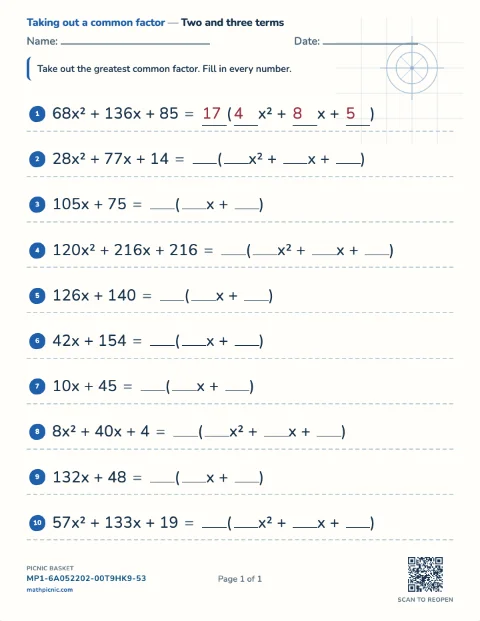 Print 12x + 18
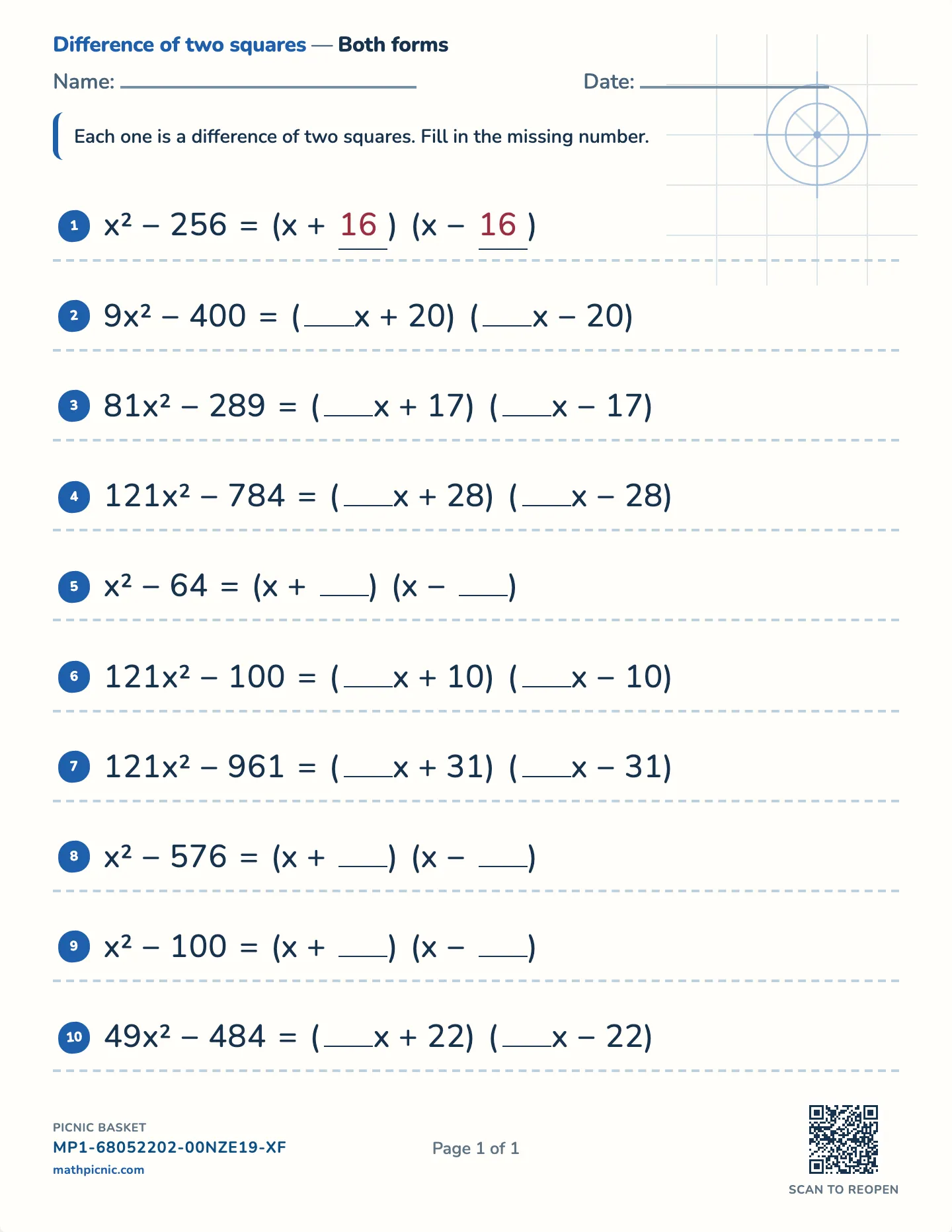
 - Difference of two squares
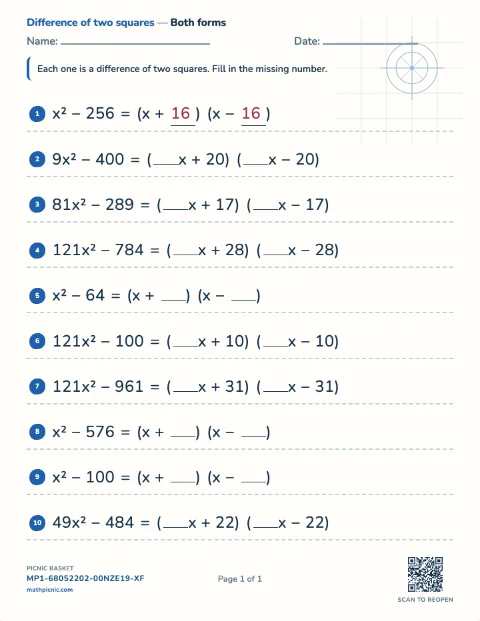 Print 9x² − 64
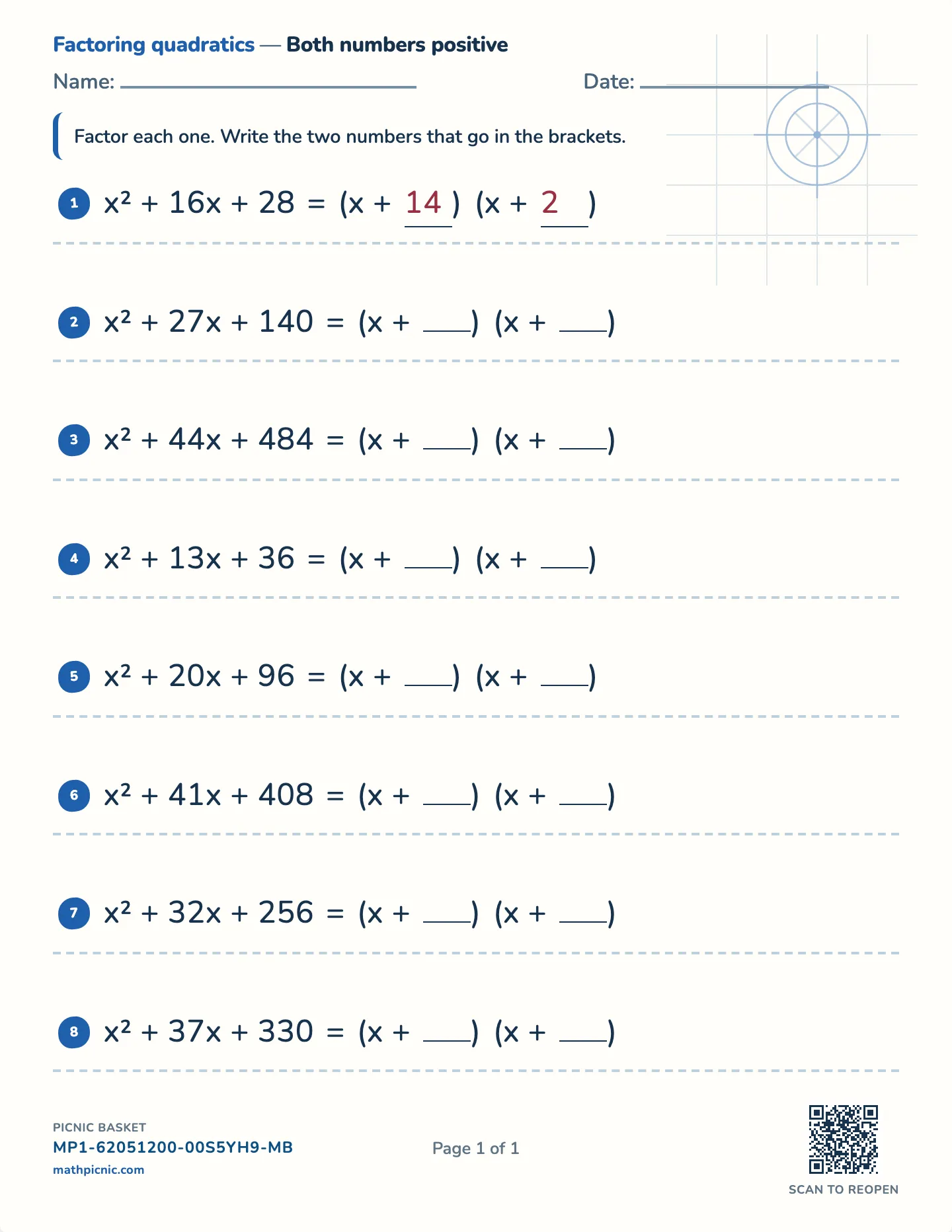
 - Factoring x² + bx + c
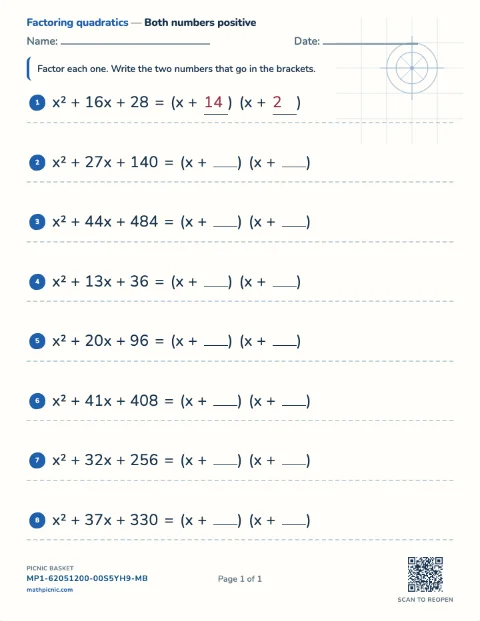 Print x² + 7x + 12
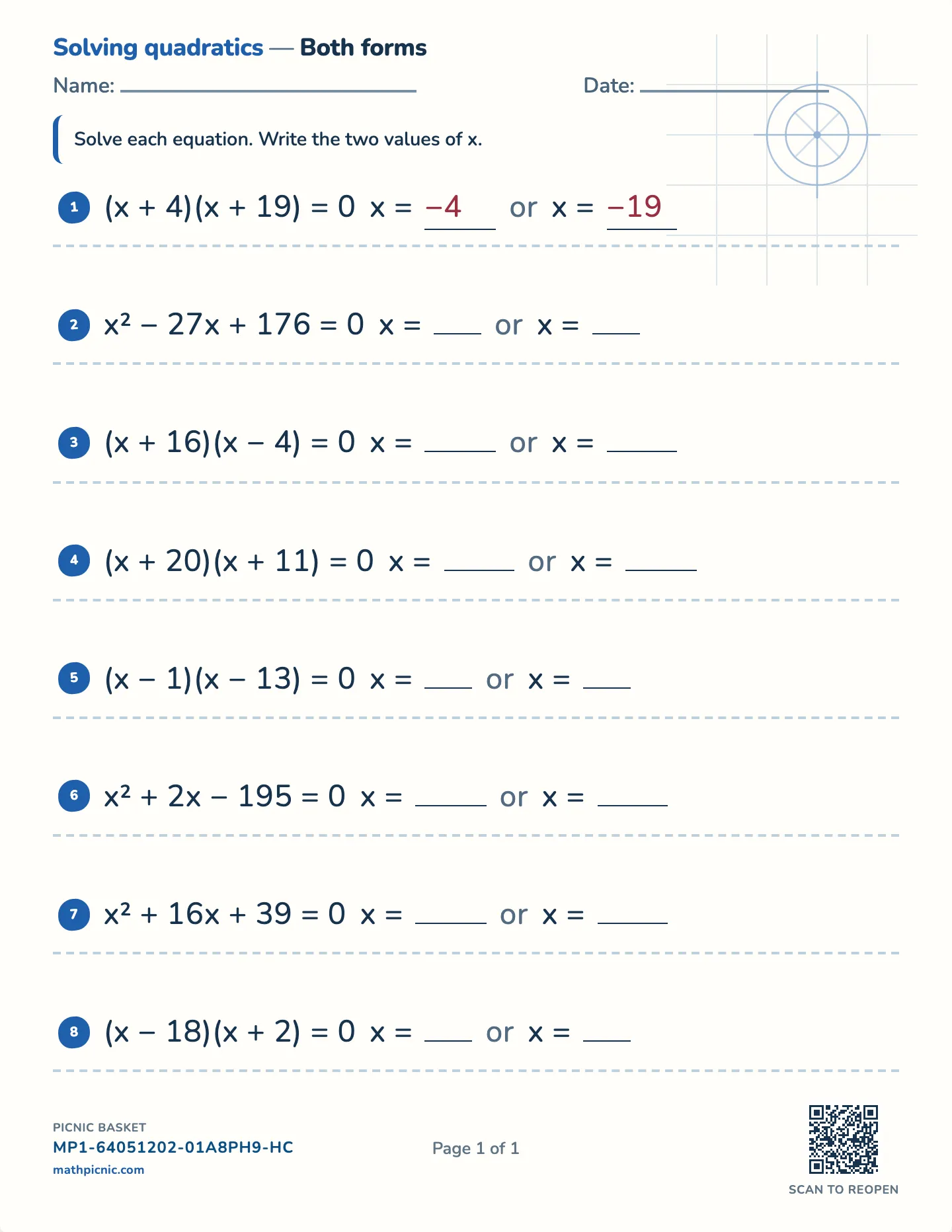
 - Solving x² + bx + c = 0
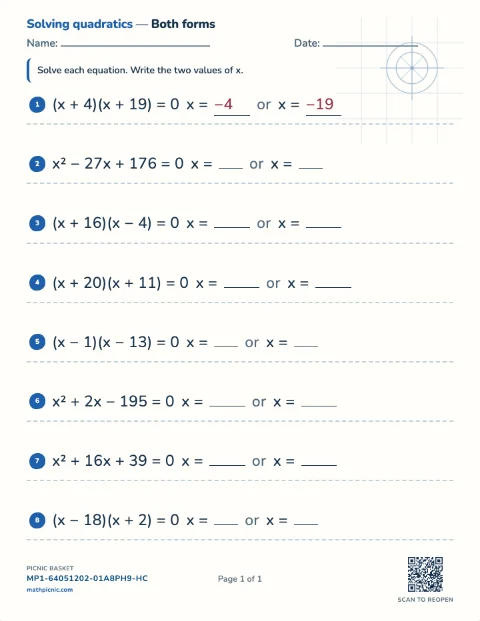 Print x² + 2x − 15 = 0
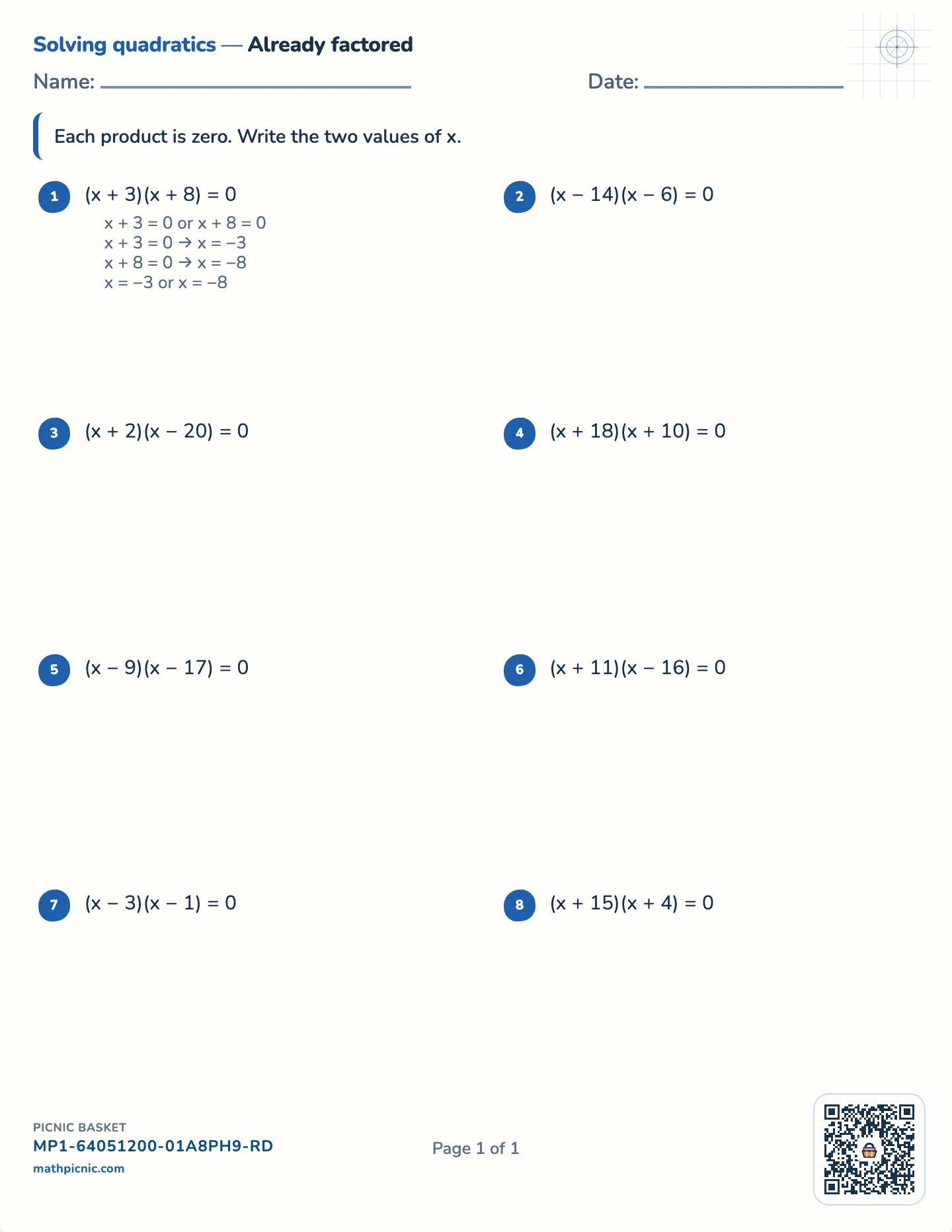
 - The zero product property
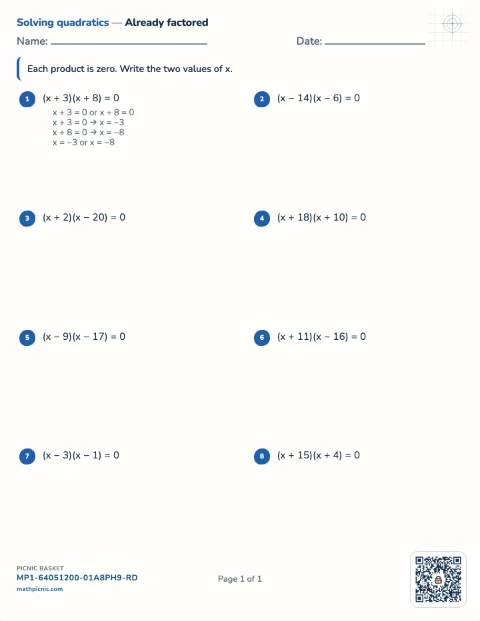 Print (x + 2)(x − 20) = 0
 - Solving quadratics by factoring
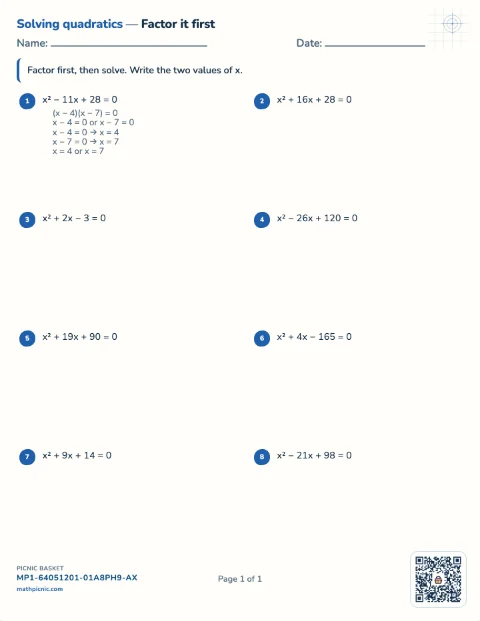 Print x² − 11x + 28 = 0
 - Solving quadratics by square roots
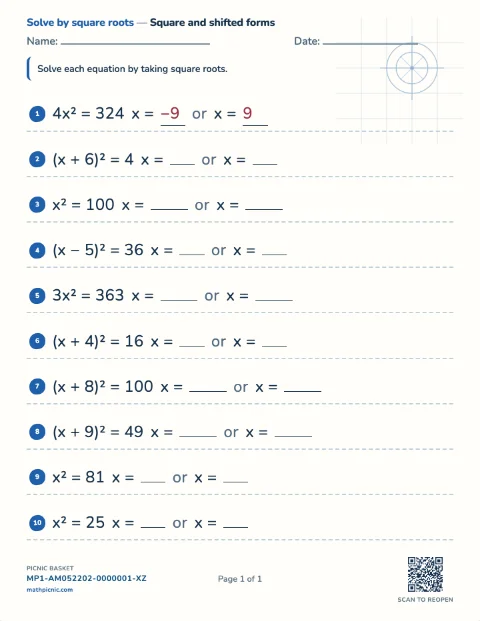 Print x² = 49
 - How many real solutions?
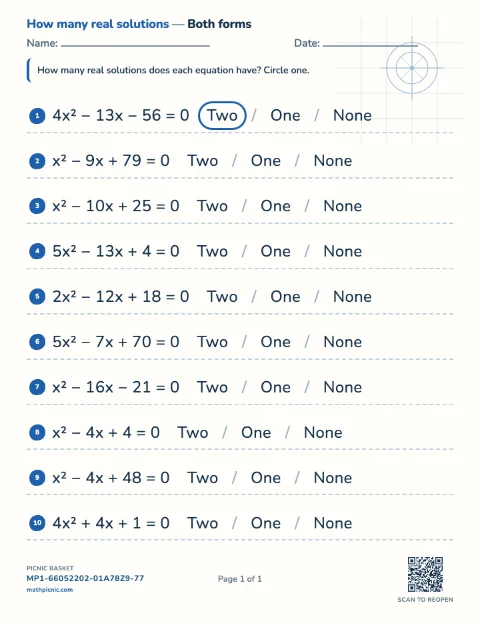 Print x² + 2x + 5 = 0
 - Adding and subtracting polynomials
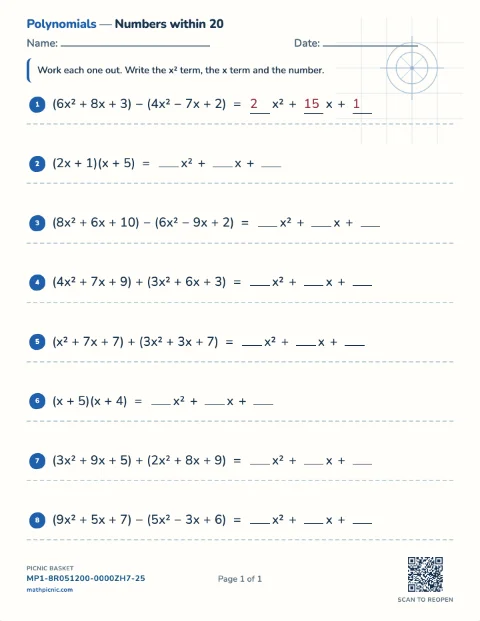 Print (3x² + 5x) − (x² − 4x)
 - Function notation
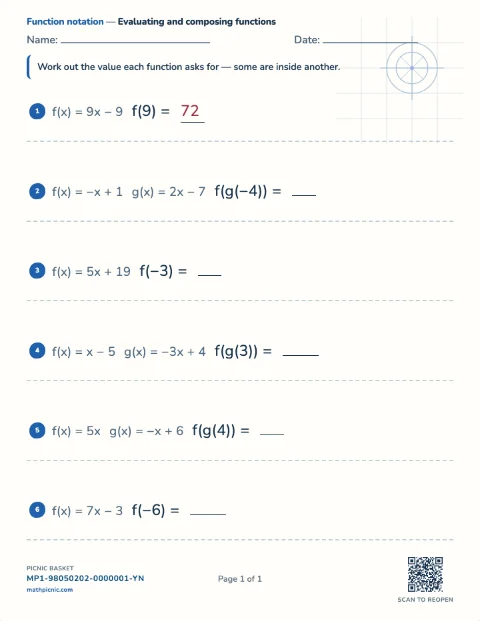 Print f(x) = 3x − 5
 - Transformations of a function
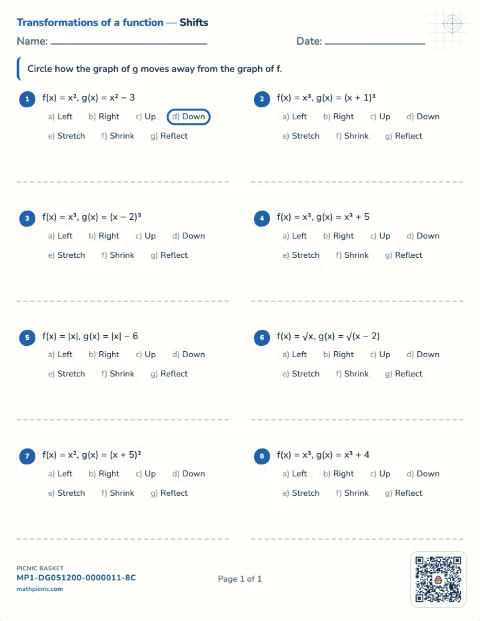 Print g(x) = (x + 4)² → left 4
 - Write the rule from a situation
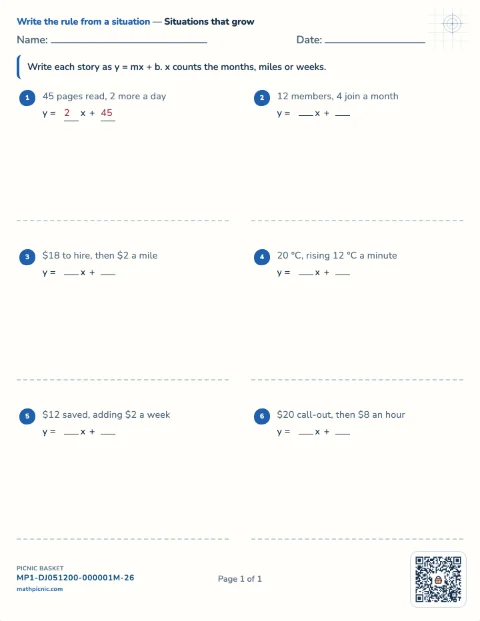 Print $25 to join, $12 a month → y = 12x + 25
 - What the numbers in a rule mean
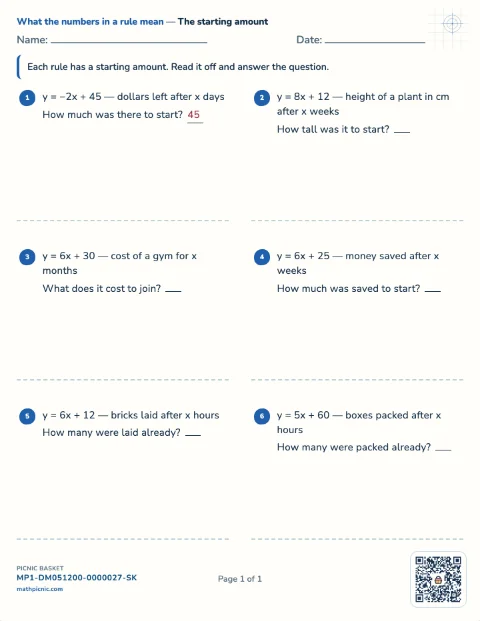 Print y = −20x + 300 → start 300
 - Working with units
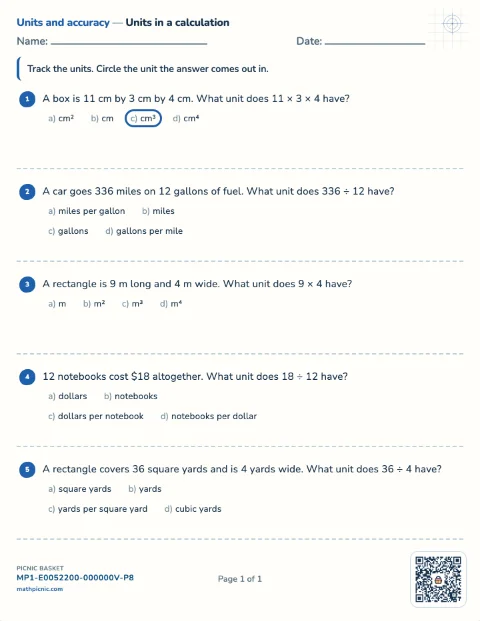 Print 60 × 3 → miles
 - Choosing the right quantity
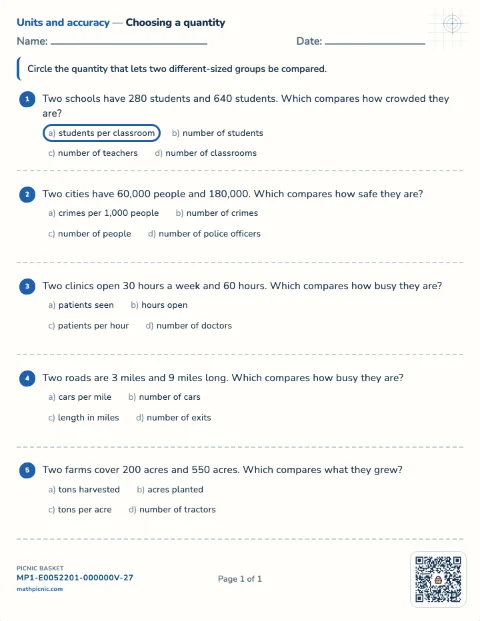 Print 450 vs 1,200 students → students per classroom
 - How accurately to report
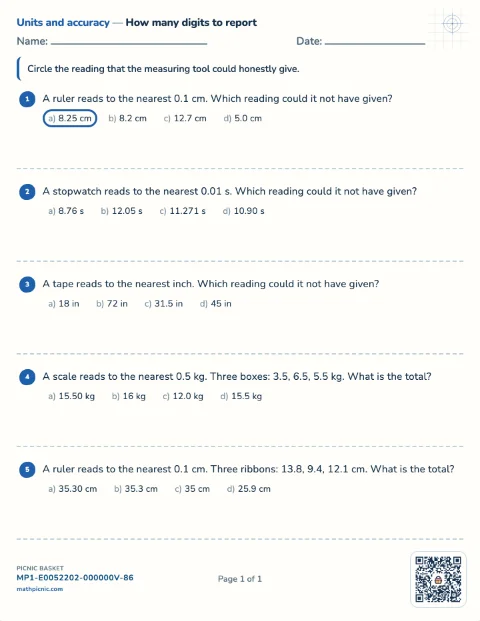 Print 4.5 + 7.0 + 2.5 kg → 14.0 kg
 - Arithmetic and geometric sequences
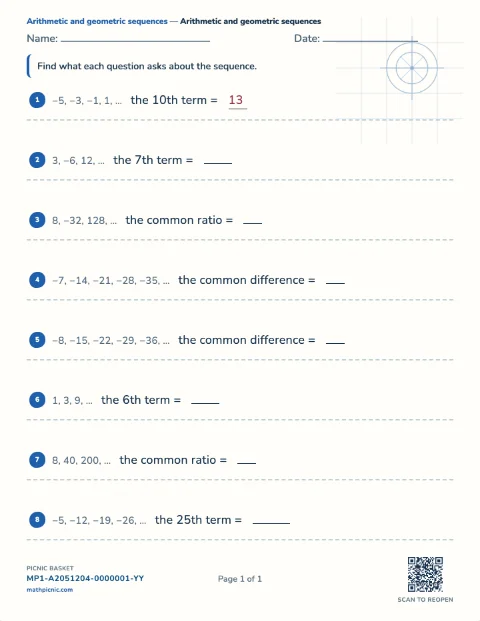 Print 3, 7, 11, … 20th term
 - x- and y-intercepts of a line
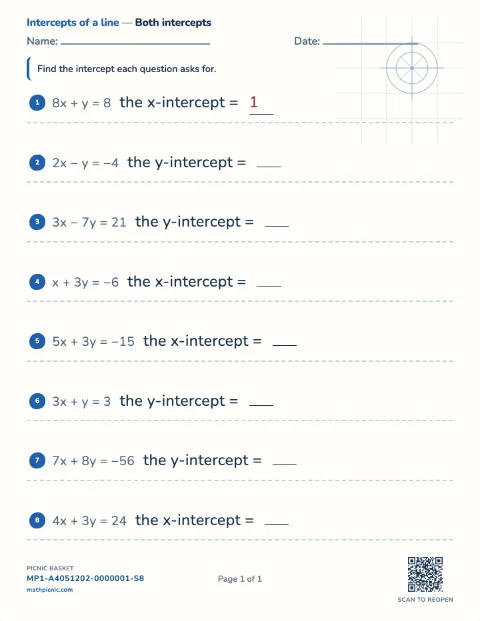 Print 3x + 4y = 24 → x-int
 - Absolute value equations
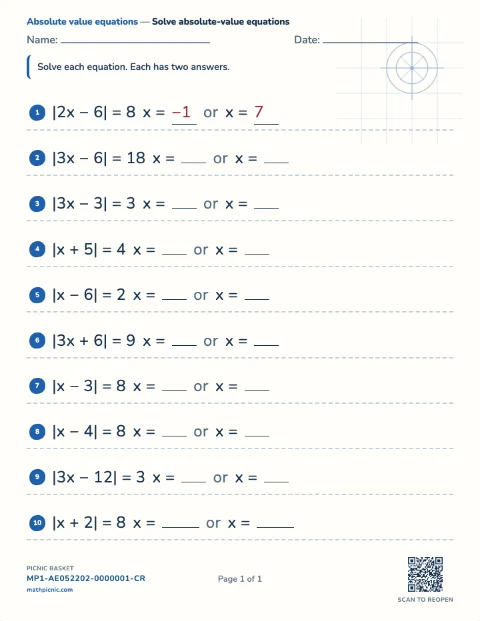 Print |x − 3| = 7
 - Writing linear equations
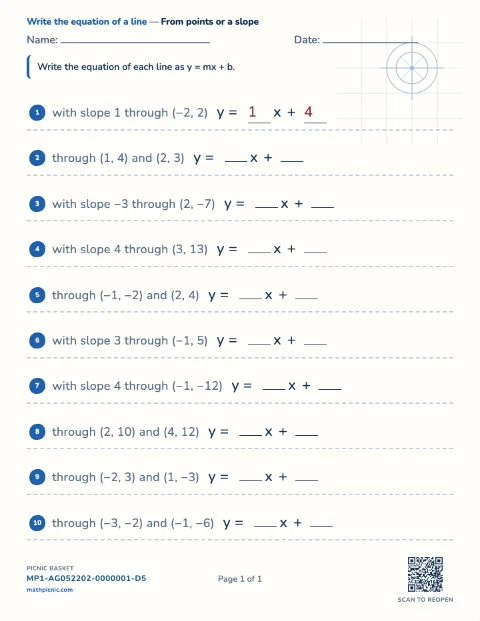 Print (1, 3) and (3, 7)
 - Exponential functions
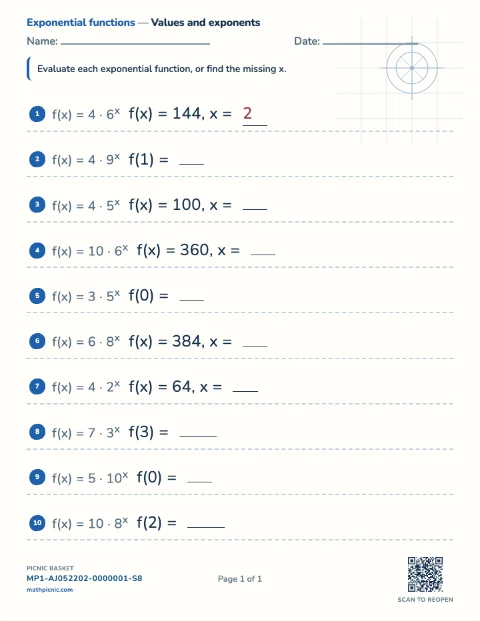 Print f(x) = 3 · 2ˣ
 - Comparing rates in words
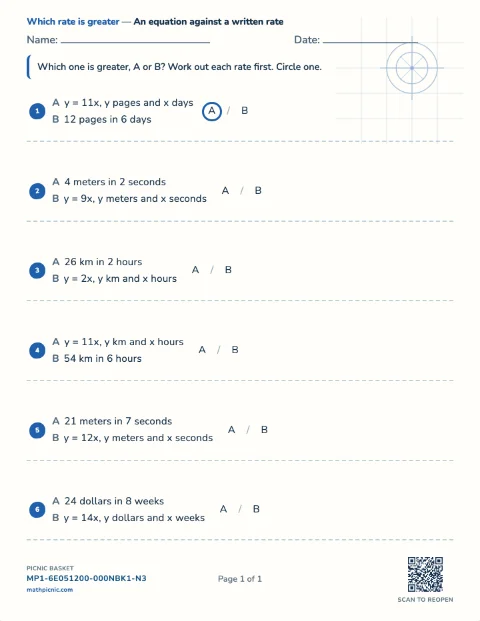 Print 60 mi in 5 h vs 84 mi in 7 h
 - Comparing rates from a table
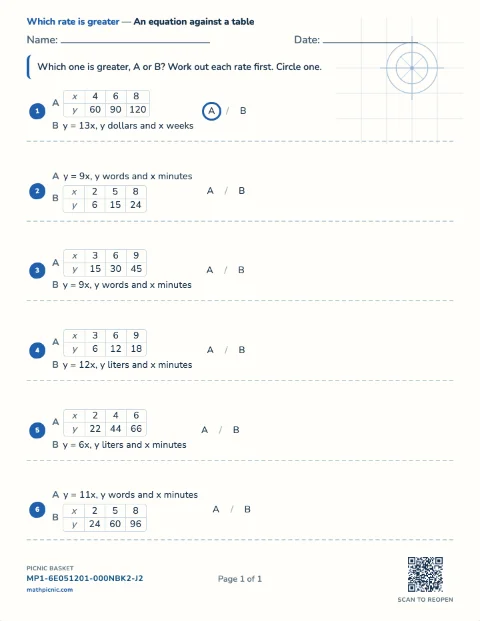 Print x: 2, 4 y: 10, 20
 - Factor a difference of squares
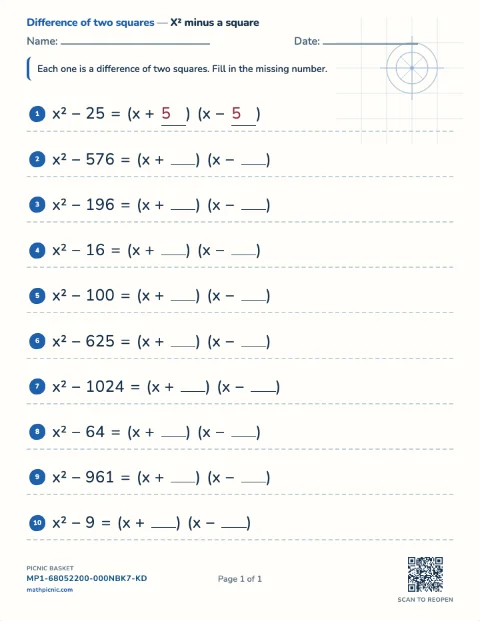 Print x² − 64
 - Difference of squares with coefficients
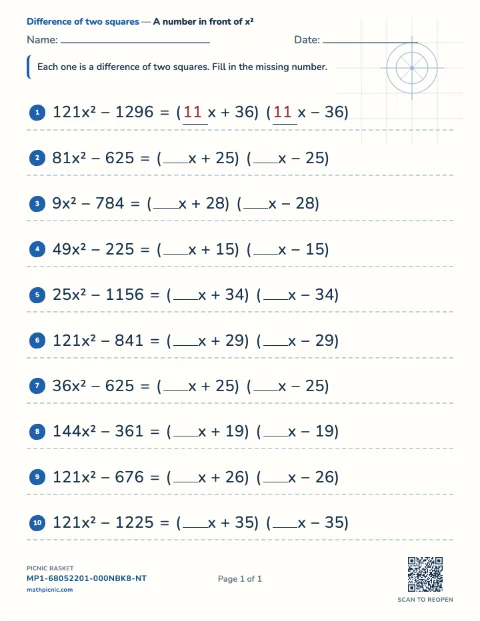 Print 9x² − 64
 - Multiply a sum by a difference
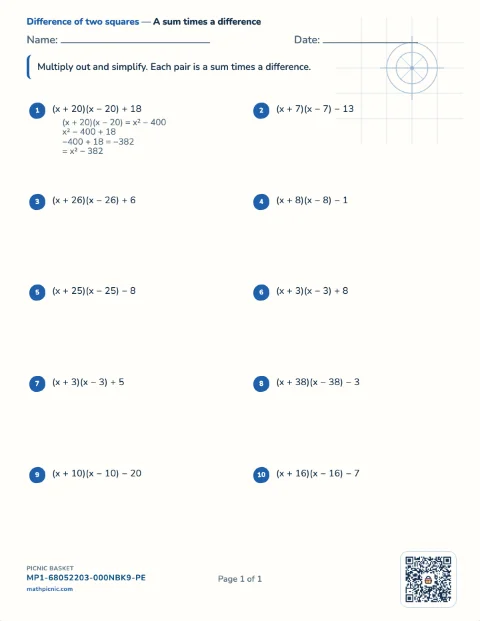 Print (x + 8)(x − 8) + 5
 - Common factor of two terms
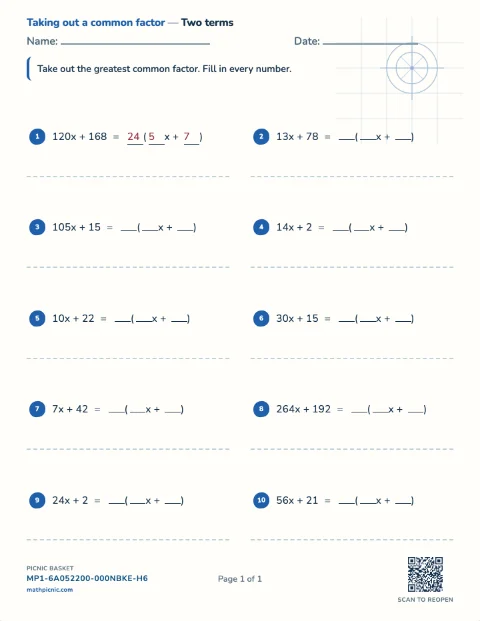 Print 12x + 18
 - Common factor of three terms
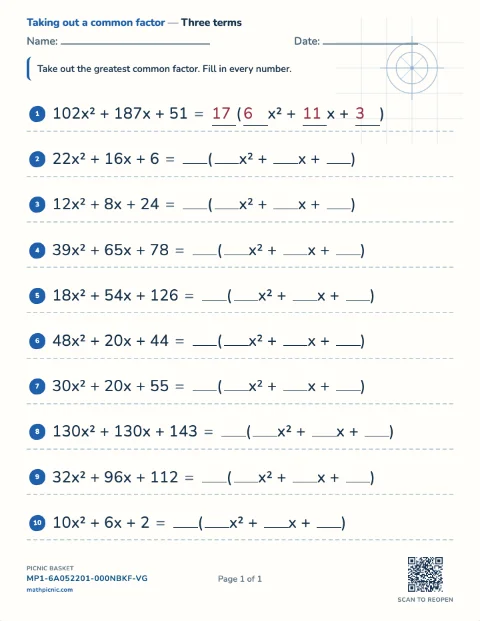 Print 6x² + 9x + 12
 - Factoring x² − bx + c
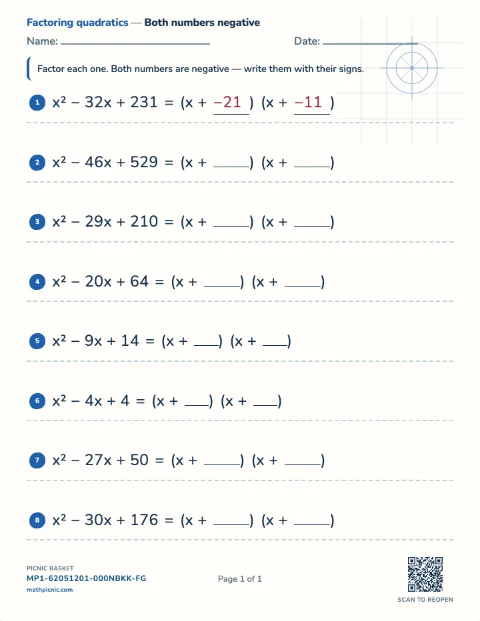 Print x² − 9x + 20
 - Factoring x² + bx − c
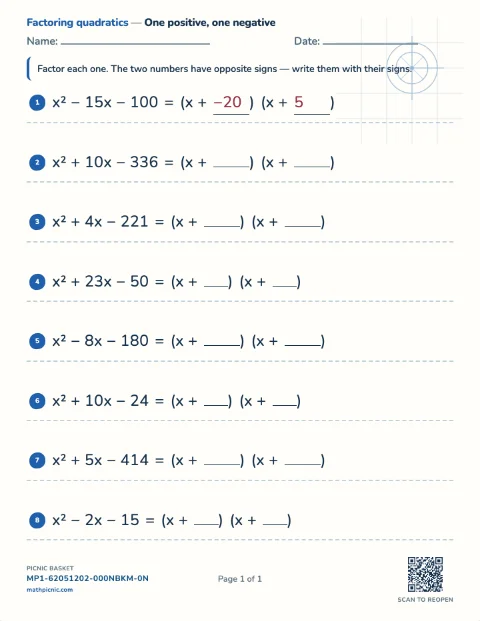 Print x² + 3x − 28
 - Factoring trinomials with a leading coefficient
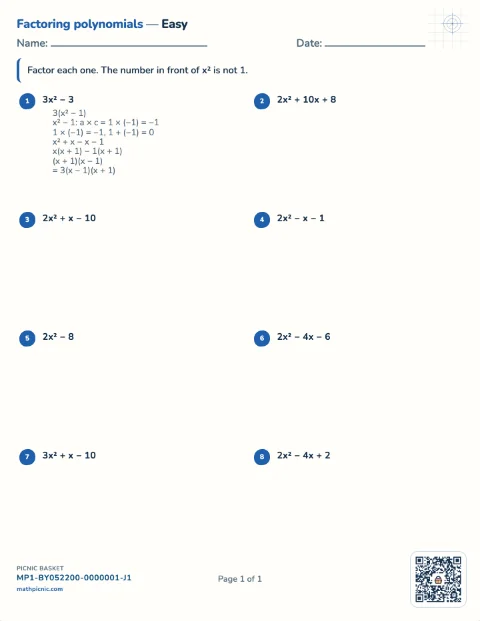 Print 2x² + x − 10
 - Evaluating functions
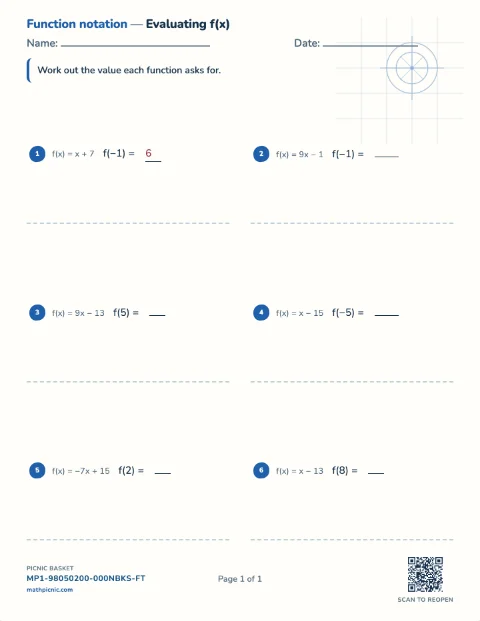 Print f(x) = 3x − 5, find f(−4)
 - Composing functions
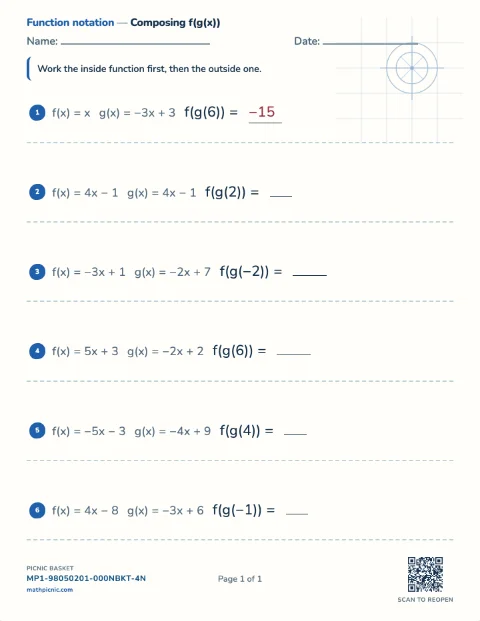 Print f(g(2))
 - The discriminant
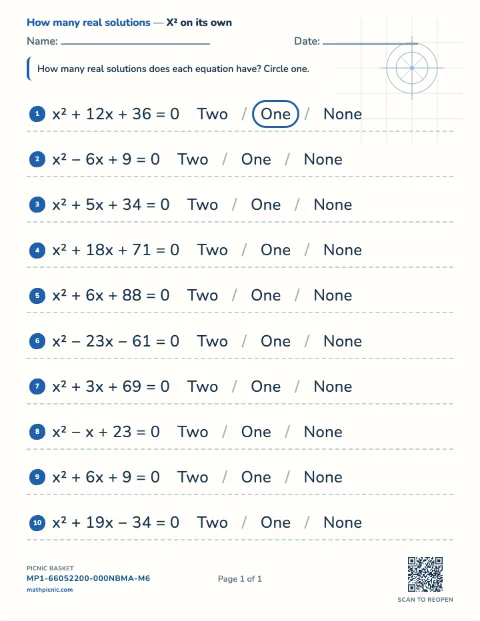 Print x² + 2x + 5 = 0
 - Discriminant with a leading coefficient
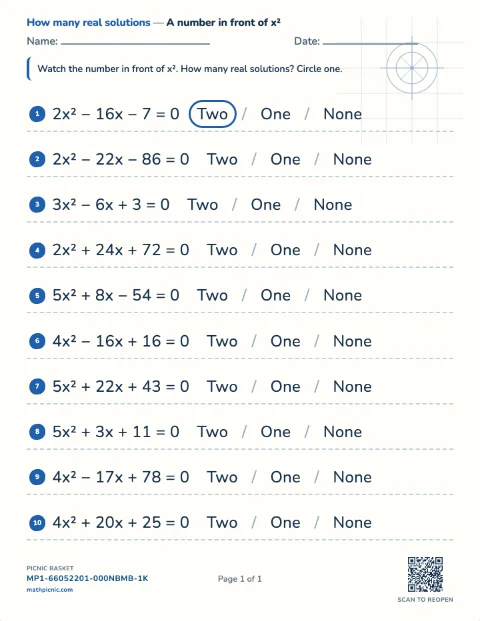 Print 3x² + 4x + 2 = 0
 - Finding the rate of change
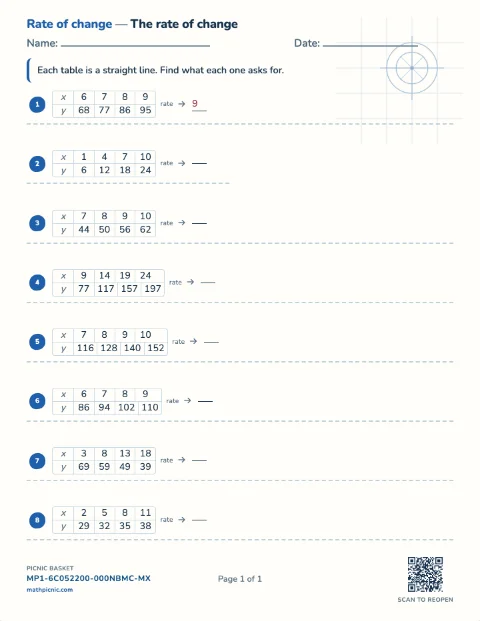 Print x: 2, 5, 8 y: 9, 21, 33
 - Initial value from a table
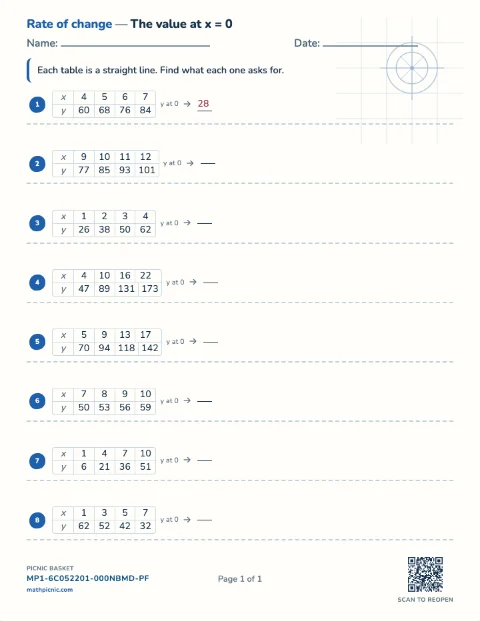 Print x: 2, 5, 8 y: 9, 21, 33
 - Multiplying in scientific notation
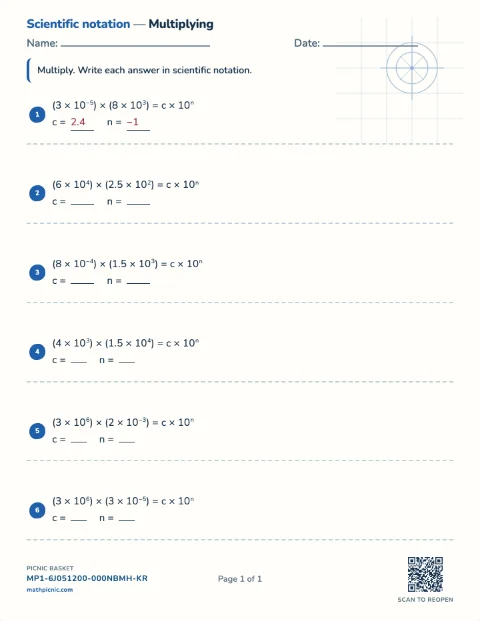 Print (5 × 10³) × (4 × 10²)
 - Dividing in scientific notation
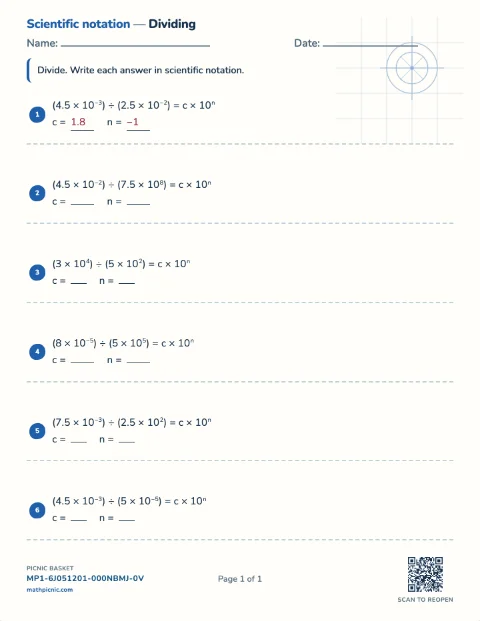 Print (8 × 10⁵) ÷ (2 × 10²)
 - Arithmetic sequence nth term
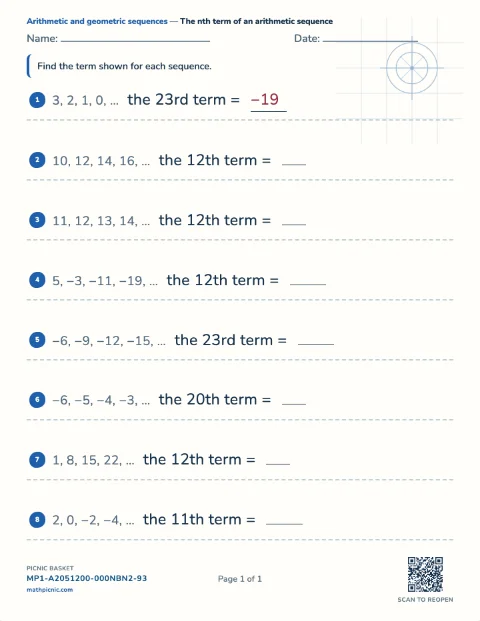 Print 5, 12, 19, … 20th term
 - Common difference of a sequence
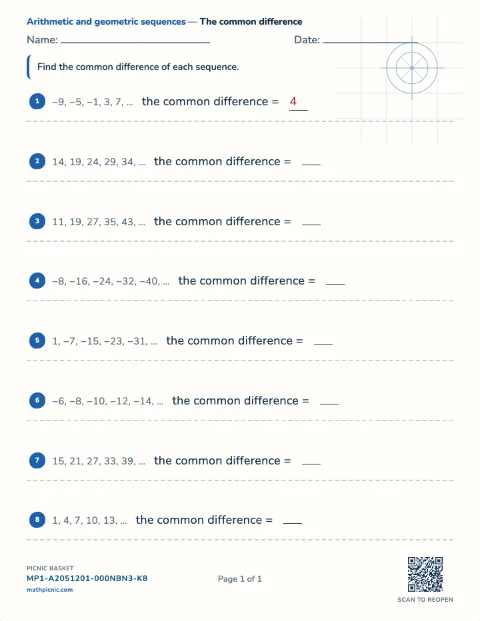 Print 5, 12, 19, 26 → d
 - Geometric sequence nth term
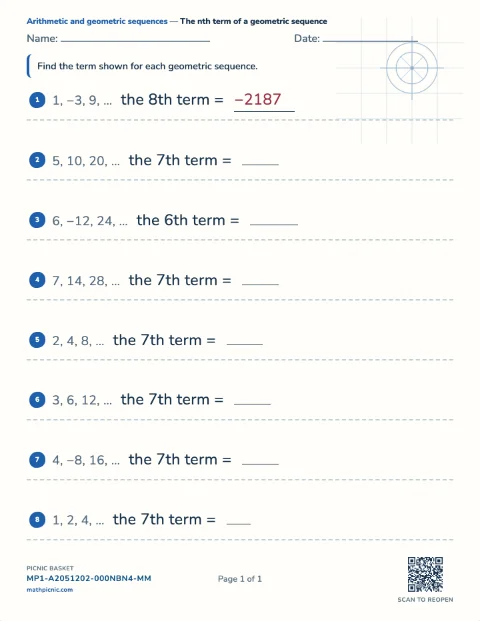 Print 3, 6, 12, … 8th term
 - Common ratio of a sequence
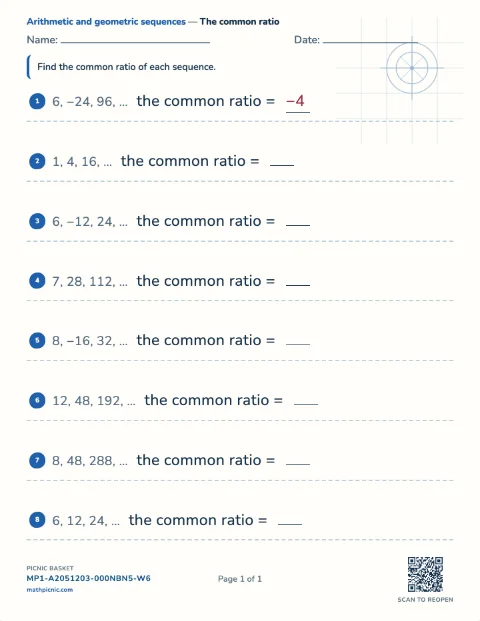 Print 3, 6, 12, 24 → r
 - Finding the x-intercept
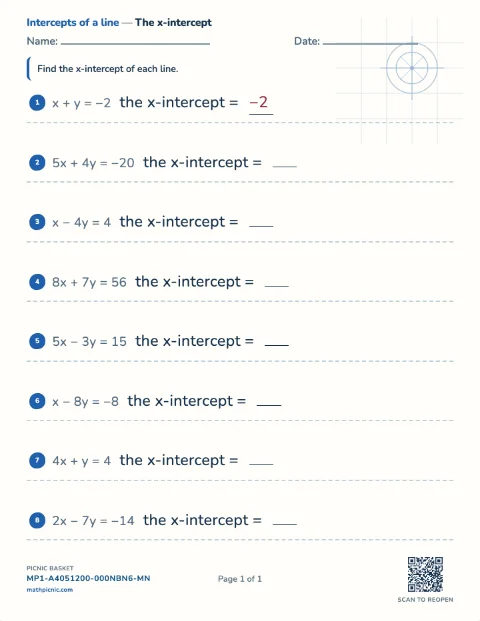 Print 3x + 4y = 24 → x-int
 - Finding the y-intercept
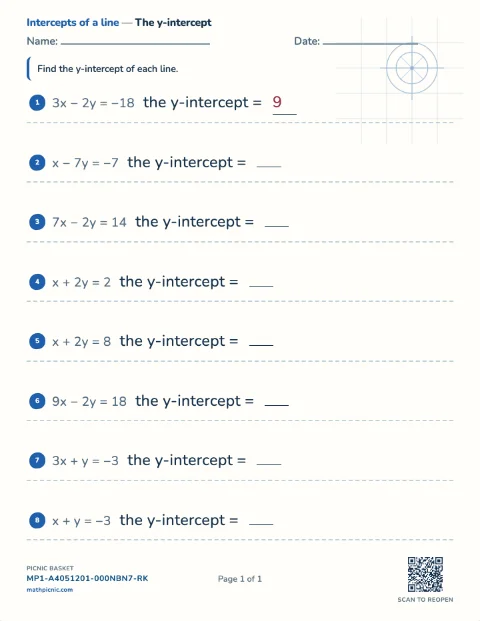 Print 3x + 4y = 24 → y-int
 - Solving absolute value equations
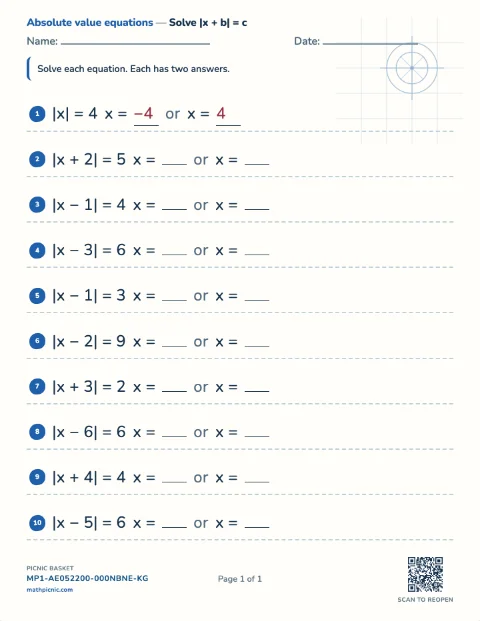 Print |x − 3| = 7
 - Absolute value equations with coefficients
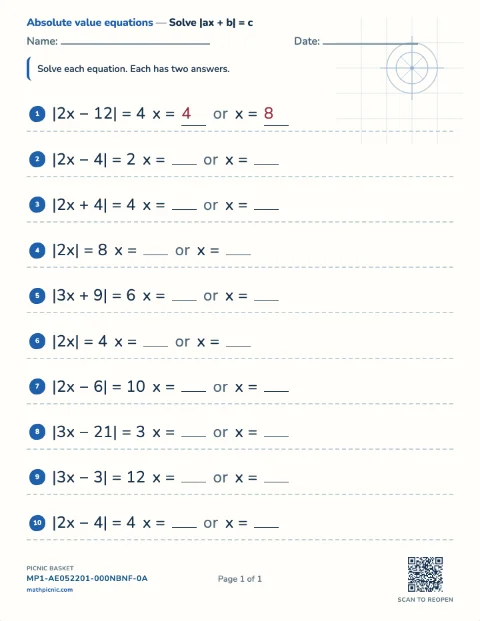 Print |3x − 18| = 3
 - Line equation from two points
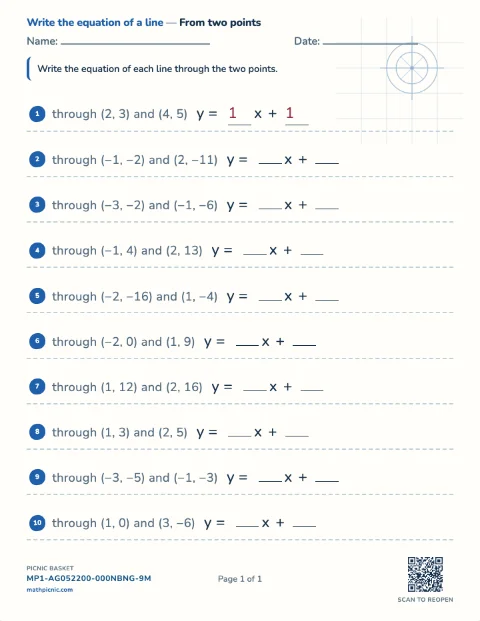 Print (1, 3) and (3, 7)
 - Point-slope equation of a line
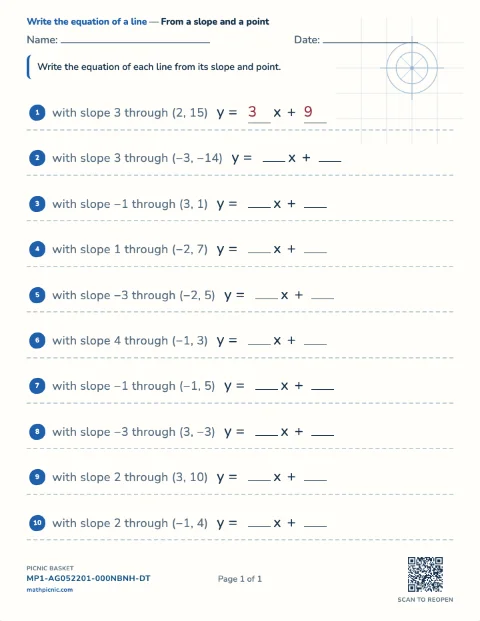 Print m = 2 through (1, 3)
 - Equation of a parallel line
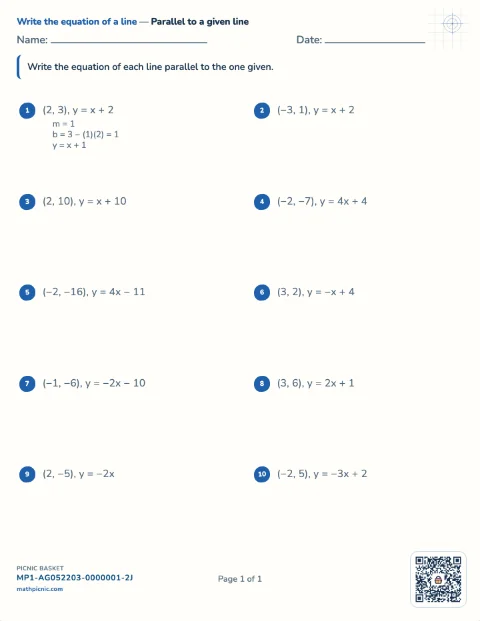 Print (−2, −7), y = 4x + 4
 - Equation of a perpendicular line
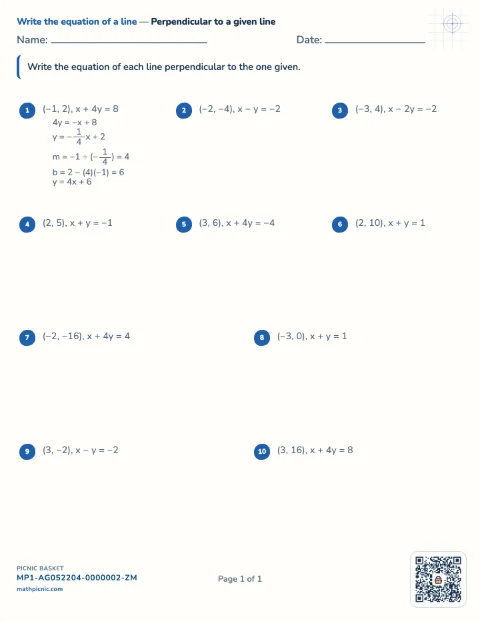 Print (−1, 2), x + 4y = 8
 - Evaluating exponential functions
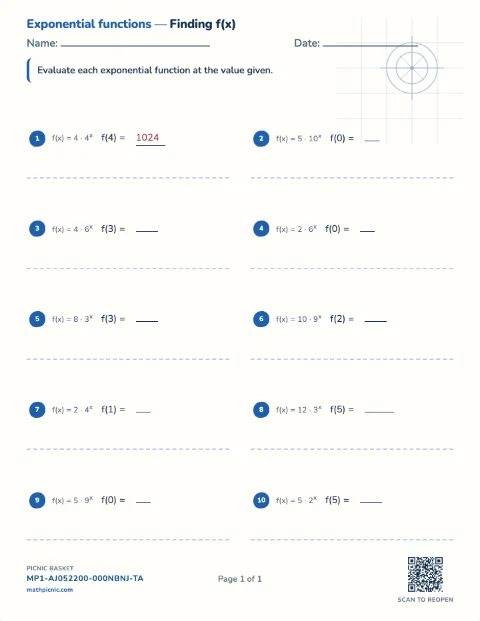 Print f(x) = 3 · 2ˣ, x = 4
 - Solving exponential equations
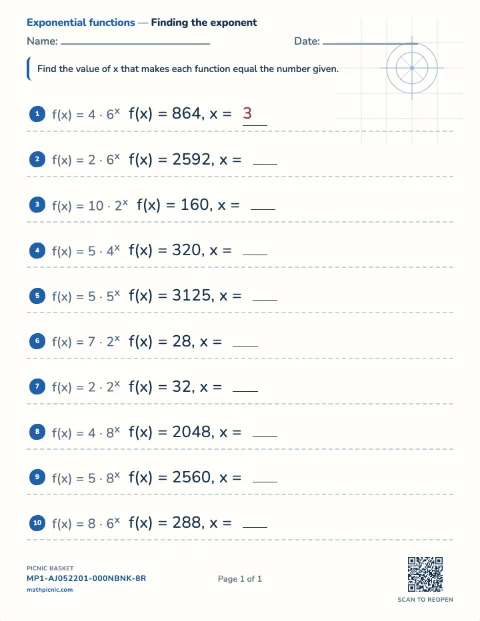 Print 3 · 2ˣ = 48 → x
 - Solving x² = p by square roots
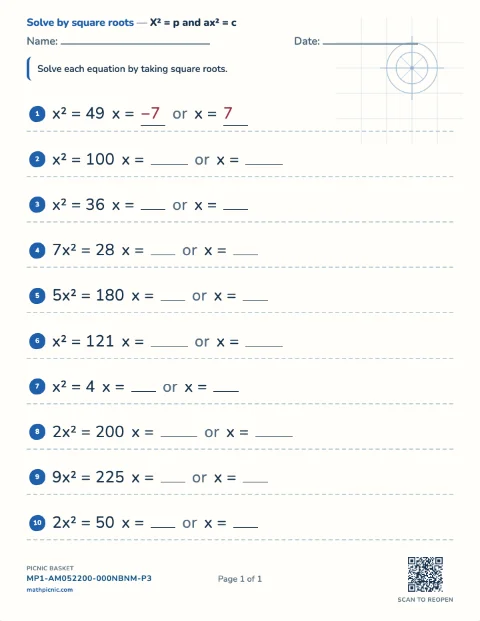 Print x² = 49
 - Solving (x − h)² = k by square roots
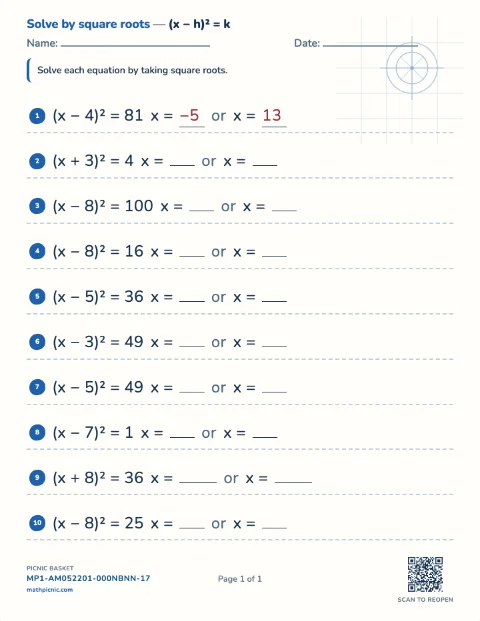 Print (x − 2)² = 9
 - Rearranging formulas
 Print A = ½bh for b
 - Solving for a variable in ax + by = c
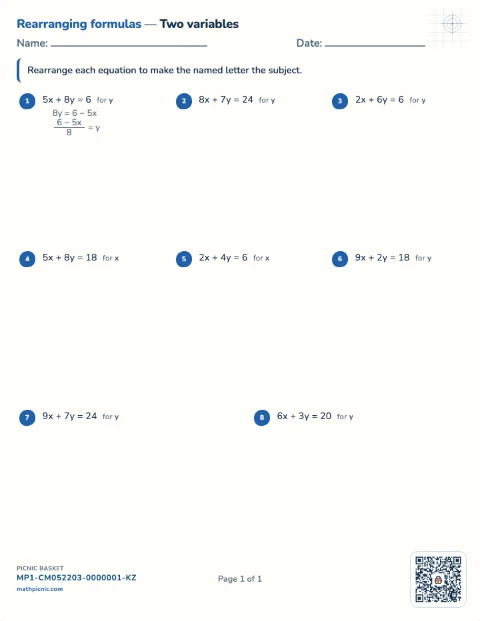 Print 5x + 8y = 6 for y
A simple way through algebra 1
Factoring comes in a fixed order and the order is the point. Take out a common factor first, because everything after it is smaller once you have. Then look for a difference of two squares, because it needs no search at all. Only then hunt for two numbers that multiply and add. A student who tries them in that order rarely gets stuck; one who reaches for the search every time will meet 4x² − 16 and grind at it.
Why this order works
Solving is the payoff, and it rests on one sentence rather than on the factoring: a product is zero only when one of the things being multiplied is zero. That is the step the marks are for, and it is where the sign turns over — (x − 3)(x + 5) = 0 gives x = 3 and x = −5, not −3 and 5. Handing a student the brackets already factored is what isolates it.