10th grade math worksheets
Need the right level, not just the grade label? Start wherever your child feels comfortable.
Triangle congruence rules
Grade 8–10
Name the congruence rule (SSS, SAS, ASA, AAS, HL) from the marks on a pair of triangles
Customize this sheet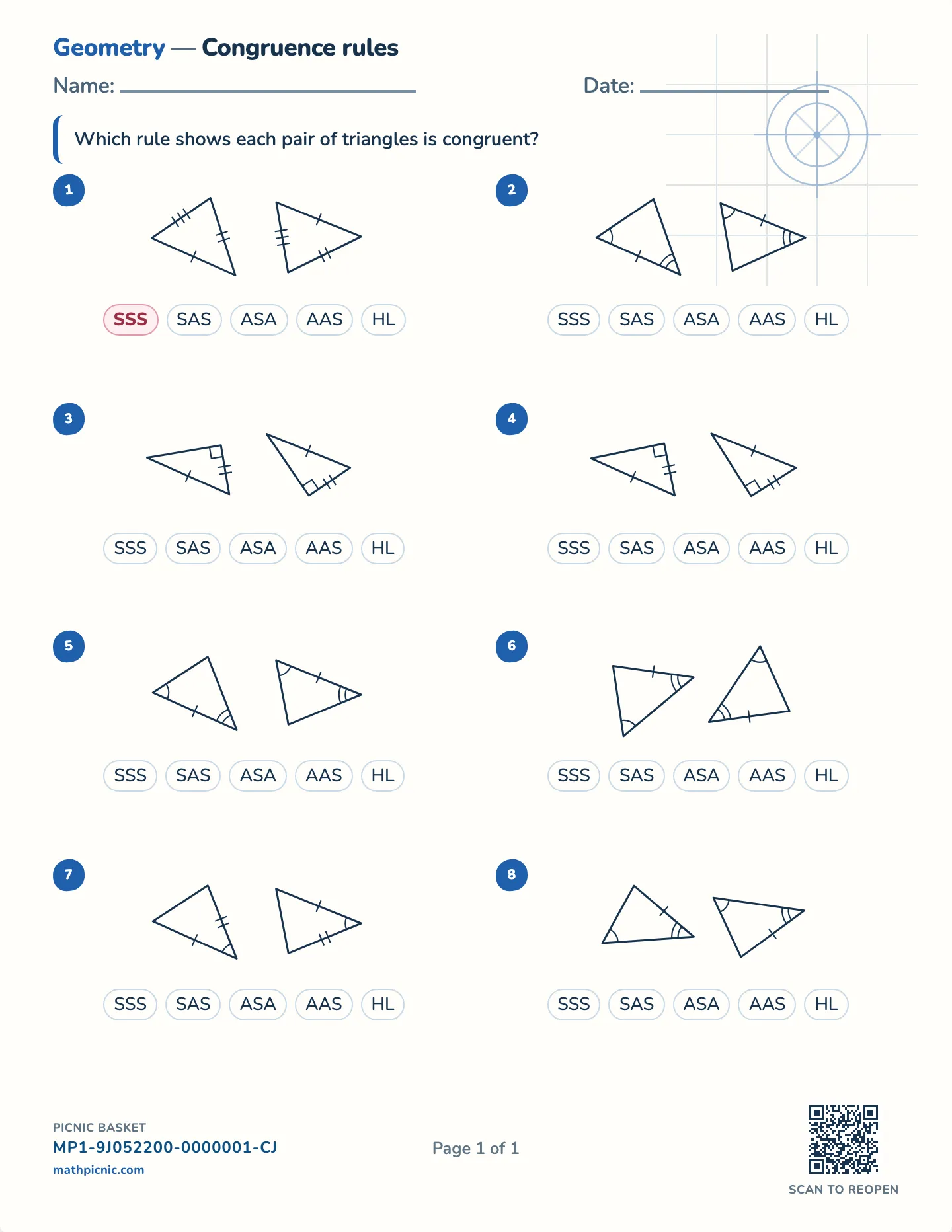


What to practice this year
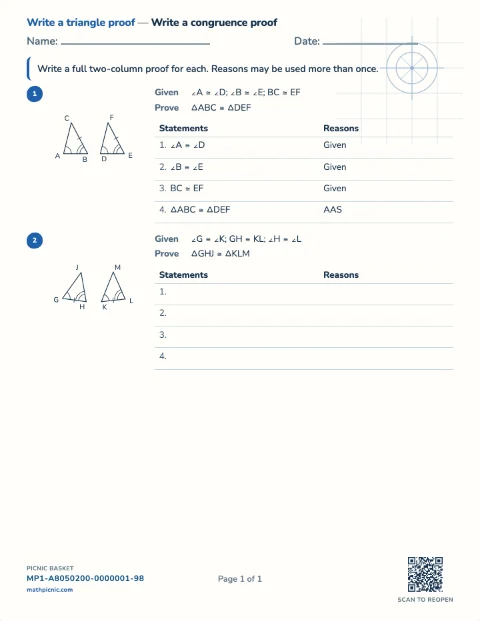
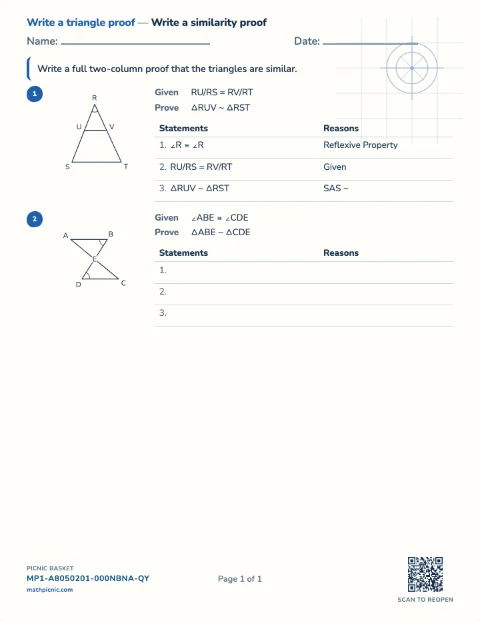
A two-column proof is the year’s real work, and it comes in two sizes. Naming which criterion applies — SSS, SAS, ASA, AAS or HL — is a reading of the marks on a figure. Writing the proof that uses it is a different act, and the sheets separate them: one set blanks a single reason, the other hands over an empty Statements and Reasons table with nothing but the Given and the Prove. Every answer key sets the model proof out in full, line by line.
Why these skills come next
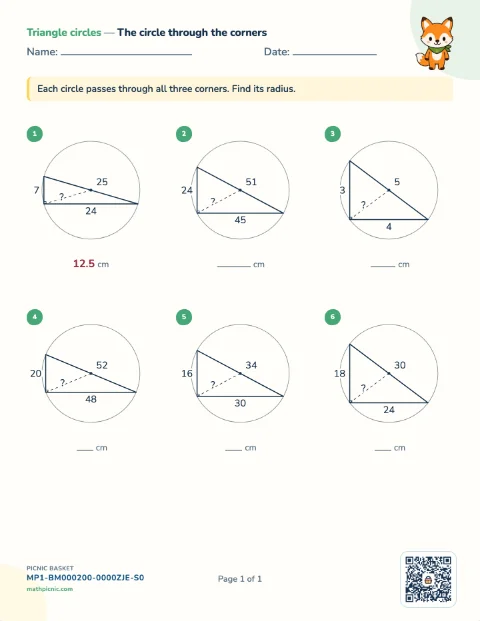
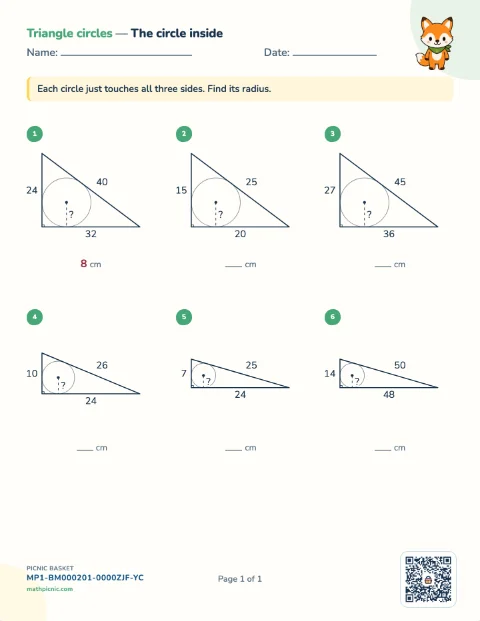
Circles carry the year’s densest set of named results — the inscribed angle and its central twin, arc length and sector area, and the two circles a triangle defines.
Nothing matches that. Try a skill, a number, or a topic.
Step 1 of 12
Congruence and similarity
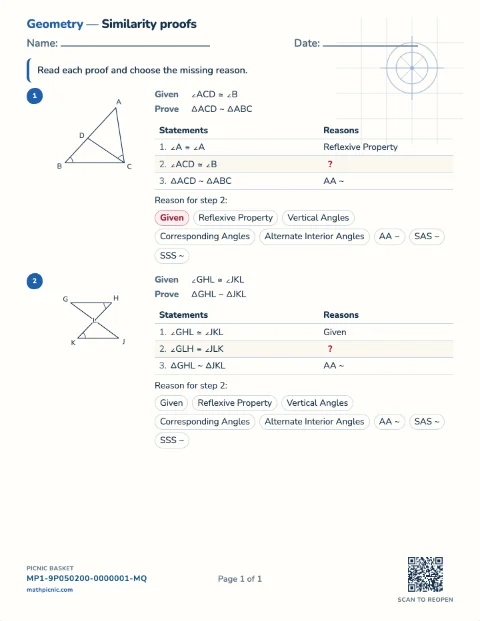
Name the criterion from the marks on a figure — SSS, SAS, ASA, AAS or HL.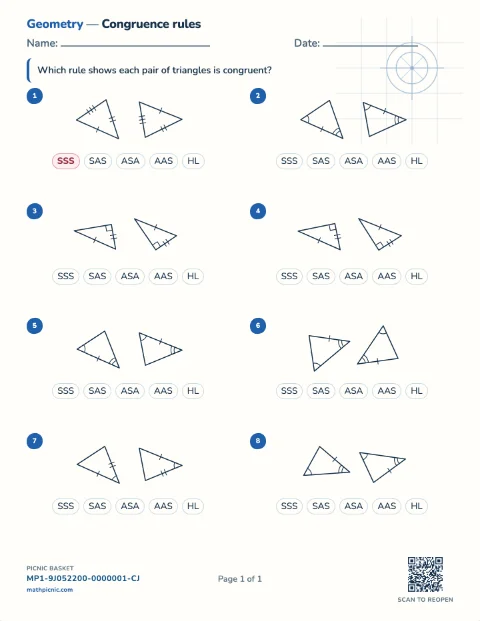
Step 2 of 12
Symmetry as a motion
Which turns carry a shape back onto itself — the half of symmetry that is not a fold.
Step 3 of 12
Modeling with geometry
A figure with a quantity on it: work out the size, then how much sits in one unit of it.

Step 4 of 12
Probability rules
“And” is one cell of a two-way table; “or” is three, minus the one counted twice.- The addition rule
 Print Bus OR Late → 65%
 - Independent events
 Print 40% × 60% = 24%, table 14%
 - Correlation and causation
 Print more police, more crime → second causes first
 - Survey, experiment or study?
 Print randomly given the drug → experiment
 - Is this sample fair?
 Print only the soccer team is asked → a group is left out
 - Does the data fit the claim?
 Print 1 in 5 of 200 is 40; the result was 84
 - Margin of error
 Print 400 asked → 5%
Step 5 of 12
Two-column proofs
Fill the missing reason, then write the whole argument from an empty table.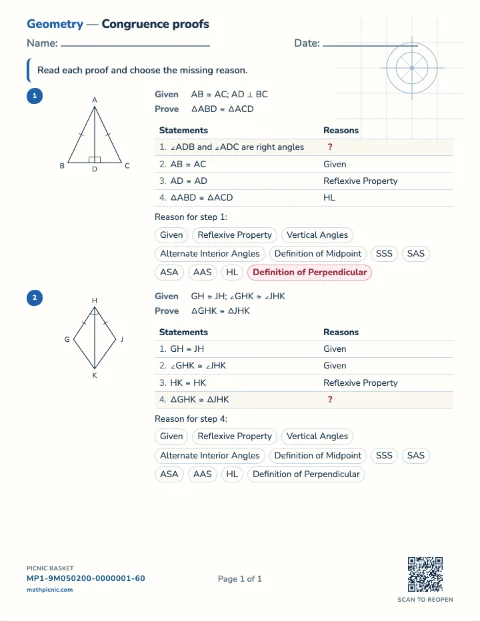


Step 6 of 12
Circles
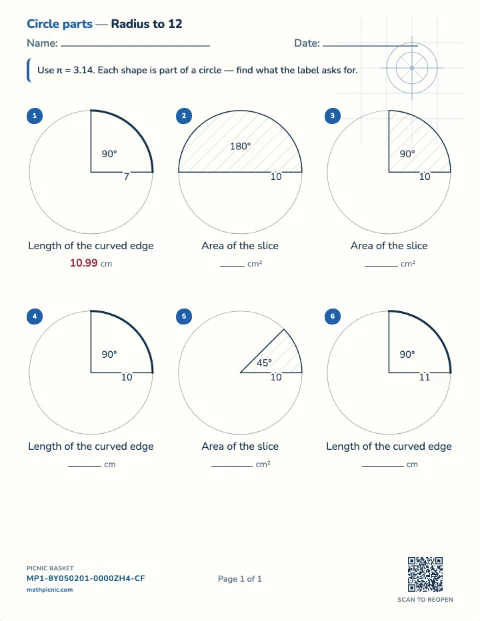
Inscribed angles, arc length and sector area, and a triangle's two circles.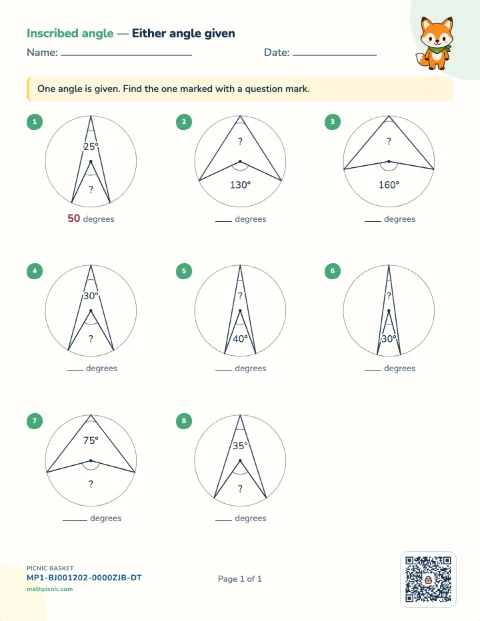
Step 7 of 12
Coordinate geometry
When two lines are parallel or perpendicular, and what a circle's equation hides.


Step 8 of 12
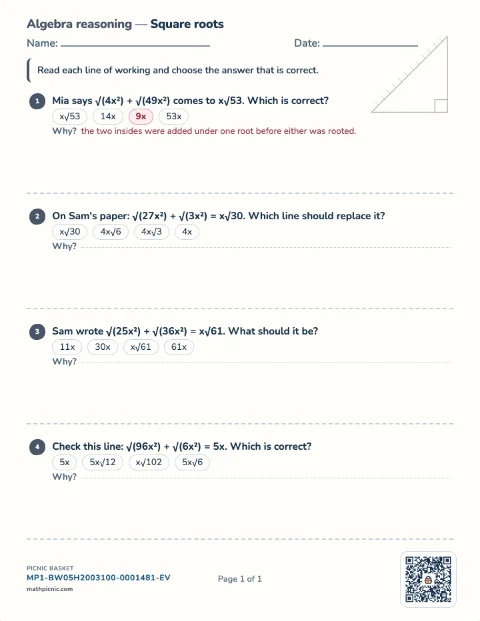
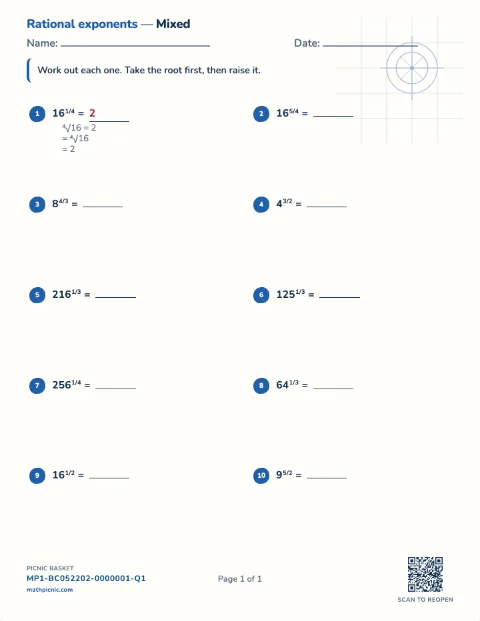
Radicals and rational exponents
Simplify a root, then write it as a power instead.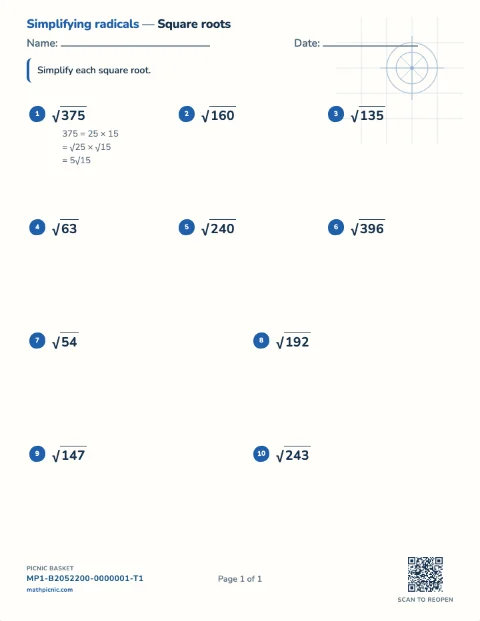
Step 9 of 12
Completing the square
Rewrite a quadratic as a square plus a number — the move that solves any of them.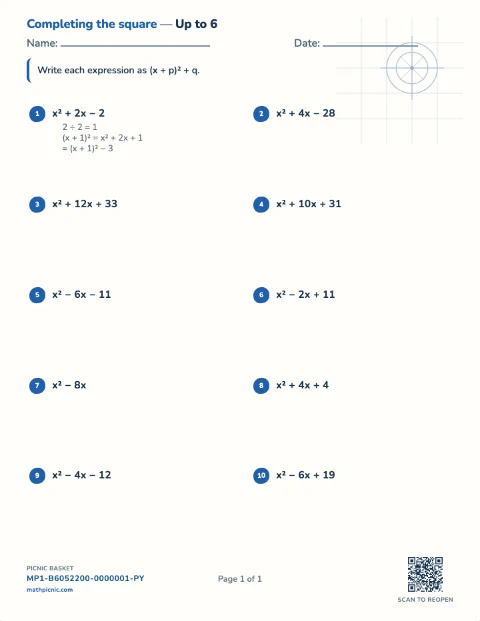
Step 10 of 12
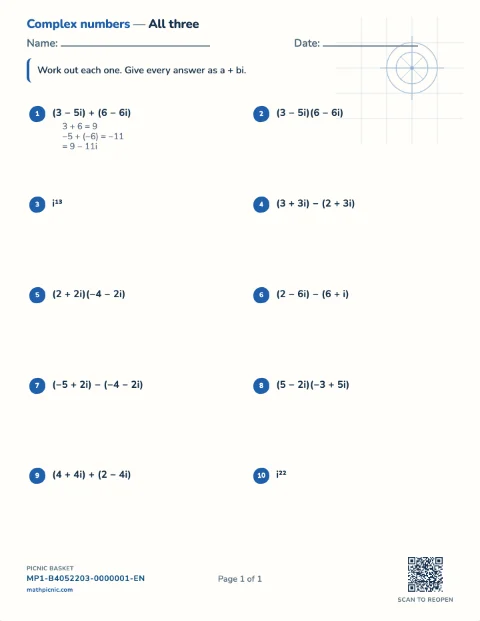
Complex numbers
When the discriminant is negative, and the arithmetic of a ± bi.
Step 11 of 12
Rearranging formulas
Make any letter the subject — thirty formulas a course actually uses.
Step 12 of 12