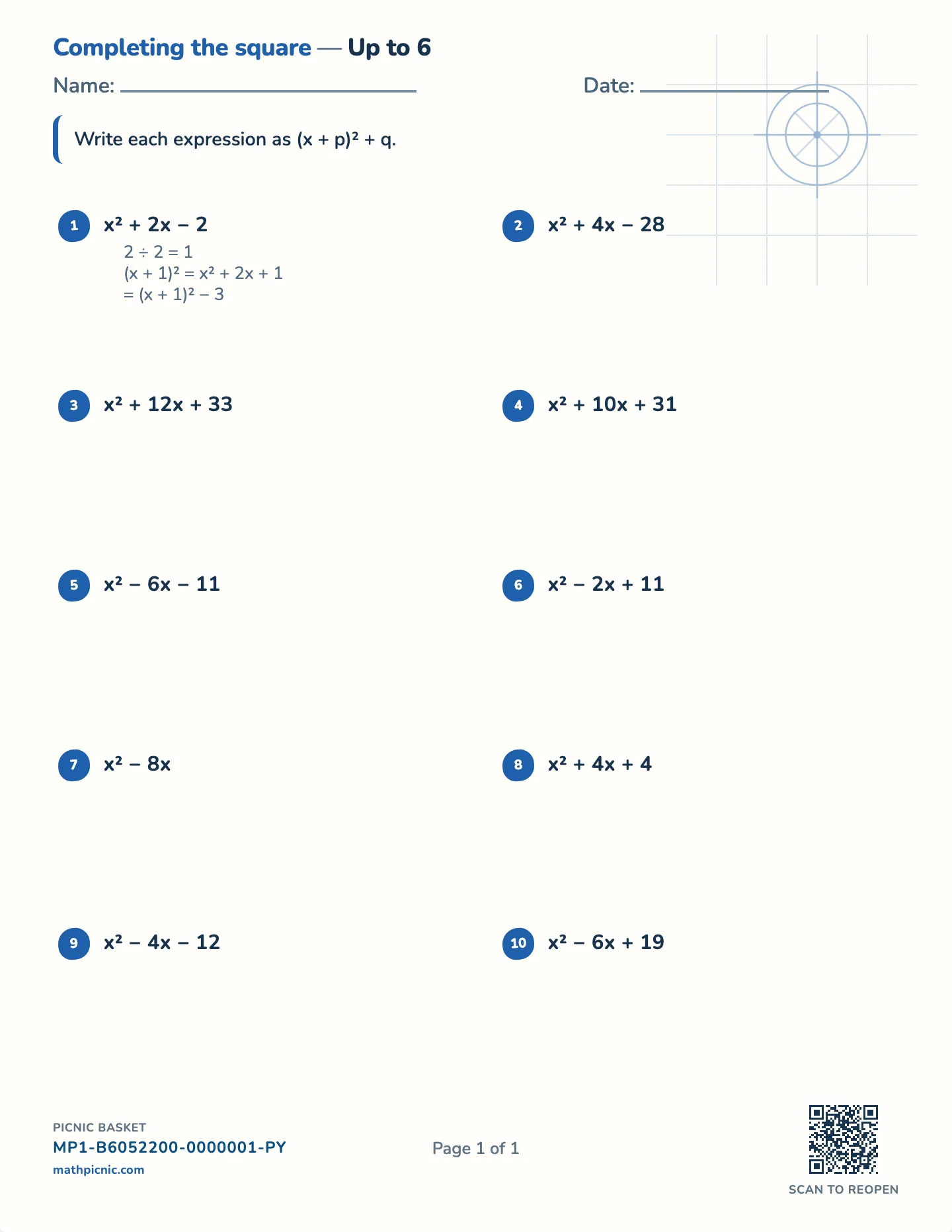
Completing the squareUp to 6
Name: Date:
Write each expression as (x + p)² + q.
1x² + 2x − 2
2x² + 4x − 28
3x² + 12x + 33
4x² + 10x + 31
5x² − 6x − 11
6x² − 2x + 11
7x² − 8x
8x² + 4x + 4
9x² − 4x − 12
10x² − 6x + 19

Completing the square rewrites a quadratic as a square plus a number. These free printable worksheets ask for both, and the answer key shows the step everybody skips: the square you build brings a number with it that has to be given back.
If they get stuck
The answer key prints on a separate page.
“Halve it and square it” is the half everyone remembers and it is only half the method. (x − 3)² is x² − 6x + 9, so it has quietly added a 9 that the original expression did not have, and the last step is subtracting it again. A student who writes (x − 3)² − 31 instead of (x − 3)² − 40 has done the memorable half and nothing else — which is why every key here expands the bracket before it touches the constant.
Every middle coefficient is even, and that is not a limitation being hidden. An odd one completes to a fraction — x² + 5x + 1 is (x + 5/2)² − 21/4 — which is a real question and not one a whole-number answer box can take. Every exercise set at this stage is even for the same reason.
One question from a sheet like this one, worked a step at a time — with a sentence saying what just happened and why.
Completing the square, step by step