
Reference for the wall
Printable math charts, ready for the wall.
78 ready-made charts — times tables, number bonds, place value, and the formulas that never stick. Print one as it is, or change the range, the answers and the character first.
Start here
Pick a chart
Sorted by what your child will do with the sheet: look a number up, see how something works, or remember the method.Nothing matches that. Try a topic (fractions), a table (times), or a grade (grade 3).
Look something up
Charts for finding a number
For the moment a fact will not come. Find the row, follow it across, carry on with the question.- Hundreds chart
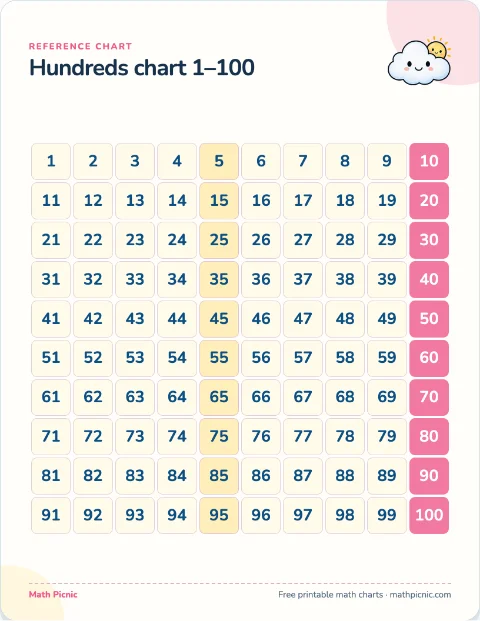 Print Count, skip count, or add ten by moving one square straight down.
 - Addition table
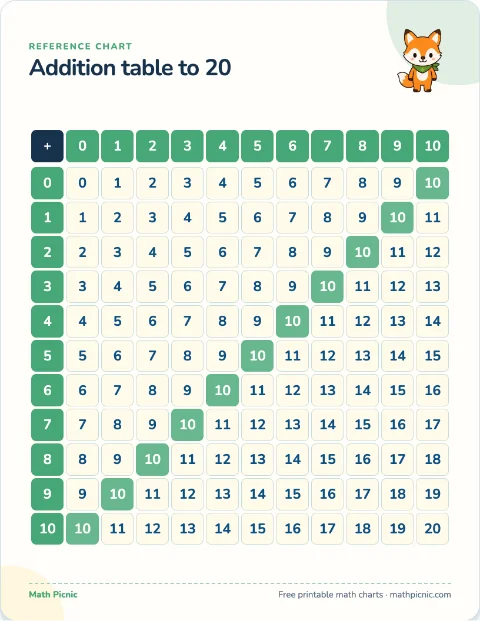 Print Follow a row and a column to the square where the two numbers meet.
 - Subtraction table
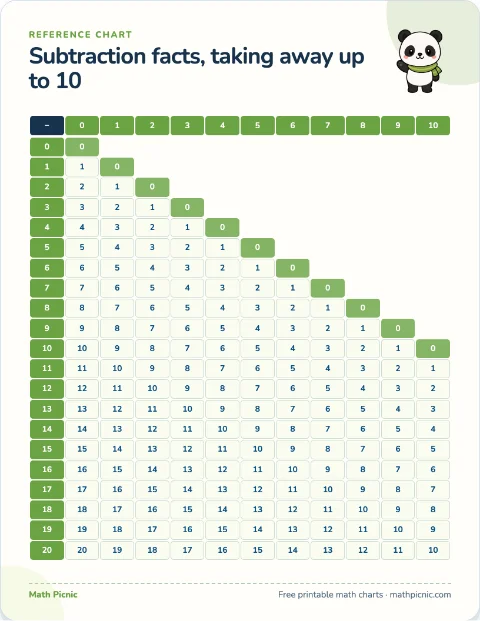 Print Start on the number being taken from, then read across to what is taken away.
 - Subtraction table to 20
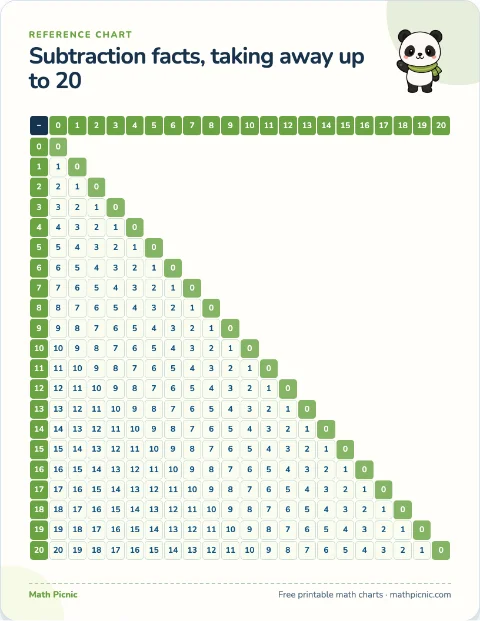 Print Find the top number down the side, the number taken away across the top.
 - Multiplication table
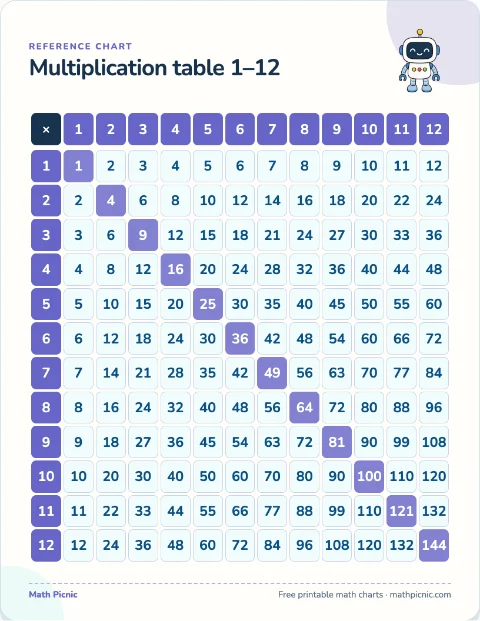 Print Read a row across and a column down to the square where they meet.
 - Division table
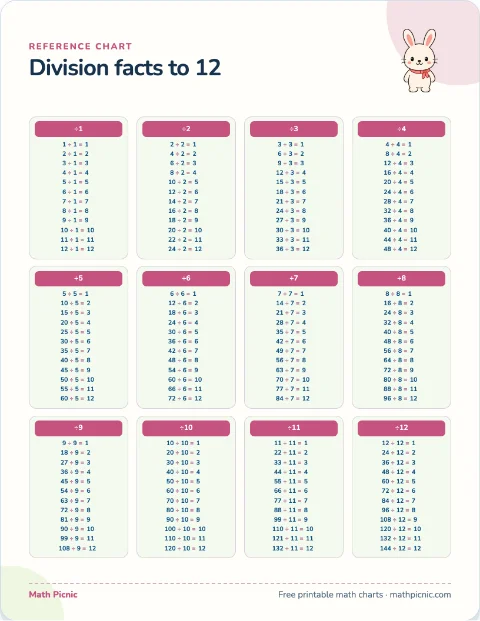 Print Find the family being divided by, then read down it to the answer.
 - Roman numerals
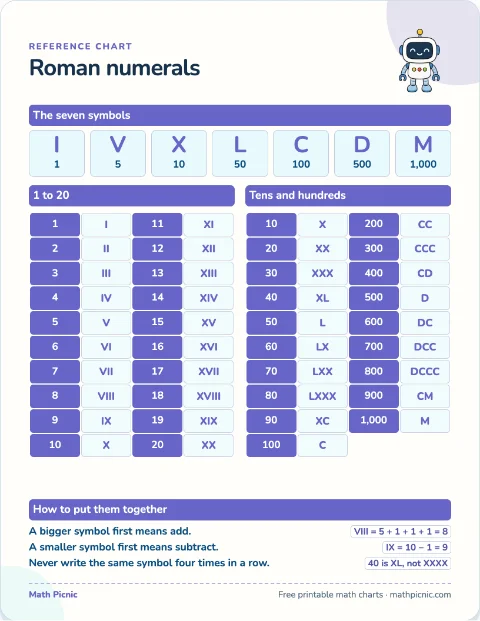 Print Build or read a numeral using the seven symbols and the three rules.
 - Multiples chart
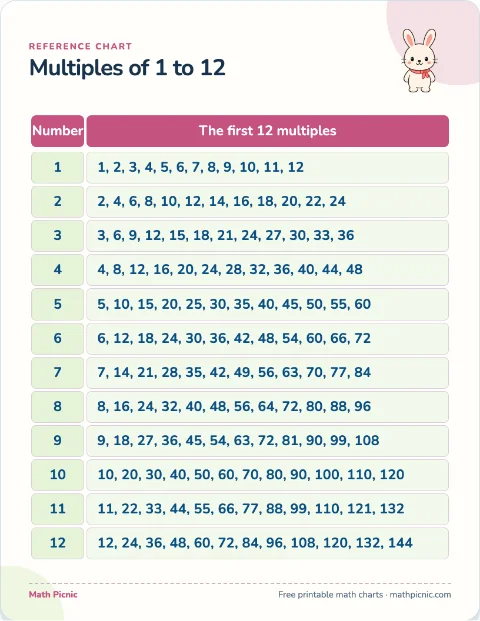 Print Run a finger along two rows until the same number appears in both.
 - Factors chart
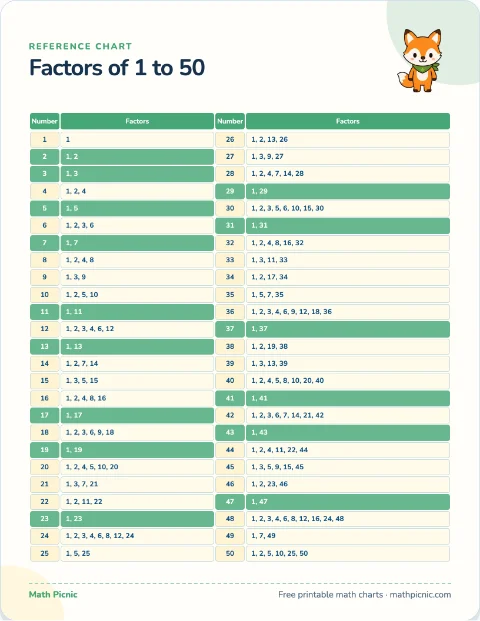 Print Read off every factor of a number before simplifying or finding a common one.
 - Multiplication table 1–20
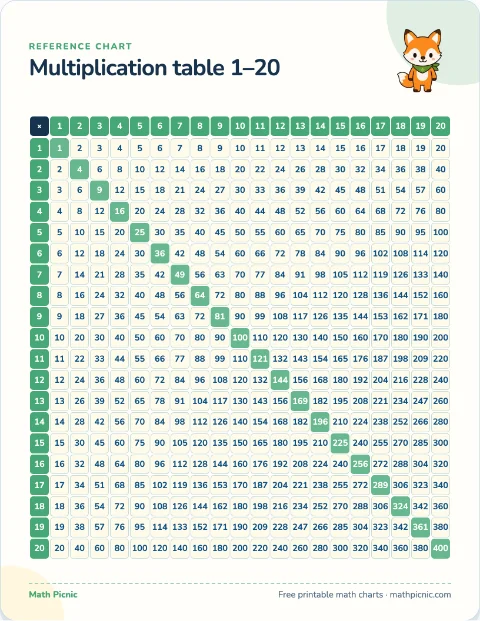 Print Look up a fact past the twelves without working it out.
 - Prime numbers to 50
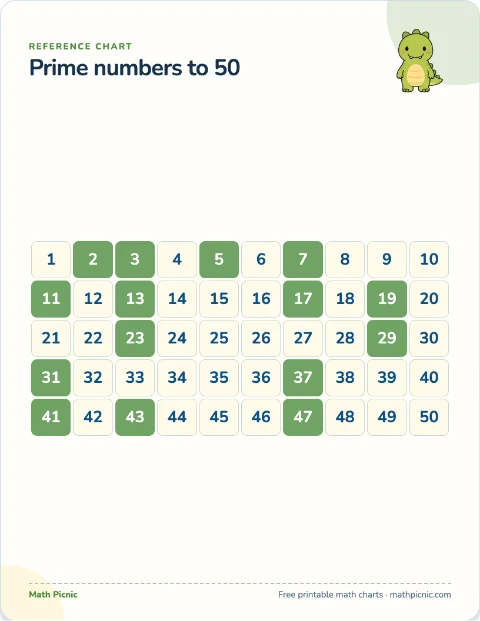 Print Check whether a number is marked before trying to break it into factors.
 - Prime numbers to 100
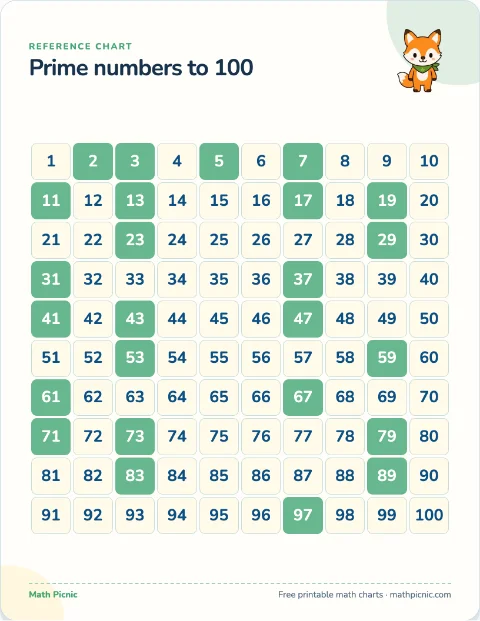 Print Find the primes on the grid and see the pattern the multiples leave behind.
 - Prime numbers to 150
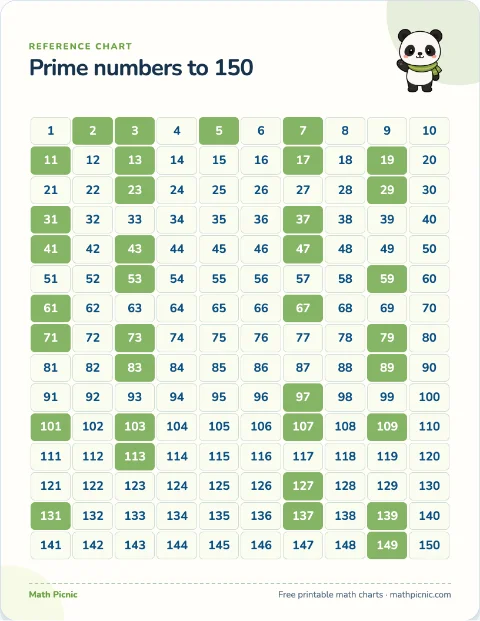 Print Look a number up on the grid instead of testing it for factors.
 - Prime numbers to 200
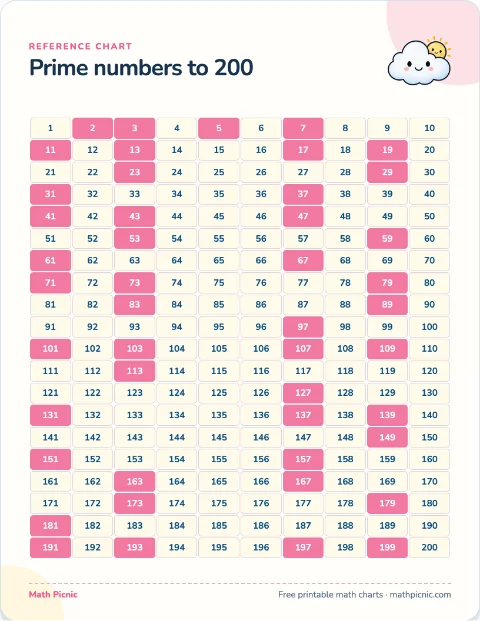 Print Tell a prime from a composite at a glance while factoring or simplifying.
 - Squares and cubes
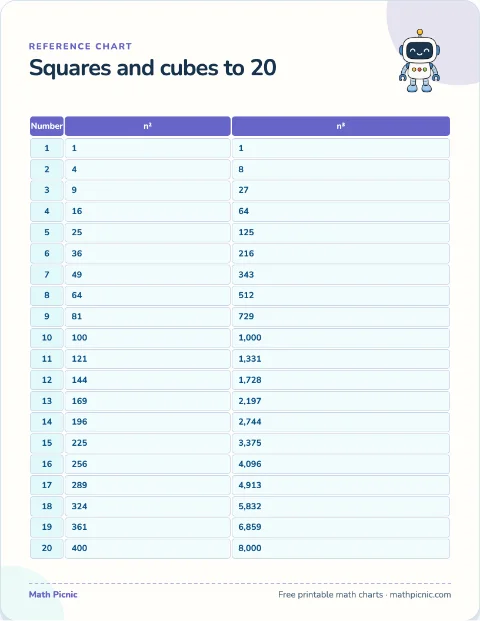 Print Read off a square or a cube instead of multiplying it out.
 - Money
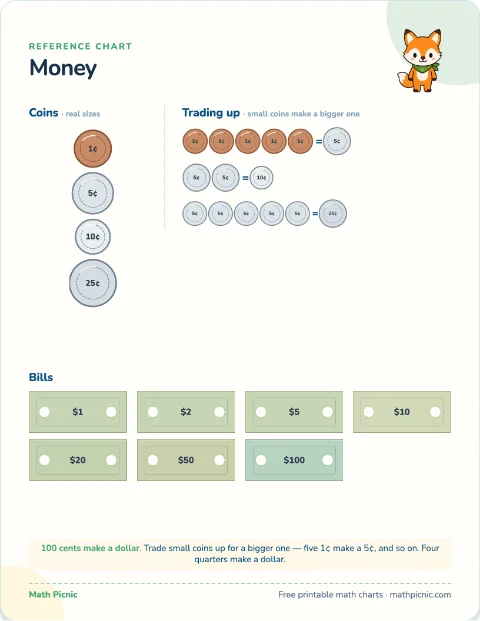 Print Read each coin's value, then trade small coins up for a bigger one.
See how it works
Charts for understanding an idea
Less for looking things up than for looking at. These make a single idea visible, then stop being needed.- Counting to 10
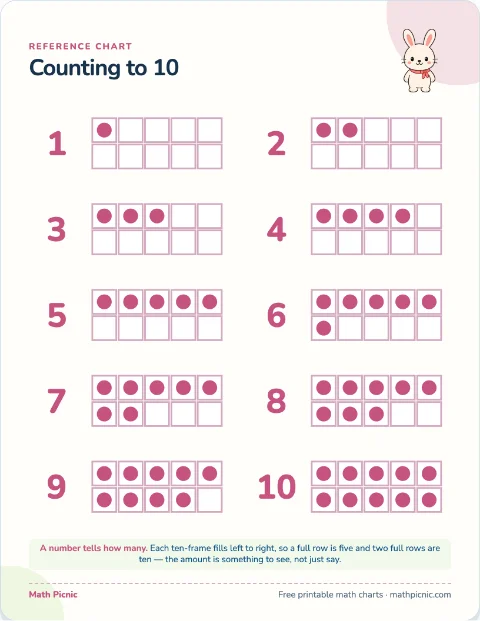 Print Count the dots in each ten-frame and read the number beside it.
 - Number bonds to 10
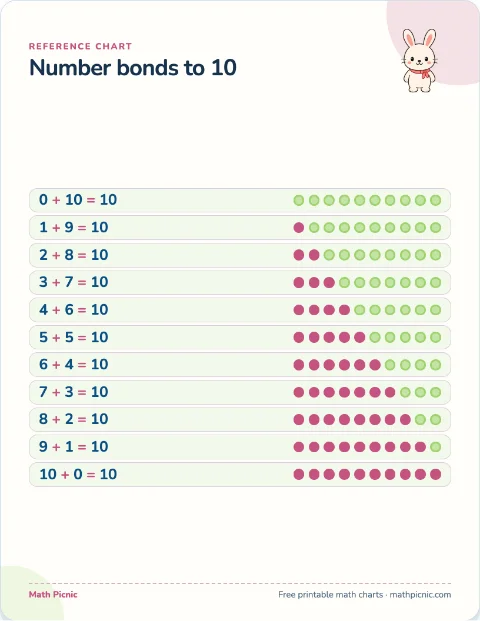 Print Read each row of counters and say the two numbers that make ten.
 - Comparing numbers
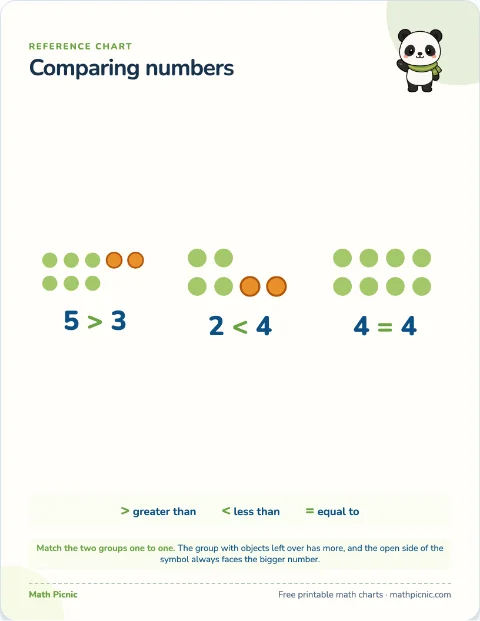 Print Line the two groups up one to one; the group with a leftover has more.
 - Odd and even
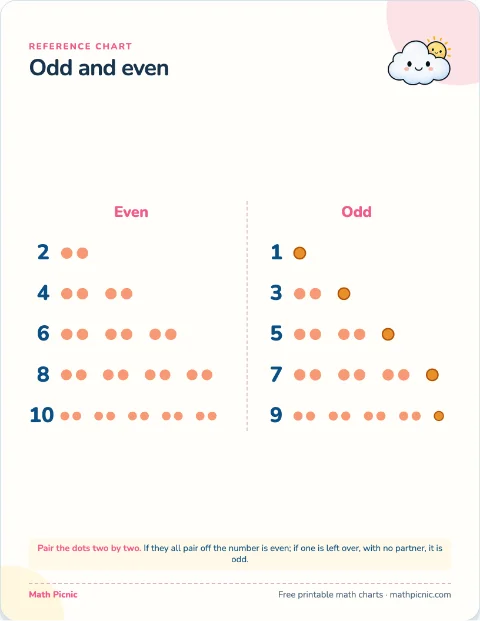 Print Pair the dots two by two; all paired is even, one left over is odd.
 - Number line 0–20
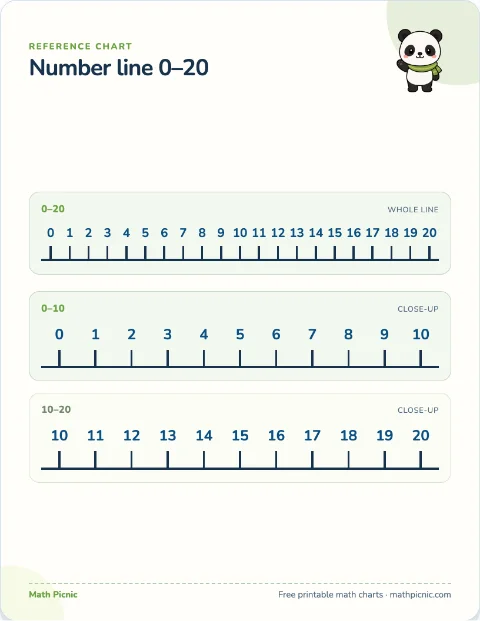 Print Count on or back by hopping along the line one number at a time.
 - Blank number line 0–20
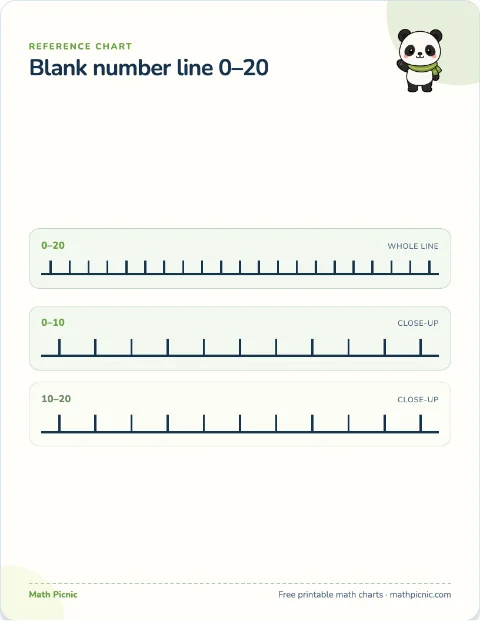 Print Label the ticks, mark a number, or draw equal jumps for an operation.
 - Number bonds to 20
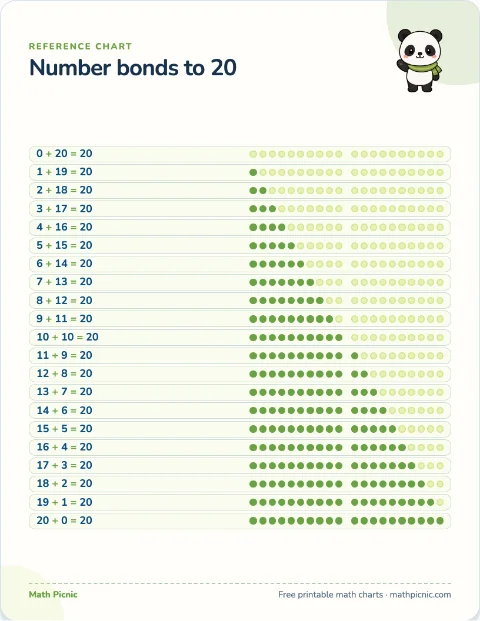 Print Count the two colors in a row and say the pair that makes twenty.
 - Telling the time
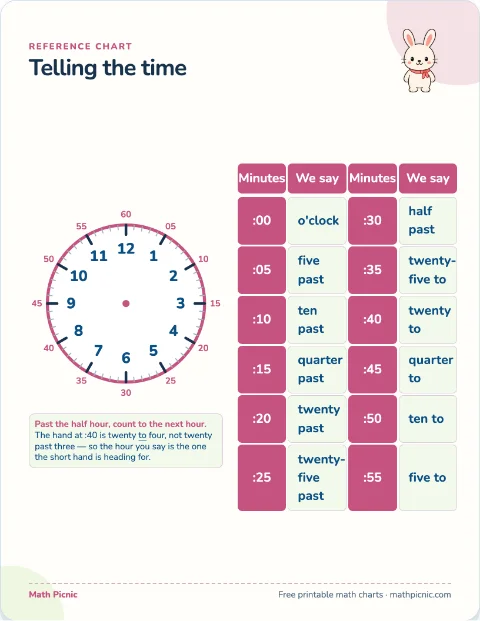 Print Read the hour inside the dial and the minutes printed outside it.
 - Place value chart
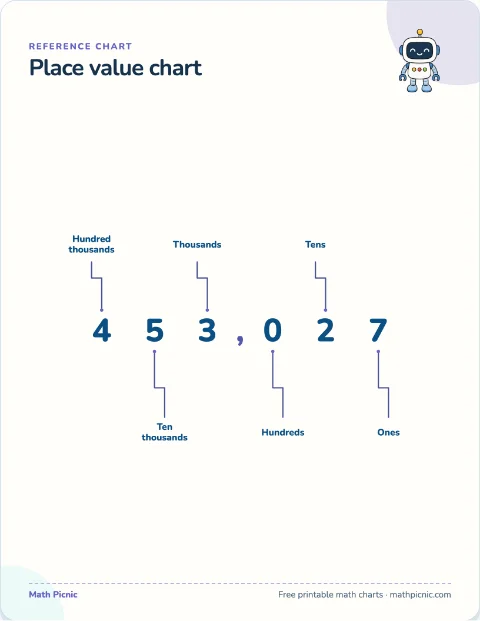 Print Put each digit in its column and read what that digit is worth.
 - Blank place value chart
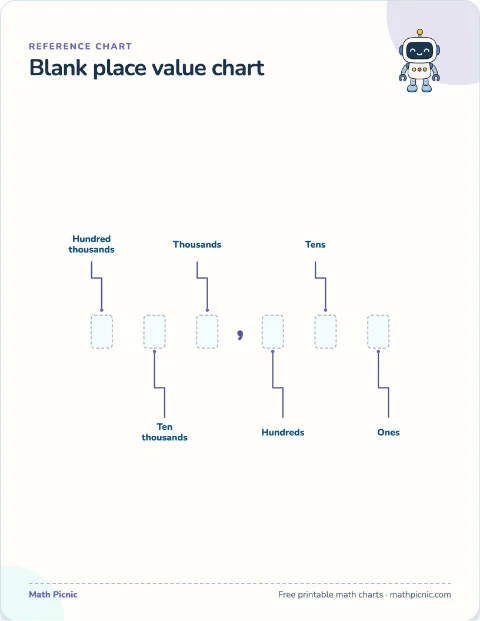 Print Write one digit in each box, then use the leader lines to name its place.
 - Fraction wall
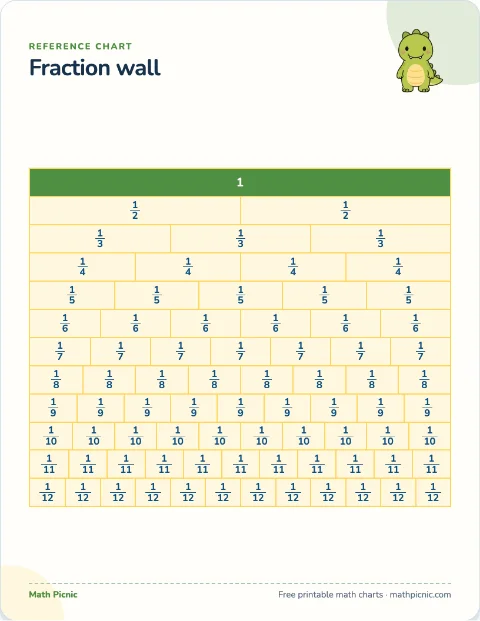 Print Line two rows up to see which fractions are the same width.
 - Rainbow fraction wall
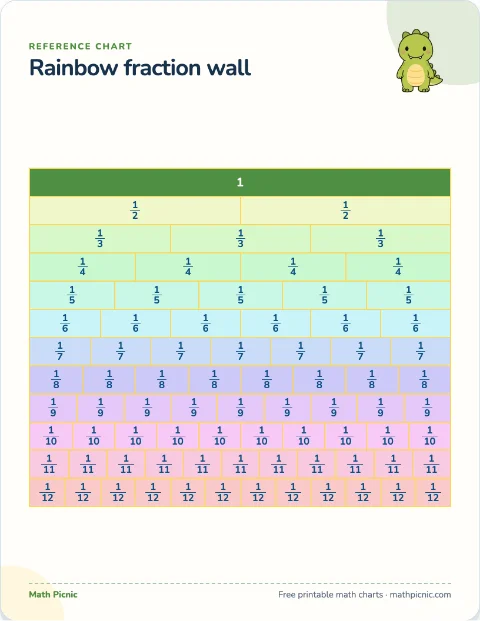 Print Follow the shared cut lines to spot equivalent fractions across colored rows.
 - Decimal place value
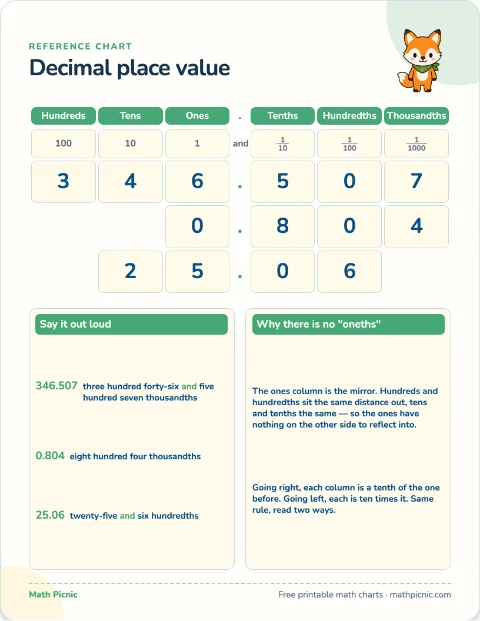 Print Place a digit in its column and read what the digit is worth.
 - Fraction, decimal & percent
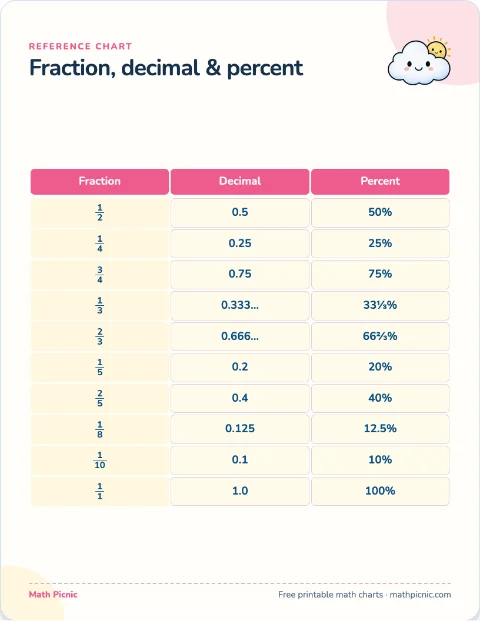 Print Swap the same amount between a fraction, a decimal, and a percent.
 - The coordinate plane
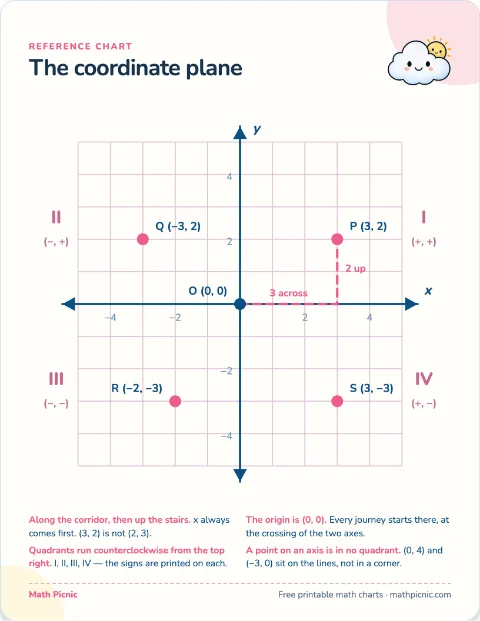 Print Read across first, then up. The dashed line shows the journey for (3, 2).
 - Pascal's triangle
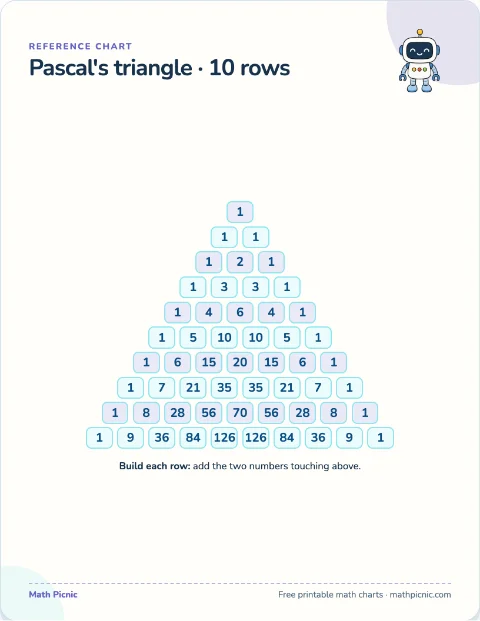 Print Add each touching pair to build the number directly below them.
 - Mean, median, mode and range
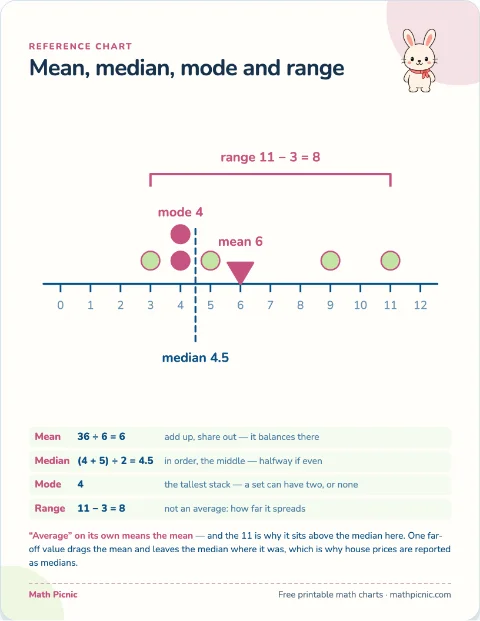 Print Find the word the question used, then follow that row.
 - How to read each graph
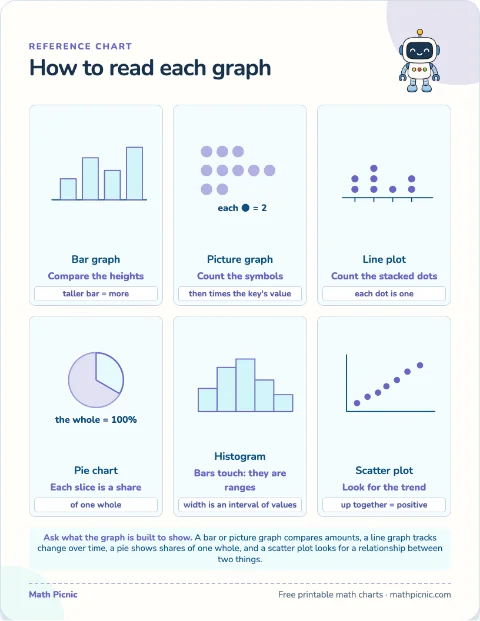 Print Find the kind of graph, then follow the one rule that reads it.
 - Percent
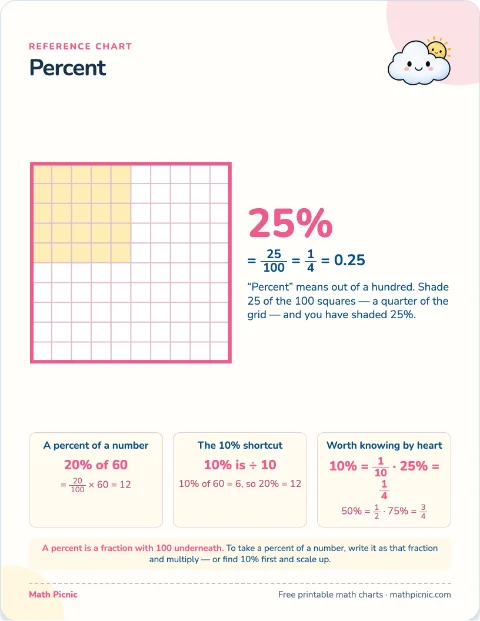 Print Read a percent off the hundred grid, then turn it into a fraction to use it.
 - Ratio and proportion
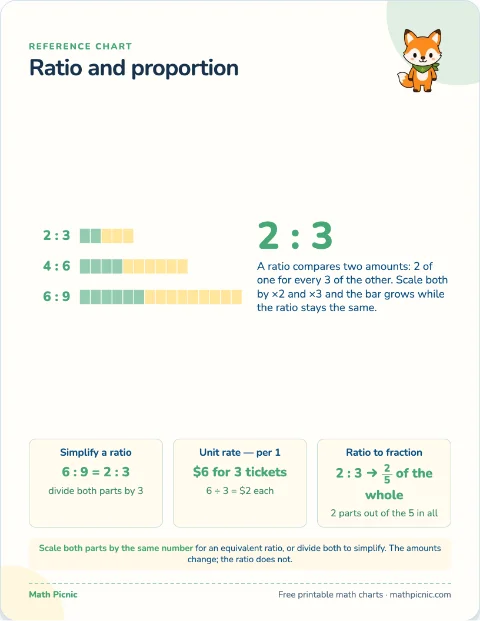 Print Read the two-color bar as a ratio, then scale both parts to match a problem.
 - Inequalities on a number line
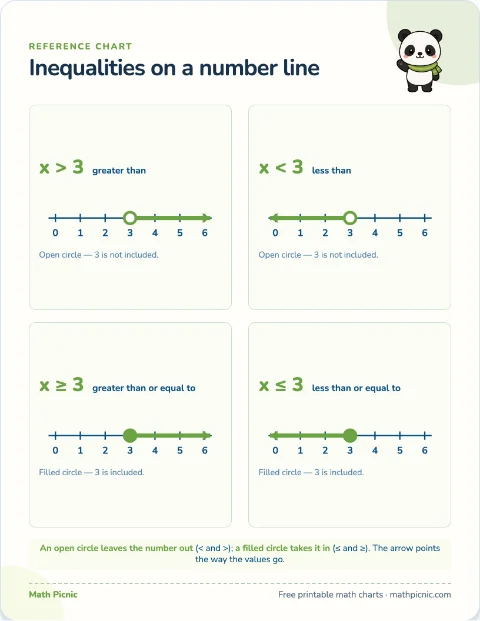 Print Read the circle and the arrow: open leaves the number out, filled takes it in.
 - Probability
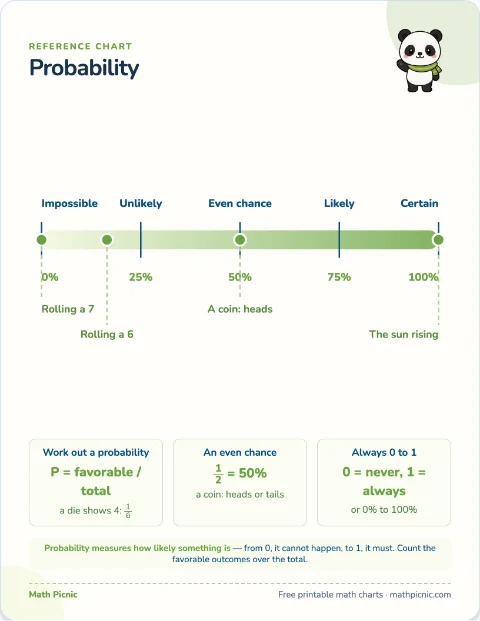 Print Find how likely an event is as a place on the line from 0 to 1.
 - Slope and y-intercept
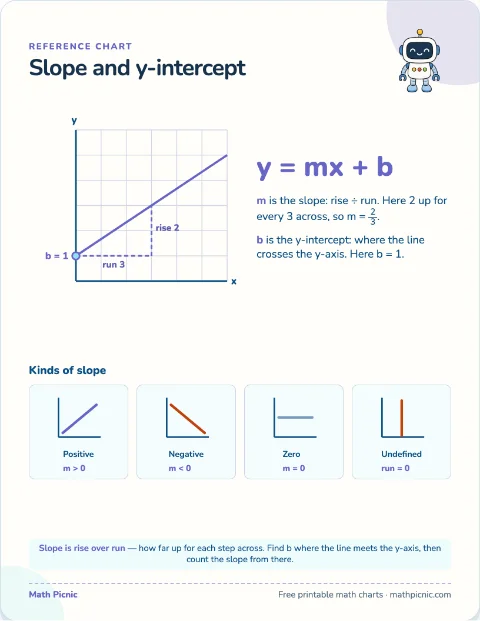 Print Read b where the line crosses the y-axis, then count the slope as rise over run.
Remember the method
Charts for remembering how
Not a number to find but a sentence to follow — the step that goes missing between the lesson and the homework.- Rounding rules
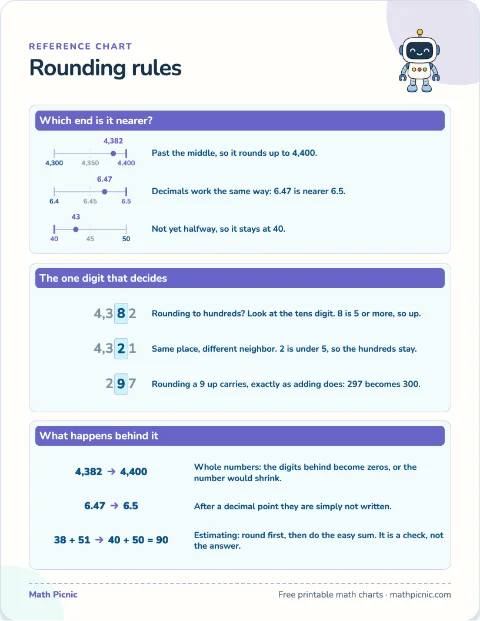 Print Find the place, look at the digit beside it, then decide.
 - Properties of operations
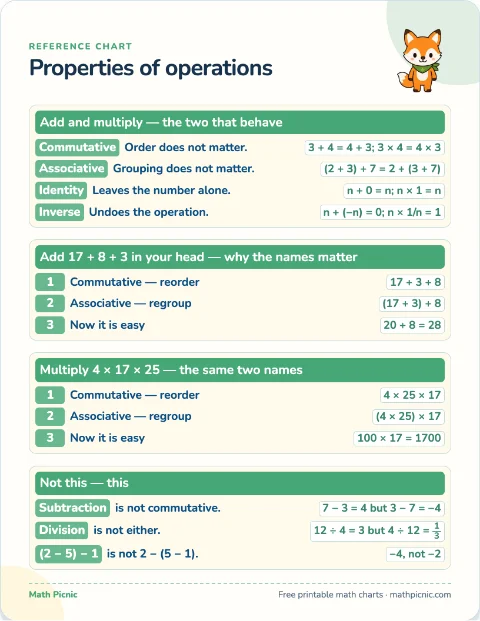 Print Name the property a step used, or find the one that makes a calculation easier.
 - The distributive property
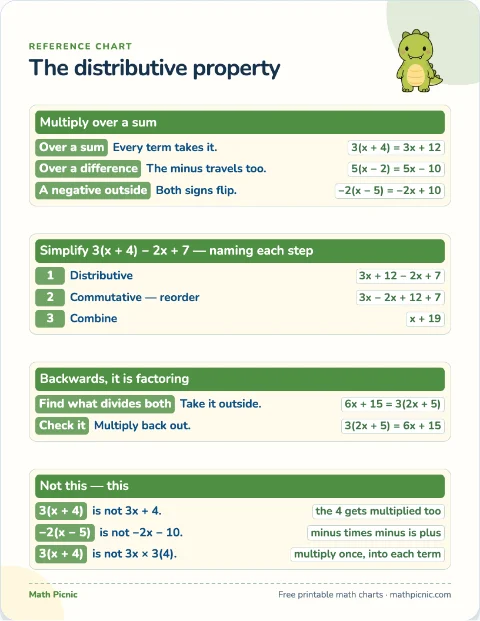 Print Expand a bracket term by term, or read the card backwards to factor.
 - Mental math tricks
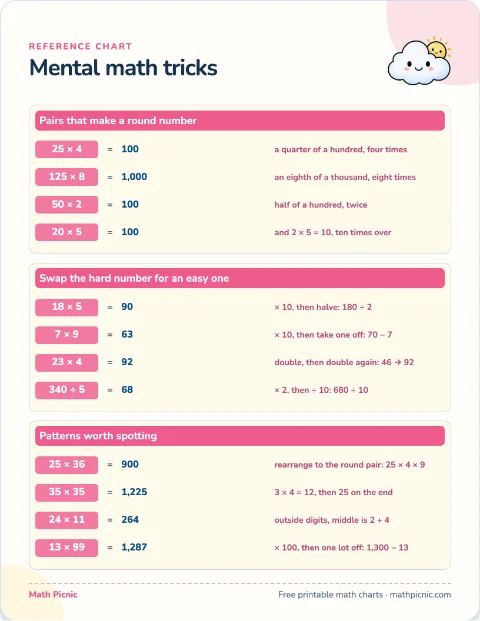 Print Swap the hard number for an easy one before you start calculating.
 - Divisibility rules
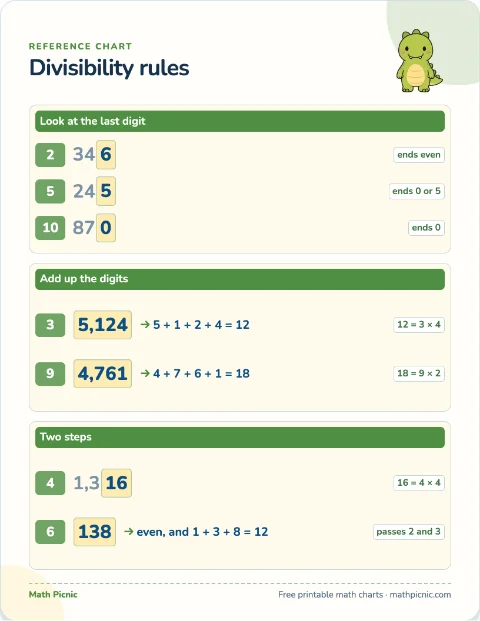 Print Run one quick test in their head instead of starting a division.
 - Fraction rules
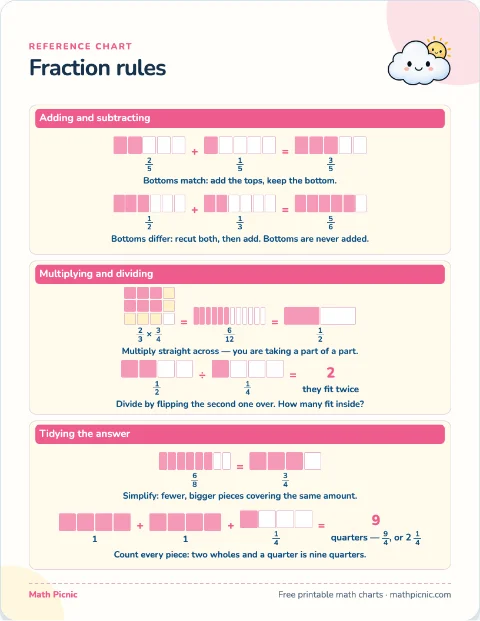 Print Check a fraction answer against the rule before doing the arithmetic.
 - Measurement conversions
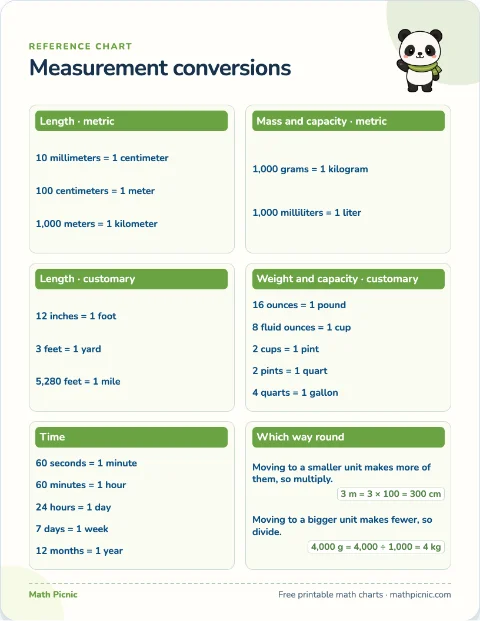 Print Look the conversion up, then decide whether to multiply or divide.
 - Order of operations
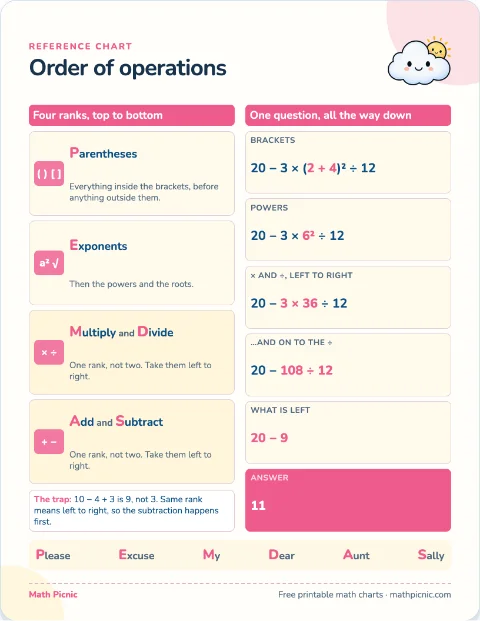 Print Work down the ranks, taking each one left to right before the next.
 - Positive and negative numbers
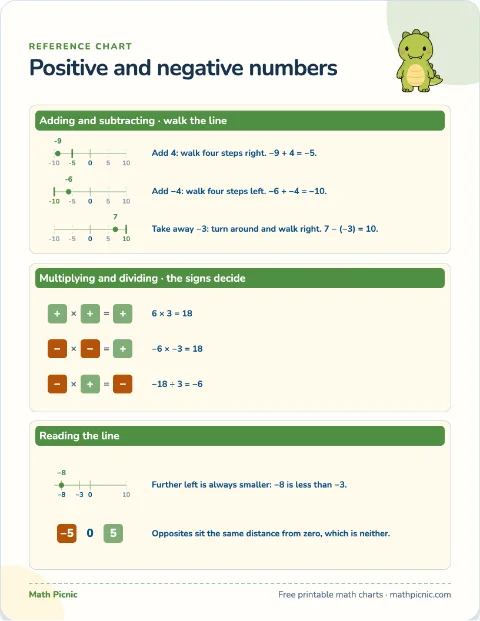 Print Check which operation you are doing before deciding the answer's sign.
 - Laws of exponents
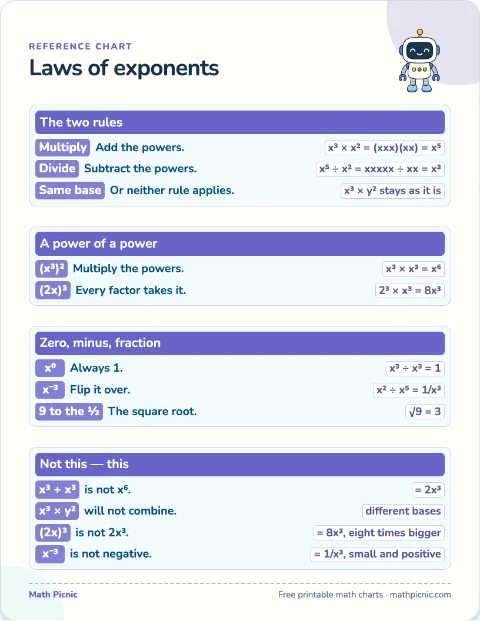 Print Find the operation you have, and the example shows where the rule comes from.
 - Scientific notation
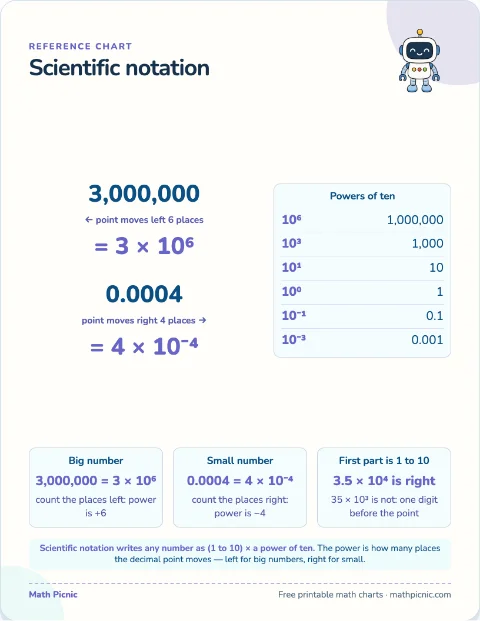 Print Move the decimal point to a number between 1 and 10, then count the places as the power.
 - Solving equations
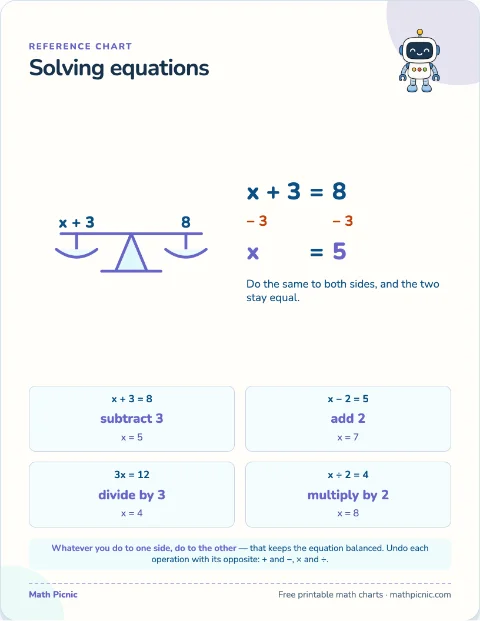 Print Do the same to both sides, undoing each operation with its opposite.
 - Adding and multiplying probabilities
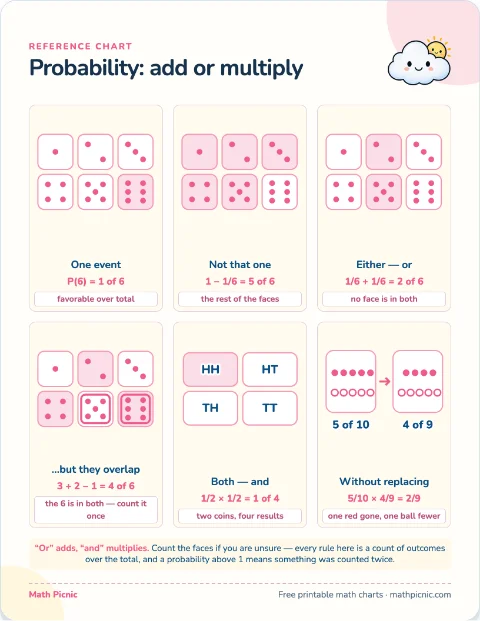 Print Find the word in the question — or, and — then use the operation printed beside it.
Read the drawing
Charts for understanding geometry
Names, relationships and measurements belong on the figures that make them true, so every rule here is drawn rather than merely stated.- Naming 2D shapes
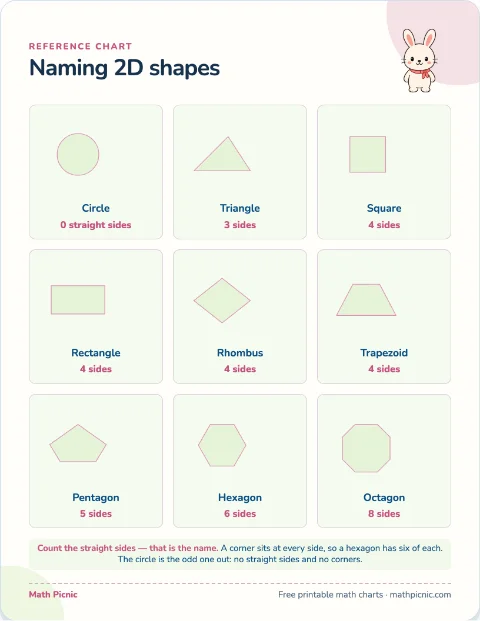 Print Count the straight sides on a shape, then read its name below it.
 - Quadrilateral family
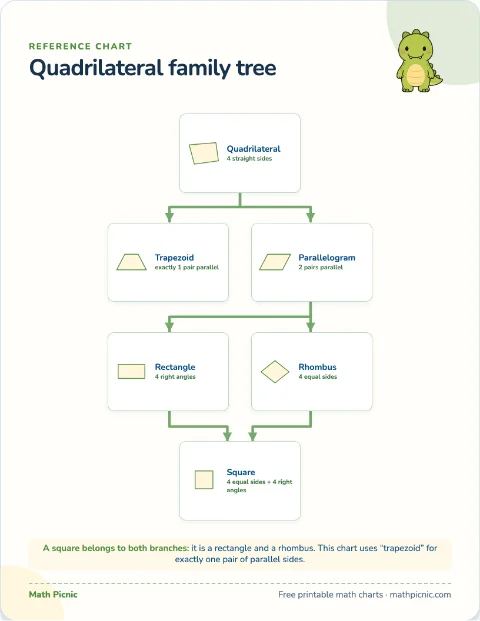 Print Follow the branches to see which names a shape inherits.
 - Lines of symmetry
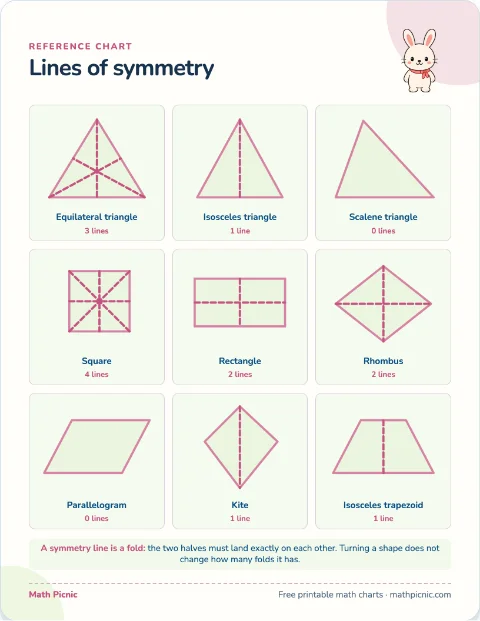 Print Fold each shape in your mind and count the matching halves.
 - Types of angles
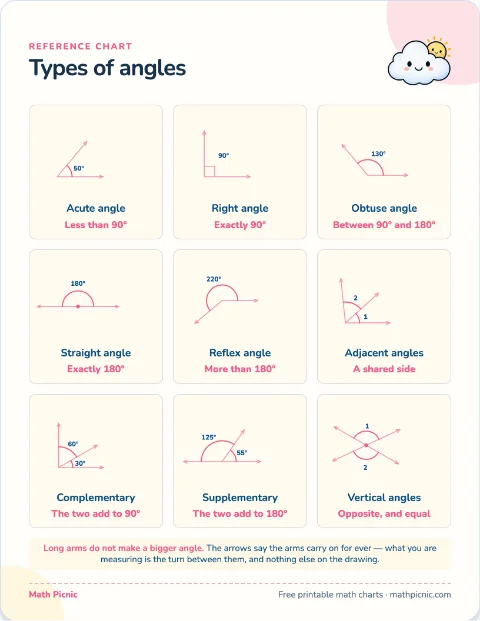 Print Find the picture that matches yours, and the name is under it.
 - Angles in parallel lines
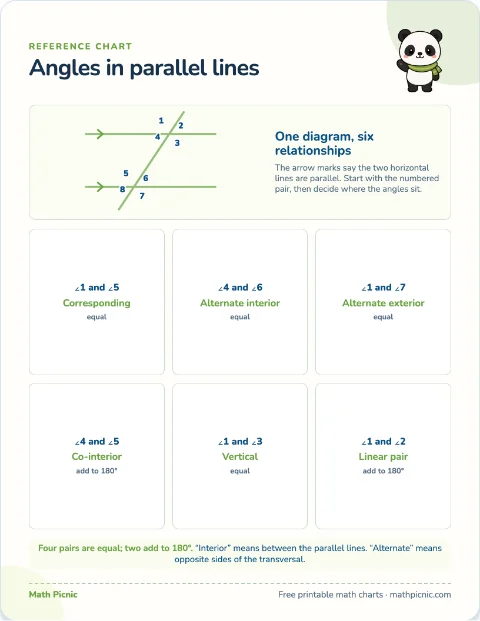 Print Match each numbered pair to its position around the transversal.
 - Perimeter formulas
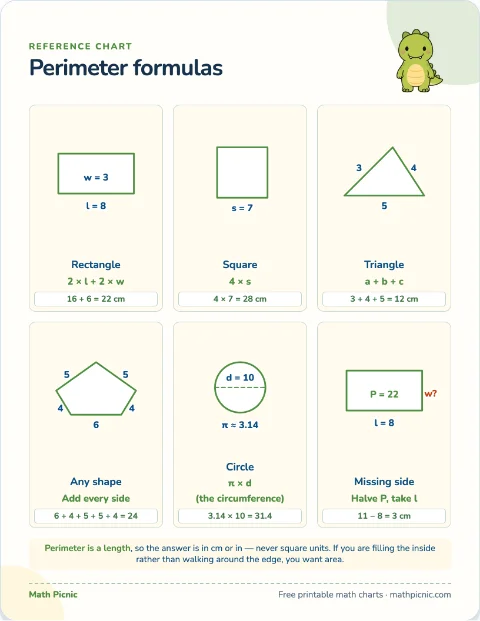 Print Follow the traced edge on the figure, then read the formula under it.
 - Area formulas
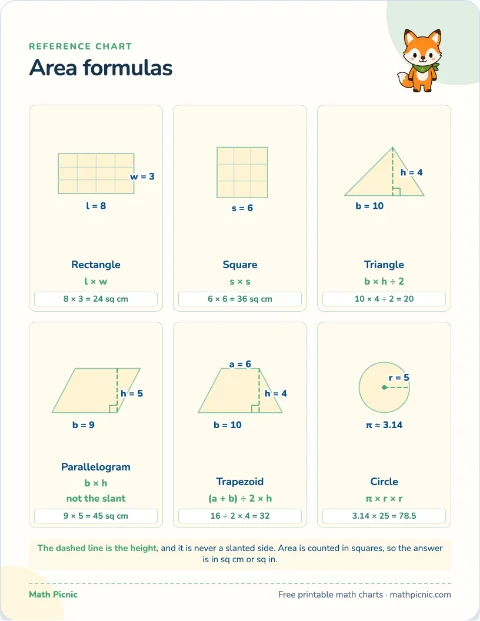 Print Match your shape to a figure and use the letters drawn on it.
 - Volume formulas
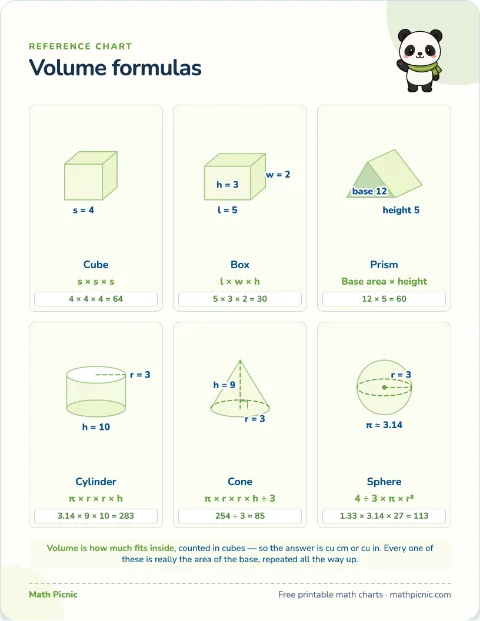 Print Find your solid, then multiply the base area by how tall it stands.
 - Surface area formulas
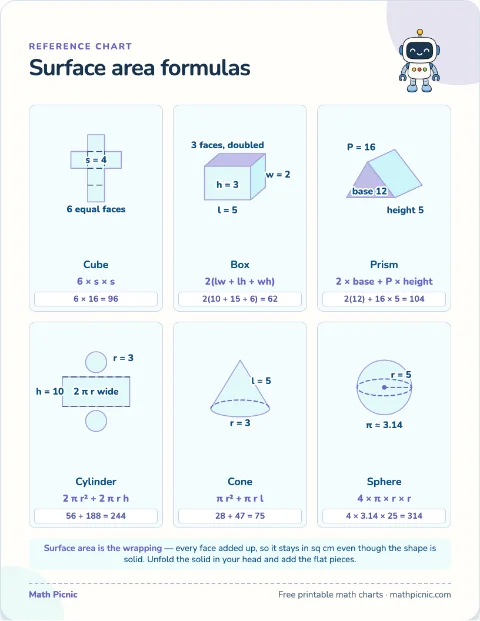 Print Unfold the solid in your head and add up every flat face.
 - Parts of a circle
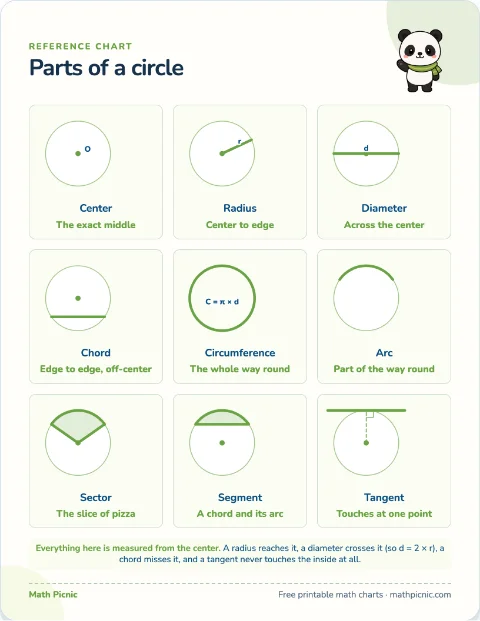 Print Find the picture that matches the line or the region you have, and the name is under it.
 - Faces, edges and vertices
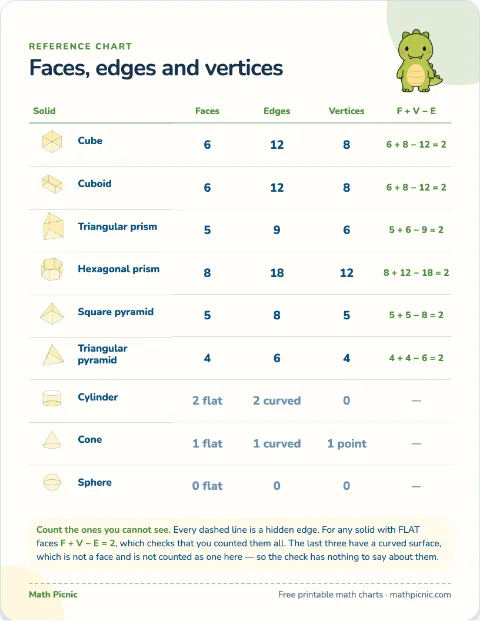 Print Find your solid, and the three counts are under it. Add them up to check.
 - The Pythagorean theorem
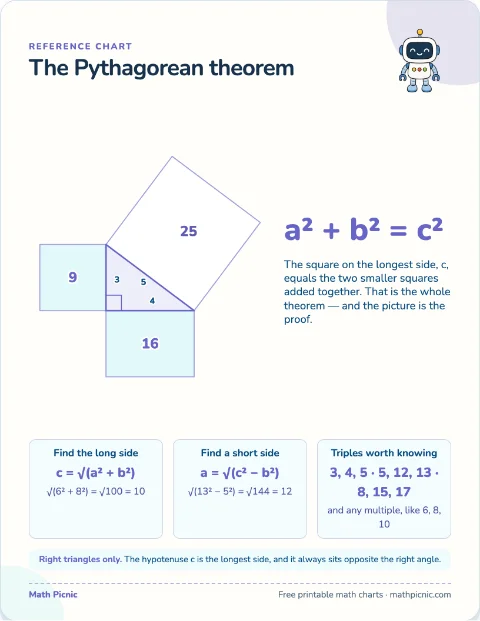 Print Read the squares on the sides: the two small ones add to the large one.
 - Transformations
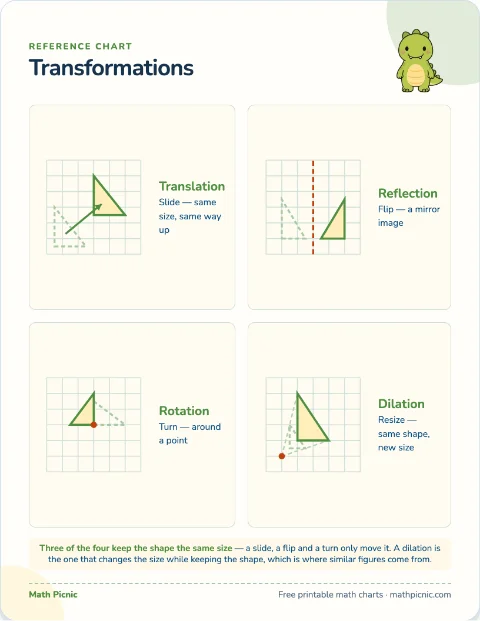 Print Match your move to a panel: slide, flip, turn, or resize the shape on the grid.
 - Triangle angle facts
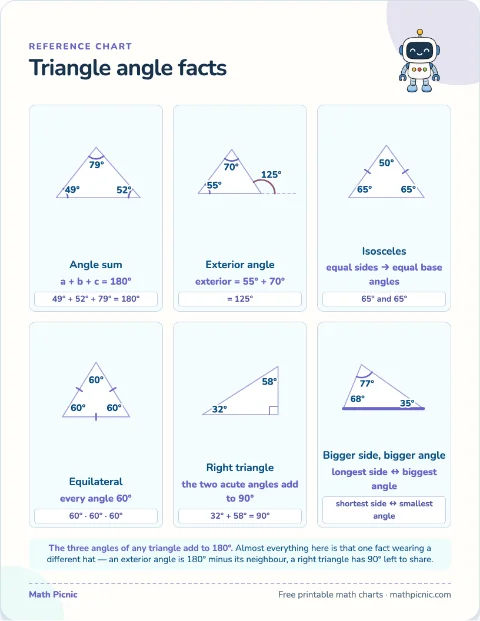 Print Find the fact, then read the angles off the triangle it is drawn on.
 - Congruence & similarity
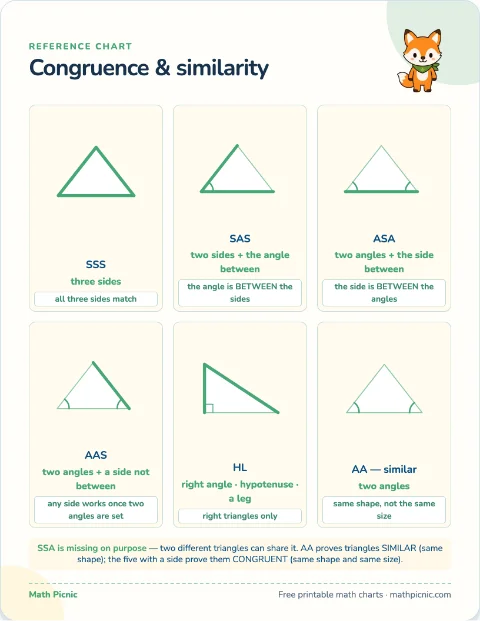 Print Match the parts you are given to the rule that names them.
 - Circle theorems
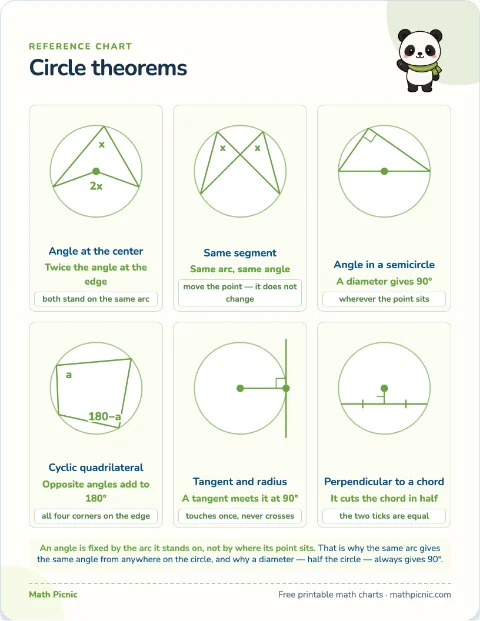 Print Find the drawing that matches the question, then read the rule printed under it.
Trigonometry
Charts for trigonometry
The high-school strand where a ratio of two sides, or a point on a circle, does the work. Print these when SOH CAH TOA and the unit circle first appear.- Trig ratios (SOH CAH TOA)
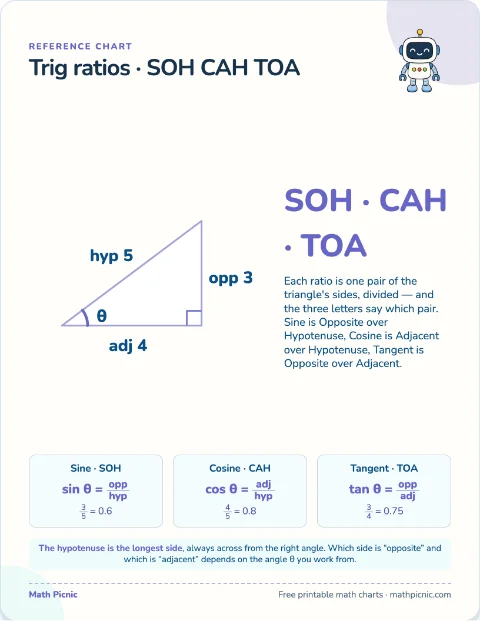 Print Match the angle to two sides, then read off the ratio.
 - Exact trig values
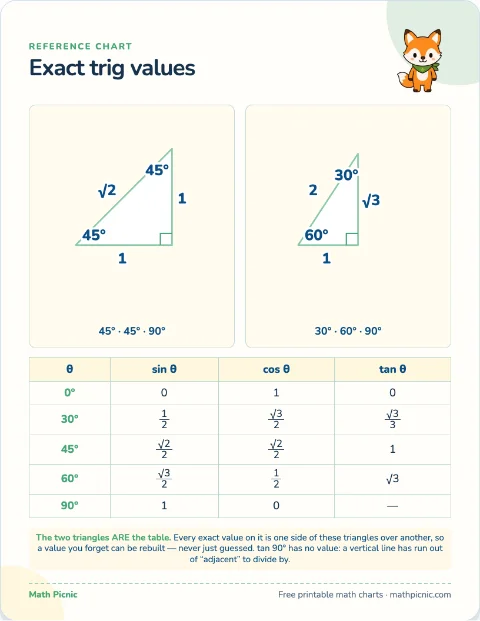 Print Read the value from the row for that angle.
 - Unit circle
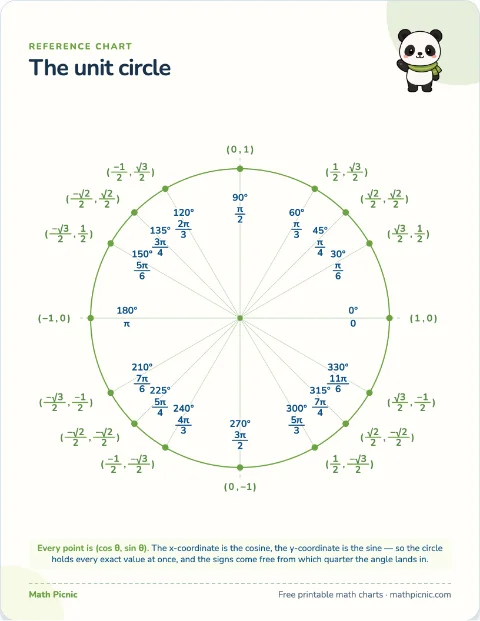 Print Find the angle, then read the point it lands on.
 - Radians and degrees
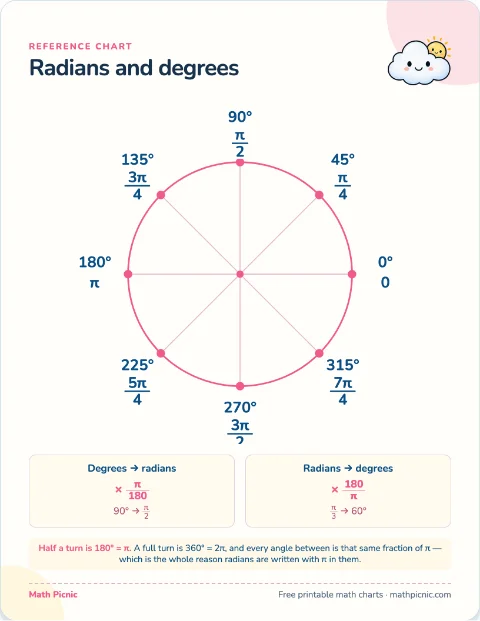 Print Find the degrees and read the radians beside them.
 - Law of sines and cosines
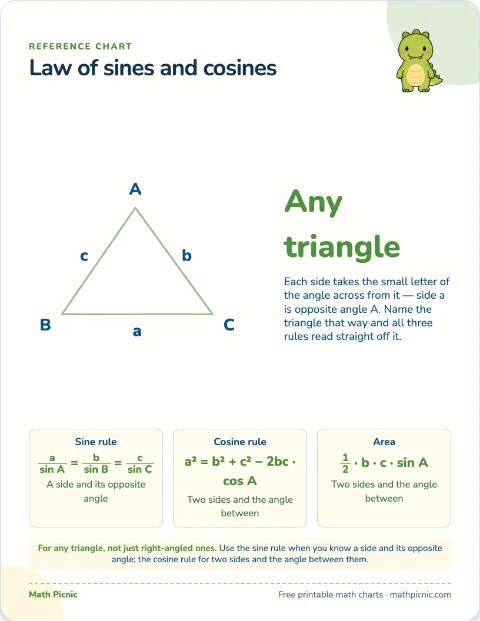 Print Pick the rule that fits the sides and angles known.
Algebra & functions
Charts for algebra and functions
The methods a first algebra course keeps reaching for — factoring, the quadratic formula, solving a system, and reading a function four ways.- The quadratic formula
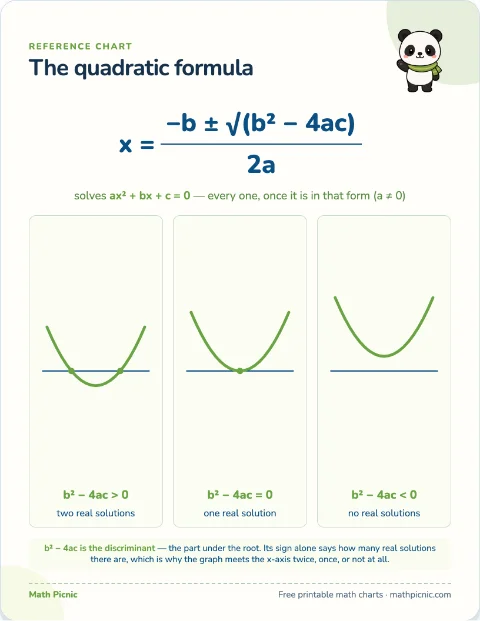 Print Put the equation in standard form, then read a, b and c into the formula.
 - Factoring patterns
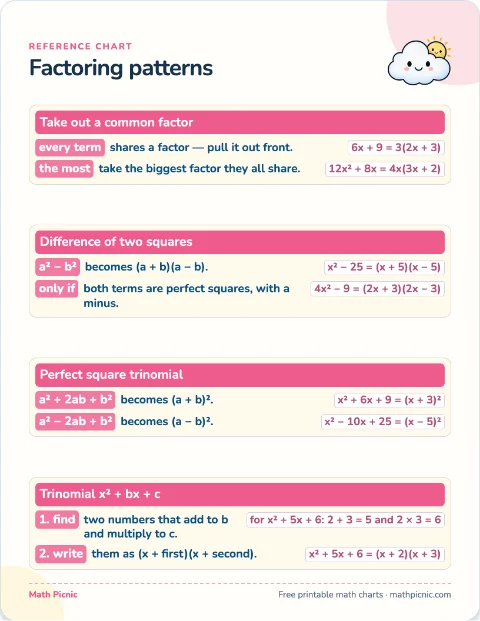 Print Spot which pattern the expression fits, then read the factors off it.
 - Solving systems
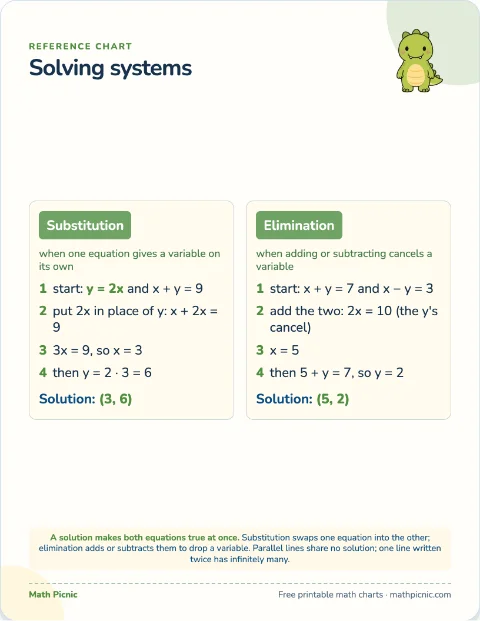 Print Pick the method that fits, then follow the worked steps beside it.
 - Function notation
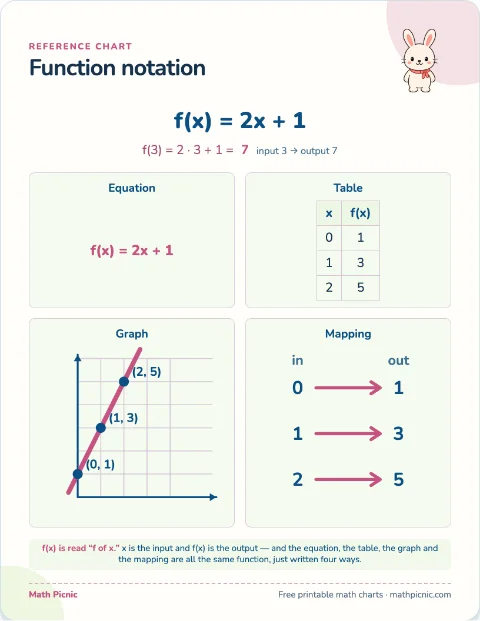 Print Read the same function across its equation, table, graph and mapping.
 - Laws of logarithms
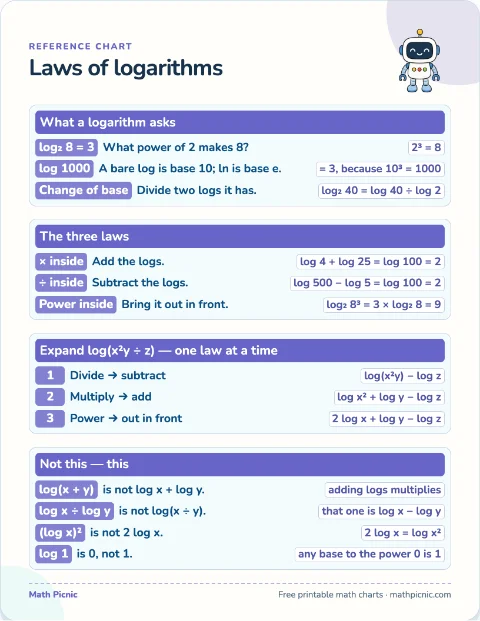 Print Match what is inside the log to a law, then follow the numbered expansion.
Keep it close while a skill is new
Use a chart to look up a fact, then move to a worksheet when your child is ready to try it without help.
Each chart fits on one Letter or A4 page and works on a wall, desk, or inside a homework folder.
Or build one
Make your own fact list
Pick a kind — fact families, a lookup table, a picture, a rule card, or a shape sheet — then choose the color, the paper, and how far the numbers go. Fact lists can print with the answers taken out, as a page to fill in.