
Area formulas
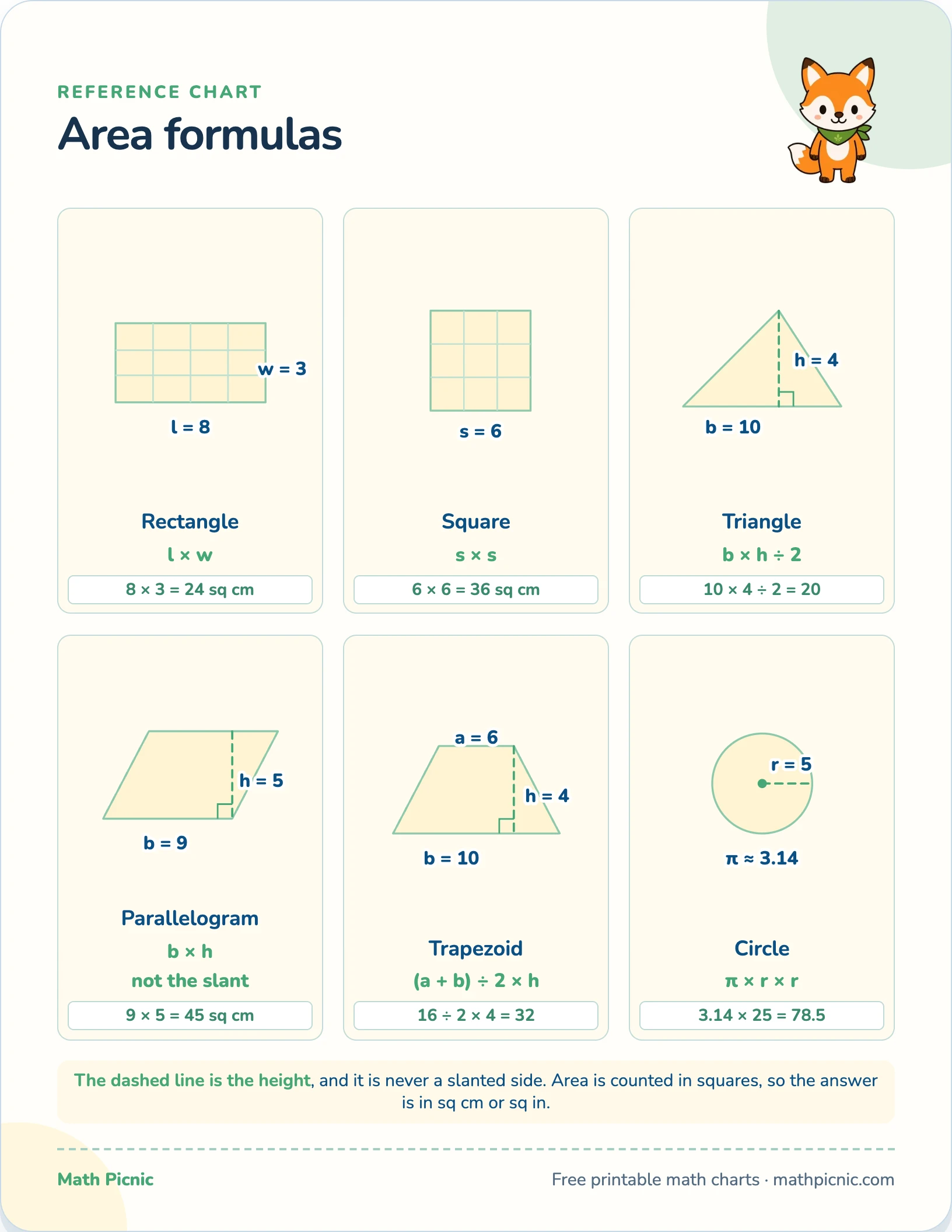
Rectangle, square, triangle, parallelogram, trapezoid, and circle — each one drawn, shaded, and lettered, with the height marked as a dashed line wherever the height is not a side.
Reference chart
Area formulas

Rectangle
l × w
8 × 3 = 24 sq cm
Square
s × s
6 × 6 = 36 sq cm
Triangle
b × h ÷ 2
10 × 4 ÷ 2 = 20
Parallelogram
b × h
not the slant
9 × 5 = 45 sq cm
Trapezoid
(a + b) ÷ 2 × h
16 ÷ 2 × 4 = 32
Circle
π × r × r
3.14 × 25 = 78.5
The dashed line is the height, and it is never a slanted side. Area is counted in squares, so the answer is in sq cm or sq in.
What's on this chart
The dashed line is the reason this page is drawn rather than written. "Base × height, never the slant side" is a true sentence and a useless one: a child staring at a parallelogram with three numbers on it needs to be shown which of the three, and reaching for the slant is the most common area mistake there is after mixing area up with perimeter. A dashed line is visibly not an edge, so it cannot be counted as one.
Why this chart helps
Shading does the other half. Every shape here is filled, and the rectangle and square are ruled into unit squares, because area is the inside — it is how many squares fit, which is what "square centimeters" has been trying to tell a child all along. The perimeter chart leaves its shapes empty for exactly the same reason.
More printable charts
- Naming 2D shapes
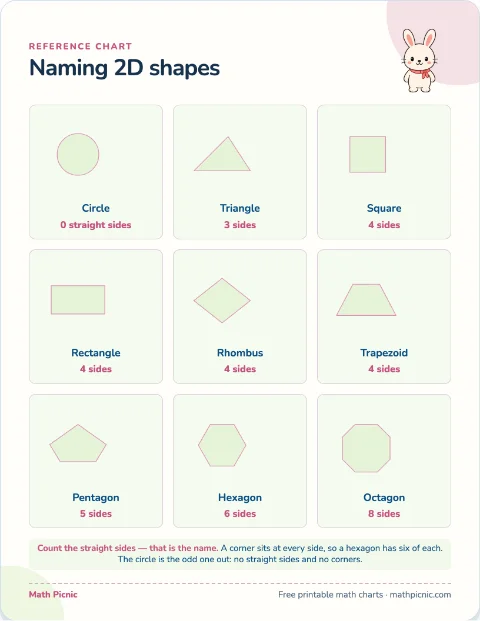 Print Count the straight sides on a shape, then read its name below it.
 - Quadrilateral family
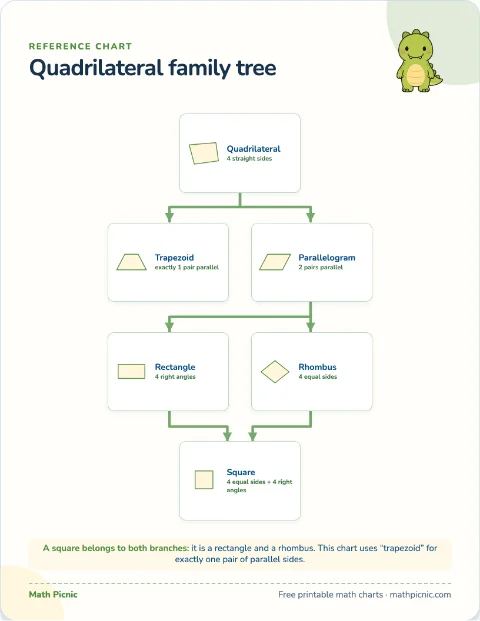 Print Follow the branches to see which names a shape inherits.
 - Lines of symmetry
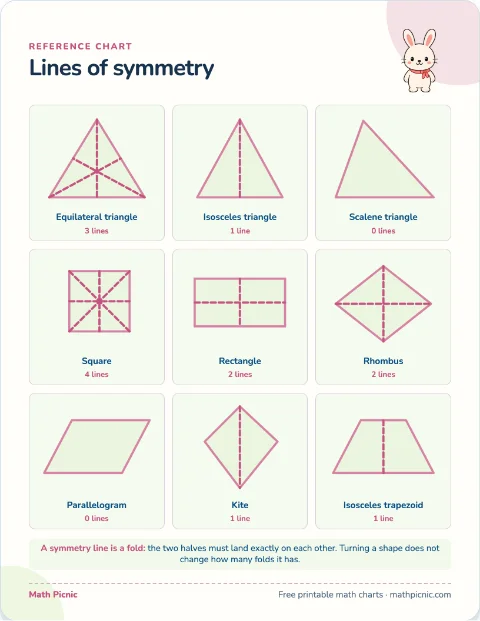 Print Fold each shape in your mind and count the matching halves.
 - Types of angles
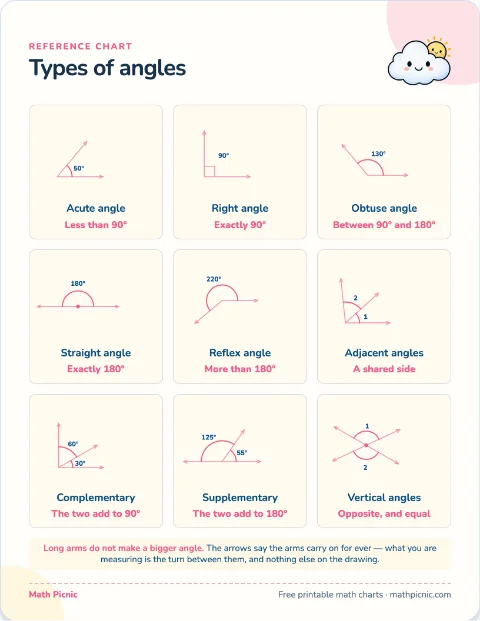 Print Find the picture that matches yours, and the name is under it.
 - Angles in parallel lines
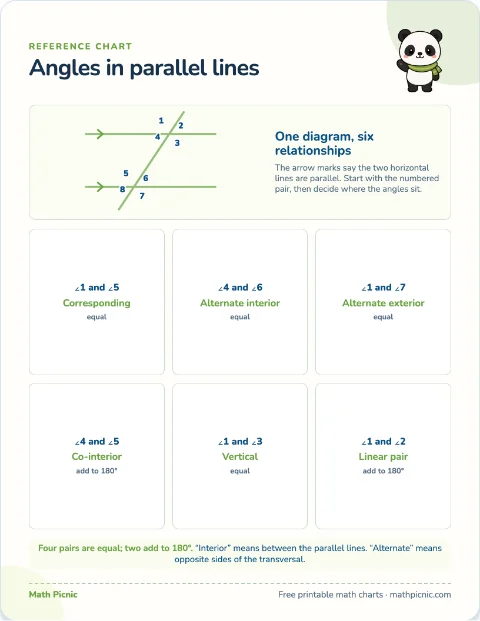 Print Match each numbered pair to its position around the transversal.
 - Perimeter formulas
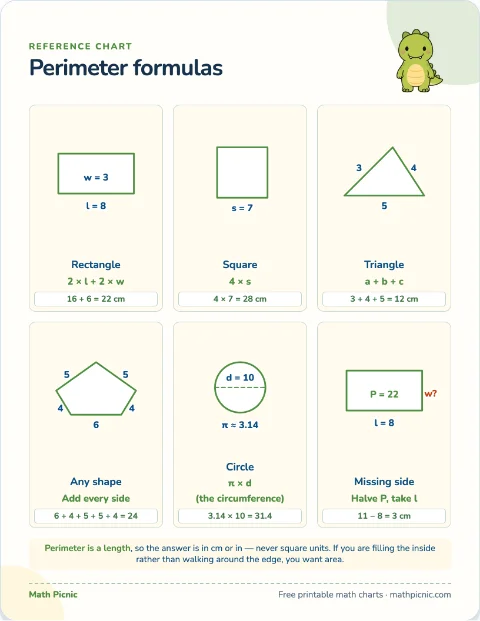 Print Follow the traced edge on the figure, then read the formula under it.
 - Volume formulas
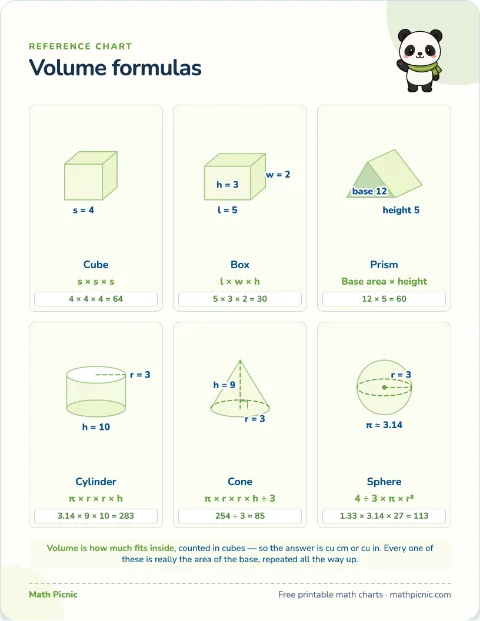 Print Find your solid, then multiply the base area by how tall it stands.
 - Surface area formulas
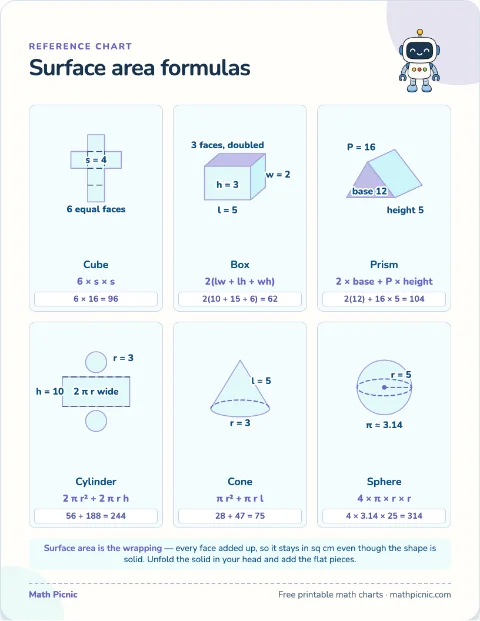 Print Unfold the solid in your head and add up every flat face.