
Naming 2D shapes
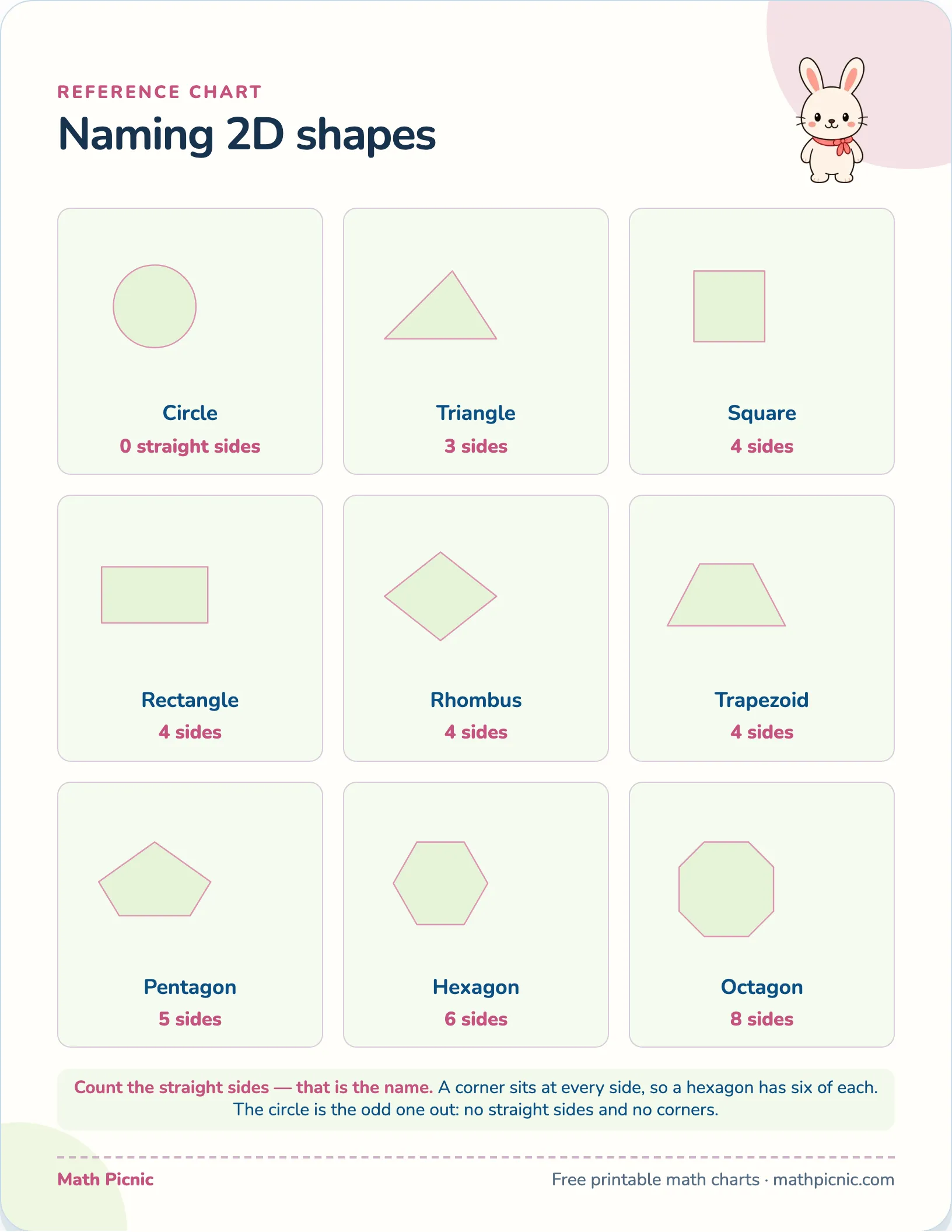
Nine flat shapes, each drawn and named, with the one fact that names it printed underneath — how many straight sides it has. A child does not recall a pentagon; they count five sides and find it.
Reference chart
Naming 2D shapes

Circle
0 straight sides
Triangle
3 sides
Square
4 sides
Rectangle
4 sides
Rhombus
4 sides
Trapezoid
4 sides
Pentagon
5 sides
Hexagon
6 sides
Octagon
8 sides
Count the straight sides — that is the name. A corner sits at every side, so a hexagon has six of each. The circle is the odd one out: no straight sides and no corners.
What's on this chart
Naming a shape is really counting, and this chart is built so it can be done that way. Every figure is drawn with its sides there to be counted and the count written beneath it, so the word arrives after a child has found the shape rather than before. Three straight sides is a triangle, four is a quadrilateral, five a pentagon, six a hexagon, eight an octagon — one rule read off the page instead of a list learned by heart.
Why this chart helps
The circle is kept on the page because it is the shape that breaks the rule: no straight sides and no corners at all, only one curved edge, and seeing it beside the others is what makes the word “side” mean something. The four-sided shapes are the other place to slow down — square, rectangle, rhombus, and trapezoid all have four sides, so the count alone does not tell them apart. The drawing does, and the quadrilateral family chart is where that difference becomes a rule.
More printable charts
- Quadrilateral family
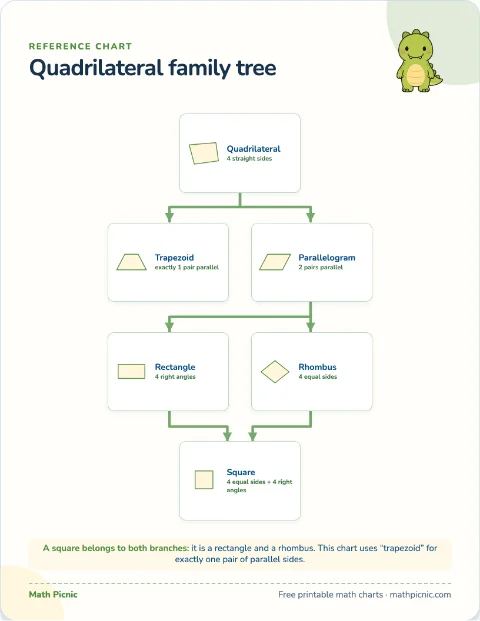 Print Follow the branches to see which names a shape inherits.
 - Lines of symmetry
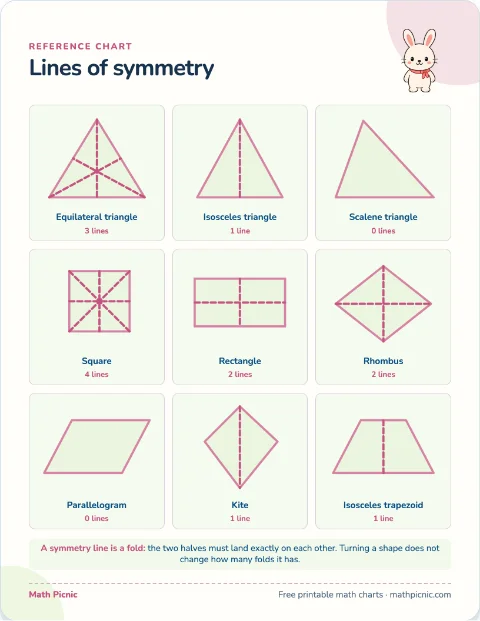 Print Fold each shape in your mind and count the matching halves.
 - Types of angles
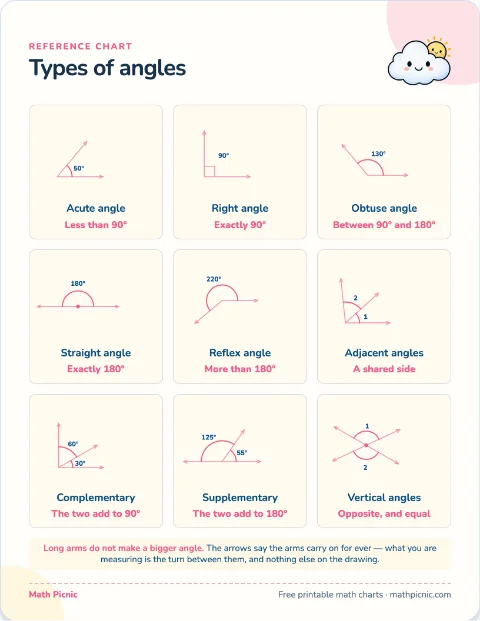 Print Find the picture that matches yours, and the name is under it.
 - Angles in parallel lines
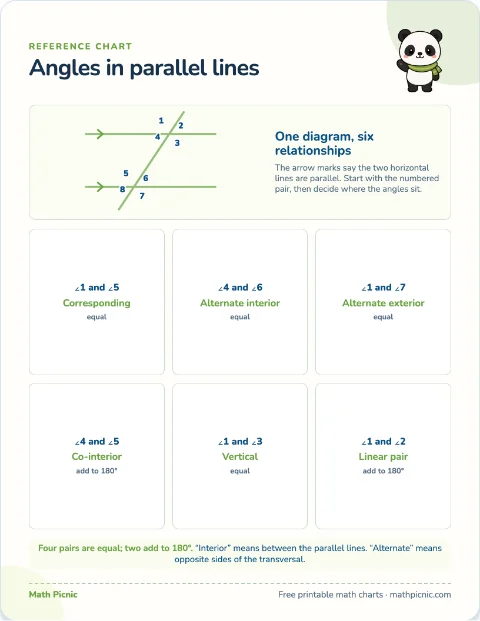 Print Match each numbered pair to its position around the transversal.
 - Perimeter formulas
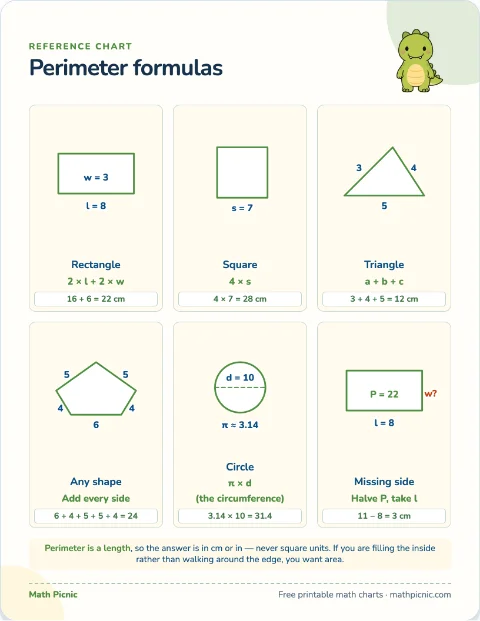 Print Follow the traced edge on the figure, then read the formula under it.
 - Area formulas
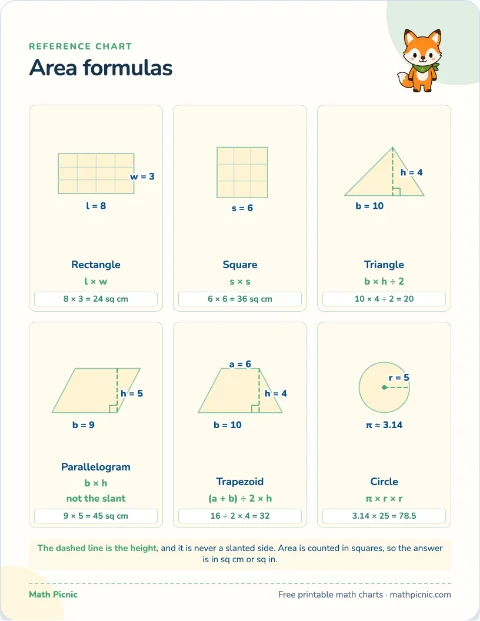 Print Match your shape to a figure and use the letters drawn on it.
 - Volume formulas
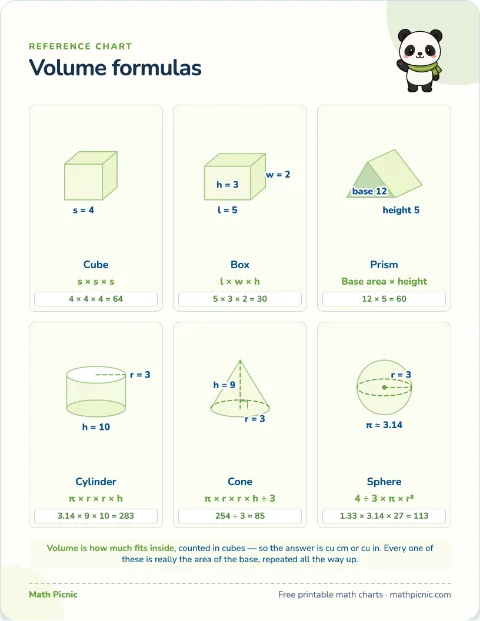 Print Find your solid, then multiply the base area by how tall it stands.
 - Surface area formulas
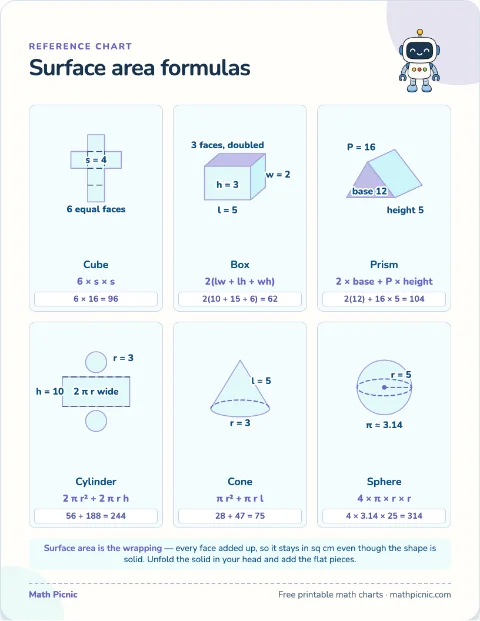 Print Unfold the solid in your head and add up every flat face.