
Types of angles
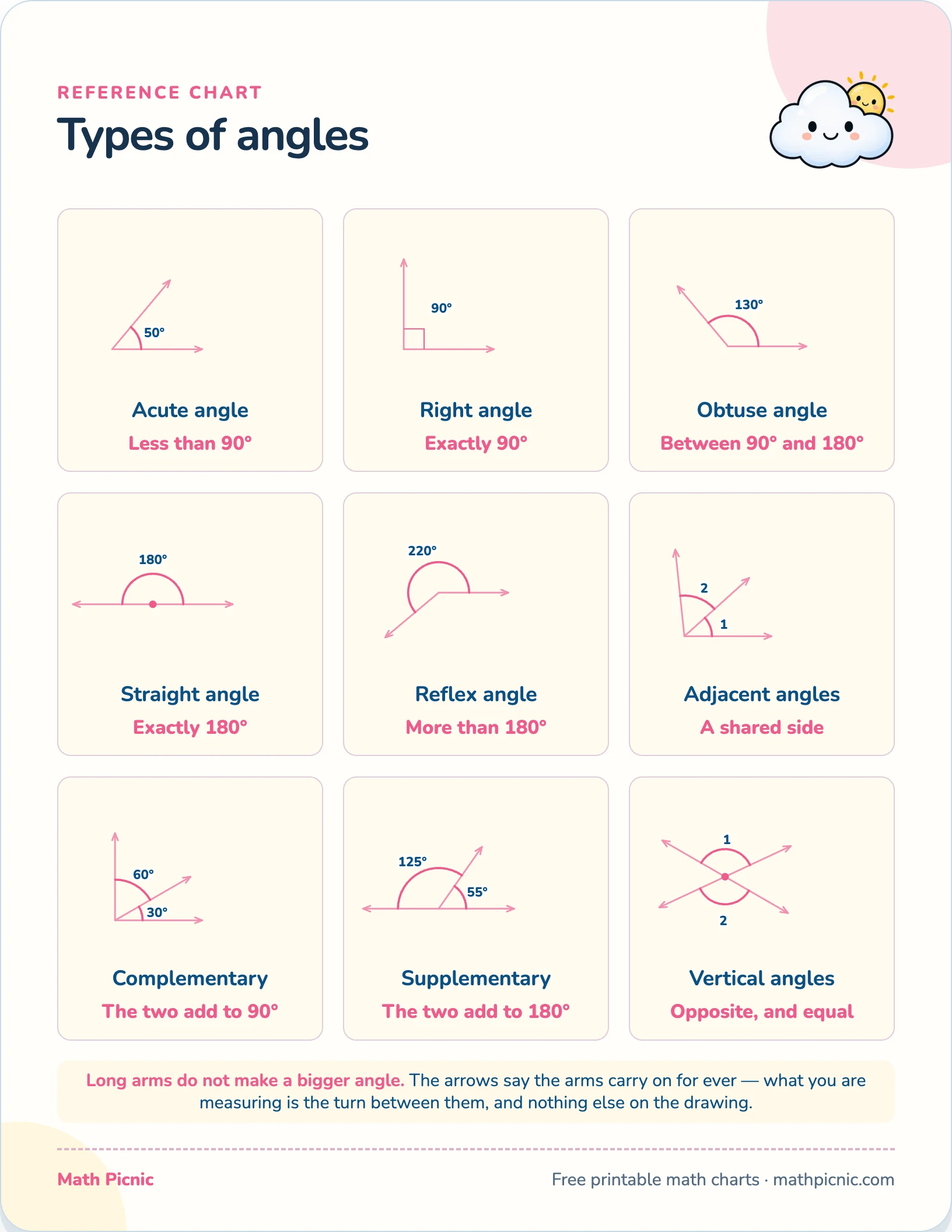
Acute, right, obtuse, straight and reflex, then the four names for how two angles sit together — each one drawn with its arms as rays and its turn marked.
Reference chart
Types of angles

Acute angle
Less than 90°
Right angle
Exactly 90°
Obtuse angle
Between 90° and 180°
Straight angle
Exactly 180°
Reflex angle
More than 180°
Adjacent angles
A shared side
Complementary
The two add to 90°
Supplementary
The two add to 180°
Vertical angles
Opposite, and equal
Long arms do not make a bigger angle. The arrows say the arms carry on for ever — what you are measuring is the turn between them, and nothing else on the drawing.
What's on this chart
The five sizes are one fact each and a child can hold them in a morning: less than 90°, exactly 90°, between 90° and 180°, exactly 180°, more than 180°. What makes them worth a wall chart is that the words arrive before the protractor does. A question that says "is this angle acute or obtuse" is asking for a judgement by eye against a right angle, and a page where all five sit side by side is what that judgement gets built from.
Why this chart helps
Every arm on this page ends in an arrowhead, and that is the one drawing decision here worth defending. The commonest mistake with angles at this age is not arithmetic — it is believing that the angle with the longer lines is the bigger one. An arm that stops is a line segment and invites the comparison; an arrow says the arm runs on for ever, so there is nothing to compare but the turn itself. Two angles of 40° drawn at different scales are the same angle, and the arrows are what make that visible without saying it.
More printable charts
- Naming 2D shapes
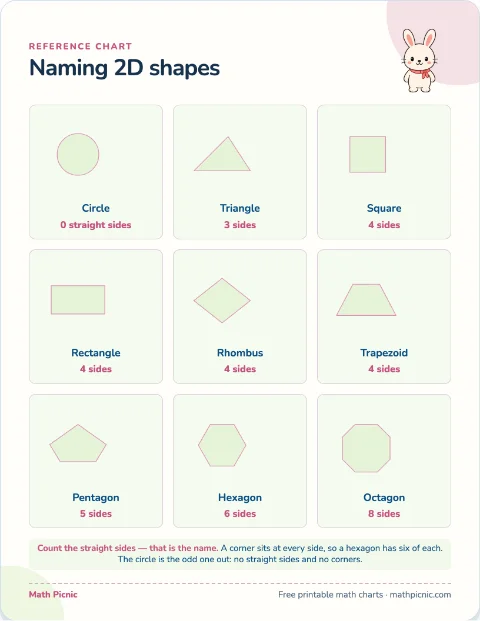 Print Count the straight sides on a shape, then read its name below it.
 - Quadrilateral family
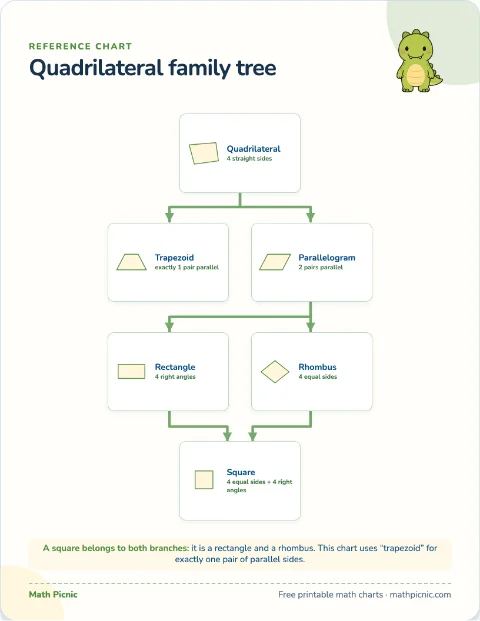 Print Follow the branches to see which names a shape inherits.
 - Lines of symmetry
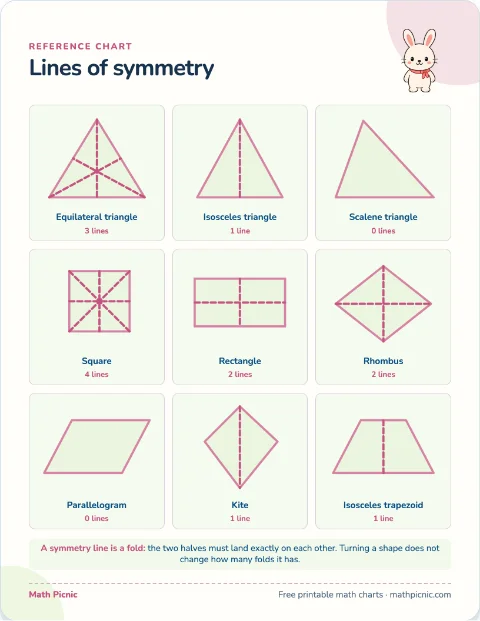 Print Fold each shape in your mind and count the matching halves.
 - Angles in parallel lines
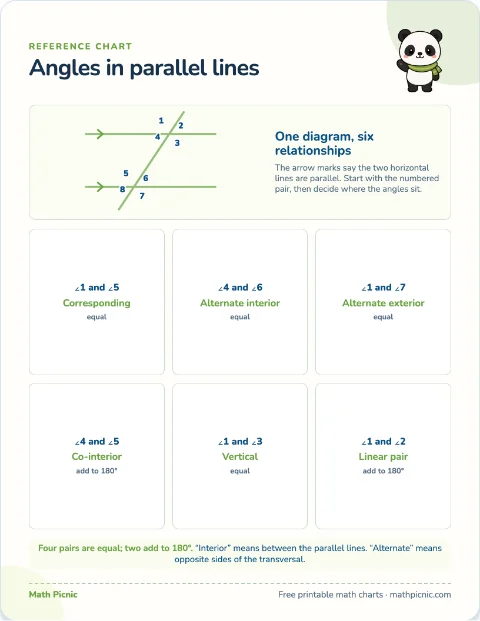 Print Match each numbered pair to its position around the transversal.
 - Perimeter formulas
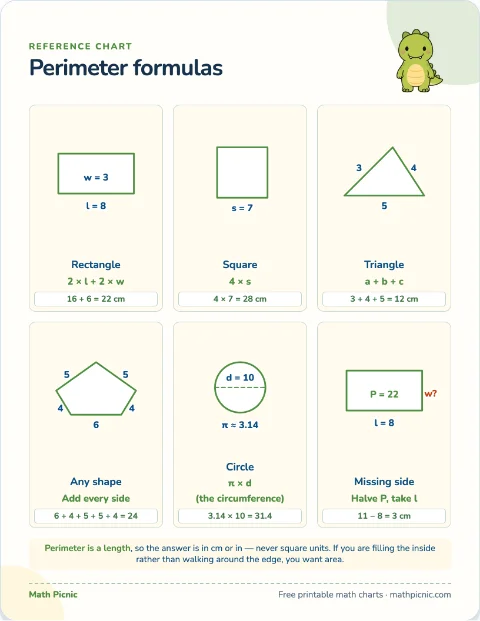 Print Follow the traced edge on the figure, then read the formula under it.
 - Area formulas
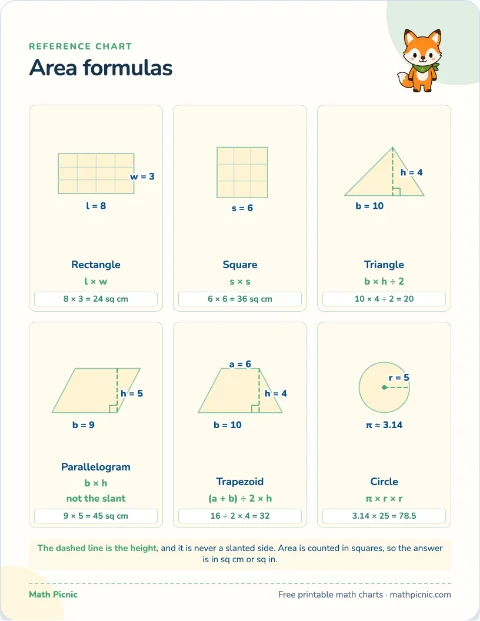 Print Match your shape to a figure and use the letters drawn on it.
 - Volume formulas
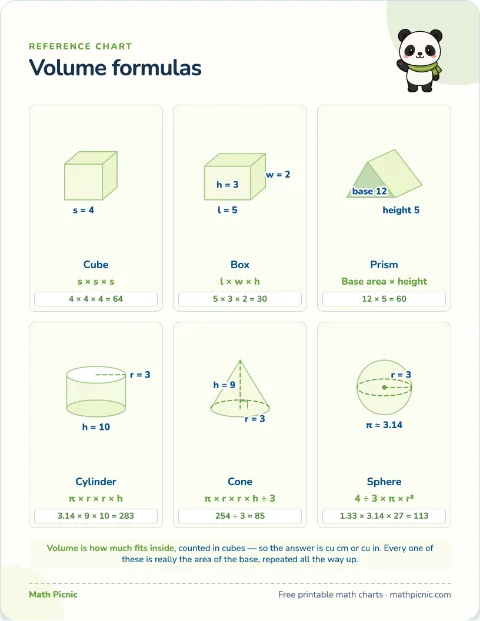 Print Find your solid, then multiply the base area by how tall it stands.
 - Surface area formulas
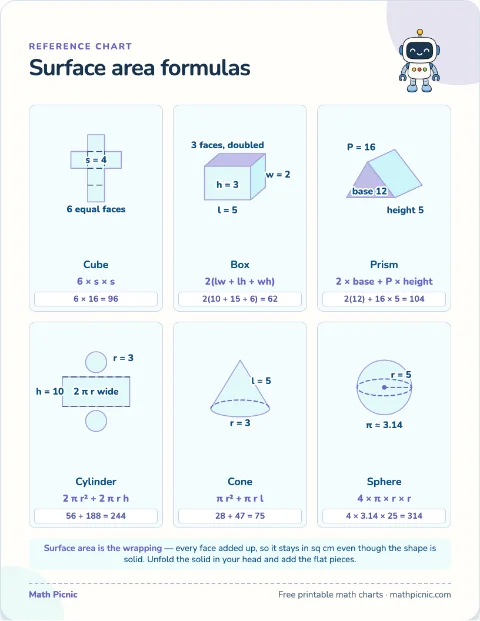 Print Unfold the solid in your head and add up every flat face.