
Angles in parallel lines
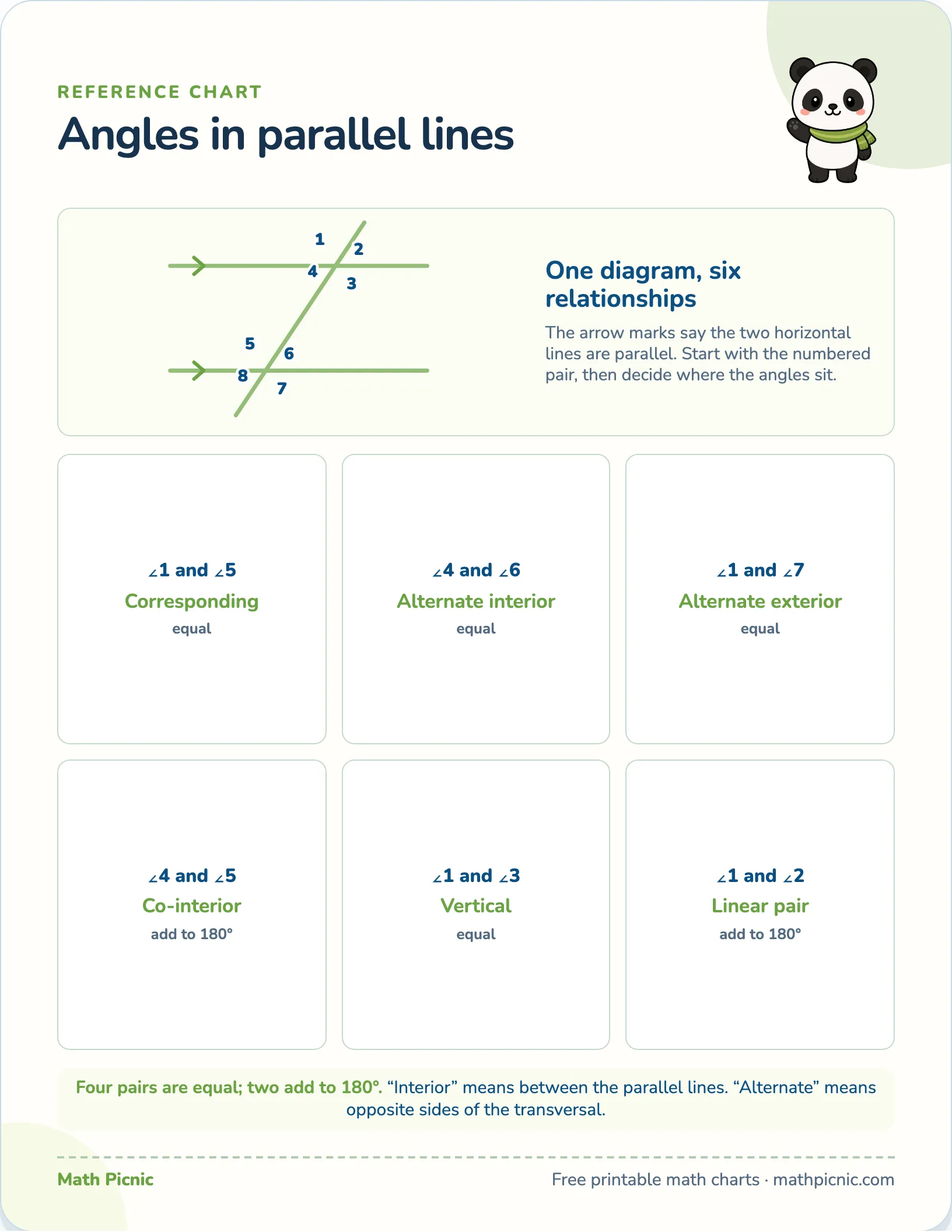
One transversal, eight numbered angles, and the six relationships a child needs to read from it. The same diagram feeds every card, so position rather than a redrawn picture carries the rule.
Reference chart
Angles in parallel lines

One diagram, six relationships
The arrow marks say the two horizontal lines are parallel. Start with the numbered pair, then decide where the angles sit.
Four pairs are equal; two add to 180°. “Interior” means between the parallel lines. “Alternate” means opposite sides of the transversal.
What's on this chart
A pair of corresponding angles is easy only after the two matching corners have been found. Alternate angles sit on opposite sides of the transversal; co-interior angles stay between the parallel lines on the same side. Putting all six relationships around one numbered diagram makes those location words do real work instead of becoming slogans beside six unrelated drawings.
Why this chart helps
The arrow marks on the horizontal lines are essential. Corresponding and alternate angles are equal only when the lines are parallel, and a clean-looking diagram without the marks has not supplied that fact. The numbered wedges also remove the common ambiguity of a label floating between two angles: every pair on the cards points back to an exact region at an exact crossing.
More printable charts
- Naming 2D shapes
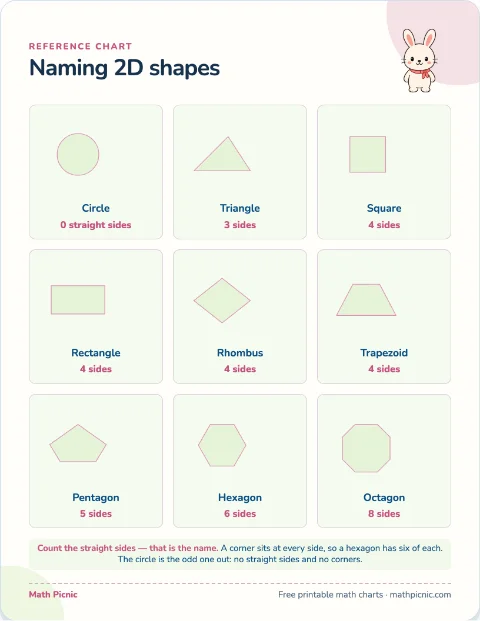 Print Count the straight sides on a shape, then read its name below it.
 - Quadrilateral family
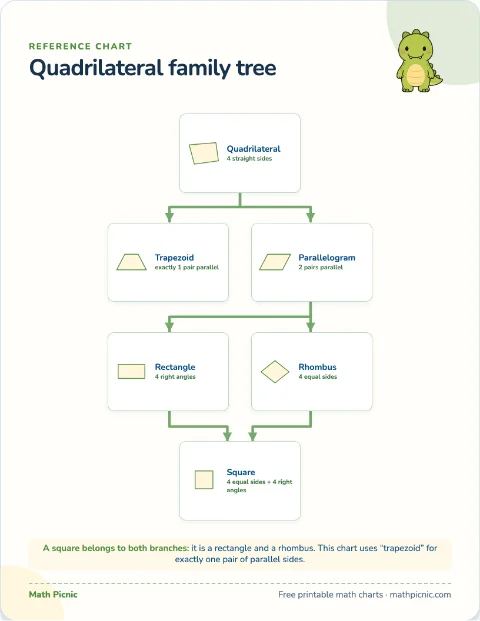 Print Follow the branches to see which names a shape inherits.
 - Lines of symmetry
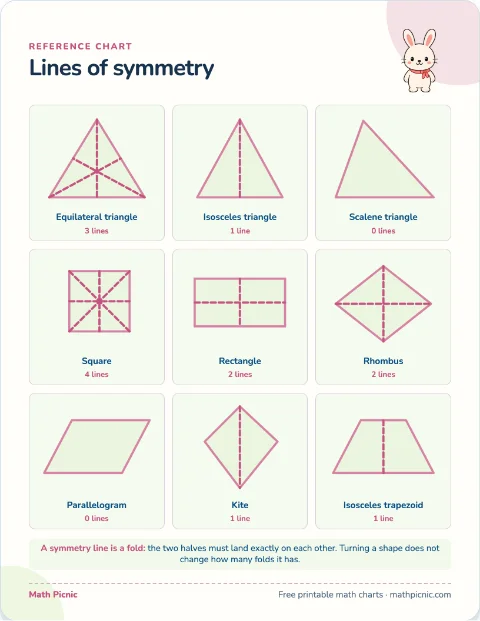 Print Fold each shape in your mind and count the matching halves.
 - Types of angles
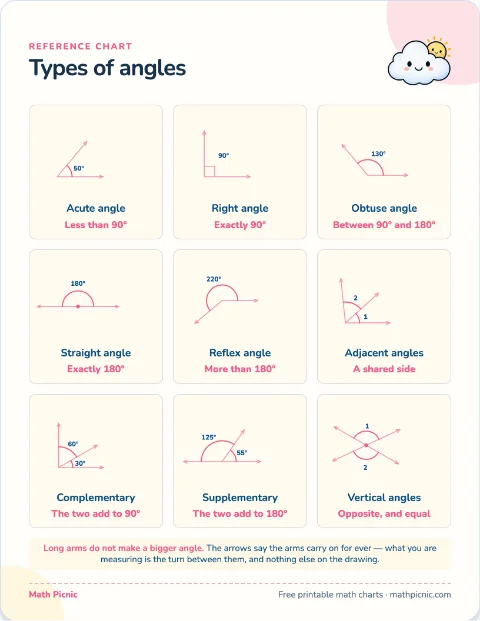 Print Find the picture that matches yours, and the name is under it.
 - Perimeter formulas
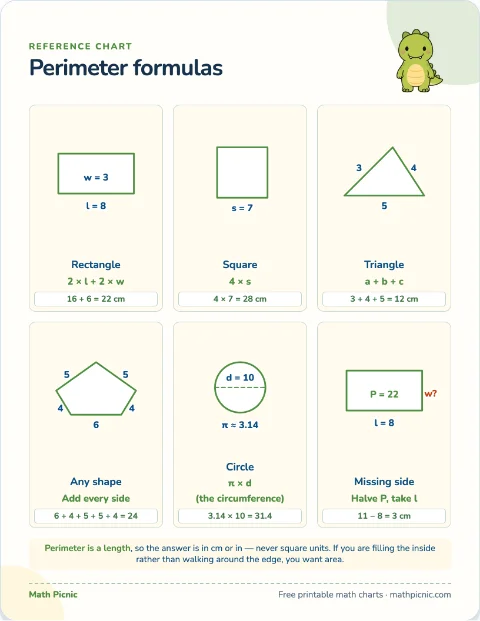 Print Follow the traced edge on the figure, then read the formula under it.
 - Area formulas
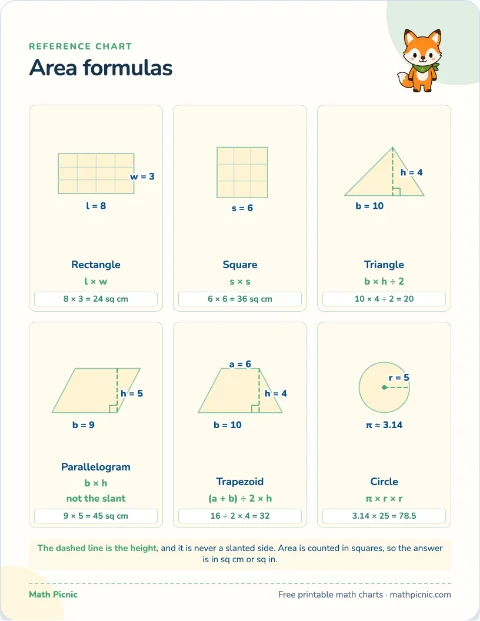 Print Match your shape to a figure and use the letters drawn on it.
 - Volume formulas
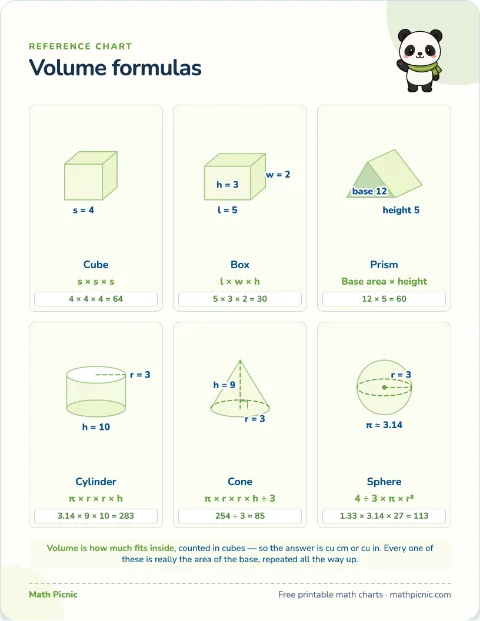 Print Find your solid, then multiply the base area by how tall it stands.
 - Surface area formulas
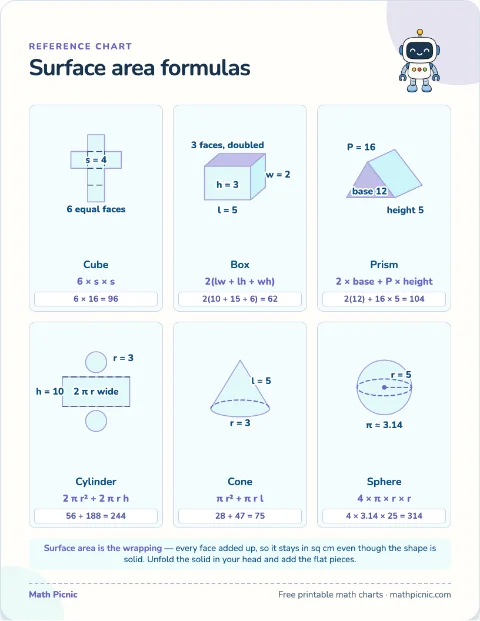 Print Unfold the solid in your head and add up every flat face.