
A different worksheet for every student — and yes, every copy is unique.
Print 20, 30 or 40 pages of the same skill at the same level, with different problems on every one — so no two students can copy, and no one's page is harder than a neighbor's.
- Different problems on every page — no copying a neighbor
- Same skill and level on every page*
- 20, 30 or 40 pages, one per student, with a compact answer key
One skill, one level, thirty different pages
Handing out one worksheet to thirty students has a well-known failure mode, and it is not that the sheet is too hard. A class set from this maker gives every page its own draw from the same pool at the same difficulty, so the work is identical in demand and different on paper — copying a neighbor's answers produces wrong ones.
What prints
It is the same generator the rest of the site uses, so the level is set the same way: pick the skill, set the range and the number of problems, then choose 20, 30 or 40 pages. Every page carries a worked example at the top — unlike the other packs, where only page one does, because here each page is going to a different student who has not seen the ones before it.
How we test “same level” — the data, and why it is the most even split arithmetic allows
We generated one real class set on this engine — 20 students, 30 division questions each, with the divisor and the quotient each free to be any whole number from 1 to 12. That is a complete space of 12 × 12 = 144 distinct facts. We treated the 600 printed questions as one batch and measured it the way an outside reviewer would: coverage of the fact space, how often each fact appears, the divisor and quotient balance, repeats within a single sheet, trivial facts (dividing by one, or an answer of one), and how much any two students’ sheets overlap.
| Students | 20 |
|---|---|
| Questions per student | 30 |
| Total questions | 600 |
| Possible facts (12 × 12) | 144 |
| Fact coverage | 144 / 144 (100%) |
| Times each fact appears | 4–5 |
| Most even split possible | 120 facts ×4, 24 facts ×5 |
| Divisor balance | 48–52 each (ideal 50) |
| Quotient balance | 48–52 each (ideal 50) |
| Repeated fact within a sheet | 0 |
| Trivial facts (÷1 or answer 1) | 95 / 600 (15.8%) |
| Trivial facts per sheet | avg 4.75, range 3–7 |
| Shared facts between two sheets | avg 5.05 / 30 (16.8%) |
Why 4-or-5 is the most even split there is. 600 questions cannot divide evenly among 144 facts: 600 = 144 × 4 + 24. At least 24 facts must therefore appear one extra time, so the flattest any batch this size can be is 120 facts 4 times and 24 facts 5 times. That is exactly what the set contains — not by chance, but because the generator repeats the pool in order before dealing, which makes the even split structural rather than lucky.
This is one independently generated class set. The figures describe this sample; they are not a formal guarantee for every set the maker can produce.
Ready-made class sets
Pick a skill
Each opens the maker with the set built. Change the level, the number of problems, or the page count before printing.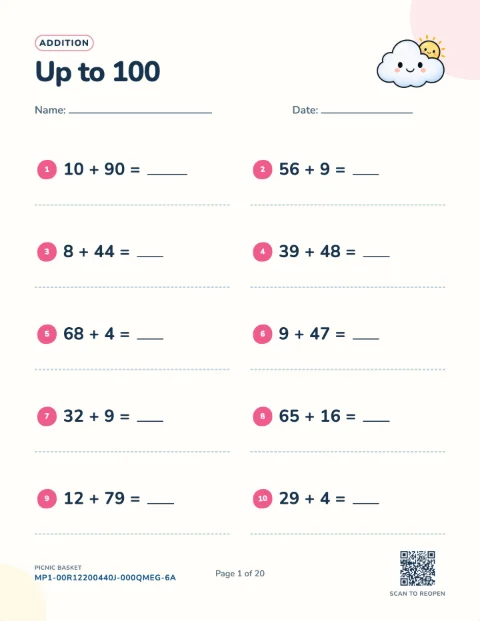 Customize Addition with regrouping 20 pages MP1-00R12201104-000QMEG-NH
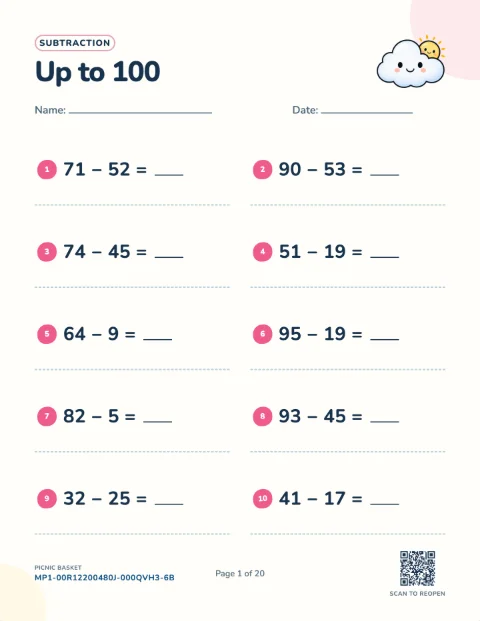 Customize Subtraction with borrowing 20 pages MP1-00R12201204-000QVH3-Q2
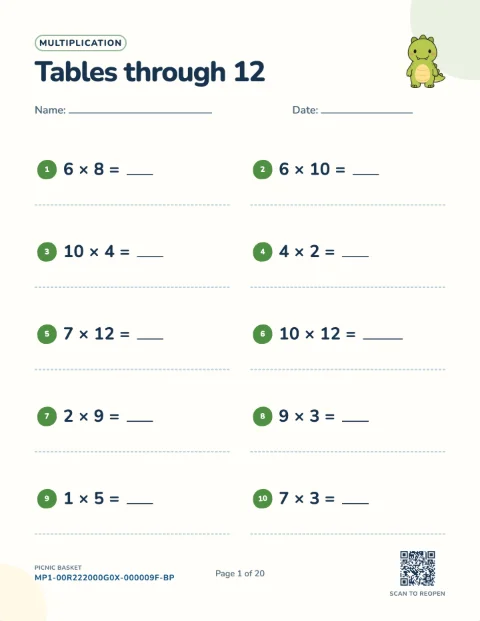 Customize Times tables to 12 20 pages MP1-00R22200401-000009F-WM
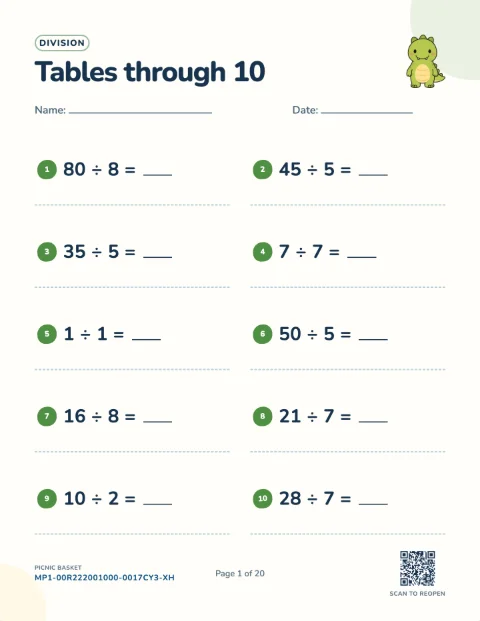 Customize Division facts 20 pages MP1-00R22200800-0017CY3-MW
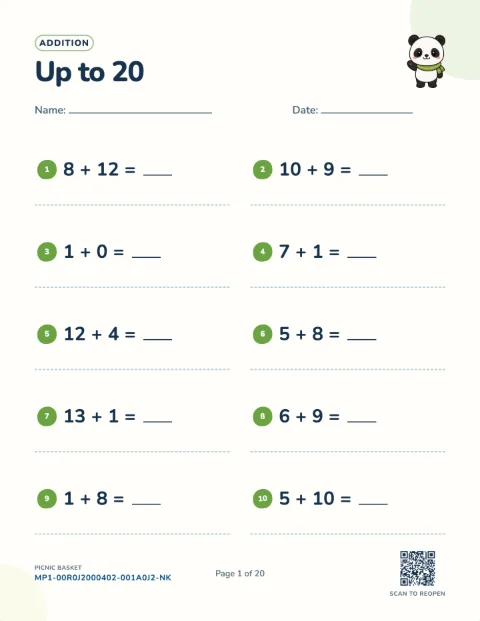 Customize Addition within 20 20 pages MP1-00R0J200102-001A0J2-Y5
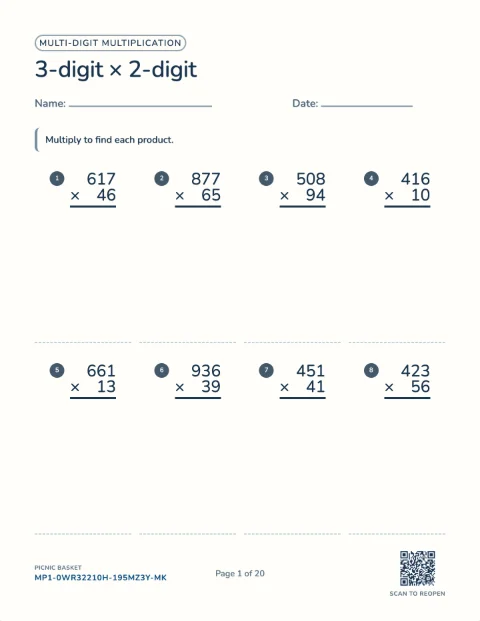 Customize Multi-digit multiplication 20 pages MP1-0WR32210H-195MZ3Y-MK