Before the first answer.
Simple printables for the littles.
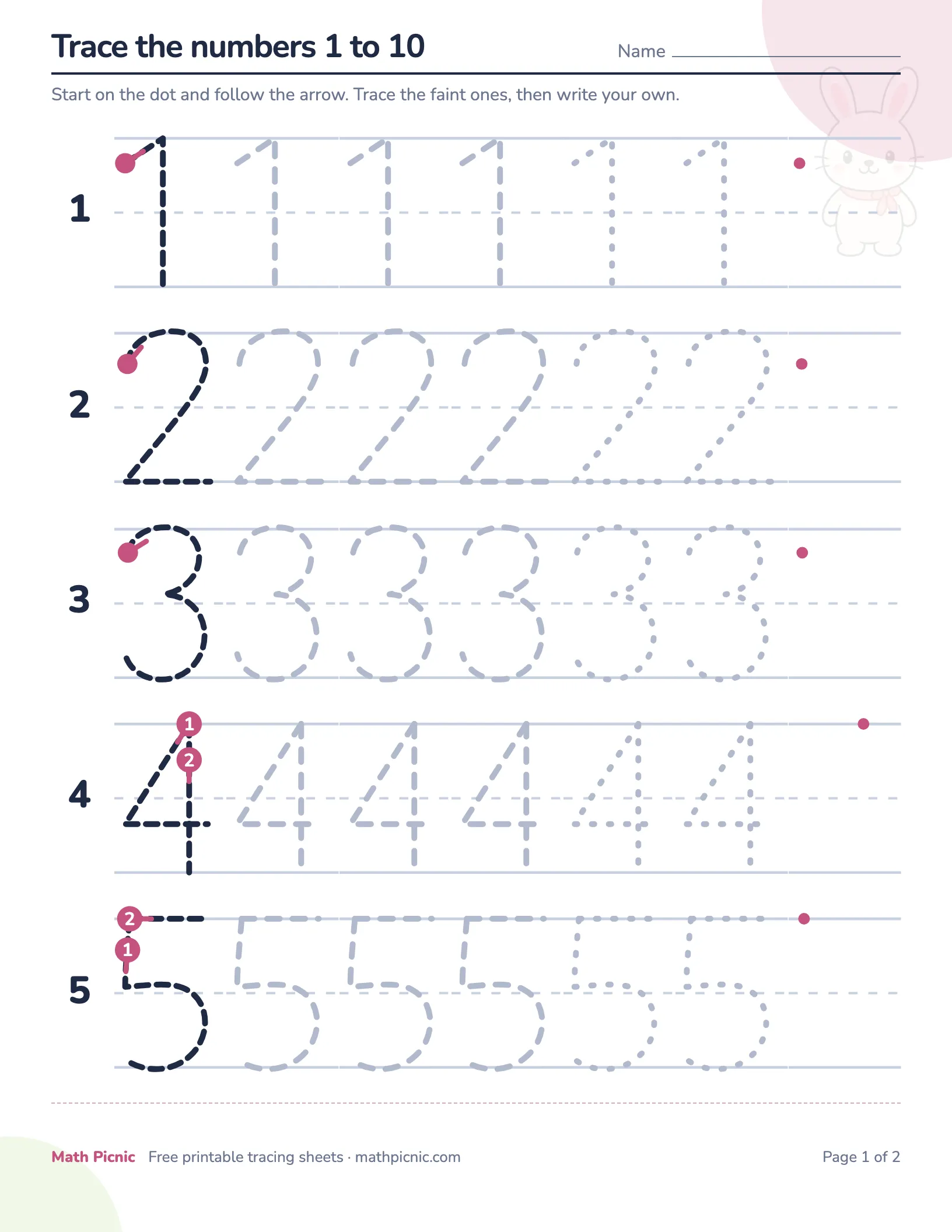
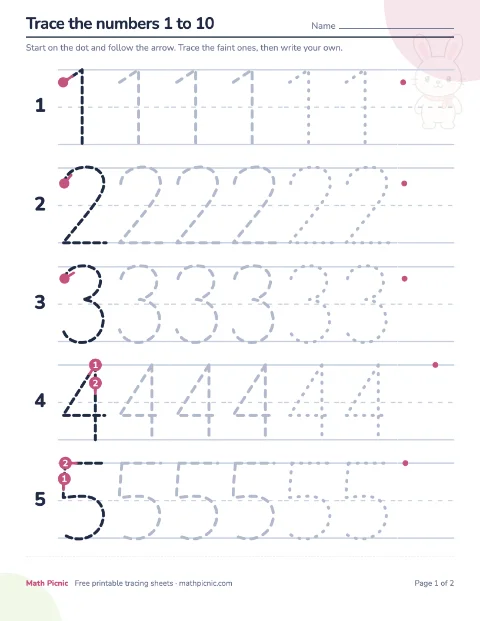
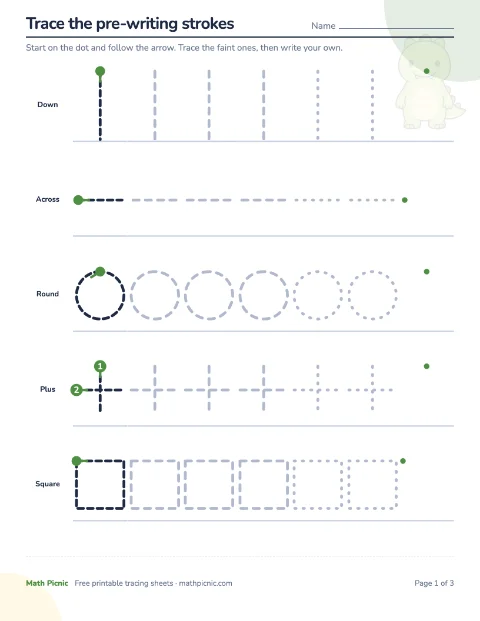
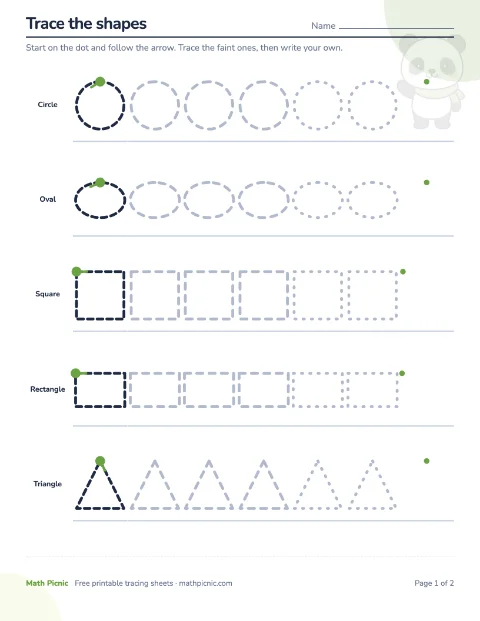
A worksheet asks for 7. These ask a child to be able to make a 7. Tracing sheets for numbers, shapes, pre-writing strokes and the math signs — every one drawn as the path a pencil travels, with the start point ringed and the stroke order marked.
Before numbers
The strokes and shapes a hand learns before it can make a digit.
The numbers
Numeral formation, with stroke order and a start point on every digit.
- Number tracing The ten digits, 0 to 9 Trace each digit over the dotted line, starting at the ring and following the arrow.
- Tracing numbers 1 to 5 1 to 5, one row each Trace 1 through 5, one practice row for each number.
- Tracing numbers 6 to 10 6 to 10, one row each Trace 6 through 10, one practice row for each number.
- Tracing numbers 1 to 10 1 to 10, one row each Trace 1 through 10, one practice row for each number.
- Tracing numbers 11 to 20 11 to 20, one row each Trace 11 through 20, one practice row for each number.
- Tracing numbers 1 to 20 1 to 20, one row each Trace 1 through 20, one practice row for each number.
- Tracing numbers 21 to 50 21 to 50, one row each Trace 21 through 50, one practice row for each number.
- Tracing numbers 1 to 100 Any range up to 100 Pick the stretch of numbers your child is working on and trace those.
The letters
Letter formation with stroke order — because a word problem has to be written on.
- Letter tracing A to Z, capitals Trace each capital letter, starting at the dot and following the arrow.
- Lowercase letter tracing a to z, small letters Trace each small letter. Watch the middle line — most of them start there.
- Alphabet tracing Aa to Zz, both cases together Trace the capital and the small letter together — they are the same letter.
The signs
The marks every arithmetic worksheet assumes a child can already write.
Why these are not dotted outlines
Almost every tracing sheet you can print is a font with a dashed border. That asks a child to trace around the edge of a hollow letter, which is coloring-in. A formation sheet needs the centerline — the single path a pencil tip travels, in teaching order — and there is no way to get one out of a font. Every character here was drawn by hand as an open curve, then measured against nine real typefaces until its proportions matched.