
Trace the alphabet, A to Z
Both cases in one cell, so the pair is learned as one letter rather than as two shapes that happen to share a name. Twenty-six rows, four-line ruling, and the stroke order numbered on both halves.
- Letter & A4, portrait or landscape
- Real stroke centerlines, not outlines
- Change the size and reprint
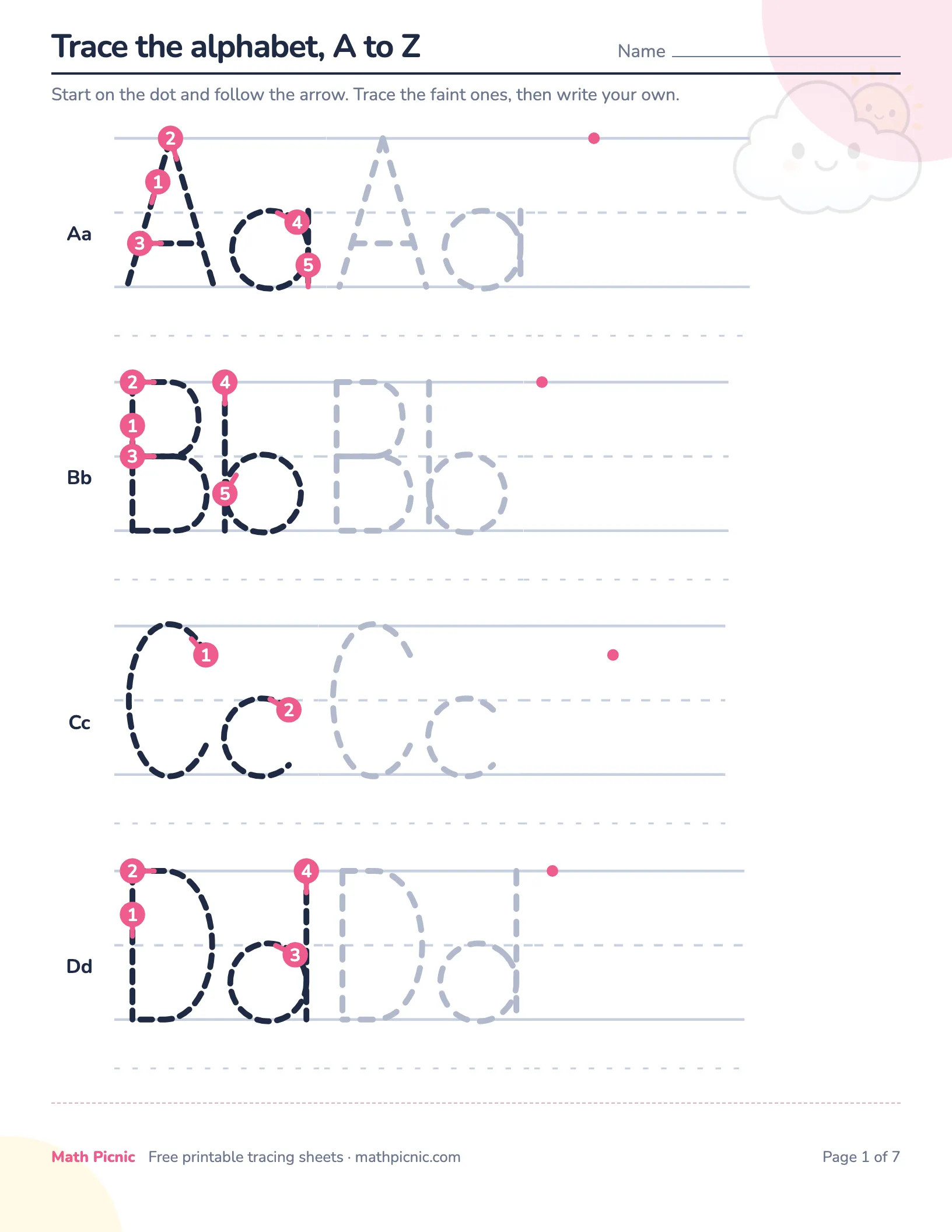

Trace the alphabet, A to Z
NameStart on the dot and follow the arrow. Trace the faint ones, then write your own.
This is page one of 7 at the default size. Open it in the maker to print the rest, choose a range, or fit more on a page.
About this sheet
A capital and its small letter are the same letter, and a surprising number of children do not know that until someone shows them. Eight pairs are obviously related — Cc, Oo, Ss, Ww — and the rest are not: nothing about an A tells you about an a, and Gg, Qq and Rr have to be learned as pairs. Printing them in one cell, side by side at the same writing size, is the arrangement that says so. Two separate rows say the opposite.
Why it is drawn this way
The two halves are spaced off their own measured edges rather than given a fixed slot each, which is the difference between a pair that reads and one that does not. W is more than twice the width of an I, so a fixed slot puts Ww in collision and leaves Ii floating in white space. Here the GAP between the two letters is the constant — the same rule this site already uses to set two-digit numbers — so every pair sits the same way.