
Gifted and talented math worksheets
A Challenge question is one a child cannot begin the moment they finish reading it. Same arithmetic they already know — what changes is that there is something to work out before they can start.
- The key prints the route, not the answer
- Room to write the reasoning
- Reopen any sheet later
Start here
Challenge sheets
Depth rather than acceleration: nothing here is above grade level, and none of it can be answered by recognizing the question.Nothing matches that. Try a topic (counting), a name (lockers), or a grade (grade 6).
The first answer is close
- The smudged sum
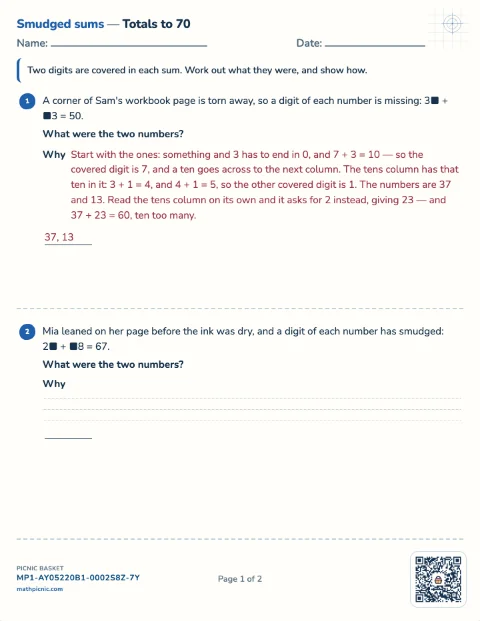 Print 4■ + ■7 = 61 → __ and __
 - Sum and difference puzzles
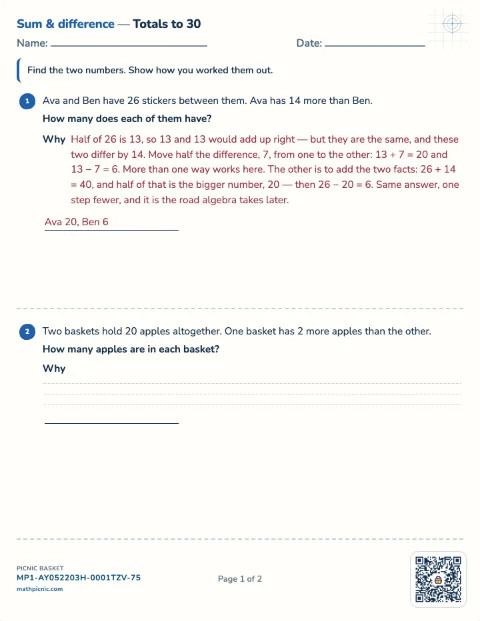 Print add to 20, differ by 6 → __ and __
 - What the leftover means
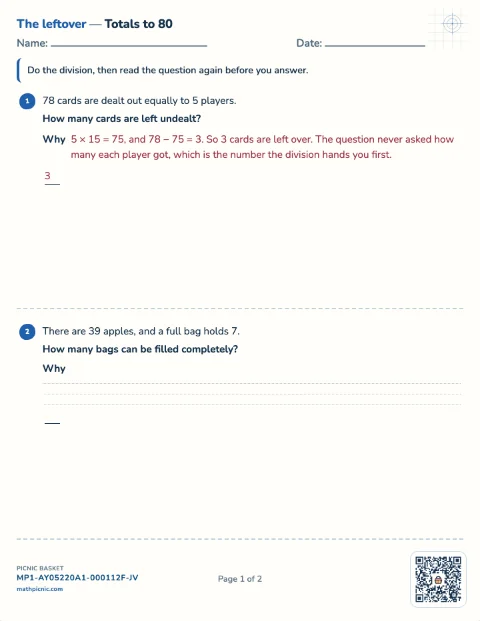 Print 19 eggs, boxes of 3 → __ boxes
 - Things and the gaps between them
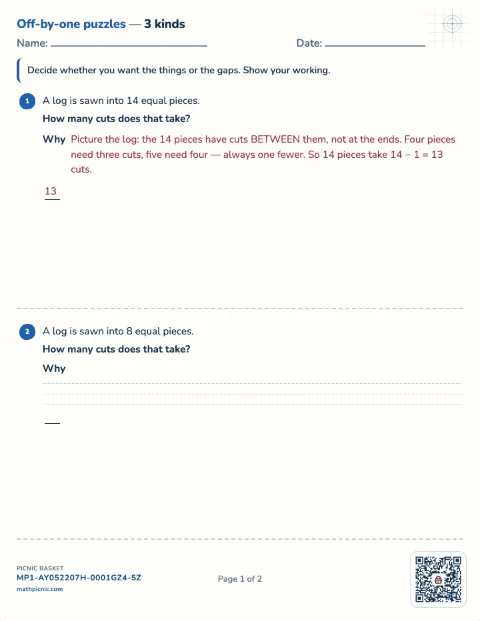 Print 5 pieces → __ cuts
 - Numbers too big to compute
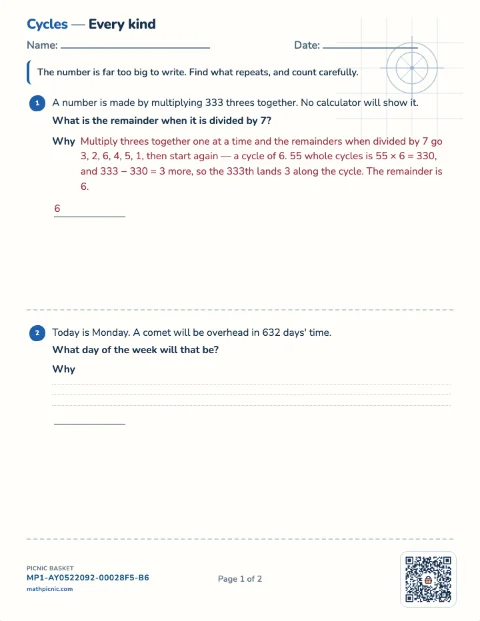 Print 100 sevens multiplied → last digit __
 - A number from its remainders
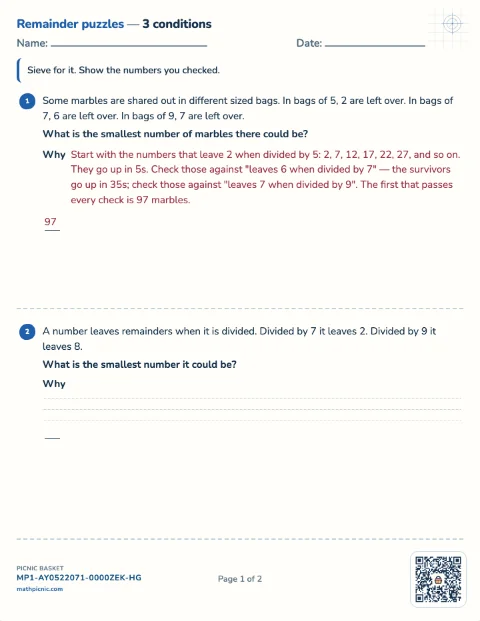 Print ÷3 rem 2, ÷5 rem 3, ÷7 rem 2 → __
More unknowns than facts
- Chickens & rabbits
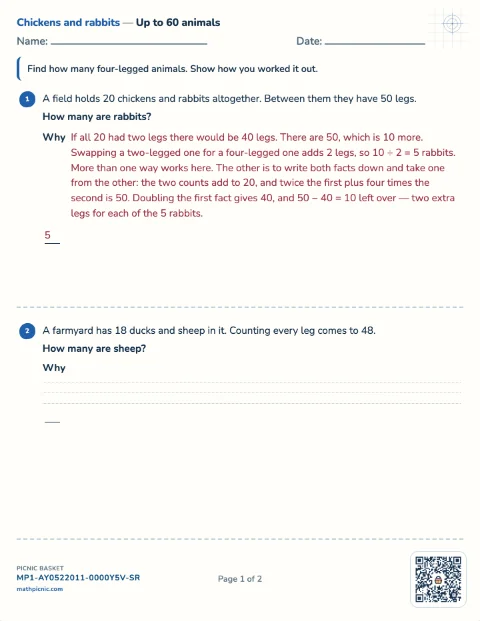 Print 13 heads, 44 legs → __ rabbits
 - One equation, two unknowns
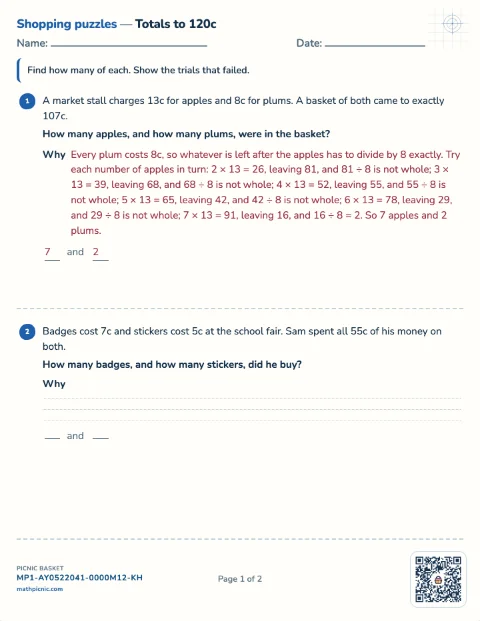 Print 15c and 8c → exactly 115c
 - Three shares from one total
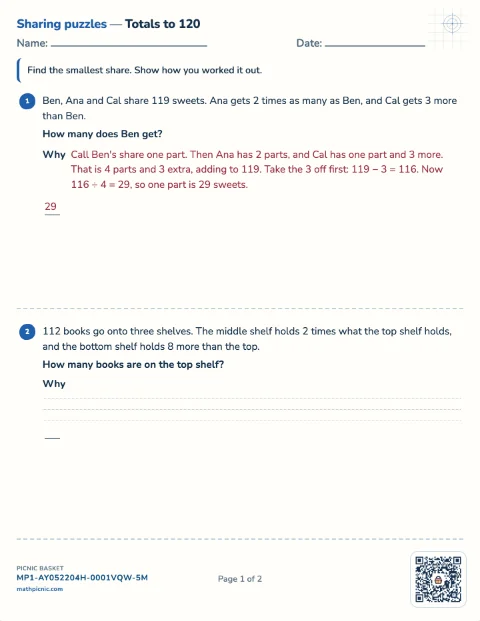 Print 92 sweets, 3× and 2 more → __
 - GCF & LCM puzzles
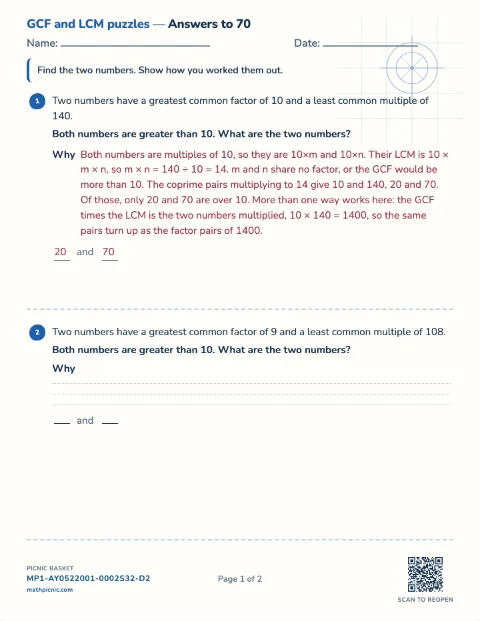 Print GCF 5, LCM 30, two digits → __ and __
 - Area & perimeter puzzles
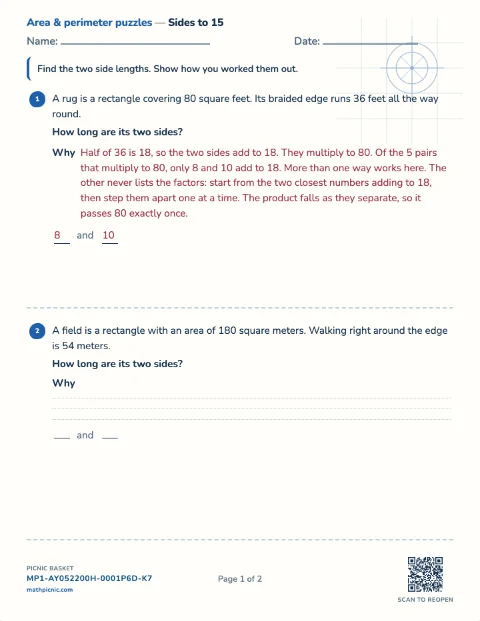 Print A = 48, P = 28 → __ and __
 - The gap between two squares
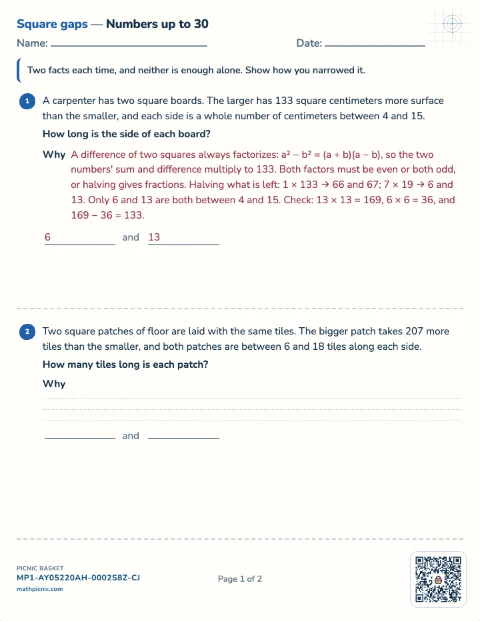 Print gap 96, both 10–33 → 14 and 10
 - Who am I? number puzzles
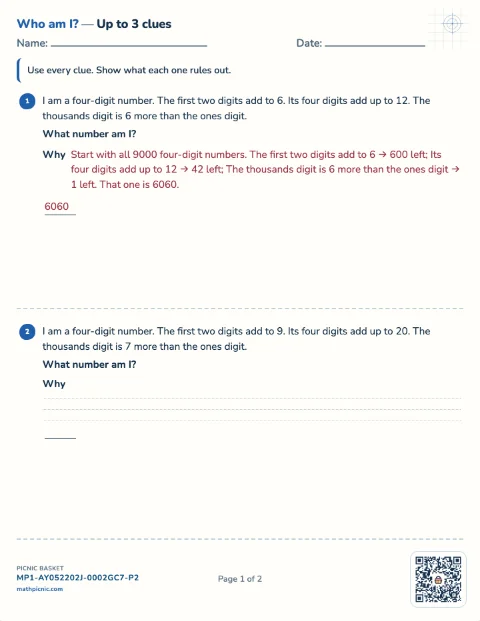 Print digits add to 16, multiple of 4 → ____
Counting & fewest
- Counting pairs
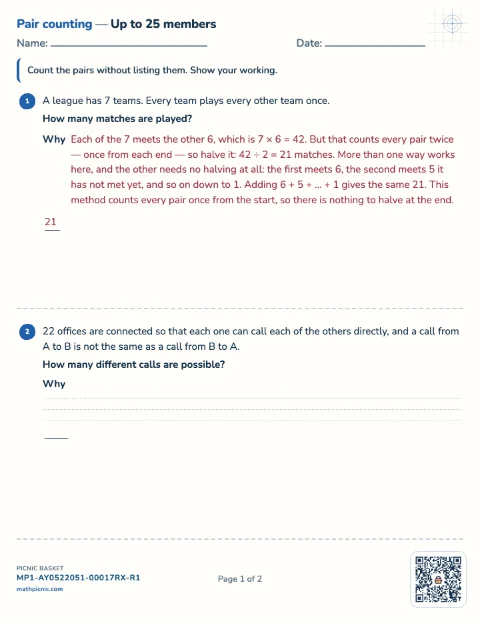 Print 12 people → __ handshakes
 - Counting diagonals
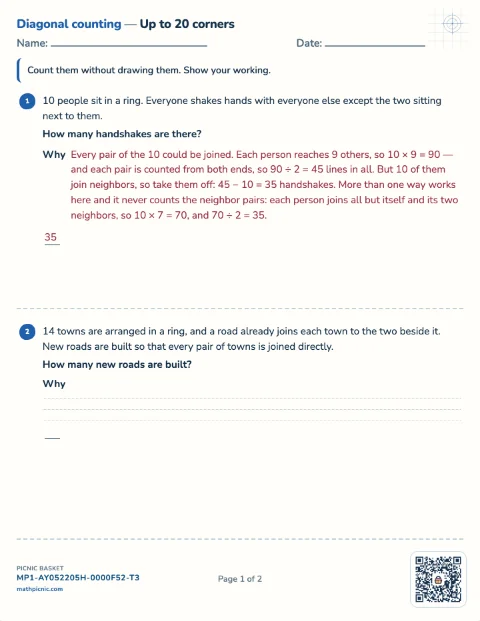 Print 20-sided polygon → __ diagonals
 - Socks in the dark
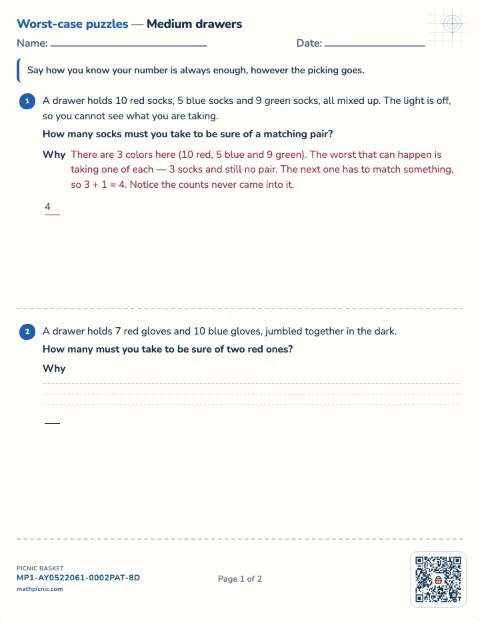 Print 3 colors → __ socks for a pair
 - The hundred lockers
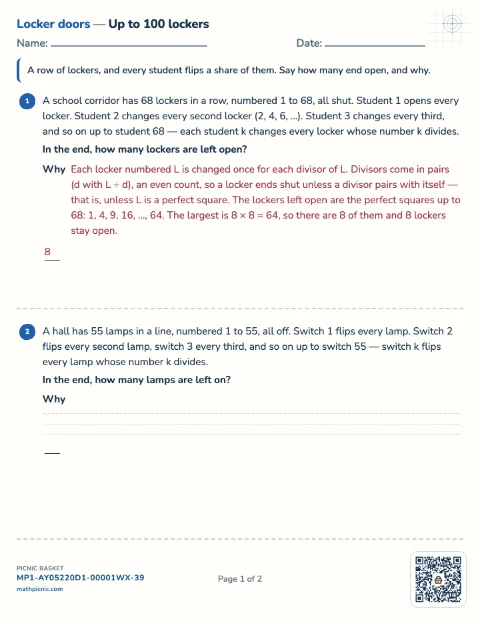 Print 100 lockers, flipped by their divisors → __ open
 - The painted cube
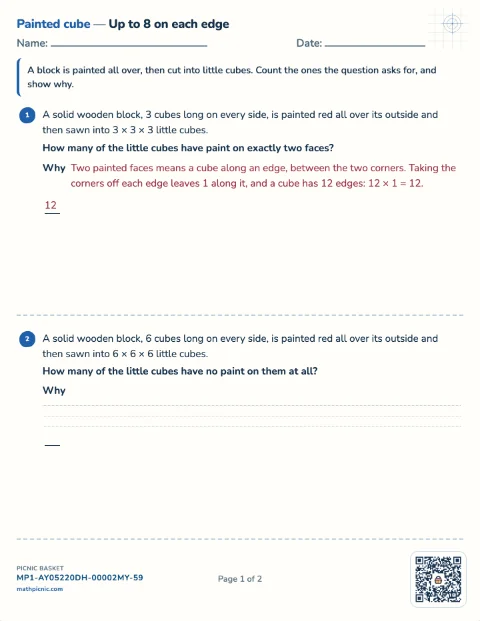 Print 5×5×5 painted, cut up → __ with 2 faces
 - Integer triangles
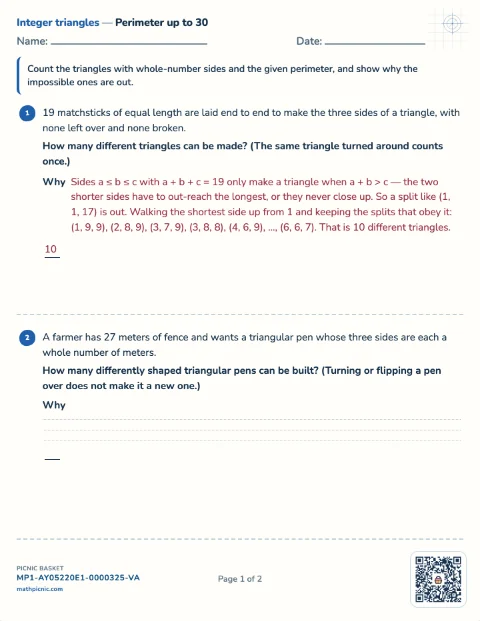 Print whole sides, perimeter 20 → __ triangles
 - A diagonal through a box
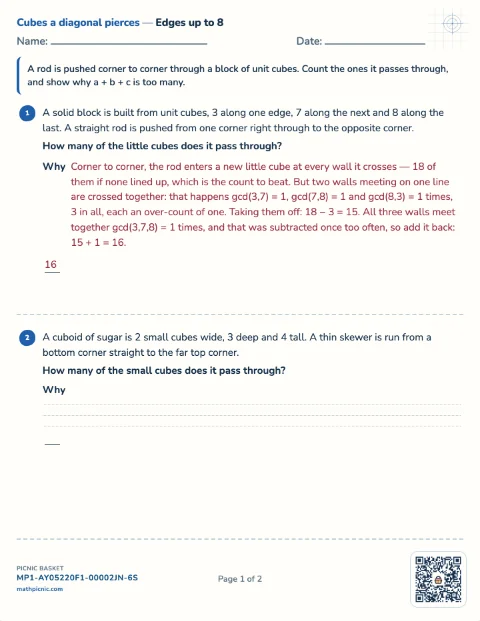 Print 3×5×6 block, corner to corner → __ cubes
 - Lattice paths
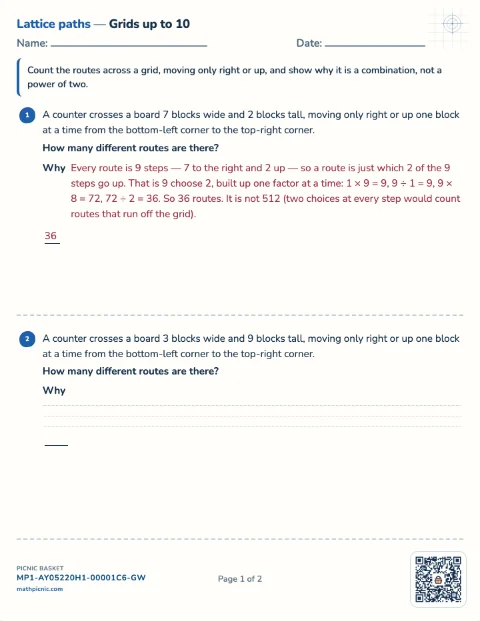 Print 3 × 7 grid → __ routes
 - Counting triangles in a grid
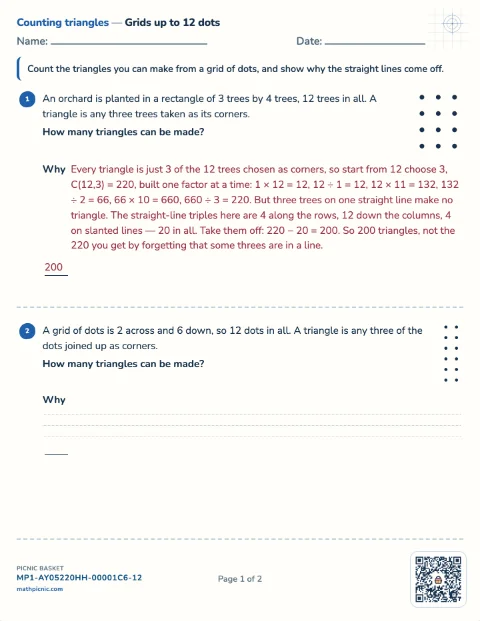 Print 3 × 3 dot grid → __ triangles
 - Counting rectangles in a grid
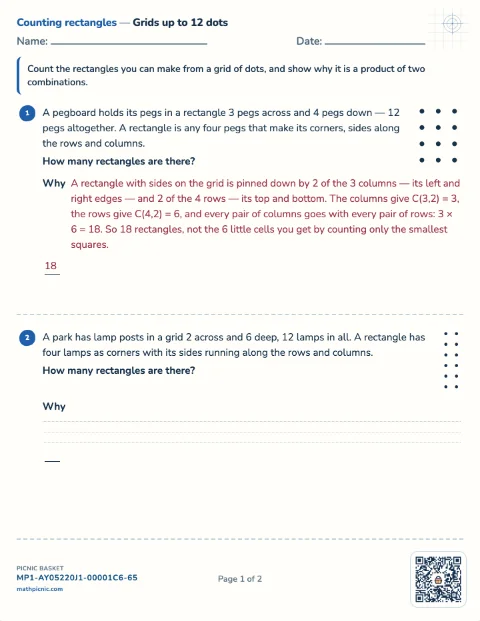 Print 4 × 4 dot grid → __ rectangles
 - The lazy caterer
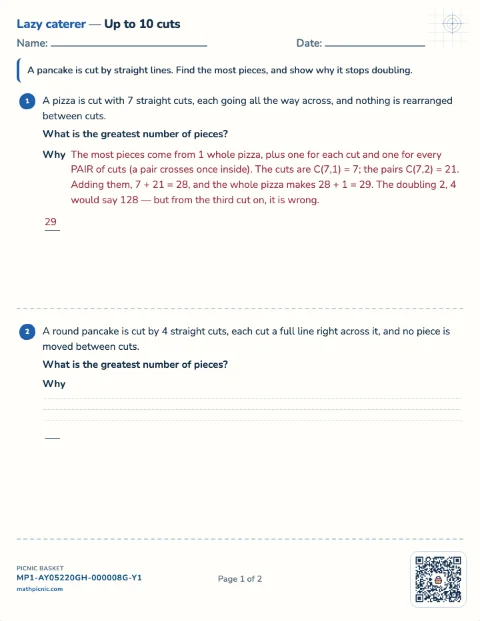 Print 3 straight cuts → __ pieces
 - Cake numbers
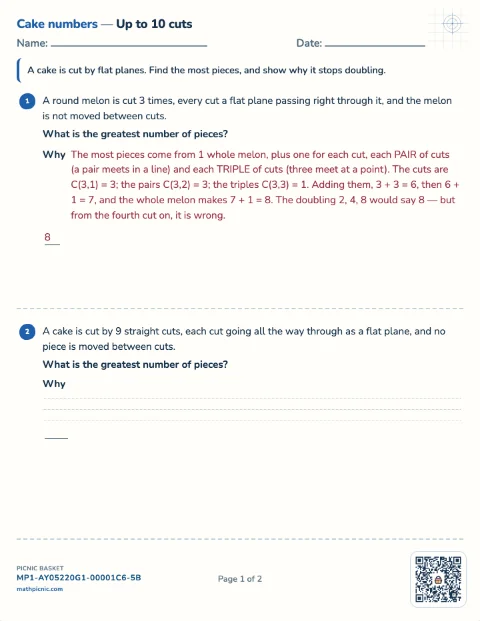 Print 4 flat cuts → __ pieces
 - Regions of a circle
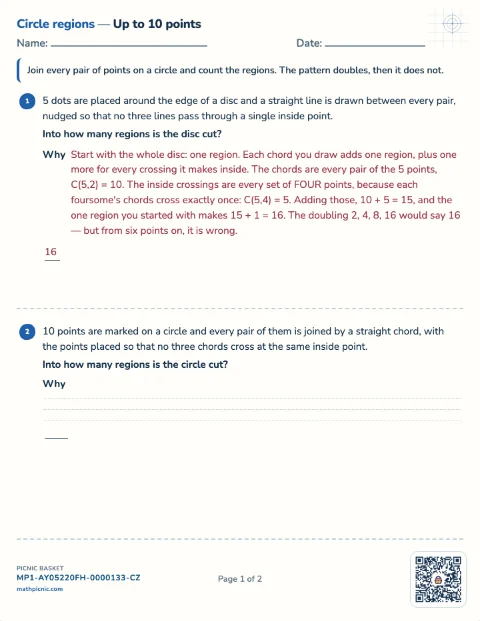 Print 6 points, all chords → __ regions
 - Domino tilings
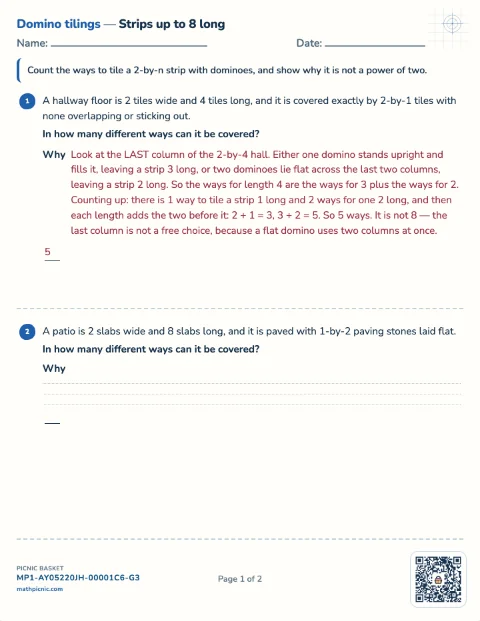 Print 2 × 5 strip → __ tilings
 - Fewest coins
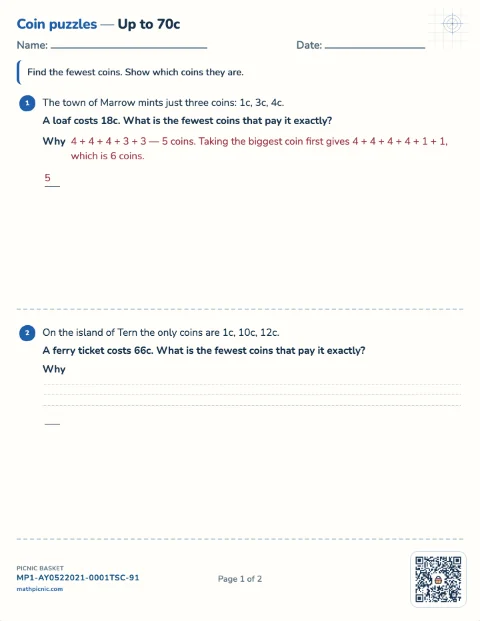 Print 1c, 4c, 6c → 8c in __ coins
 - Two jugs and a tap
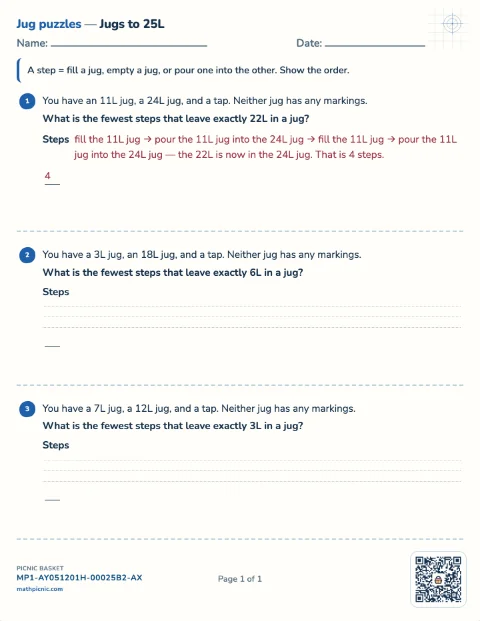 Print 6L and 11L → exactly 7L
 - The fake coin
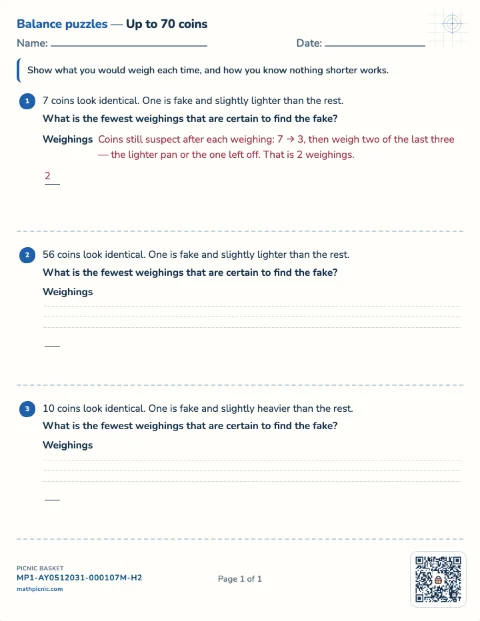 Print 9 coins, one light → __ weighings
 - The spider and the fly
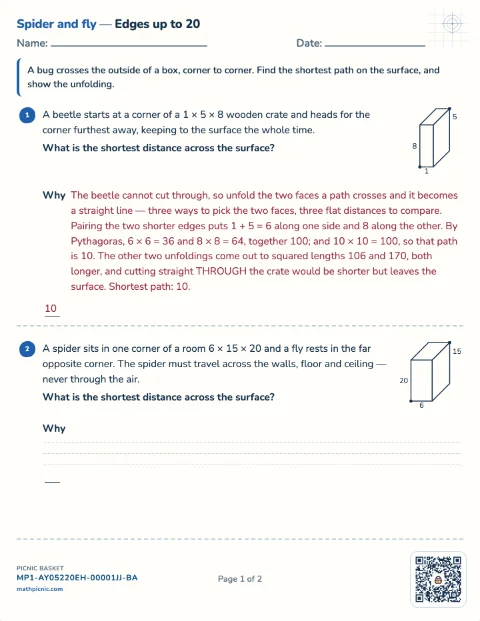 Print 3×5×6 box, corner to corner → __
No single answer
- The number that cannot change
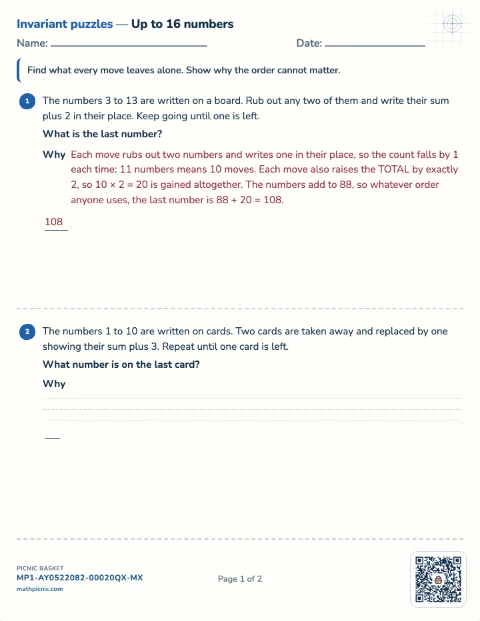 Print 1 to 5, sum minus 1 → __
 - What two facts settle
 Print 3t + 2c + 1k = 96c → t + c + k = __
 - The taking game
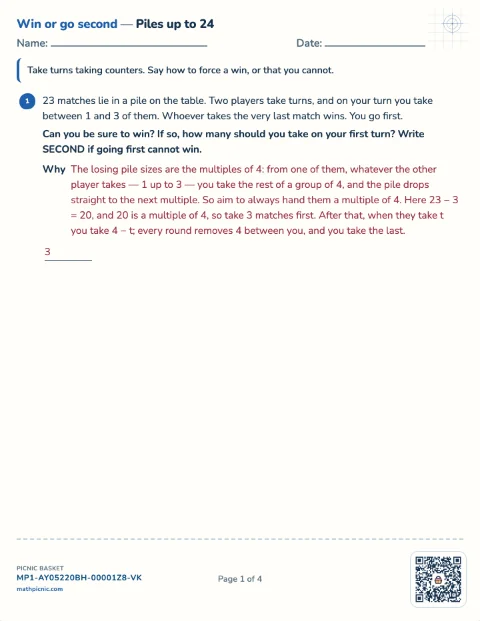 Print 20 counters, take 1–3 → take __ first
 - Write your own question
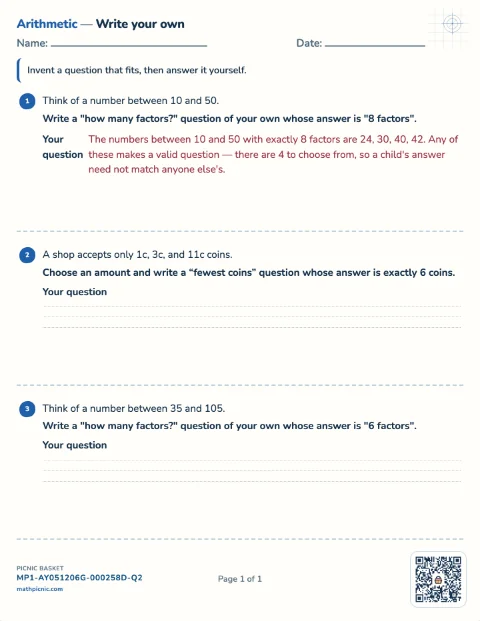 Print answer is "3 coins" → write the question
 - Can it be done at all?
 Print 11 cups, turn 2 at a time → NEVER
When computing will not help
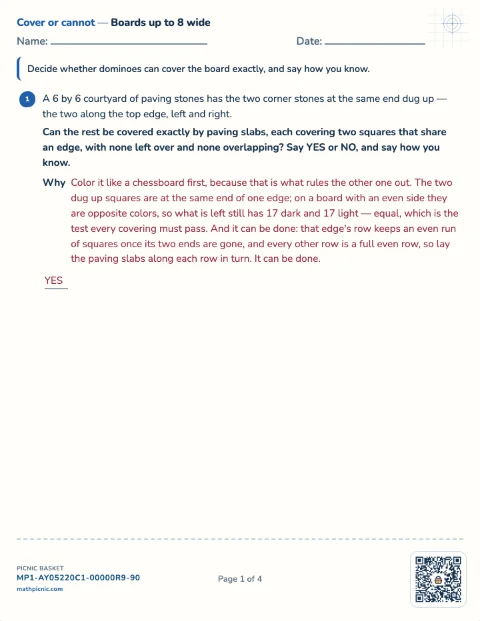
What must be true
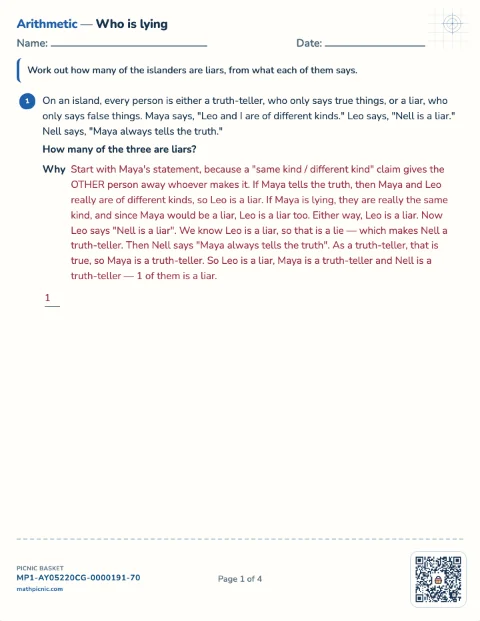
In this order
Ten sheets that follow on
Every sheet above teaches one thing well. These ten put three or seven of them on one page around a single idea, and they are listed in the order they are meant to be met — each one asks the child to give up something the last one let them keep.- 1Nearly rightStart here. Your first answer is close — find what is missing from it.
- 2What must be trueNow with one fact instead of two, used to the last drop.
- 3Count without listingNow without listing the cases.
- 4Counting in a gridNow counting routes and shapes on a grid, never drawing them out.
- 5Looks like doublingNow without trusting the pattern to keep going.
- 6Work backwardsNow without working forwards.
- 7FewestNow without settling for the first answer that works.
- 8Where does it land?Now without trusting the count you divided for.
- 9Does it depend on what you choose?Now without expecting one answer to exist.
- 10When computing will not helpNow without computing at all.
What makes a question a Challenge
Two things, and both are checked by the generator rather than claimed by us. The first is that the answer can be proved: every question is solved by searching the whole space, and any question the engine cannot verify has exactly one defensible answer is never printed. The second is that there is a wrong turn a child can genuinely take — a first move that looks right and is not — and that this is measured on every question rather than asserted about the topic.
What this is not
The wrong turn is different on every sheet, and it is always the reading that usually works. Counting handshakes, you multiply and forget to halve; watching a cake go 2, 4, 8 pieces, you double once more when the pattern has quietly stopped; on the fake-coin sheet you weigh one coin at a time when the balance could have split the pile in three. None is carelessness — each is a habit that fits most questions and not this one, which is why the answer key prints the whole route rather than the number.