Count without listing
Name: Date:
1. Challenge puzzlesCount the pairs without listing them. Show your working.1 question
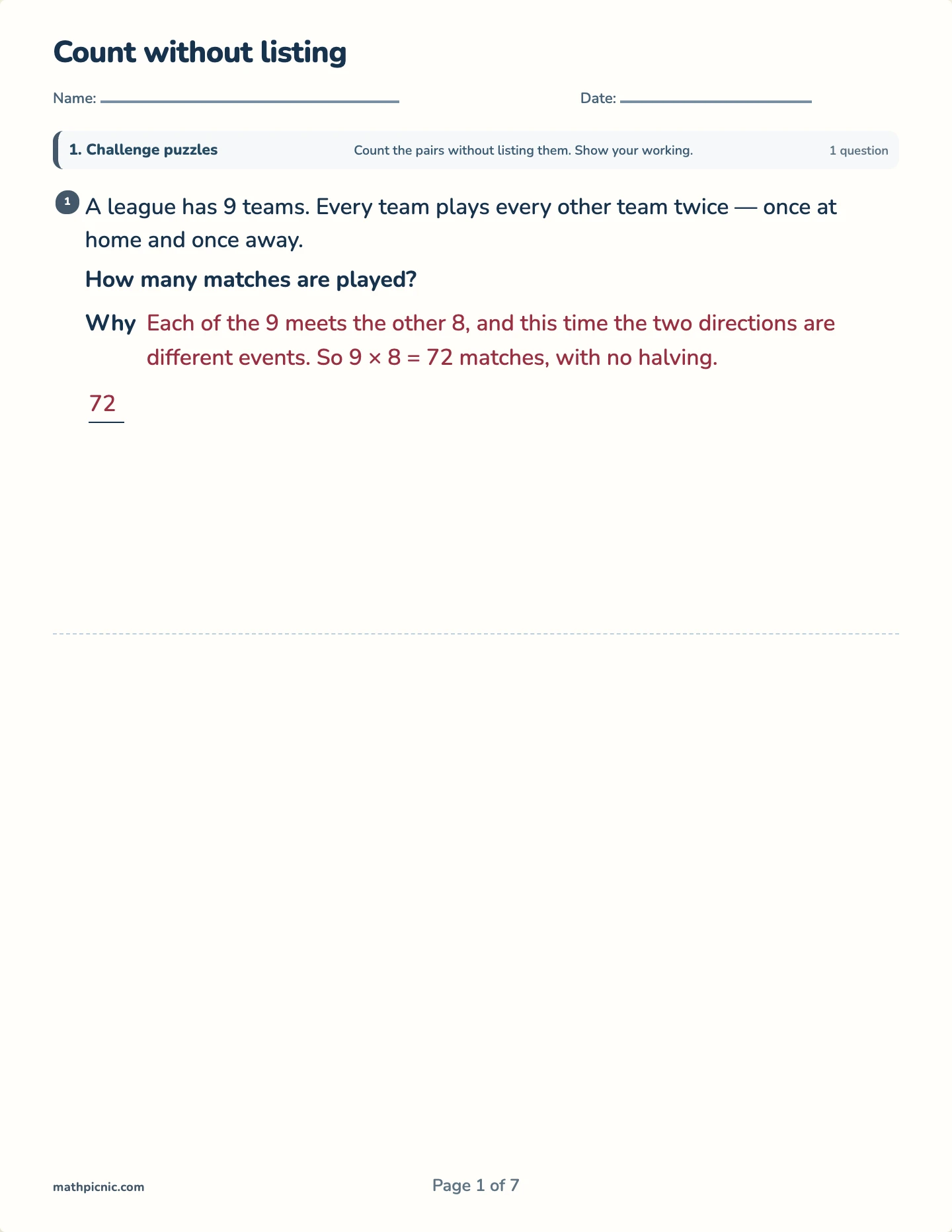
1A league has 9 teams. Every team plays every other team twice — once at home and once away.How many matches are played?Why

Seven questions where writing them all out is not an option — and seven different ways of getting the count wrong.
The answer key prints on a separate page.
Section 1 is handshakes: everyone meets everyone, so each person's count is easy and the total is exactly twice the answer, because a handshake belongs to two people. Section 2 is a polygon's diagonals, which is the same count with the sides taken off — and the halving is still there to forget. Section 3 is socks in a dark drawer, and it is not a count of cases at all: it is a count of the unluckiest run of bad luck, plus one. Section 4 is a corridor of lockers, opened and shut by every number that divides them, where only the perfect squares end up open. Section 5 is a painted block cut into little cubes, where the paint on each one is decided entirely by where it sat. Section 6 is triangles with whole-number sides and a fixed perimeter, where most ways of splitting the number are not triangles at all. Section 7 is a rod pushed corner to corner through a block of unit cubes, counted by the walls it crosses rather than cube by cube.
The order is deliberate. Each of the first three sections' classic mistake is the previous section's lesson: a child who has just learned to halve meets the question where the subtraction takes their attention and the halving slips, and a child who has learned both meets a question where neither applies and the method is to imagine the worst instead. The later sections change the trap entirely — the lockers surprise is that almost every one ends shut, the painted cube's is that stripping the outer shell leaves a smaller cube whose size does the counting, the triangles' is that a whole list of splits has to be thrown away for failing to close up, and the rod's is that a coordinated box like 2 × 2 × 2 lines its walls up so the naive six becomes two.