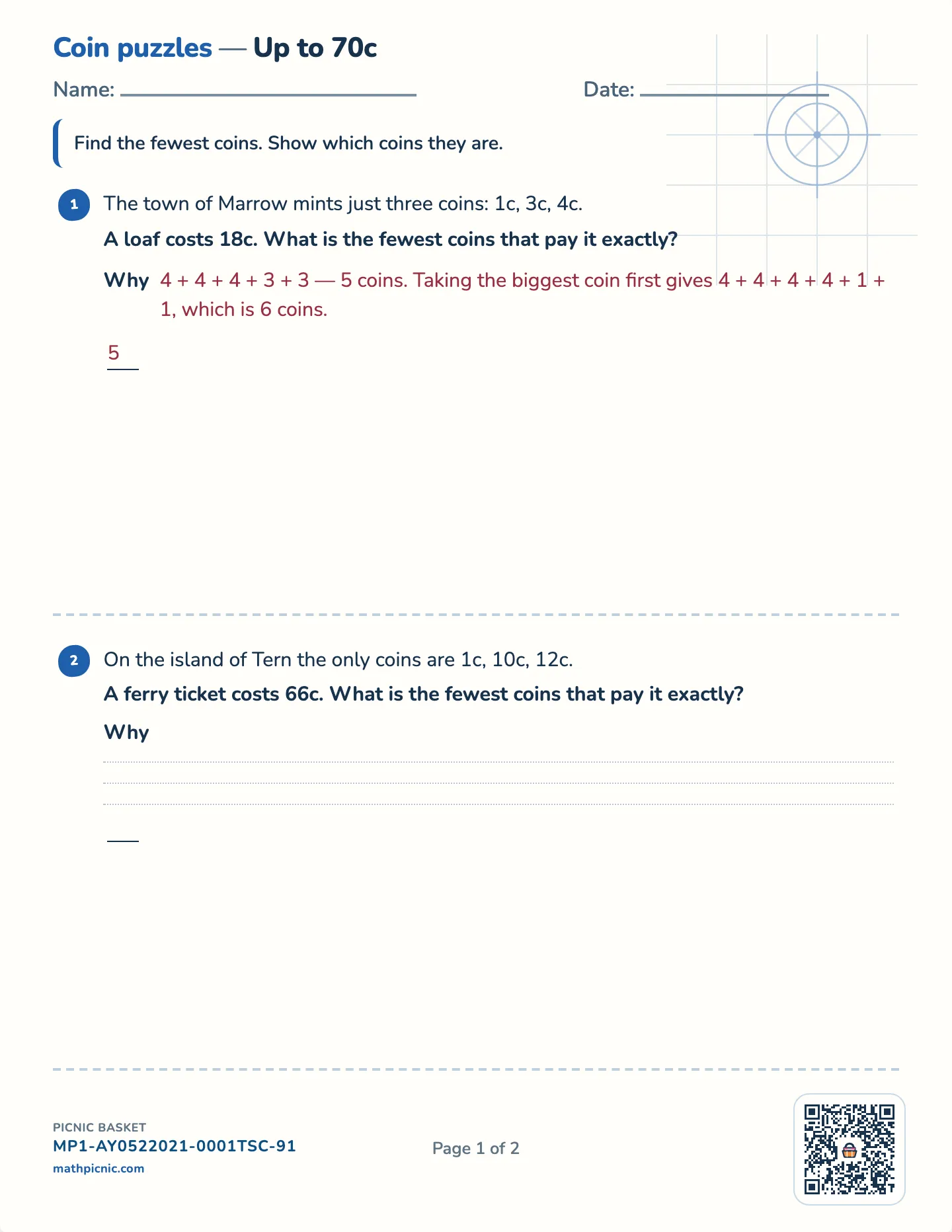
Coin puzzlesUp to 70c
Find the fewest coins. Show which coins they are.
Take the biggest coin that fits, then the next, then the next. It is what everyone does, and in a shop whose coins are 1c, 4c and 6c it is wrong: 8c is 6+1+1 that way, and 4+4 in fact. Finding the gap is the question.

The answer key prints on a separate page.
Real money is built so the obvious method always works. Pounds, dollars and euros are all designed that way — 1, 5, 10, 25 and 1, 2, 5, 10 both reward taking the largest coin first, every single time. That is why the rule feels like arithmetic rather than a guess, and why a shop where it fails is worth a page.
On every question here the everyday way of paying costs more coins than the best way — that gap is the question. The answer key prints both tallies side by side, because a child who answered four coins was not careless: they used a rule that usually works, and what they need to see is which rule to distrust.
One question from a sheet like this one, worked a step at a time — with a sentence saying what just happened and why.
Fewest coins, step by step