Find the two numbers. Show how you worked them out.
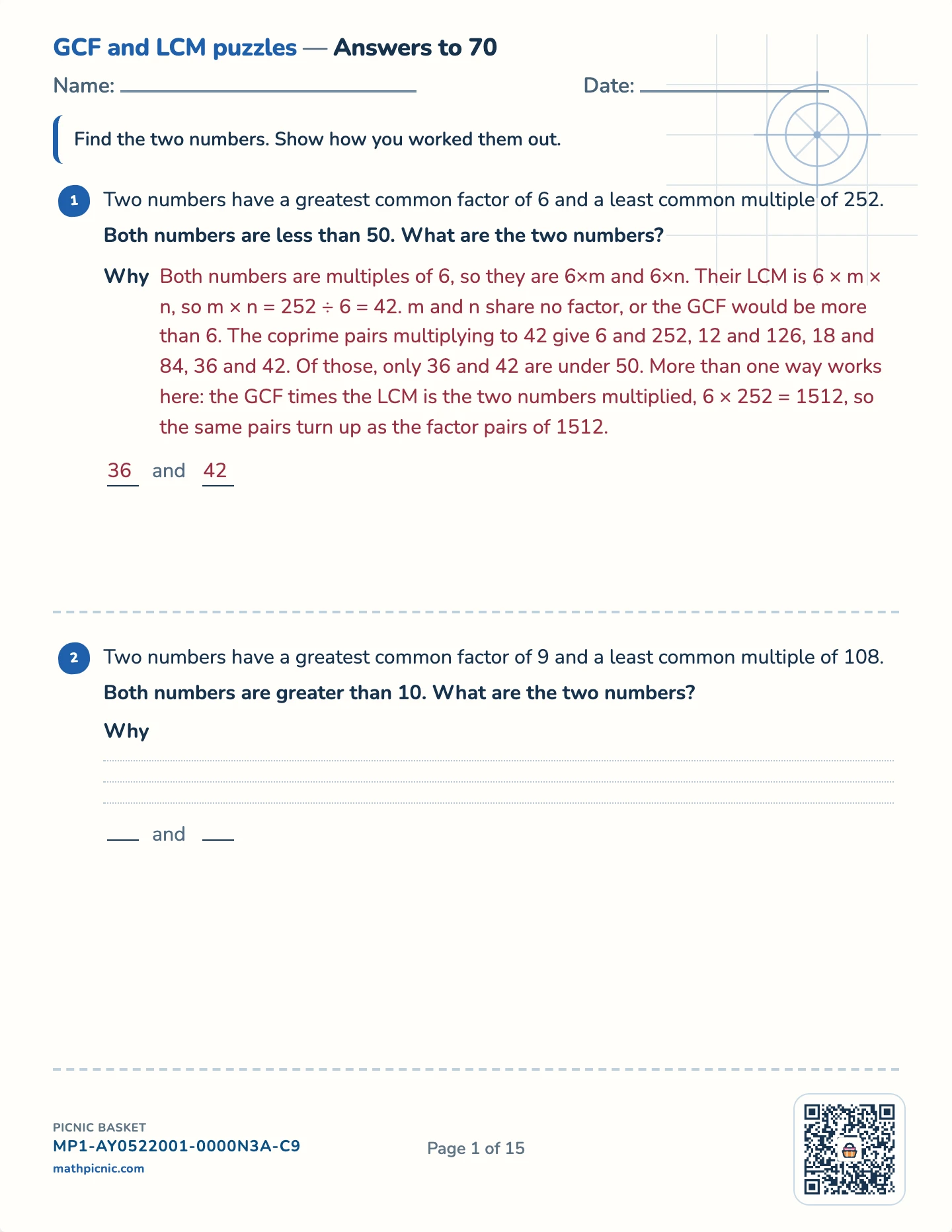
1Two numbers have a greatest common factor of 6 and a least common multiple of 252.Both numbers are less than 50. What are the two numbers?Whyand
2Two numbers have a greatest common factor of 9 and a least common multiple of 108.Both numbers are greater than 10. What are the two numbers?Whyand
GCF and LCM puzzlesAnswers to 70
Name: Date:
Find the two numbers. Show how you worked them out.
3Two numbers have a greatest common factor of 2 and a least common multiple of 70.Both numbers have two digits. What are the two numbers?Whyand
4Two numbers have a greatest common factor of 10 and a least common multiple of 120.Both numbers are greater than 10. What are the two numbers?Whyand
Who am I?Up to 4 clues
Name: Date:
Use every clue. Show what each one rules out.
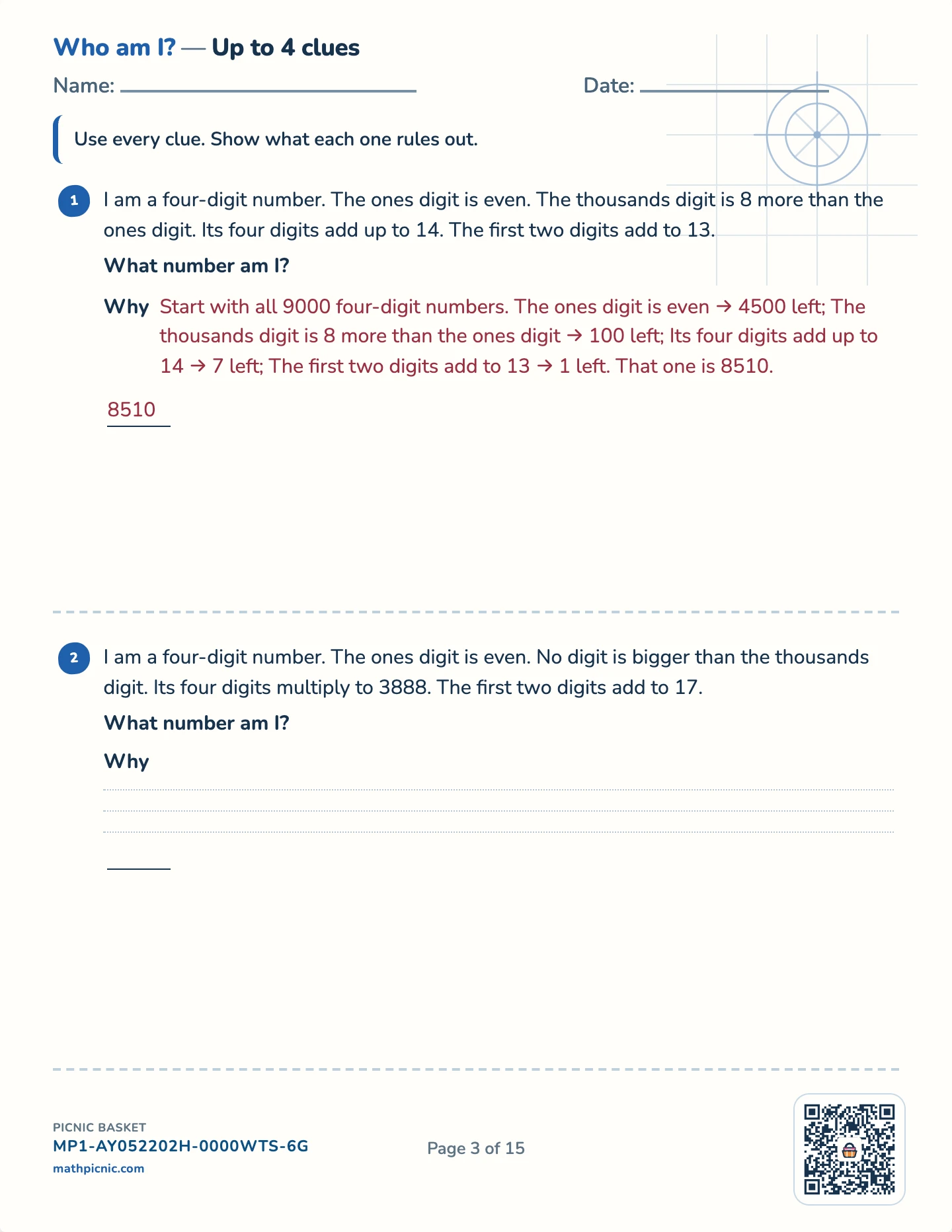
1I am a four-digit number. The ones digit is even. The thousands digit is 8 more than the ones digit. Its four digits add up to 14. The first two digits add to 13.What number am I?Why
2I am a four-digit number. The ones digit is even. No digit is bigger than the thousands digit. Its four digits multiply to 3888. The first two digits add to 17.What number am I?Why
Who am I?Up to 4 clues
Name: Date:
Use every clue. Show what each one rules out.
3I am a four-digit number. The first two digits add to 1. The ones digit is odd. Its four digits add up to 18.What number am I?Why
4I am a four-digit number. Its four digits multiply to 1008. The ones digit is even. The first two digits add to 12.What number am I?Why
Remainder puzzles3 conditions
Name: Date:
Sieve for it. Show the numbers you checked.
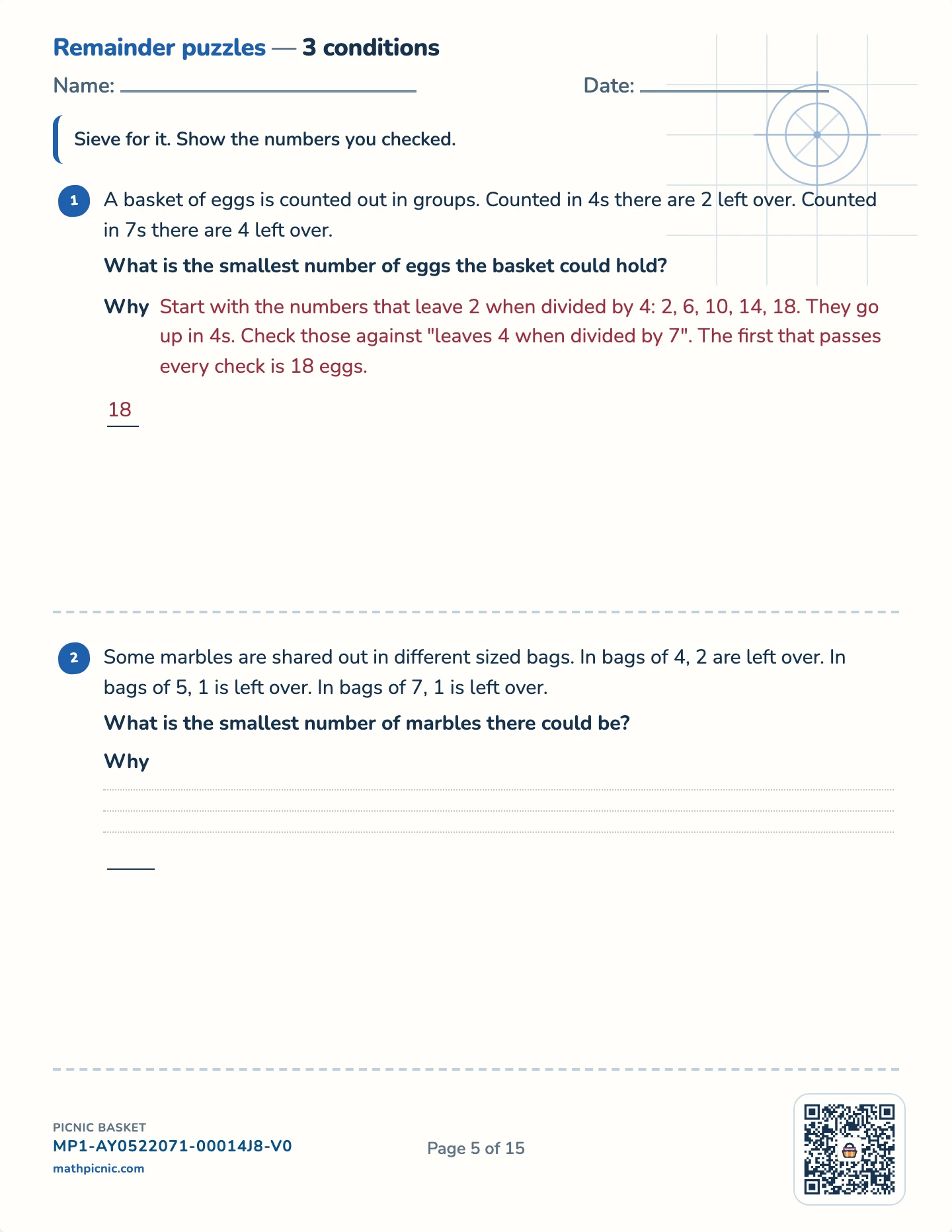
1A basket of eggs is counted out in groups. Counted in 4s there are 2 left over. Counted in 7s there are 4 left over.What is the smallest number of eggs the basket could hold?Why
2Some marbles are shared out in different sized bags. In bags of 4, 2 are left over. In bags of 5, 1 is left over. In bags of 7, 1 is left over.What is the smallest number of marbles there could be?Why
Remainder puzzles3 conditions
Name: Date:
Sieve for it. Show the numbers you checked.
3Some marbles are shared out in different sized bags. In bags of 5, 3 are left over. In bags of 8, 5 are left over.What is the smallest number of marbles there could be?Why
4Some marbles are shared out in different sized bags. In bags of 5, 4 are left over. In bags of 7, 2 are left over. In bags of 9, 2 are left over.What is the smallest number of marbles there could be?Why
Smudged sumsTotals to 70
Name: Date:
Two digits are covered in each sum. Work out what they were, and show how.
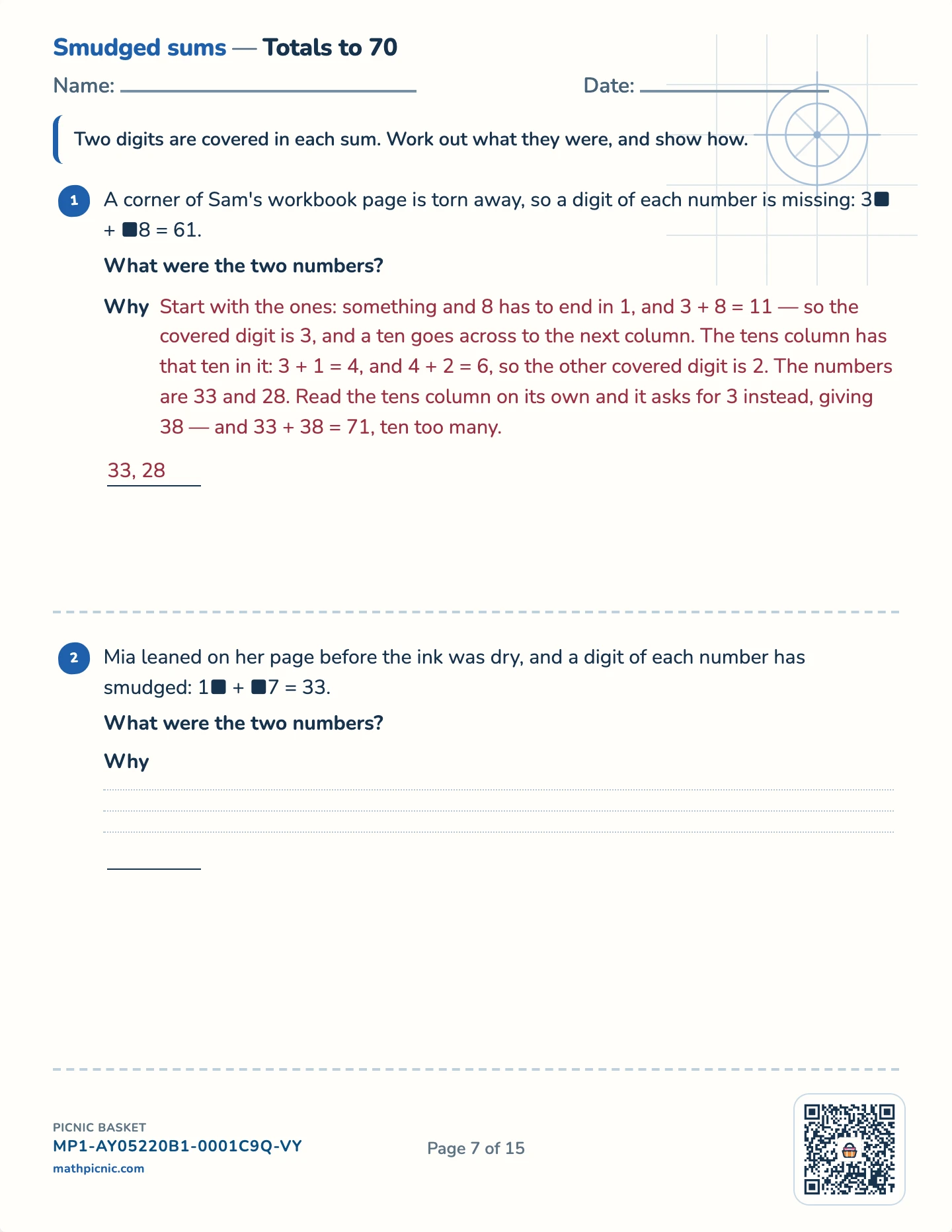
1A corner of Sam's workbook page is torn away, so a digit of each number is missing: 3■ + ■8 = 61.What were the two numbers?Why
2Mia leaned on her page before the ink was dry, and a digit of each number has smudged: 1■ + ■7 = 33.What were the two numbers?Why
Smudged sumsTotals to 70
Name: Date:
Two digits are covered in each sum. Work out what they were, and show how.
3This sum was photocopied badly and two digits came out blank: 1■ + ■8 = 52.What were the two numbers?Why
4Mia leaned on her page before the ink was dry, and a digit of each number has smudged: 4■ + ■9 = 62.What were the two numbers?Why
Square gapsNumbers up to 30
Name: Date:
Two facts each time, and neither is enough alone. Show how you narrowed it.
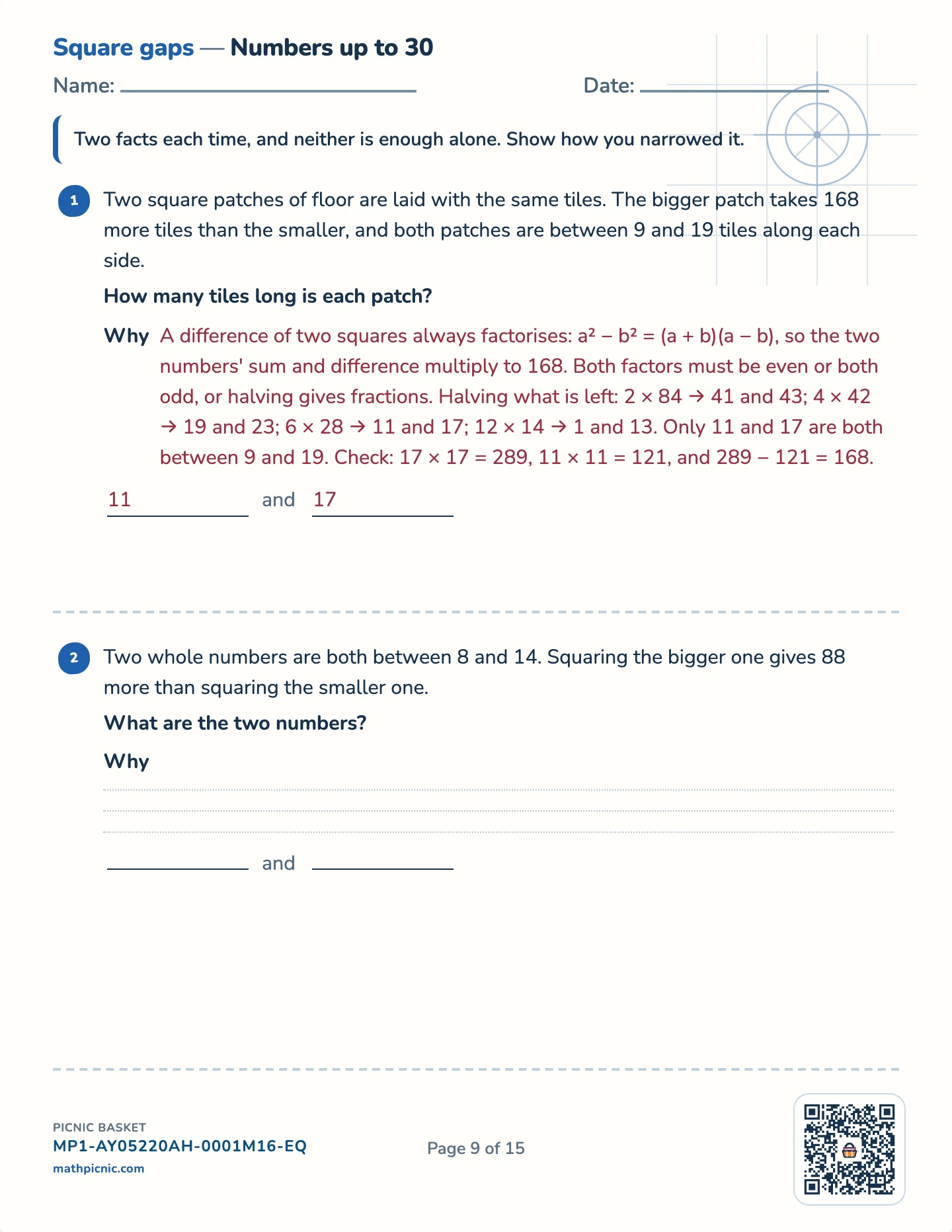
1Two square patches of floor are laid with the same tiles. The bigger patch takes 168 more tiles than the smaller, and both patches are between 9 and 19 tiles along each side.How many tiles long is each patch?Whyand
2Two whole numbers are both between 8 and 14. Squaring the bigger one gives 88 more than squaring the smaller one.What are the two numbers?Whyand
Square gapsNumbers up to 30
Name: Date:
Two facts each time, and neither is enough alone. Show how you narrowed it.
3Two square gardens sit side by side. The bigger one covers 493 square meters more than the smaller one, and both have sides that are a whole number of meters between 4 and 26.How long is each side?Whyand
4A carpenter has two square boards. The larger has 208 square centimeters more surface than the smaller, and each side is a whole number of centimeters between 6 and 18.How long is the side of each board?Whyand
Off-by-one puzzles3 kinds
Name: Date:
Decide whether you want the things or the gaps. Show your working.
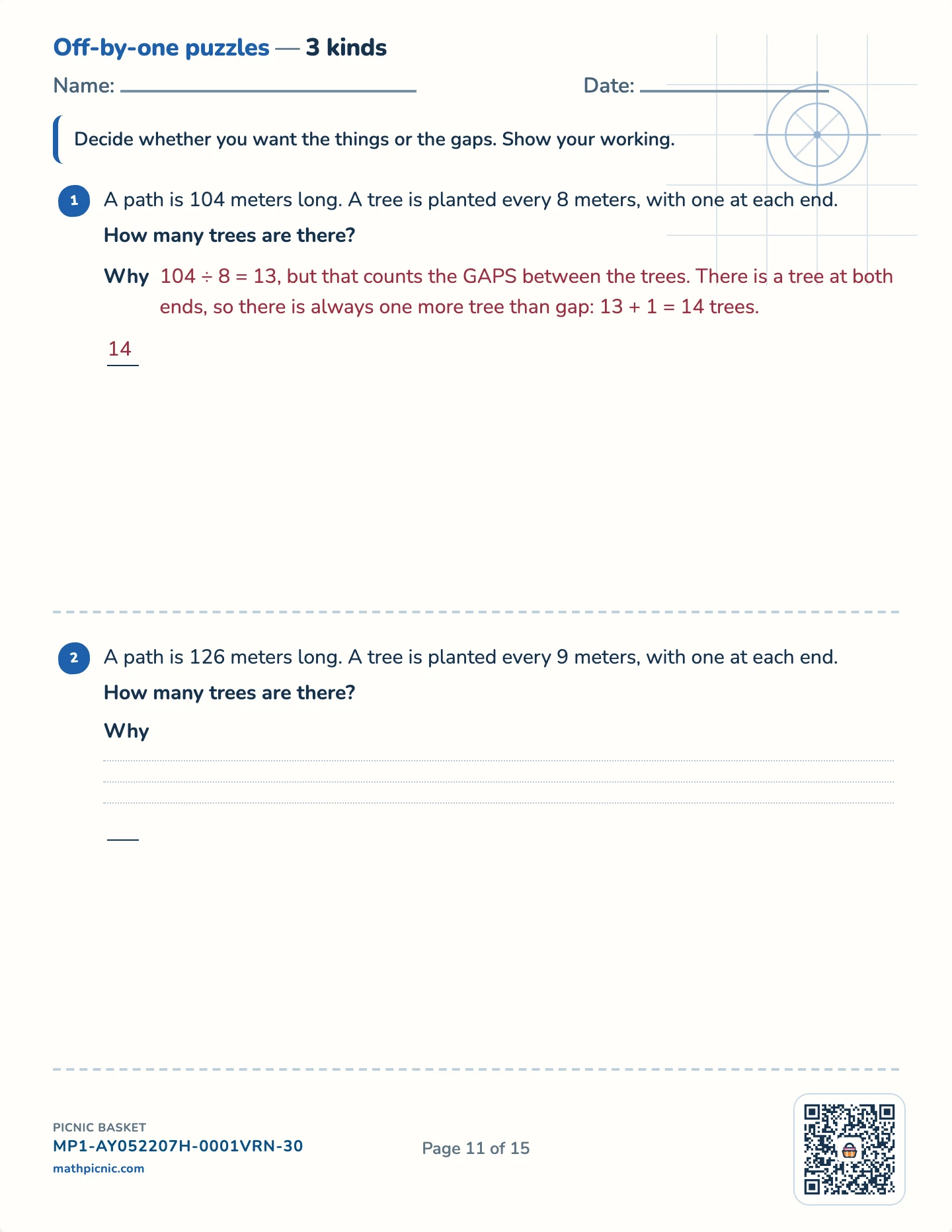
1A path is 104 meters long. A tree is planted every 8 meters, with one at each end.How many trees are there?Why
2A path is 126 meters long. A tree is planted every 9 meters, with one at each end.How many trees are there?Why
Off-by-one puzzles3 kinds
Name: Date:
Decide whether you want the things or the gaps. Show your working.
3A log is sawn into 13 equal pieces.How many cuts does that take?Why
4A fence is 88 meters long. A post goes every 8 meters, starting 8 meters in from the left-hand end and finishing at the right-hand end.How many posts are there?Why
Power Pack · Number puzzlesAnswer key
GCF and LCM
1. Both numbers are multiples of 6, so they are 6×m and 6×n. Their LCM is 6 × m × n, so m × n = 252 ÷ 6 = 42. m and n share no factor, or the GCF would be more than 6. The coprime pairs multiplying to 42 give 6 and 252, 12 and 126, 18 and 84, 36 and 42. Of those, only 36 and 42 are under 50. More than one way works here: the GCF times the LCM is the two numbers multiplied, 6 × 252 = 1512, so the same pairs turn up as the factor pairs of 1512.2. Both numbers are multiples of 9, so they are 9×m and 9×n. Their LCM is 9 × m × n, so m × n = 108 ÷ 9 = 12. m and n share no factor, or the GCF would be more than 9. The coprime pairs multiplying to 12 give 9 and 108, 27 and 36. Of those, only 27 and 36 are over 10. More than one way works here: the GCF times the LCM is the two numbers multiplied, 9 × 108 = 972, so the same pairs turn up as the factor pairs of 972.3. Both numbers are multiples of 2, so they are 2×m and 2×n. Their LCM is 2 × m × n, so m × n = 70 ÷ 2 = 35. m and n share no factor, or the GCF would be more than 2. The coprime pairs multiplying to 35 give 2 and 70, 10 and 14. Of those, only 10 and 14 have two digits. More than one way works here: the GCF times the LCM is the two numbers multiplied, 2 × 70 = 140, so the same pairs turn up as the factor pairs of 140.4. Both numbers are multiples of 10, so they are 10×m and 10×n. Their LCM is 10 × m × n, so m × n = 120 ÷ 10 = 12. m and n share no factor, or the GCF would be more than 10. The coprime pairs multiplying to 12 give 10 and 120, 30 and 40. Of those, only 30 and 40 are over 10. More than one way works here: the GCF times the LCM is the two numbers multiplied, 10 × 120 = 1200, so the same pairs turn up as the factor pairs of 1200.
Four-digit numbers
1. Start with all 9000 four-digit numbers. The ones digit is even → 4500 left; The thousands digit is 8 more than the ones digit → 100 left; Its four digits add up to 14 → 7 left; The first two digits add to 13 → 1 left. That one is 8510.2. Start with all 9000 four-digit numbers. The ones digit is even → 4500 left; No digit is bigger than the thousands digit → 1594 left; Its four digits multiply to 3888 → 4 left; The first two digits add to 17 → 1 left. That one is 9896.3. Start with all 9000 four-digit numbers. The first two digits add to 1 → 100 left; The ones digit is odd → 50 left; Its four digits add up to 18 → 1 left. That one is 1089.4. Start with all 9000 four-digit numbers. Its four digits multiply to 1008 → 72 left; The ones digit is even → 39 left; The first two digits add to 12 → 1 left. That one is 6674.
Power Pack · Number puzzlesAnswer key
A number from its remainders
1. Start with the numbers that leave 2 when divided by 4: 2, 6, 10, 14, 18. They go up in 4s. Check those against "leaves 4 when divided by 7". The first that passes every check is 18 eggs.2. Start with the numbers that leave 2 when divided by 4: 2, 6, 10, 14, 18, 22, and so on. They go up in 4s. Check those against "leaves 1 when divided by 5" — the survivors go up in 20s; check those against "leaves 1 when divided by 7". The first that passes every check is 106 marbles.3. Start with the numbers that leave 3 when divided by 5: 3, 8, 13. They go up in 5s. Check those against "leaves 5 when divided by 8". The first that passes every check is 13 marbles.4. Start with the numbers that leave 4 when divided by 5: 4, 9, 14, 19, 24, 29, and so on. They go up in 5s. Check those against "leaves 2 when divided by 7" — the survivors go up in 35s; check those against "leaves 2 when divided by 9". The first that passes every check is 254 marbles.
The smudged sum
1. Start with the ones: something and 8 has to end in 1, and 3 + 8 = 11 — so the covered digit is 3, and a ten goes across to the next column. The tens column has that ten in it: 3 + 1 = 4, and 4 + 2 = 6, so the other covered digit is 2. The numbers are 33 and 28. Read the tens column on its own and it asks for 3 instead, giving 38 — and 33 + 38 = 71, ten too many.2. Start with the ones: something and 7 has to end in 3, and 6 + 7 = 13 — so the covered digit is 6, and a ten goes across to the next column. The tens column has that ten in it: 1 + 1 = 2, and 2 + 1 = 3, so the other covered digit is 1. The numbers are 16 and 17. Read the tens column on its own and it asks for 2 instead, giving 27 — and 16 + 27 = 43, ten too many.3. Start with the ones: something and 8 has to end in 2, and 4 + 8 = 12 — so the covered digit is 4, and a ten goes across to the next column. The tens column has that ten in it: 1 + 1 = 2, and 2 + 3 = 5, so the other covered digit is 3. The numbers are 14 and 38. Read the tens column on its own and it asks for 4 instead, giving 48 — and 14 + 48 = 62, ten too many.4. Start with the ones: something and 9 has to end in 2, and 3 + 9 = 12 — so the covered digit is 3, and a ten goes across to the next column. The tens column has that ten in it: 4 + 1 = 5, and 5 + 1 = 6, so the other covered digit is 1. The numbers are 43 and 19. Read the tens column on its own and it asks for 2 instead, giving 29 — and 43 + 29 = 72, ten too many.
Power Pack · Number puzzlesAnswer key
The gap between two squares
1. A difference of two squares always factorises: a² − b² = (a + b)(a − b), so the two numbers' sum and difference multiply to 168. Both factors must be even or both odd, or halving gives fractions. Halving what is left: 2 × 84 → 41 and 43; 4 × 42 → 19 and 23; 6 × 28 → 11 and 17; 12 × 14 → 1 and 13. Only 11 and 17 are both between 9 and 19. Check: 17 × 17 = 289, 11 × 11 = 121, and 289 − 121 = 168.2. A difference of two squares always factorises: a² − b² = (a + b)(a − b), so the two numbers' sum and difference multiply to 88. Both factors must be even or both odd, or halving gives fractions. Halving what is left: 2 × 44 → 21 and 23; 4 × 22 → 9 and 13. Only 9 and 13 are both between 8 and 14. Check: 13 × 13 = 169, 9 × 9 = 81, and 169 − 81 = 88.3. A difference of two squares always factorises: a² − b² = (a + b)(a − b), so the two numbers' sum and difference multiply to 493. Both factors must be even or both odd, or halving gives fractions. Halving what is left: 1 × 493 → 246 and 247; 17 × 29 → 6 and 23. Only 6 and 23 are both between 4 and 26. Check: 23 × 23 = 529, 6 × 6 = 36, and 529 − 36 = 493.4. A difference of two squares always factorises: a² − b² = (a + b)(a − b), so the two numbers' sum and difference multiply to 208. Both factors must be even or both odd, or halving gives fractions. Halving what is left: 2 × 10⁴ → 51 and 53; 4 × 52 → 24 and 28; 8 × 26 → 9 and 17. Only 9 and 17 are both between 6 and 18. Check: 17 × 17 = 289, 9 × 9 = 81, and 289 − 81 = 208.
Things and the gaps between
1. 104 ÷ 8 = 13, but that counts the GAPS between the trees. There is a tree at both ends, so there is always one more tree than gap: 13 + 1 = 14 trees.2. 126 ÷ 9 = 14, but that counts the GAPS between the trees. There is a tree at both ends, so there is always one more tree than gap: 14 + 1 = 15 trees.3. Picture the log: the 13 pieces have cuts BETWEEN them, not at the ends. Four pieces need three cuts, five need four — always one fewer. So 13 pieces take 13 − 1 = 12 cuts.4. 88 ÷ 8 = 11 gaps. This time there is no post at the left-hand end, so the posts and the gaps come out equal: 11 posts. Not every one of these questions adds one.