Find how many four-legged animals. Show how you worked it out.
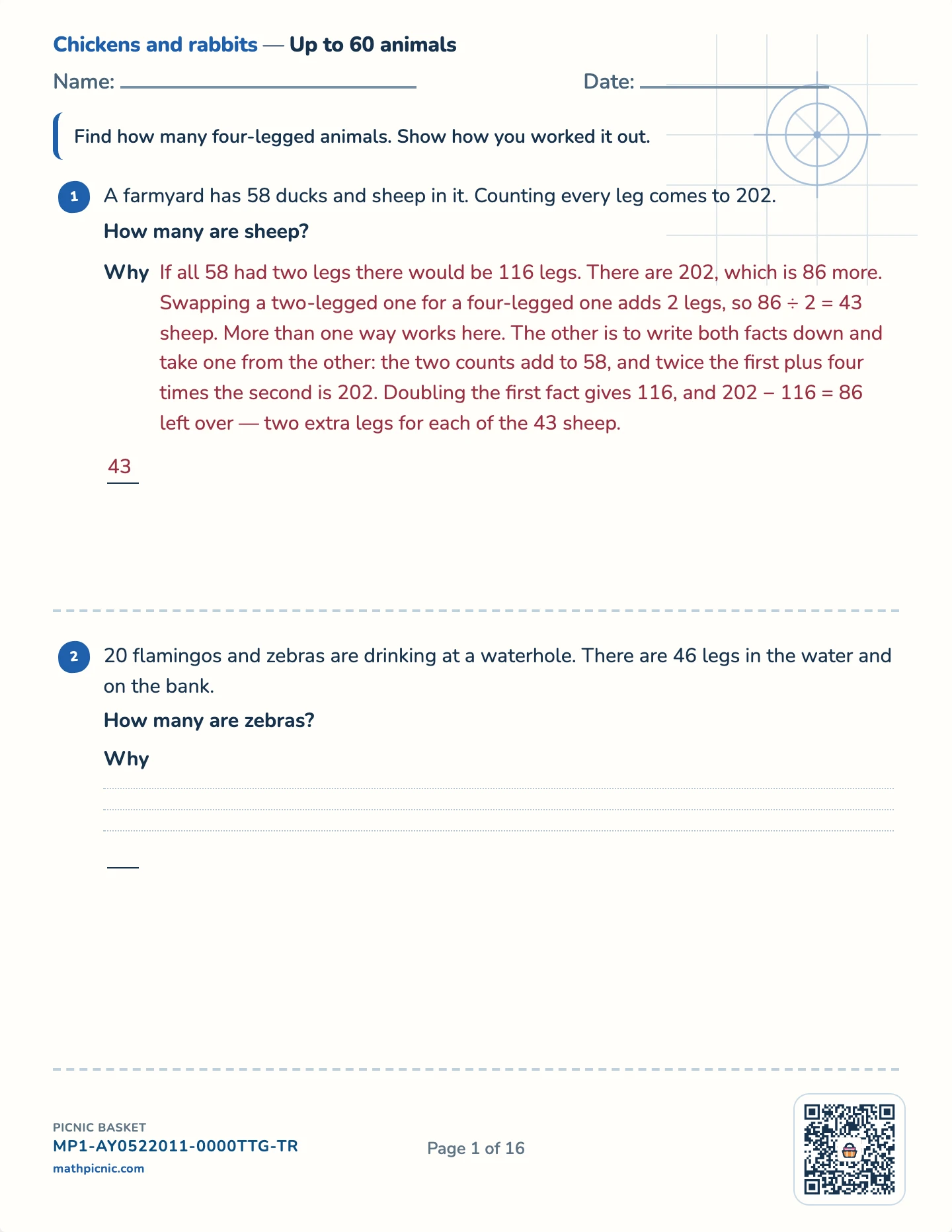
1A farmyard has 58 ducks and sheep in it. Counting every leg comes to 202.How many are sheep?Why
220 flamingos and zebras are drinking at a waterhole. There are 46 legs in the water and on the bank.How many are zebras?Why
Chickens and rabbitsUp to 60 animals
Name: Date:
Find how many four-legged animals. Show how you worked it out.
3A field holds 18 chickens and rabbits altogether. Between them they have 42 legs.How many are rabbits?Why
4A pet shop keeps 51 parrots and cats. Altogether they stand on 188 legs.How many are cats?Why
Shopping puzzlesTotals to 120c
Name: Date:
Find how many of each. Show the trials that failed.
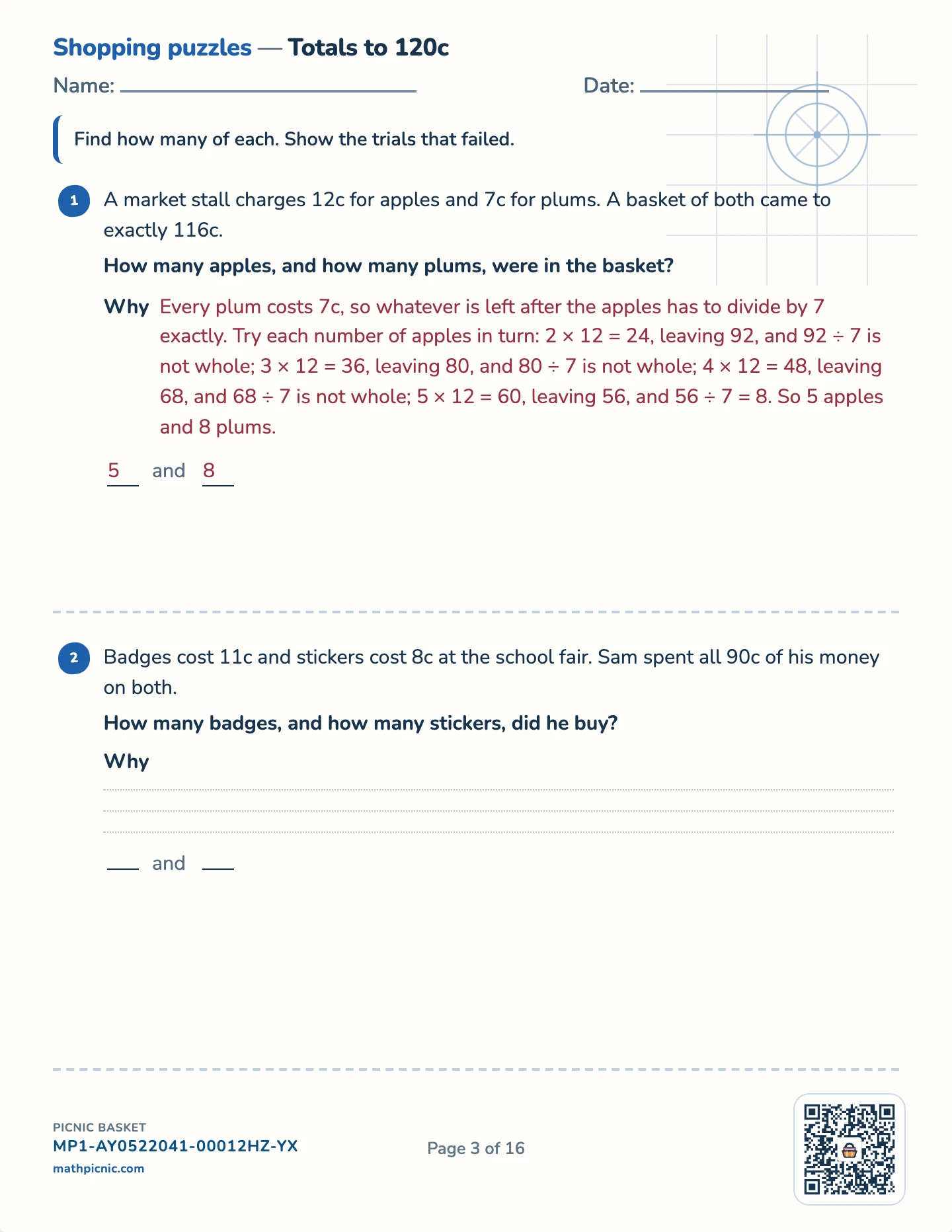
1A market stall charges 12c for apples and 7c for plums. A basket of both came to exactly 116c.How many apples, and how many plums, were in the basket?Whyand
2Badges cost 11c and stickers cost 8c at the school fair. Sam spent all 90c of his money on both.How many badges, and how many stickers, did he buy?Whyand
Shopping puzzlesTotals to 120c
Name: Date:
Find how many of each. Show the trials that failed.
3A shop sells pens at 10c each and erasers at 7c each. Mia spent exactly 119c and bought some of both.How many pens, and how many erasers, did she buy?Whyand
4Kites are 8c each and ribbons are 7c each. A club spent exactly 91c and took some of each.How many kites, and how many ribbons, did they take?Whyand
Sharing puzzlesTotals to 120
Name: Date:
Find the smallest share. Show how you worked it out.
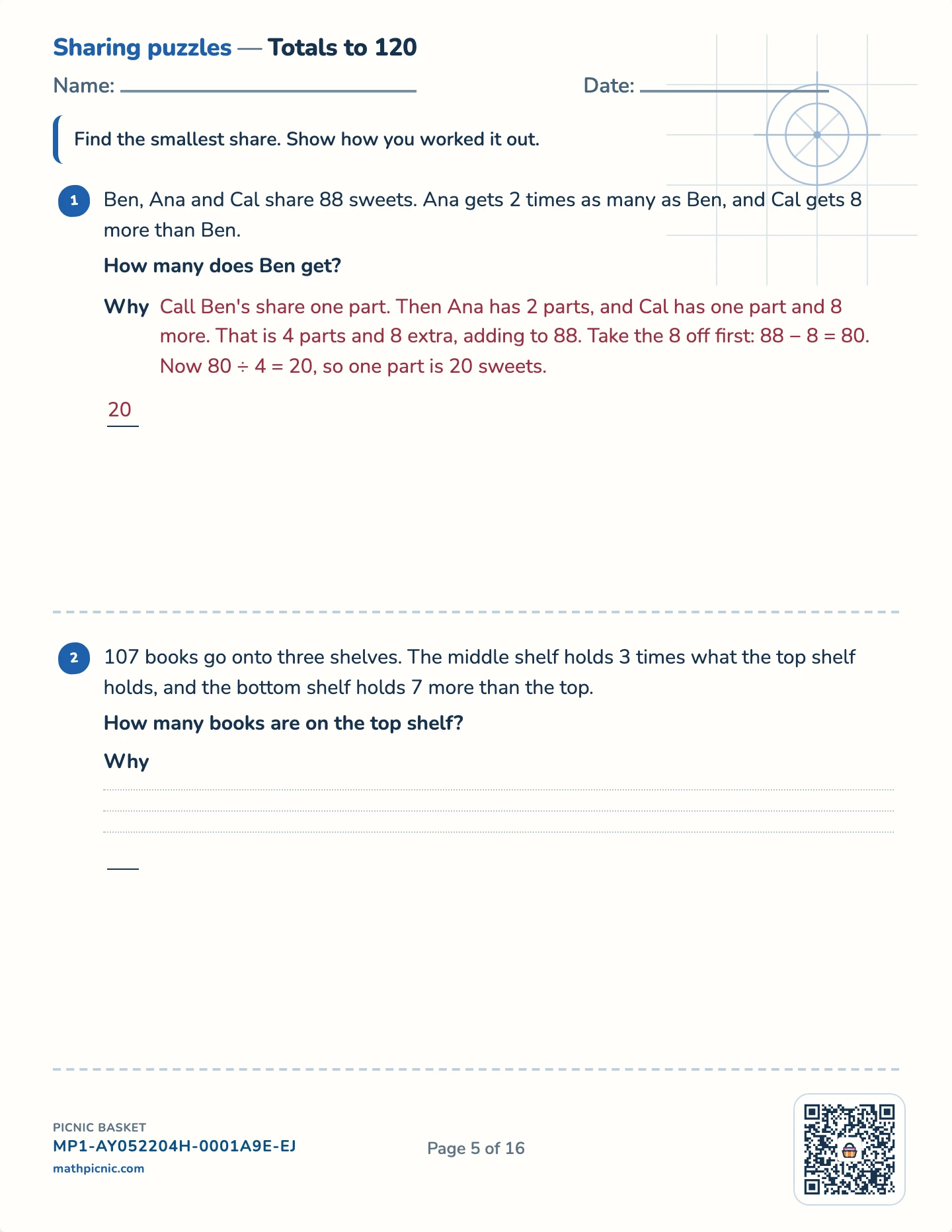
1Ben, Ana and Cal share 88 sweets. Ana gets 2 times as many as Ben, and Cal gets 8 more than Ben.How many does Ben get?Why
2107 books go onto three shelves. The middle shelf holds 3 times what the top shelf holds, and the bottom shelf holds 7 more than the top.How many books are on the top shelf?Why
Sharing puzzlesTotals to 120
Name: Date:
Find the smallest share. Show how you worked it out.
3A prize of 64 tokens is split between Iris, Jon and Kit. Jon takes 2 times Iris's share, and Kit takes 8 more than Iris.How many tokens does Iris get?Why
4Three teams pick 116 apples between them. Blue picks 4 times as many as Red, and Green picks 2 more than Red.How many does Red pick?Why
Sum & differenceTotals to 30
Name: Date:
Find the two numbers. Show how you worked them out.
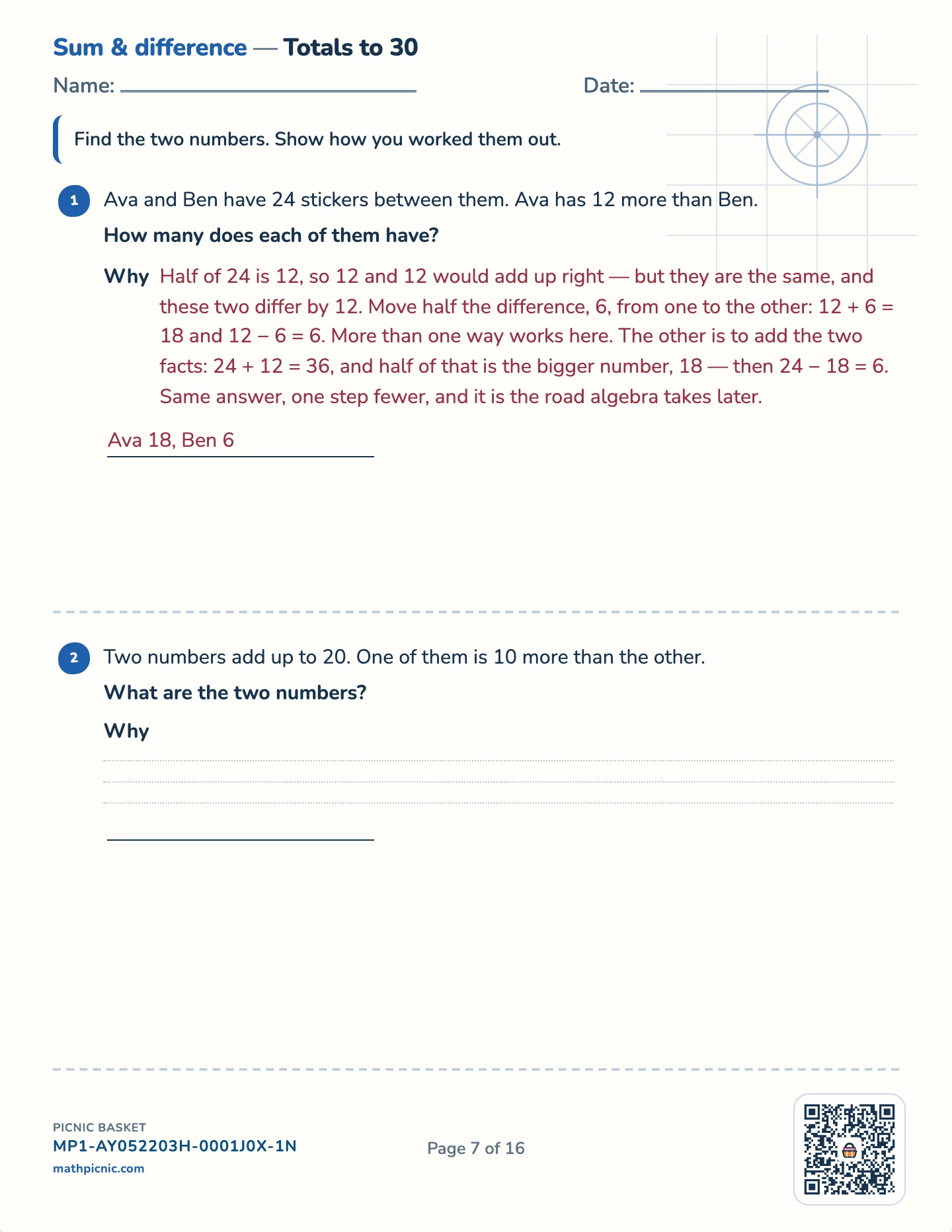
1Ava and Ben have 24 stickers between them. Ava has 12 more than Ben.How many does each of them have?Why
2Two numbers add up to 20. One of them is 10 more than the other.What are the two numbers?Why
Sum & differenceTotals to 30
Name: Date:
Find the two numbers. Show how you worked them out.
3A shelf holds 24 books on two rows. The top row has 6 more than the bottom row.How many books are on each row?Why
4Two baskets hold 20 apples altogether. One basket has 2 more apples than the other.How many apples are in each basket?Why
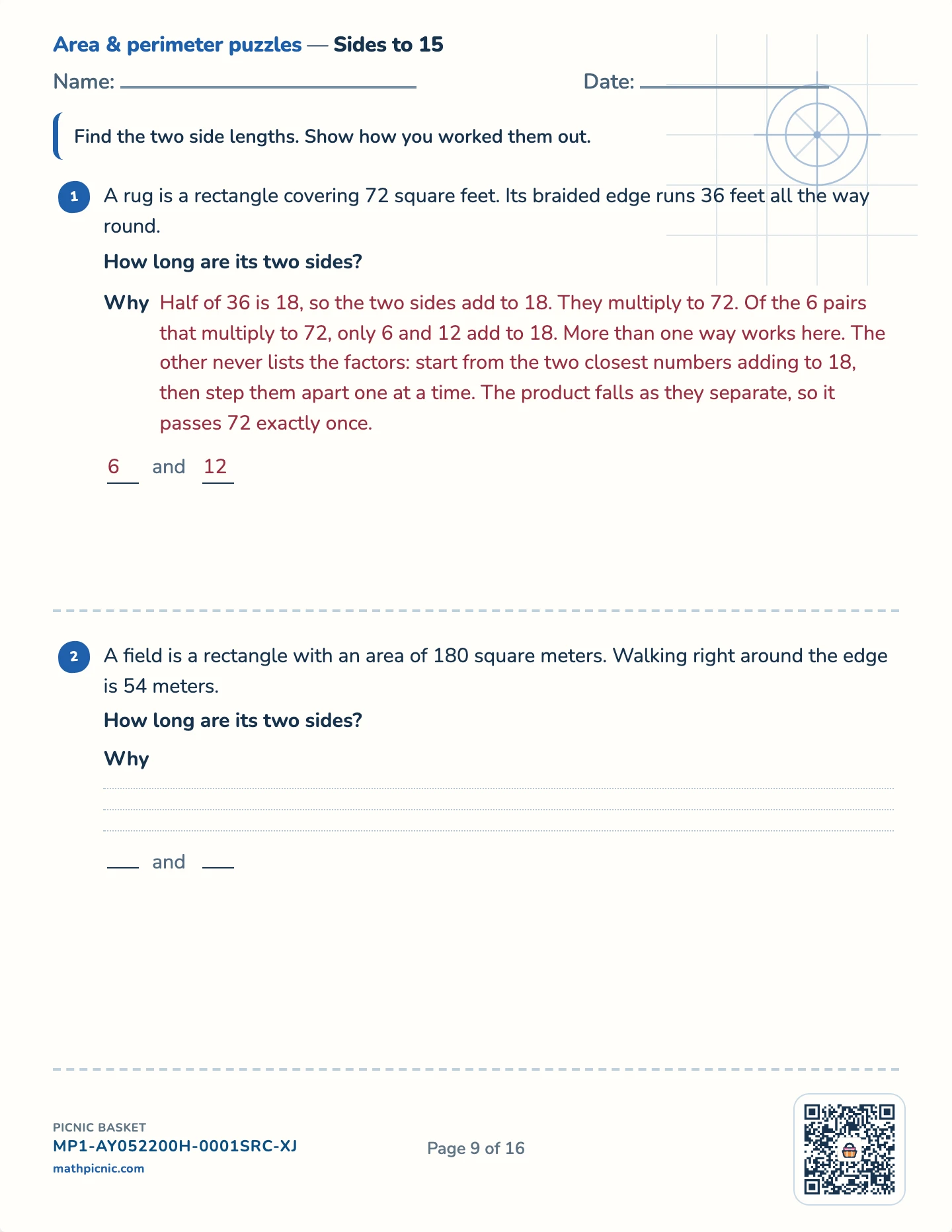
Area & perimeter puzzlesSides to 15
Name: Date:
Find the two side lengths. Show how you worked them out.
1A rug is a rectangle covering 72 square feet. Its braided edge runs 36 feet all the way round.How long are its two sides?Whyand
2A field is a rectangle with an area of 180 square meters. Walking right around the edge is 54 meters.How long are its two sides?Whyand
Area & perimeter puzzlesSides to 15
Name: Date:
Find the two side lengths. Show how you worked them out.
3A rug is a rectangle covering 165 square feet. Its braided edge runs 52 feet all the way round.How long are its two sides?Whyand
4A poster is a rectangle. Its face is 48 square centimeters, and the ribbon around its border is 28 centimeters.How long are its two sides?Whyand
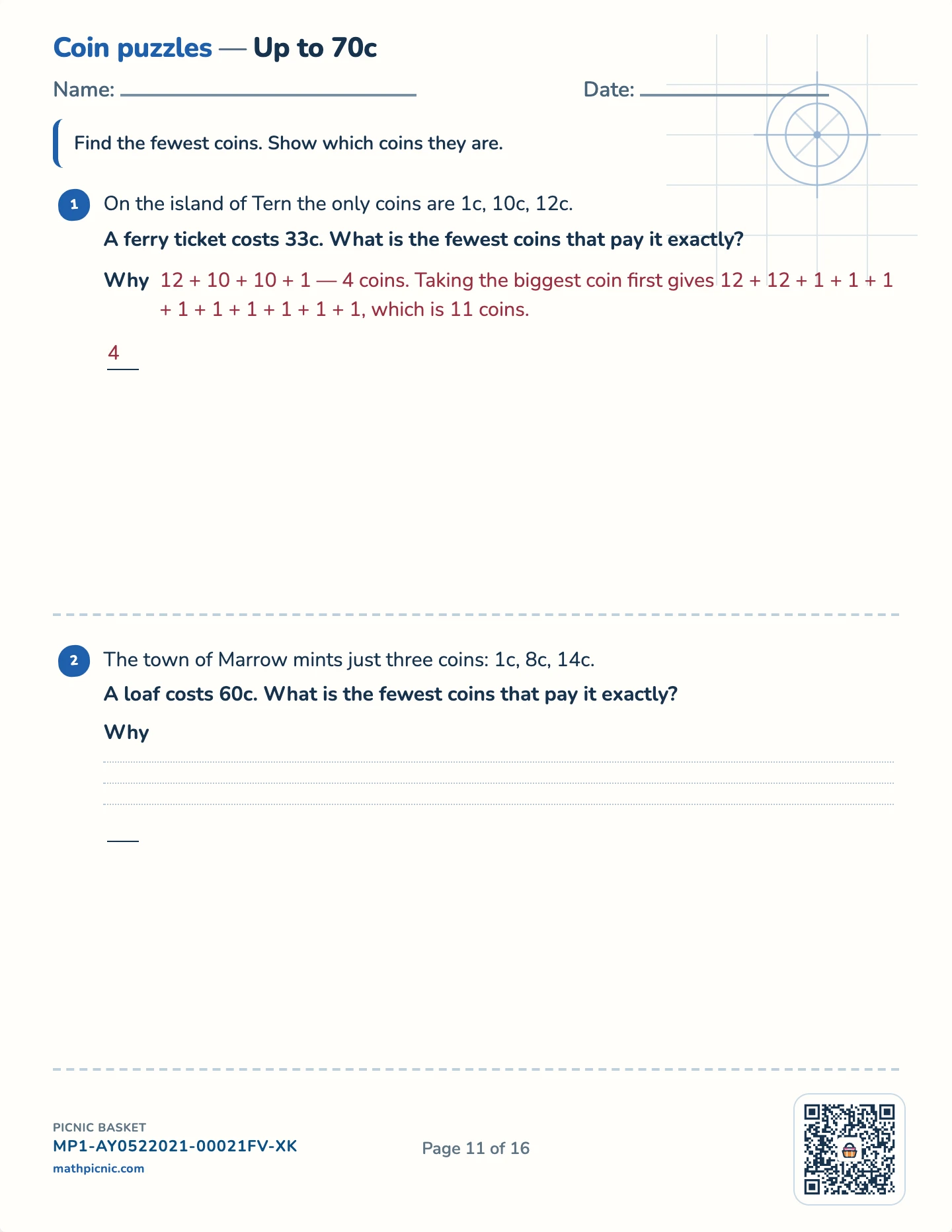
Coin puzzlesUp to 70c
Name: Date:
Find the fewest coins. Show which coins they are.
1On the island of Tern the only coins are 1c, 10c, 12c.A ferry ticket costs 33c. What is the fewest coins that pay it exactly?Why
2The town of Marrow mints just three coins: 1c, 8c, 14c.A loaf costs 60c. What is the fewest coins that pay it exactly?Why
Coin puzzlesUp to 70c
Name: Date:
Find the fewest coins. Show which coins they are.
3A machine takes only 1c, 7c, 18c tokens and gives no change.A ride costs 47c. What is the fewest tokens that pay it exactly?Why
4A market on Tern gives no change, and its coins come in 1c, 4c, 5c only.A basket comes to 48c. What is the fewest coins that pay it exactly?Why
Power Pack · Two-unknown puzzlesAnswer key
Chickens and rabbits
1. If all 58 had two legs there would be 116 legs. There are 202, which is 86 more. Swapping a two-legged one for a four-legged one adds 2 legs, so 86 ÷ 2 = 43 sheep. More than one way works here. The other is to write both facts down and take one from the other: the two counts add to 58, and twice the first plus four times the second is 202. Doubling the first fact gives 116, and 202 − 116 = 86 left over — two extra legs for each of the 43 sheep.2. If all 20 had two legs there would be 40 legs. There are 46, which is 6 more. Swapping a two-legged one for a four-legged one adds 2 legs, so 6 ÷ 2 = 3 zebras. More than one way works here. The other is to write both facts down and take one from the other: the two counts add to 20, and twice the first plus four times the second is 46. Doubling the first fact gives 40, and 46 − 40 = 6 left over — two extra legs for each of the 3 zebras.3. If all 18 had two legs there would be 36 legs. There are 42, which is 6 more. Swapping a two-legged one for a four-legged one adds 2 legs, so 6 ÷ 2 = 3 rabbits. More than one way works here. The other is to write both facts down and take one from the other: the two counts add to 18, and twice the first plus four times the second is 42. Doubling the first fact gives 36, and 42 − 36 = 6 left over — two extra legs for each of the 3 rabbits.4. If all 51 had two legs there would be 102 legs. There are 188, which is 86 more. Swapping a two-legged one for a four-legged one adds 2 legs, so 86 ÷ 2 = 43 cats. More than one way works here. The other is to write both facts down and take one from the other: the two counts add to 51, and twice the first plus four times the second is 188. Doubling the first fact gives 102, and 188 − 102 = 86 left over — two extra legs for each of the 43 cats.
Power Pack · Two-unknown puzzlesAnswer key
One equation, two unknowns
1. Every plum costs 7c, so whatever is left after the apples has to divide by 7 exactly. Try each number of apples in turn: 2 × 12 = 24, leaving 92, and 92 ÷ 7 is not whole; 3 × 12 = 36, leaving 80, and 80 ÷ 7 is not whole; 4 × 12 = 48, leaving 68, and 68 ÷ 7 is not whole; 5 × 12 = 60, leaving 56, and 56 ÷ 7 = 8. So 5 apples and 8 plums.2. Every sticker costs 8c, so whatever is left after the badges has to divide by 8 exactly. Try each number of badges in turn: 2 × 11 = 22, leaving 68, and 68 ÷ 8 is not whole; 3 × 11 = 33, leaving 57, and 57 ÷ 8 is not whole; 4 × 11 = 44, leaving 46, and 46 ÷ 8 is not whole; 5 × 11 = 55, leaving 35, and 35 ÷ 8 is not whole; 6 × 11 = 66, leaving 24, and 24 ÷ 8 = 3. So 6 badges and 3 stickers.3. Every eraser costs 7c, so whatever is left after the pens has to divide by 7 exactly. Try each number of pens in turn: 2 × 10 = 20, leaving 99, and 99 ÷ 7 is not whole; 3 × 10 = 30, leaving 89, and 89 ÷ 7 is not whole; 4 × 10 = 40, leaving 79, and 79 ÷ 7 is not whole; 5 × 10 = 50, leaving 69, and 69 ÷ 7 is not whole; 6 × 10 = 60, leaving 59, and 59 ÷ 7 is not whole; 7 × 10 = 70, leaving 49, and 49 ÷ 7 = 7. So 7 pens and 7 erasers.4. Every ribbon costs 7c, so whatever is left after the kites has to divide by 7 exactly. Try each number of kites in turn: 2 × 8 = 16, leaving 75, and 75 ÷ 7 is not whole; 3 × 8 = 24, leaving 67, and 67 ÷ 7 is not whole; 4 × 8 = 32, leaving 59, and 59 ÷ 7 is not whole; 5 × 8 = 40, leaving 51, and 51 ÷ 7 is not whole; 6 × 8 = 48, leaving 43, and 43 ÷ 7 is not whole; 7 × 8 = 56, leaving 35, and 35 ÷ 7 = 5. So 7 kites and 5 ribbons.
Three shares from one total
1. Call Ben's share one part. Then Ana has 2 parts, and Cal has one part and 8 more. That is 4 parts and 8 extra, adding to 88. Take the 8 off first: 88 − 8 = 80. Now 80 ÷ 4 = 20, so one part is 20 sweets.2. Call the top shelf's share one part. Then the middle shelf has 3 parts, and the bottom shelf has one part and 7 more. That is 5 parts and 7 extra, adding to 107. Take the 7 off first: 107 − 7 = 100. Now 100 ÷ 5 = 20, so one part is 20 books.3. Call Iris's share one part. Then Jon has 2 parts, and Kit has one part and 8 more. That is 4 parts and 8 extra, adding to 64. Take the 8 off first: 64 − 8 = 56. Now 56 ÷ 4 = 14, so one part is 14 tokens.4. Call Red's share one part. Then Blue has 4 parts, and Green has one part and 2 more. That is 6 parts and 2 extra, adding to 116. Take the 2 off first: 116 − 2 = 114. Now 114 ÷ 6 = 19, so one part is 19 apples.
Power Pack · Two-unknown puzzlesAnswer key
Sum and difference
1. Half of 24 is 12, so 12 and 12 would add up right — but they are the same, and these two differ by 12. Move half the difference, 6, from one to the other: 12 + 6 = 18 and 12 − 6 = 6. More than one way works here. The other is to add the two facts: 24 + 12 = 36, and half of that is the bigger number, 18 — then 24 − 18 = 6. Same answer, one step fewer, and it is the road algebra takes later.2. Half of 20 is 10, so 10 and 10 would add up right — but they are the same, and these two differ by 10. Move half the difference, 5, from one to the other: 10 + 5 = 15 and 10 − 5 = 5. More than one way works here. The other is to add the two facts: 20 + 10 = 30, and half of that is the bigger number, 15 — then 20 − 15 = 5. Same answer, one step fewer, and it is the road algebra takes later.3. Half of 24 is 12, so 12 and 12 would add up right — but they are the same, and these two differ by 6. Move half the difference, 3, from one to the other: 12 + 3 = 15 and 12 − 3 = 9. More than one way works here. The other is to add the two facts: 24 + 6 = 30, and half of that is the bigger number, 15 — then 24 − 15 = 9. Same answer, one step fewer, and it is the road algebra takes later.4. Half of 20 is 10, so 10 and 10 would add up right — but they are the same, and these two differ by 2. Move half the difference, 1, from one to the other: 10 + 1 = 11 and 10 − 1 = 9. More than one way works here. The other is to add the two facts: 20 + 2 = 22, and half of that is the bigger number, 11 — then 20 − 11 = 9. Same answer, one step fewer, and it is the road algebra takes later.
A rectangle from its area and perimeter
1. Half of 36 is 18, so the two sides add to 18. They multiply to 72. Of the 6 pairs that multiply to 72, only 6 and 12 add to 18. More than one way works here. The other never lists the factors: start from the two closest numbers adding to 18, then step them apart one at a time. The product falls as they separate, so it passes 72 exactly once.2. Half of 54 is 27, so the two sides add to 27. They multiply to 180. Of the 9 pairs that multiply to 180, only 12 and 15 add to 27. More than one way works here. The other never lists the factors: start from the two closest numbers adding to 27, then step them apart one at a time. The product falls as they separate, so it passes 180 exactly once.3. Half of 52 is 26, so the two sides add to 26. They multiply to 165. Of the 4 pairs that multiply to 165, only 11 and 15 add to 26. More than one way works here. The other never lists the factors: start from the two closest numbers adding to 26, then step them apart one at a time. The product falls as they separate, so it passes 165 exactly once.4. Half of 28 is 14, so the two sides add to 14. They multiply to 48. Of the 5 pairs that multiply to 48, only 6 and 8 add to 14. More than one way works here. The other never lists the factors: start from the two closest numbers adding to 14, then step them apart one at a time. The product falls as they separate, so it passes 48 exactly once.