An ordinary GCF question can be started the moment it is read. This one cannot: you are given the greatest common factor, the least common multiple and a range, and no one of those three facts is enough on its own. The arithmetic is the same arithmetic — what changes is that there is something to work out before you can begin.
Running the question backwards is what makes it a puzzle. Both numbers must be multiples of the GCF, so they are GCF×m and GCF×n; their least common multiple is GCF×m×n, so m and n multiply to LCM ÷ GCF; and m and n can share no factor, or the GCF would have been bigger than the one you were given. That last clause is the whole idea, and it is the step a child has to find rather than recall.
Why this sheet works
The trap is measured rather than decorated. The pair (GCF, LCM) itself always satisfies both headline facts — the GCF of 5 and 30 really is 5, and their LCM really is 30 — so a reader who treats the range as decoration writes down an answer that is wrong for a reason worth discussing. Every question on the sheet has that trap in it, and the range is always what rules it out.
How this one works
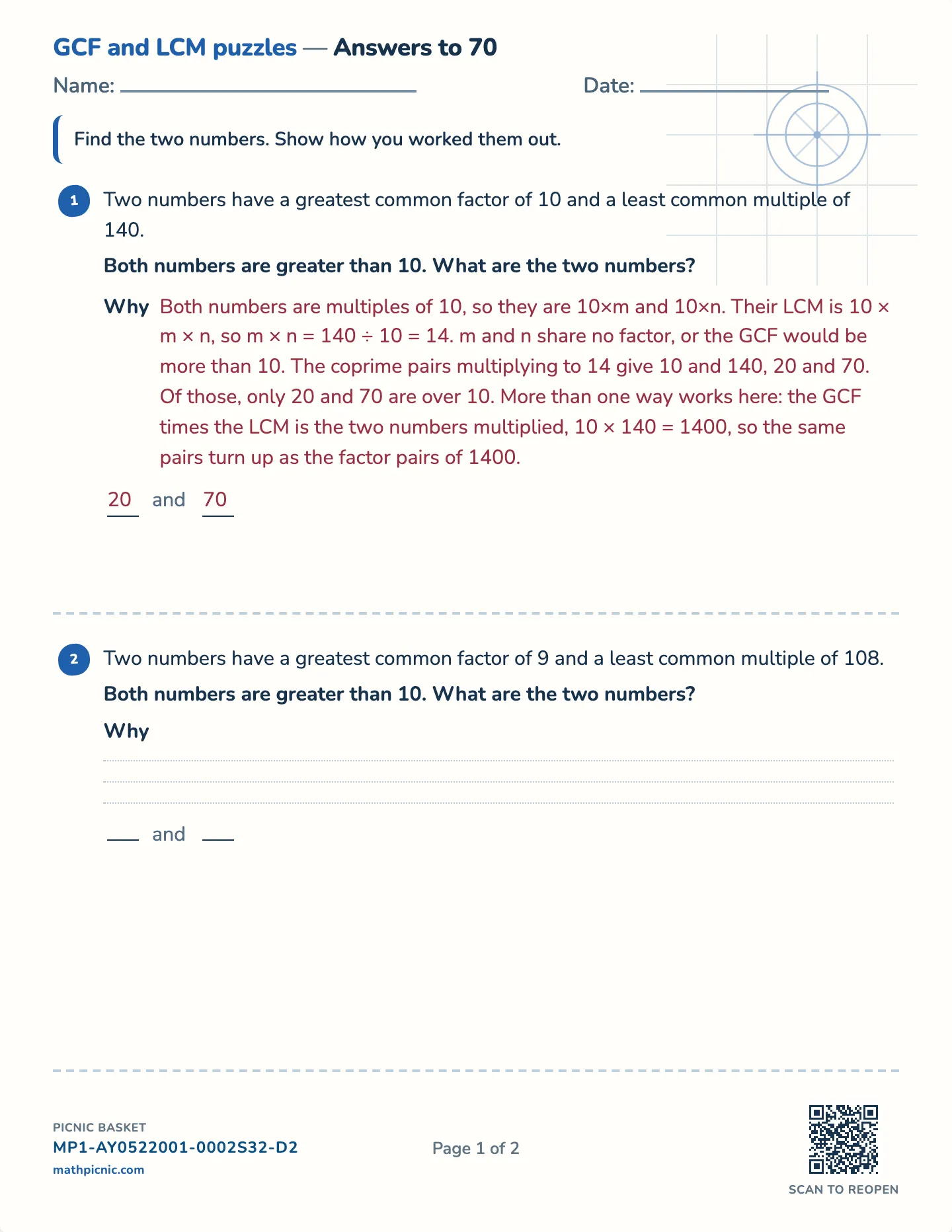
One question from a sheet like this one, worked a step at a time — with a sentence saying what just happened and why.
Find the two numbers. Show how you worked them out.
1Two numbers have a greatest common factor of 10 and a least common multiple of 140.Both numbers are greater than 10. What are the two numbers?Whyand
2Two numbers have a greatest common factor of 9 and a least common multiple of 108.Both numbers are greater than 10. What are the two numbers?Whyand
GCF and LCM puzzlesAnswers to 70
Name: Date:
Find the two numbers. Show how you worked them out.
3Two numbers have a greatest common factor of 1 and a least common multiple of 50.Both numbers are less than 50. What are the two numbers?Whyand
4Two numbers have a greatest common factor of 6 and a least common multiple of 252.Both numbers are less than 50. What are the two numbers?Whyand
GCF and LCM puzzles · Answers to 70Answer key
1. Both numbers are multiples of 10, so they are 10×m and 10×n. Their LCM is 10 × m × n, so m × n = 140 ÷ 10 = 14. m and n share no factor, or the GCF would be more than 10. The coprime pairs multiplying to 14 give 10 and 140, 20 and 70. Of those, only 20 and 70 are over 10. More than one way works here: the GCF times the LCM is the two numbers multiplied, 10 × 140 = 1400, so the same pairs turn up as the factor pairs of 1400.2. Both numbers are multiples of 9, so they are 9×m and 9×n. Their LCM is 9 × m × n, so m × n = 108 ÷ 9 = 12. m and n share no factor, or the GCF would be more than 9. The coprime pairs multiplying to 12 give 9 and 108, 27 and 36. Of those, only 27 and 36 are over 10. More than one way works here: the GCF times the LCM is the two numbers multiplied, 9 × 108 = 972, so the same pairs turn up as the factor pairs of 972.3. Both numbers are multiples of 1, so they are 1×m and 1×n. Their LCM is 1 × m × n, so m × n = 50 ÷ 1 = 50. m and n share no factor, or the GCF would be more than 1. The coprime pairs multiplying to 50 give 1 and 50, 2 and 25. Of those, only 2 and 25 are under 50. More than one way works here: the GCF times the LCM is the two numbers multiplied, 1 × 50 = 50, so the same pairs turn up as the factor pairs of 50.4. Both numbers are multiples of 6, so they are 6×m and 6×n. Their LCM is 6 × m × n, so m × n = 252 ÷ 6 = 42. m and n share no factor, or the GCF would be more than 6. The coprime pairs multiplying to 42 give 6 and 252, 12 and 126, 18 and 84, 36 and 42. Of those, only 36 and 42 are under 50. More than one way works here: the GCF times the LCM is the two numbers multiplied, 6 × 252 = 1512, so the same pairs turn up as the factor pairs of 1512.