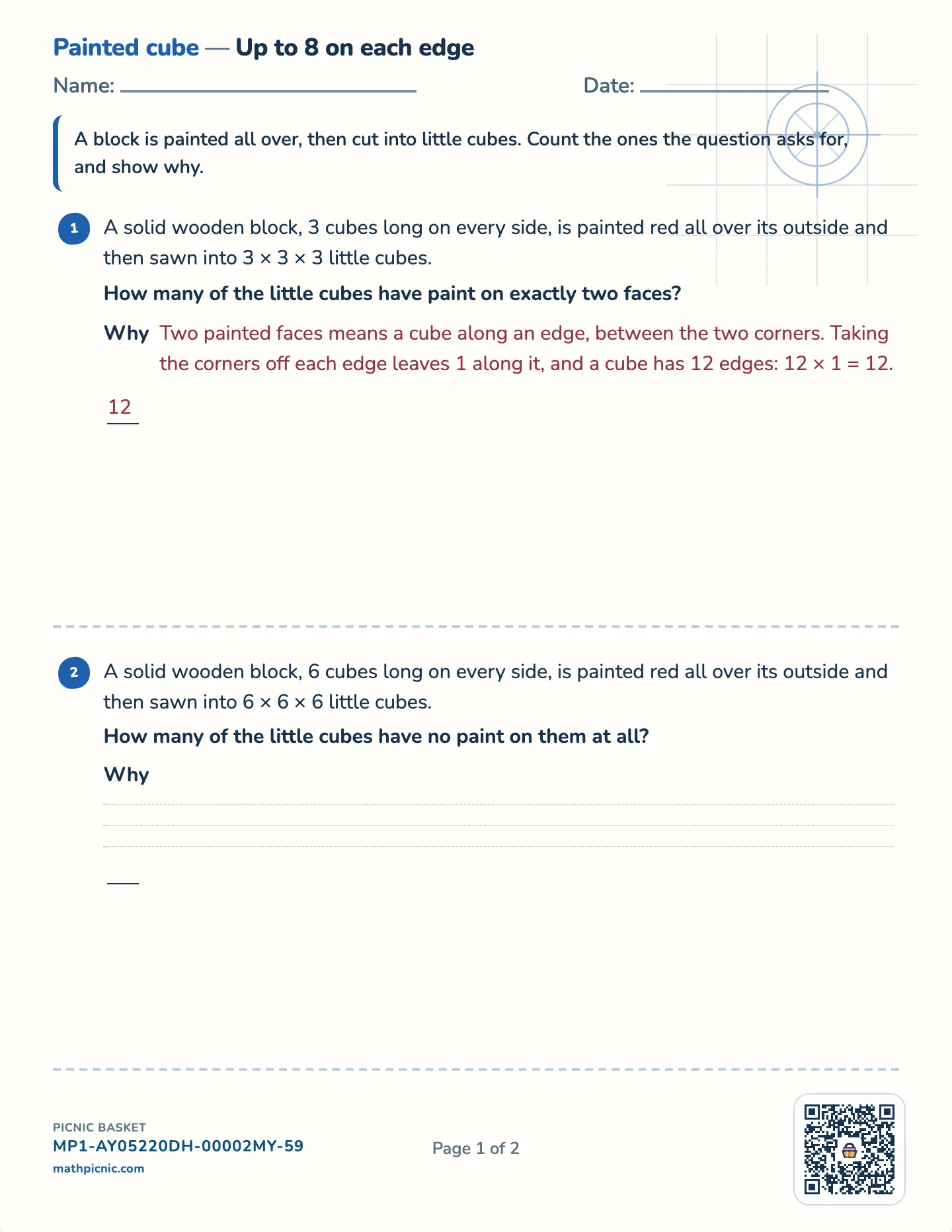
Painted cubeUp to 8 on each edge
A block is painted all over, then cut into little cubes. Count the ones the question asks for, and show why.
A wooden block is painted all over and sawn into little cubes. A few come out with three painted faces, most with fewer, some with none at all — and how many of each is fixed entirely by where the cube sat, not by counting them one at a time.

The answer key prints on a separate page.
Every little cube's paint is decided by its position, and there are only four kinds. The eight corners carry three painted faces — always eight, whatever the block's size. Along each of the twelve edges, between the corners, sit the cubes with two faces; in the middle of each of the six faces, the cubes with one; and buried inside, touching nothing, the cubes with none. Peel the painted shell off and what is left is a smaller cube, two shorter on every side — and each count is a product built from it.
The mistake almost everyone makes is to use the block's whole size where the answer needs the size minus two. Twelve edges times the full side over-counts, because the two corners on each edge were already spoken for; six faces times the full face counts the edges twice. The sheet is built so the shell cannot be skipped — once a child sees that the corners and edges must come off before the middle is counted, all four numbers fall out of the same small cube.
One question from a sheet like this one, worked a step at a time — with a sentence saying what just happened and why.
The painted cube, step by step