Challenge puzzles
If they are stuck: Doubling stops working. Count the cuts, then the pairs of cuts that cross, then add one.
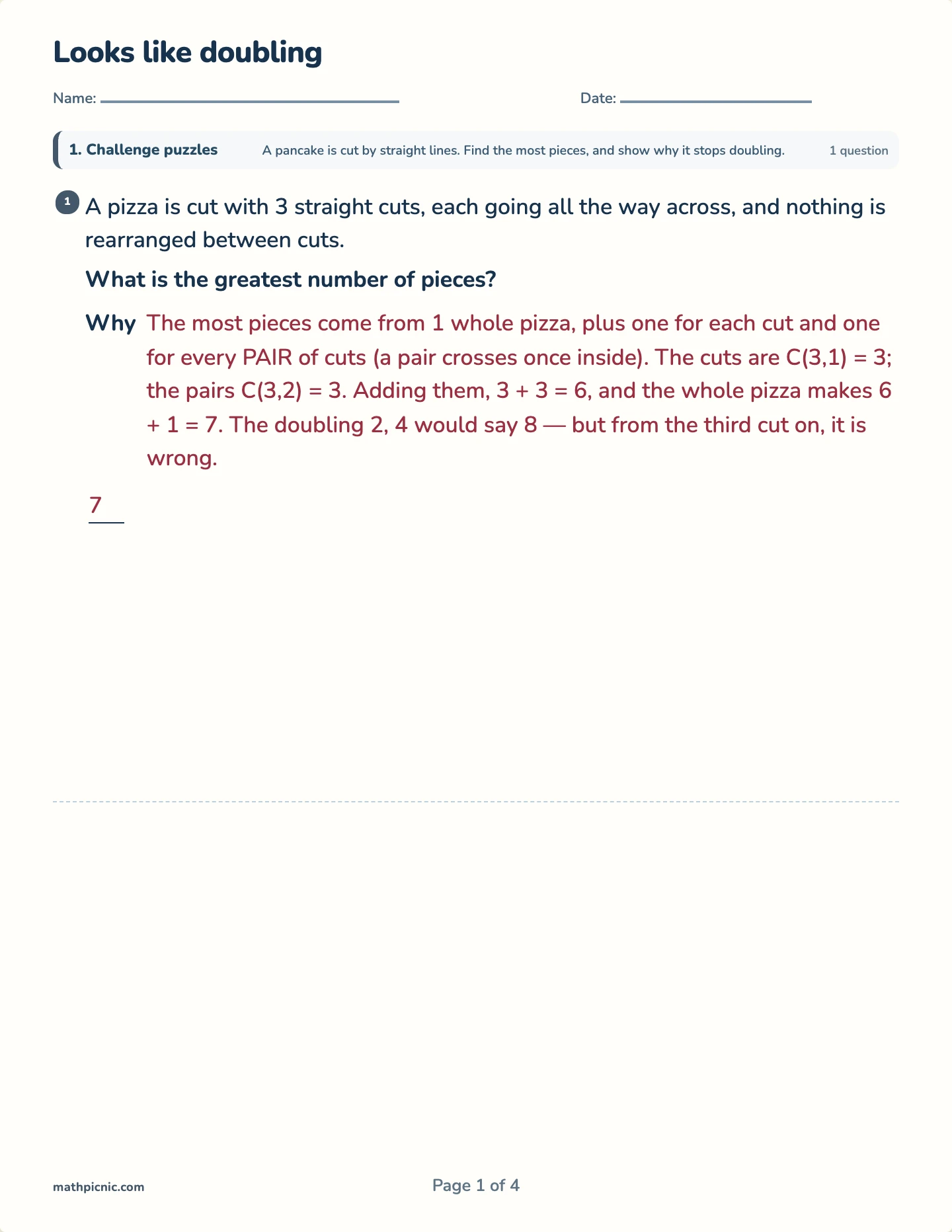
1. The most pieces come from 1 whole pizza, plus one for each cut and one for every PAIR of cuts (a pair crosses once inside). The cuts are C(3,1) = 3; the pairs C(3,2) = 3. Adding them, 3 + 3 = 6, and the whole pizza makes 6 + 1 = 7. The doubling 2, 4 would say 8 — but from the third cut on, it is wrong.
Challenge puzzles
If they are stuck: Doubling stops working. Count the cuts, the pairs of cuts, and the triples, then add one.
2. The most pieces come from 1 whole cheese, plus one for each cut, each PAIR of cuts (a pair meets in a line) and each TRIPLE of cuts (three meet at a point). The cuts are C(5,1) = 5; the pairs C(5,2) = 10; the triples C(5,3) = 10. Adding them, 5 + 10 = 15, then 15 + 10 = 25, and the whole cheese makes 25 + 1 = 26. The doubling 2, 4, 8 would say 32 — but from the fourth cut on, it is wrong.
Challenge puzzles
If they are stuck: Do not trust the doubling. Count the chords, then the places two chords cross inside.
3. Start with the whole disc: one region. Each chord you draw adds one region, plus one more for every crossing it makes inside. The chords are every pair of the 5 points, C(5,2) = 10. The inside crossings are every set of FOUR points, because each foursome's chords cross exactly once: C(5,4) = 5. Adding those, 10 + 5 = 15, and the one region you started with makes 15 + 1 = 16. The doubling 2, 4, 8, 16 would say 16 — but from six points on, it is wrong.