Challenge puzzles
If they are stuck: Do not draw the routes. Every route is the same length; count which of its steps go right, and that is a combination.
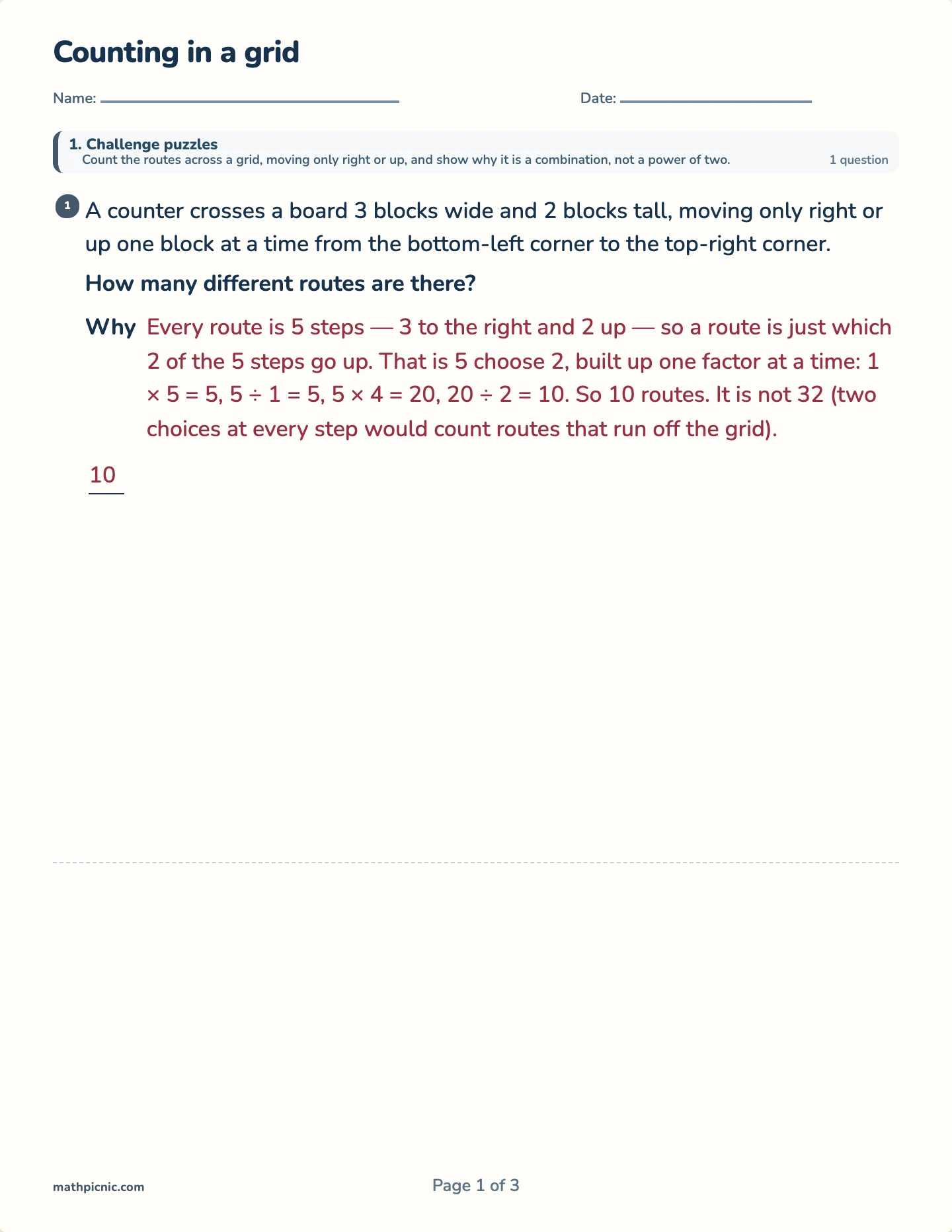
1. Every route is 5 steps — 3 to the right and 2 up — so a route is just which 2 of the 5 steps go up. That is 5 choose 2, built up one factor at a time: 1 × 5 = 5, 5 ÷ 1 = 5, 5 × 4 = 20, 20 ÷ 2 = 10. So 10 routes. It is not 32 (two choices at every step would count routes that run off the grid).
Challenge puzzles
If they are stuck: A triangle is a choice of three dots. Count all the choices, then take off the threes that sit in a straight line.
2. Every triangle is just 3 of the 8 trees chosen as corners, so start from 8 choose 3, C(8,3) = 56, built one factor at a time: 1 × 8 = 8, 8 ÷ 1 = 8, 8 × 7 = 56, 56 ÷ 2 = 28, 28 × 6 = 168, 168 ÷ 3 = 56. But three trees on one straight line make no triangle. The straight-line triples here are 8 down the columns — 8 in all. Take them off: 56 − 8 = 48. So 48 triangles, not the 56 you get by forgetting that some threes are in a line.
Challenge puzzles
If they are stuck: A rectangle is two columns and two rows. Count the ways to choose each, and multiply — do not just count the little cells.
3. A rectangle with sides on the grid is pinned down by 2 of the 2 columns — its left and right edges — and 2 of the 3 rows — its top and bottom. The columns give C(2,2) = 1, the rows give C(3,2) = 3, and every pair of columns goes with every pair of rows: 1 × 3 = 3. So 3 rectangles, not the 2 little cells you get by counting only the smallest squares.