
Trace the small letters a to z
Small letters are the harder half and the more useful one: nearly everything a child will ever read or write is lowercase. These sheets are ruled with four lines instead of three, because a, b and g do not all live in the same place.
- Letter & A4, portrait or landscape
- Real stroke centerlines, not outlines
- Change the size and reprint
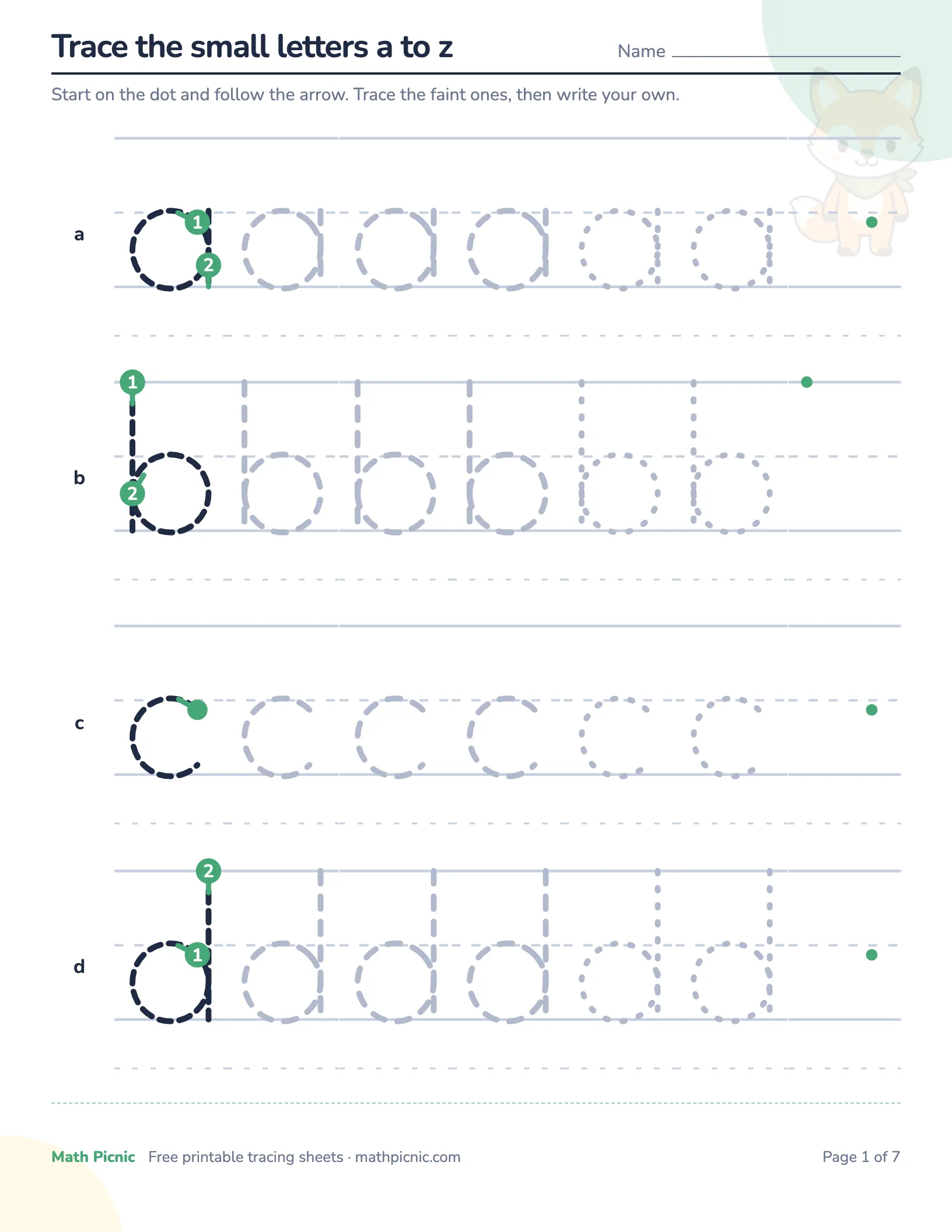

Trace the small letters a to z
NameStart on the dot and follow the arrow. Trace the faint ones, then write your own.
This is page one of 7 at the default size. Open it in the maker to print the rest, choose a range, or fit more on a page.
About this sheet
A capital sits between two lines. A small letter has three heights to get right: an x-height letter like a or o fills the bottom half, an ascender like b or l reaches the top line, and g, j, p, q and y hang below the baseline. That is why these sheets carry a fourth rule under the writing line — a child copying a g with nowhere to put the tail either writes it above the line or runs it into the next row, and neither is the letter.
Why it is drawn this way
The bowls are all the same circle, and that is not a drawing convenience. Manuscript teaching calls a, d, g and q the "magic c" letters because they literally begin with the c — it is taught first as their shared opening stroke — so the bowl of a d is the bowl of an o is the c itself. Drawing four different bowls makes each one look fine alone and wrong beside the others, and it hides the one pattern that makes the group easy to learn.