
Lines of symmetry
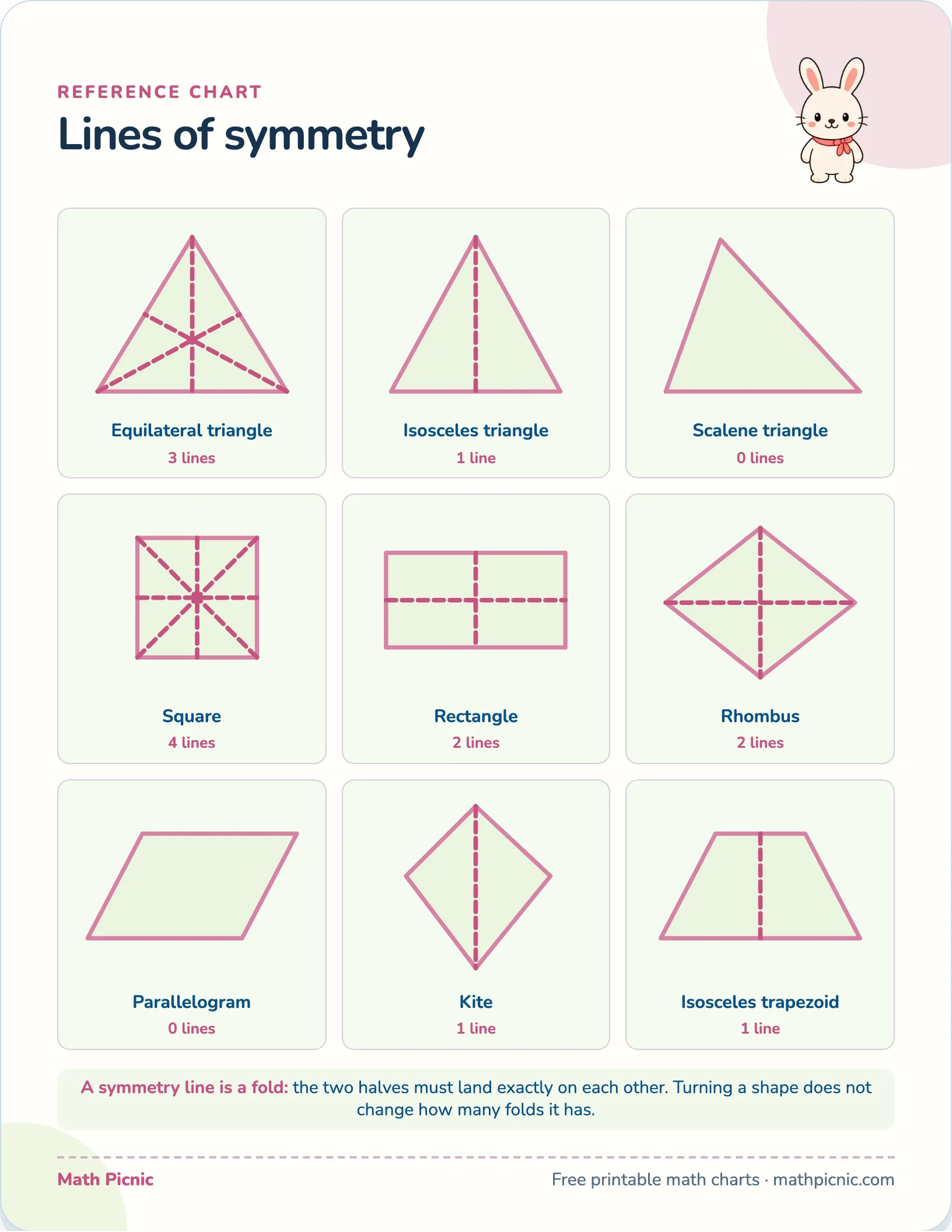
Nine familiar shapes with every valid fold drawn across them. The zeroes matter as much as the fours: looking balanced is not the same as folding onto itself.
Reference chart
Lines of symmetry

Equilateral triangle
3 lines
Isosceles triangle
1 line
Scalene triangle
0 lines
Square
4 lines
Rectangle
2 lines
Rhombus
2 lines
Parallelogram
0 lines
Kite
1 line
Isosceles trapezoid
1 line
A symmetry line is a fold: the two halves must land exactly on each other. Turning a shape does not change how many folds it has.
What's on this chart
A symmetry line is a physical claim, not a decoration. If the paper were folded on that dashed line, every edge and corner on one side would have to land exactly on the other. Drawing the lines on the shapes makes the test visible: the square folds four ways, the ordinary rectangle only two, and the slanted parallelogram none at all.
Why this chart helps
The three triangles make the progression especially clear. An equilateral triangle has three interchangeable corners and three symmetry lines. An isosceles triangle has only the fold through its unequal side. A scalene triangle has no matching sides and no fold. Those are not three facts to recite; they are one relationship between equal parts and possible folds.
More printable charts
- Naming 2D shapes
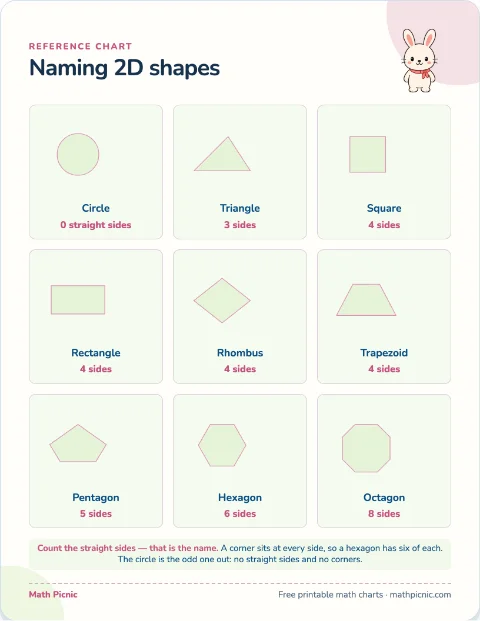 Print Count the straight sides on a shape, then read its name below it.
 - Quadrilateral family
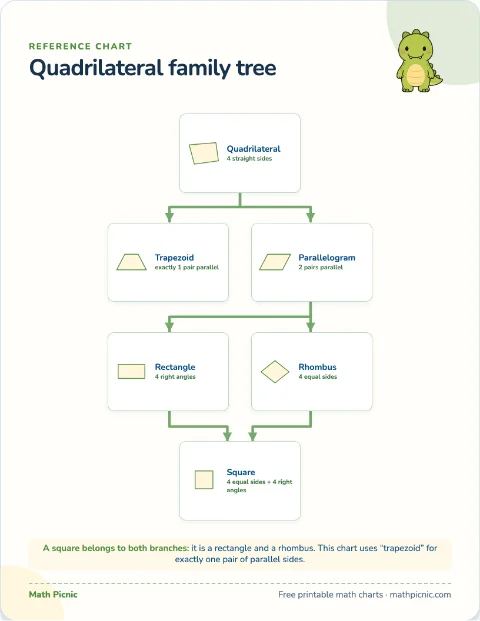 Print Follow the branches to see which names a shape inherits.
 - Types of angles
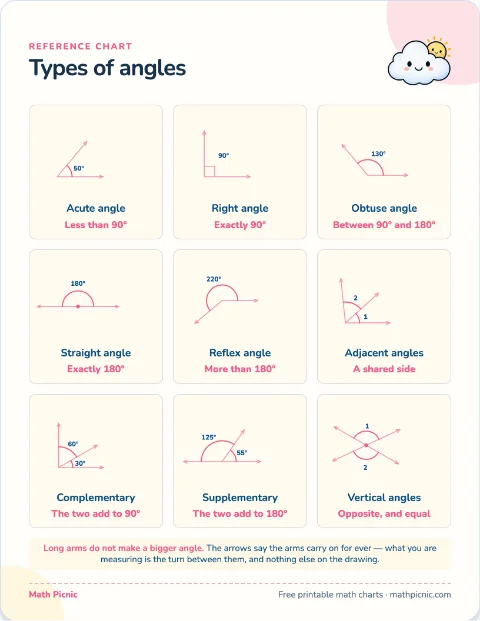 Print Find the picture that matches yours, and the name is under it.
 - Angles in parallel lines
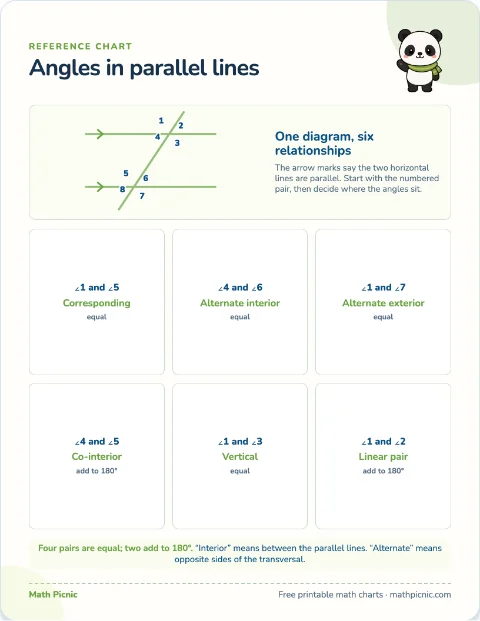 Print Match each numbered pair to its position around the transversal.
 - Perimeter formulas
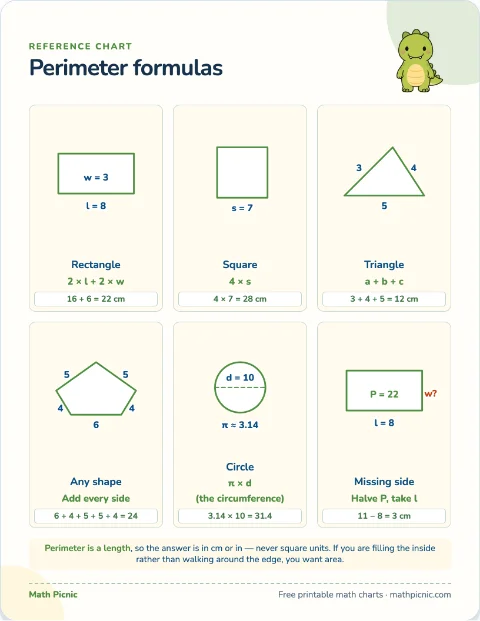 Print Follow the traced edge on the figure, then read the formula under it.
 - Area formulas
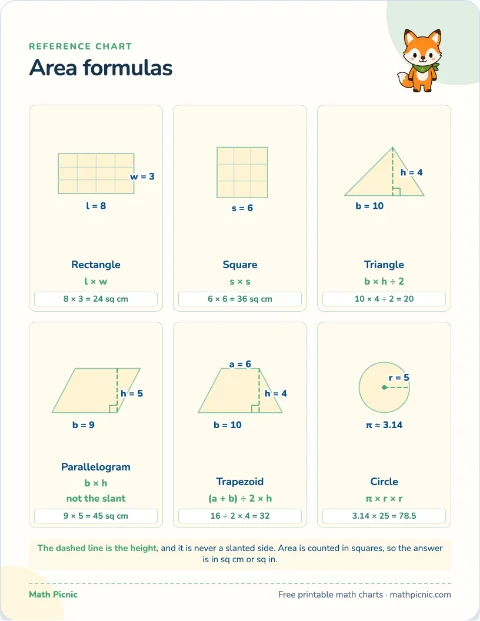 Print Match your shape to a figure and use the letters drawn on it.
 - Volume formulas
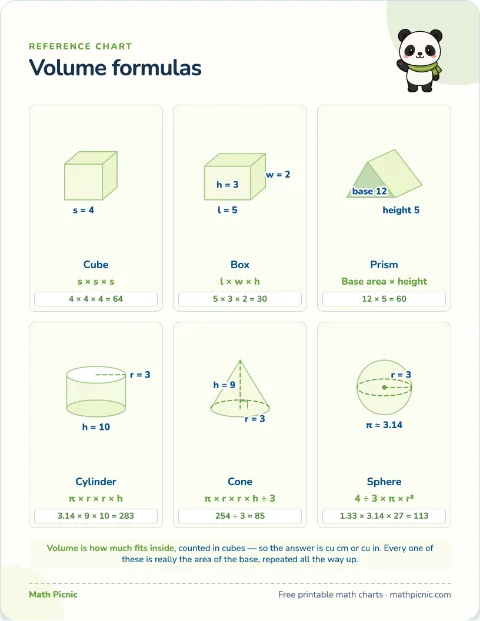 Print Find your solid, then multiply the base area by how tall it stands.
 - Surface area formulas
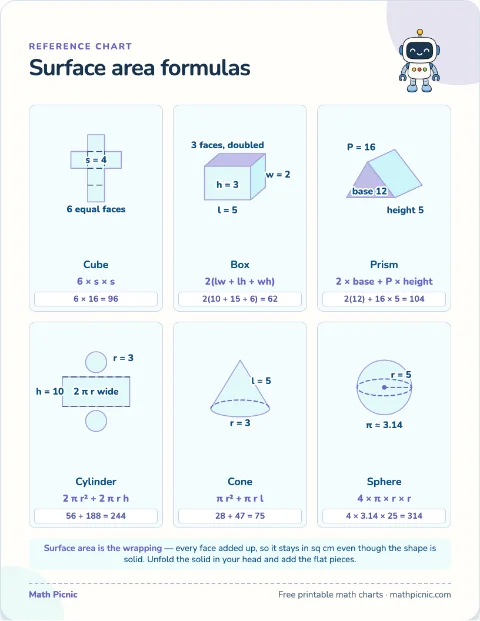 Print Unfold the solid in your head and add up every flat face.