Trig ratios · SOH CAH TOA
The three ratios that start trigonometry, each read off the same right triangle. Sine, cosine and tangent are just one side divided by another — and which two sides you use is decided by the angle you are standing at.
Reference chart
Trig ratios · SOH CAH TOA

SOH · CAH · TOA
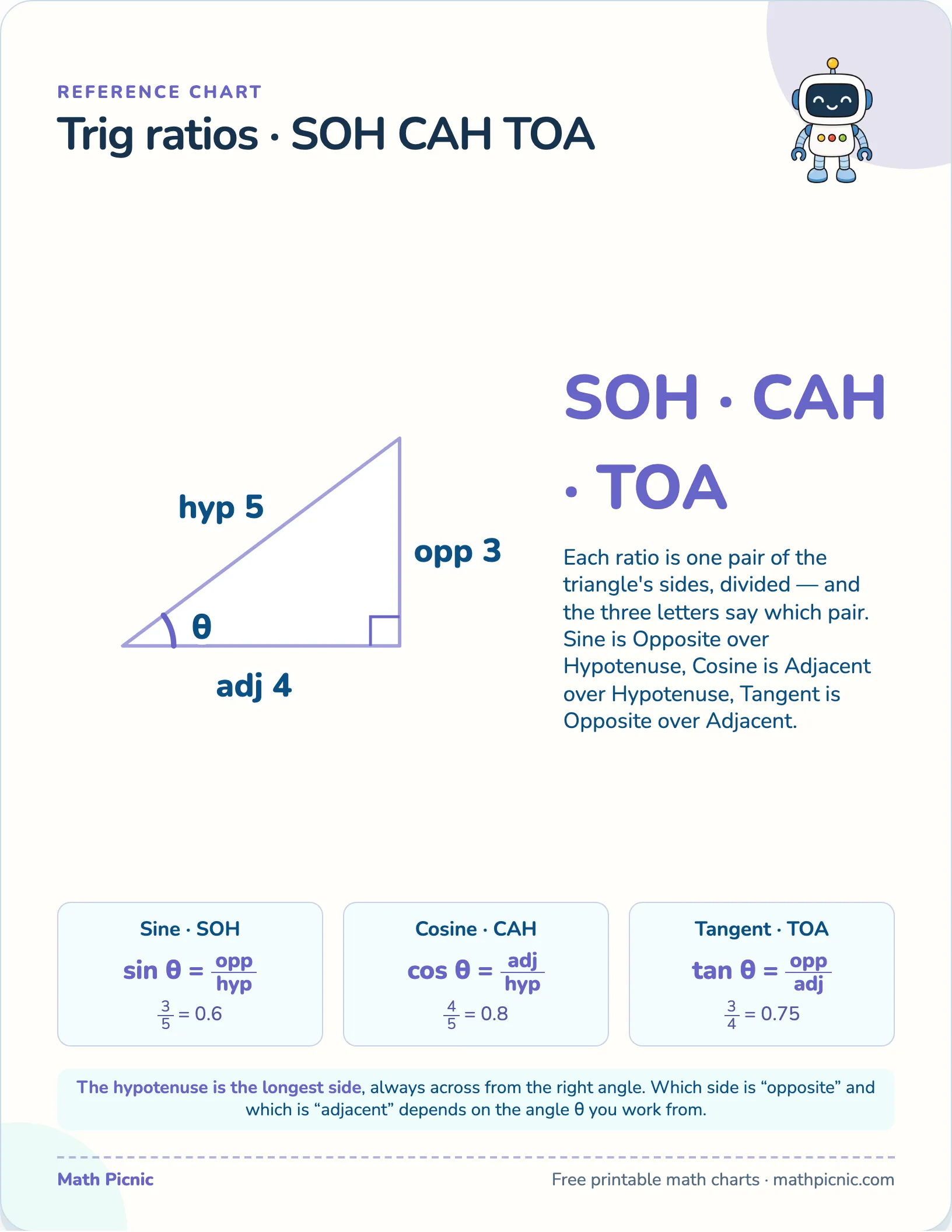
Each ratio is one pair of the triangle's sides, divided — and the three letters say which pair. Sine is Opposite over Hypotenuse, Cosine is Adjacent over Hypotenuse, Tangent is Opposite over Adjacent.
Sine · SOH
sin θ = opphyp
35 = 0.6
Cosine · CAH
cos θ = adjhyp
45 = 0.8
Tangent · TOA
tan θ = oppadj
34 = 0.75
The hypotenuse is the longest side, always across from the right angle. Which side is “opposite” and which is “adjacent” depends on the angle θ you work from.
What's on this chart
Trigonometry begins with one idea: in a right triangle, the ratio of two sides depends only on the angle, not on how big the triangle is. So a single 3-4-5 triangle carries all three ratios at once — sine is the opposite side over the hypotenuse, cosine is the adjacent over the hypotenuse, and tangent is the opposite over the adjacent. This chart draws that triangle three times and lights up the two sides each ratio uses, so the formula and the picture are the same thing.
Why this chart helps
SOH CAH TOA is the whole card in six letters, and it is worth saying aloud until it sticks: Sine Opposite Hypotenuse, Cosine Adjacent Hypotenuse, Tangent Opposite Adjacent. The letters only tell you which two sides to divide; the drawing tells you which side is which. Opposite is the side across the triangle from the angle, adjacent is the one beside it, and the hypotenuse is the long side facing the right angle — always the same side, whichever angle you pick.