
The unit circle
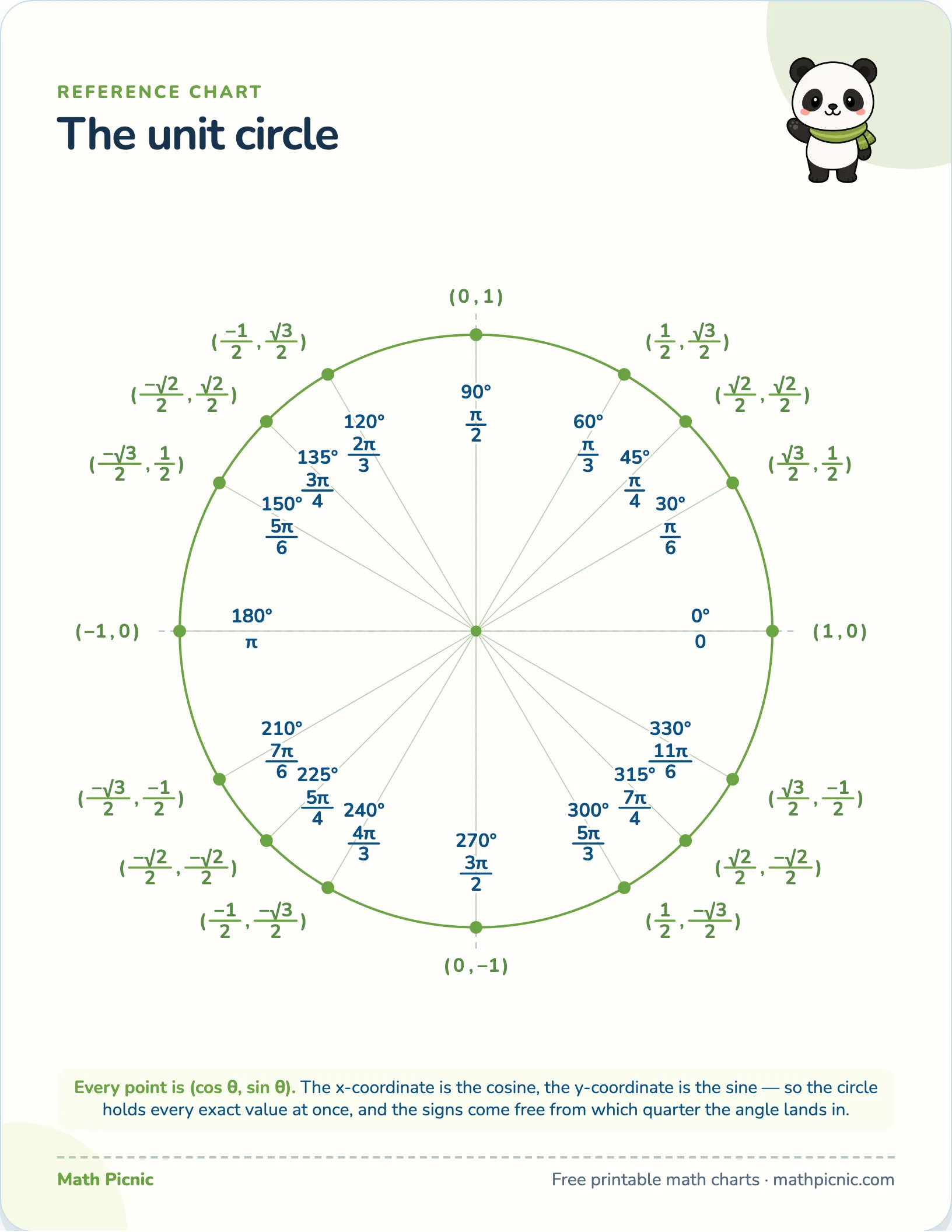
Every standard angle on one circle, labeled three ways: in degrees, in radians, and by the point (cos θ, sin θ) it lands on. Because the radius is one, the circle holds all the exact values at the same time.
Reference chart
The unit circle

Every point is (cos θ, sin θ). The x-coordinate is the cosine, the y-coordinate is the sine — so the circle holds every exact value at once, and the signs come free from which quarter the angle lands in.
What's on this chart
The unit circle is trigonometry's single most useful page, because it turns three separate things a student has to memorize into one picture they can read. Each of the sixteen marked angles carries its degree measure, its radian measure, and the coordinate it reaches on a circle of radius one — and on that circle the x-coordinate IS the cosine and the y-coordinate IS the sine, so a value is never recalled, only located.
Why this chart helps
Reading it is a habit worth building early. Find the angle around the rim, follow its spoke to the point, and the pair written there is (cos θ, sin θ). The signs come free from the quarter the angle lands in: everything is positive in the top right, and each quarter after it flips one coordinate, which is why cosine goes negative on the left and sine goes negative at the bottom.
More printable charts
- Trig ratios (SOH CAH TOA)
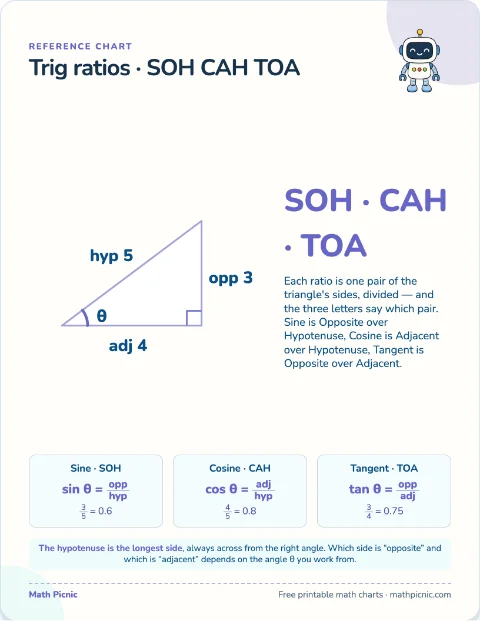 Print Match the angle to two sides, then read off the ratio.
 - Exact trig values
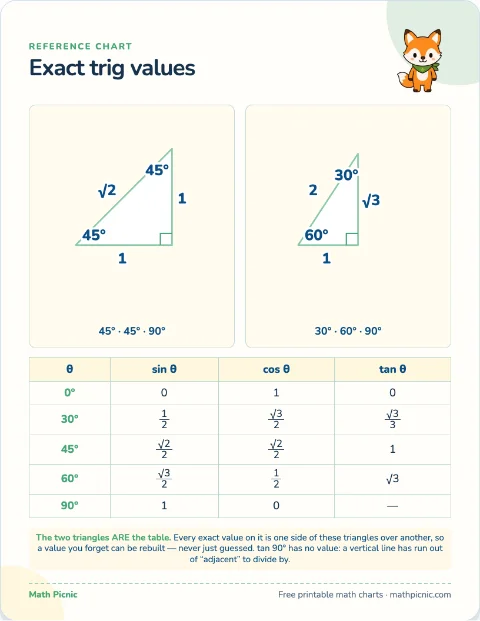 Print Read the value from the row for that angle.
 - Radians and degrees
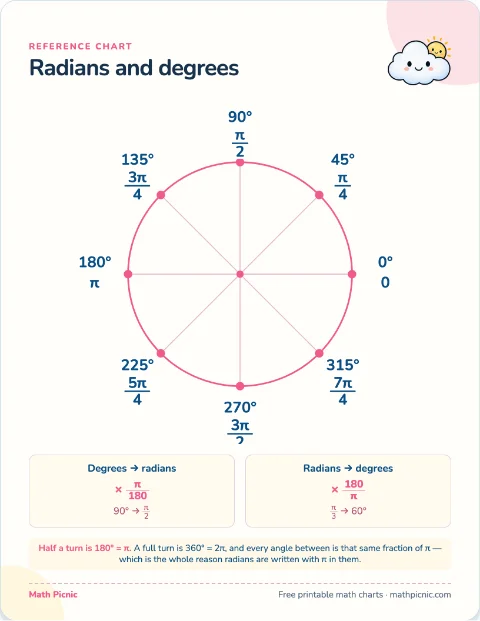 Print Find the degrees and read the radians beside them.
 - Law of sines and cosines
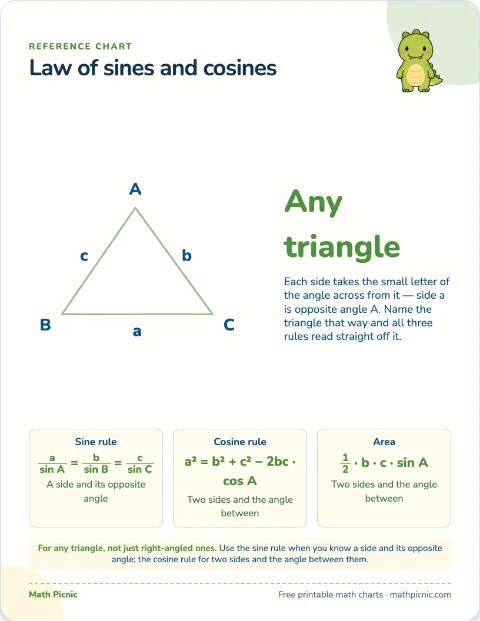 Print Pick the rule that fits the sides and angles known.