Law of sines and cosines
Two rules that solve any triangle, not just right-angled ones, with the area formula alongside — all drawn on one triangle. The sine rule pairs a side with its opposite angle; the cosine rule takes two sides and the angle between.
Reference chart
Law of sines and cosines

Any triangle
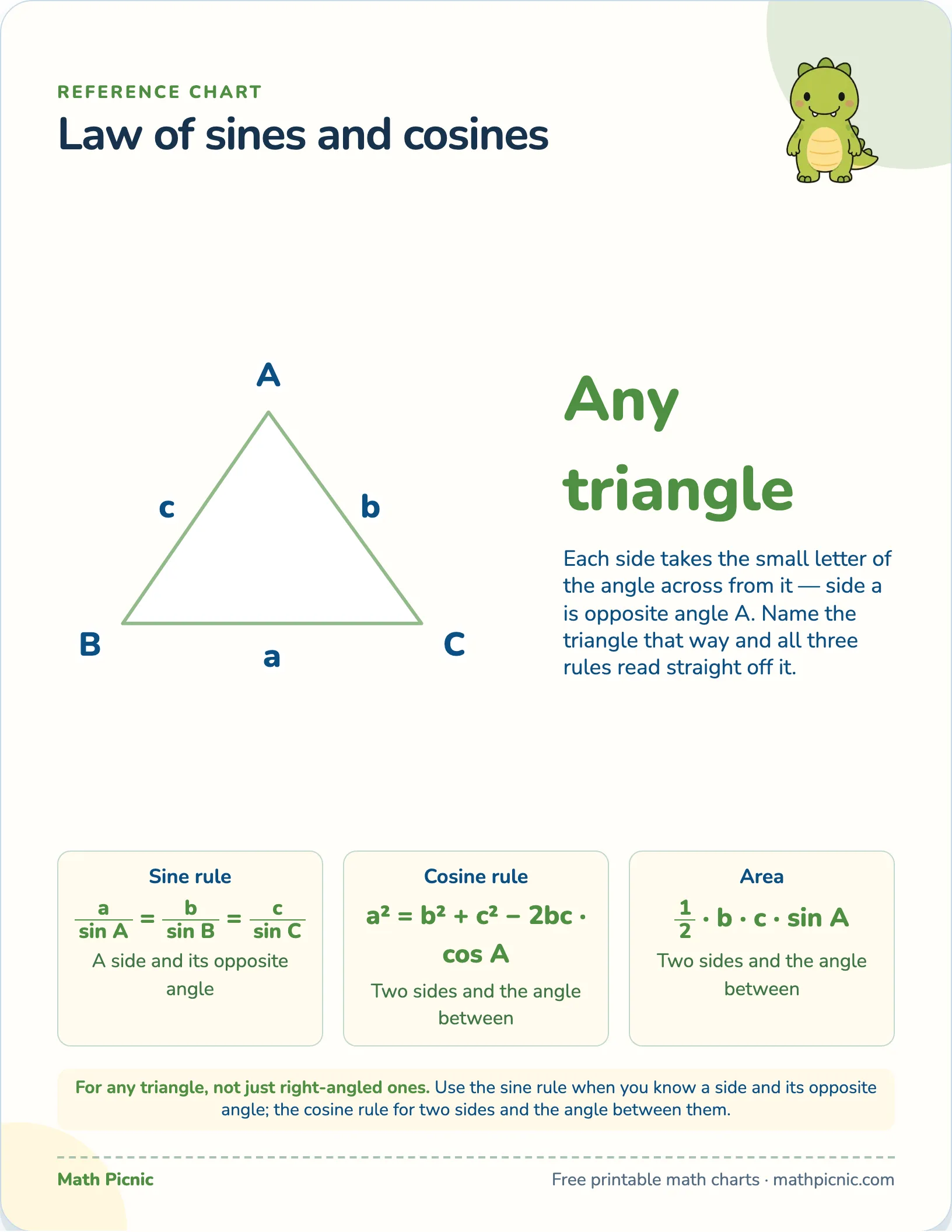
Each side takes the small letter of the angle across from it — side a is opposite angle A. Name the triangle that way and all three rules read straight off it.
Sine rule
asin A = bsin B = csin C
A side and its opposite angle
Cosine rule
a² = b² + c² − 2bc · cos A
Two sides and the angle between
Area
12 · b · c · sin A
Two sides and the angle between
For any triangle, not just right-angled ones. Use the sine rule when you know a side and its opposite angle; the cosine rule for two sides and the angle between them.
What's on this chart
Right-triangle trigonometry stops working the moment a triangle has no right angle, and these two rules are what carry on from there. They rest on a naming convention the chart draws first: each side takes the small letter of the angle across from it, so side a sits opposite angle A. Get that habit and both rules read straight off the figure.
Why this chart helps
The sine rule links a side to its opposite angle: a over sin A equals b over sin B equals c over sin C. Reach for it when you already have one such matched pair and want a second side or angle. The cosine rule is the stand-in for Pythagoras on a non-right triangle — a² equals b² plus c² minus 2bc cos A — and you use it when you know two sides and the angle wedged between them, or all three sides and want an angle back.