
Radians and degrees
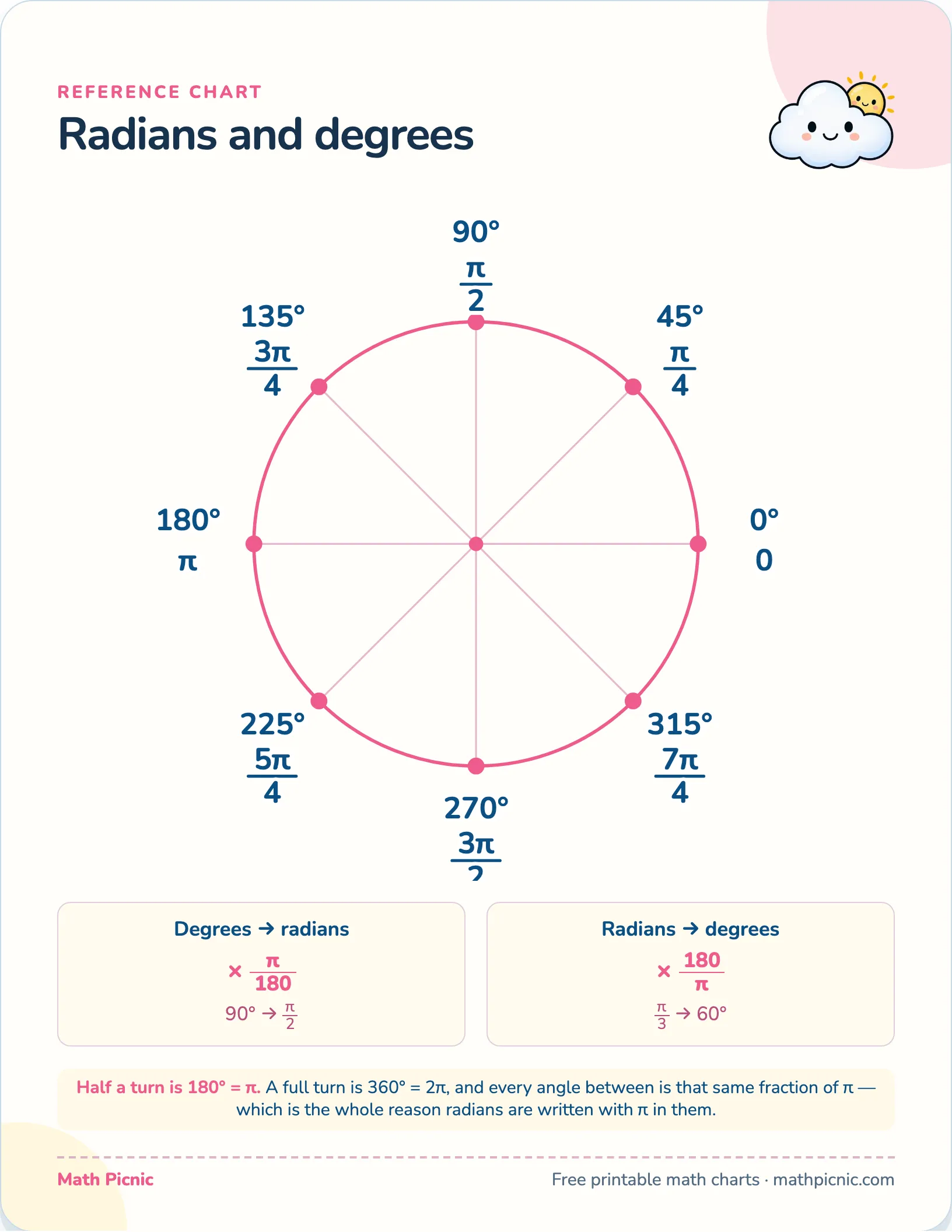
The same angle measured two ways — in degrees and in radians — marked around one circle, with the conversion that turns either into the other. A half turn is 180 degrees, and a half turn is π.
Reference chart
Radians and degrees

Degrees → radians
× π180
90° → π2
Radians → degrees
× 180π
π3 → 60°
Half a turn is 180° = π. A full turn is 360° = 2π, and every angle between is that same fraction of π — which is the whole reason radians are written with π in them.
What's on this chart
Radians are not a harder way to measure an angle, only a different one, and this chart puts the two side by side so the second stops being mysterious. A full turn is 360 degrees, and a full turn is 2π radians — so the whole system is built on one fact, that a half turn of 180 degrees is π. Every angle around the circle is then just a fraction of π, and the marks show which fraction.
Why this chart helps
The conversion falls straight out of that fact. To go from degrees to radians, multiply by π over 180; to go the other way, multiply by 180 over π. Because 180 degrees is π, the numbers you actually work with stay small: 90 degrees is π over 2, 60 degrees is π over 3, 45 degrees is π over 4. A student who learns those three barely needs the formula.
More printable charts
- Trig ratios (SOH CAH TOA)
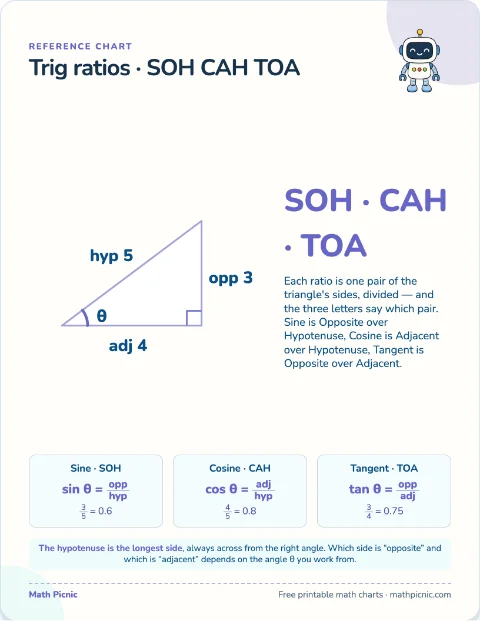 Print Match the angle to two sides, then read off the ratio.
 - Exact trig values
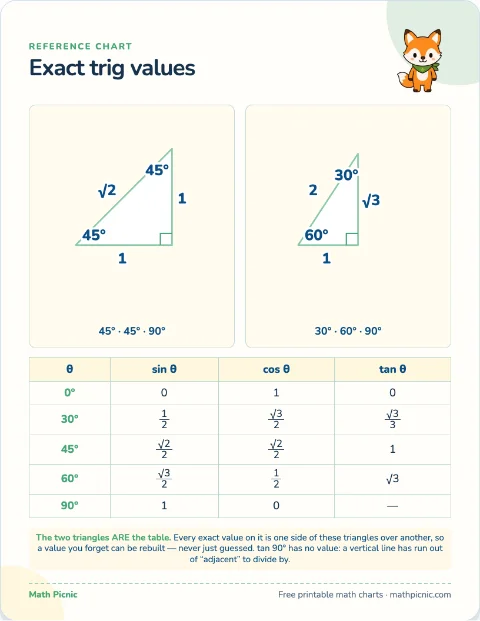 Print Read the value from the row for that angle.
 - Unit circle
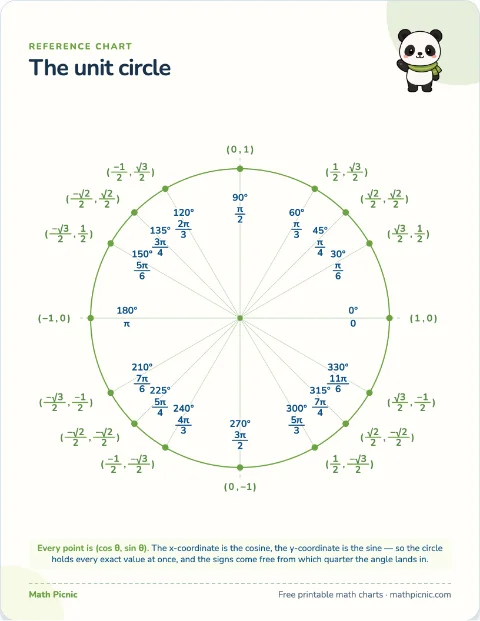 Print Find the angle, then read the point it lands on.
 - Law of sines and cosines
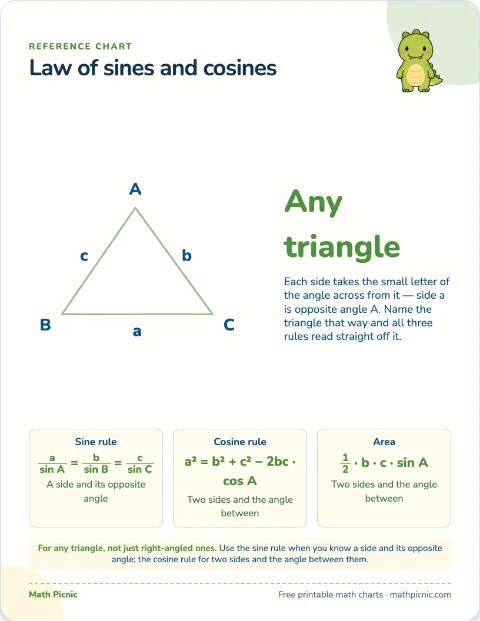 Print Pick the rule that fits the sides and angles known.