
Factoring patterns
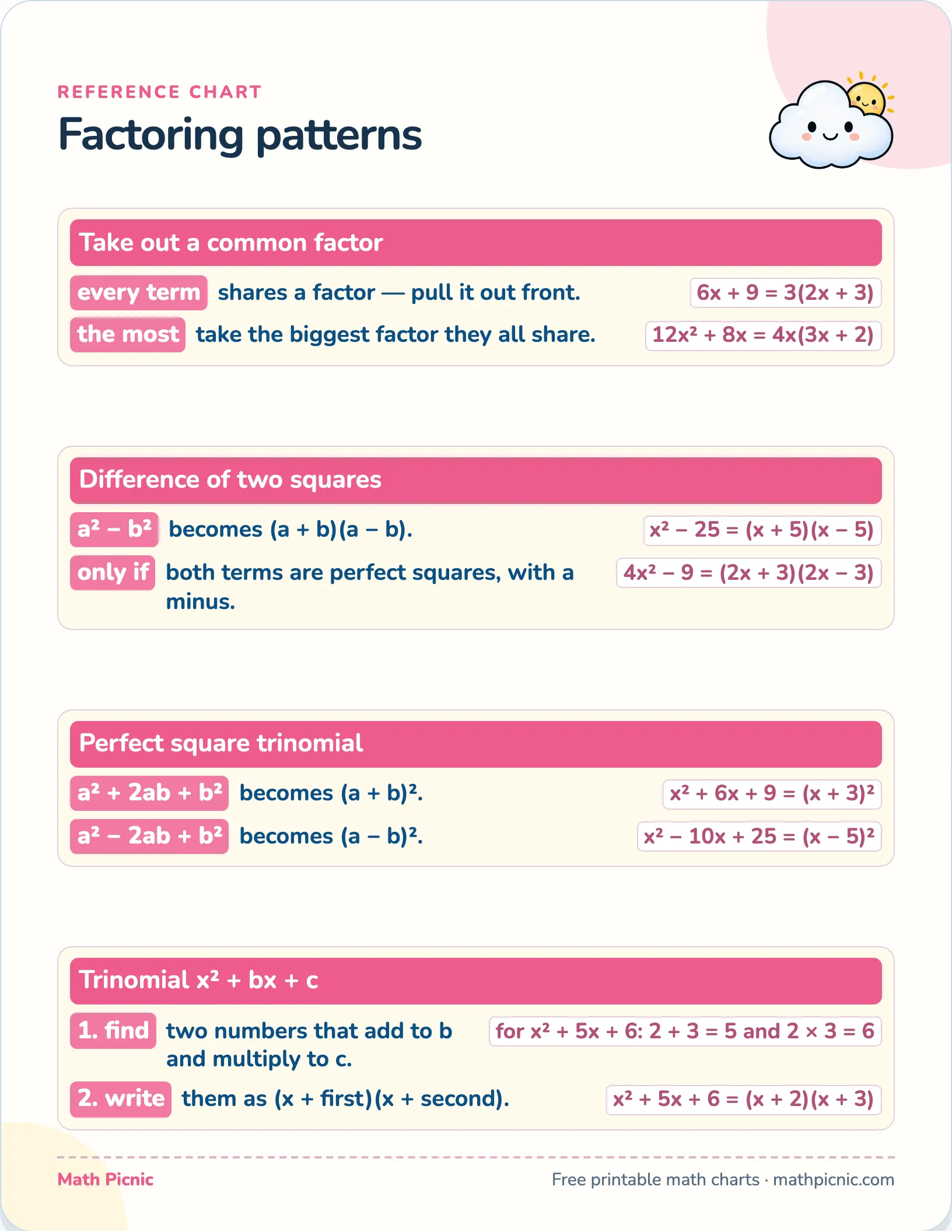
Multiplying turns a product into a sum; factoring runs it backwards. Four patterns cover most of what a first algebra course asks, and this chart puts each one beside a worked example.
Reference chart
Factoring patterns

Take out a common factor
- every termshares a factor — pull it out front.6x + 9 = 3(2x + 3)
- the mosttake the biggest factor they all share.12x² + 8x = 4x(3x + 2)
Difference of two squares
- a² − b²becomes (a + b)(a − b).x² − 25 = (x + 5)(x − 5)
- only ifboth terms are perfect squares, with a minus.4x² − 9 = (2x + 3)(2x − 3)
Perfect square trinomial
- a² + 2ab + b²becomes (a + b)².x² + 6x + 9 = (x + 3)²
- a² − 2ab + b²becomes (a − b)².x² − 10x + 25 = (x − 5)²
Trinomial x² + bx + c
- 1. findtwo numbers that add to b and multiply to c.for x² + 5x + 6: 2 + 3 = 5 and 2 × 3 = 6
- 2. writethem as (x + first)(x + second).x² + 5x + 6 = (x + 2)(x + 3)
What's on this chart
Factoring is pattern recognition before it is anything else. The first move on almost every problem is to take out the biggest common factor — if every term shares a 4 and an x, pull out 4x and the expression gets simpler underneath. Skipping that step is the most common reason a factoring problem stalls.
Why this chart helps
Two patterns are worth knowing on sight. A difference of two squares, a² − b², always splits into (a + b)(a − b) — but both terms have to be perfect squares first, which is the check students forget. A perfect square trinomial, a² ± 2ab + b², folds back into a single bracket squared, and the sign inside the bracket matches the sign in the middle term.
More printable charts
- The quadratic formula
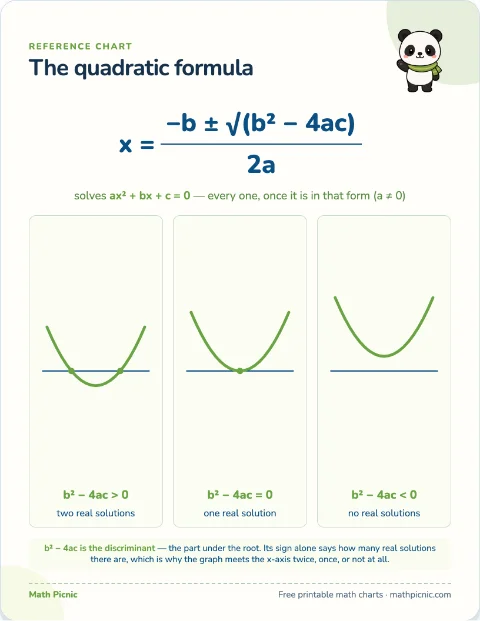 Print Put the equation in standard form, then read a, b and c into the formula.
 - Solving systems
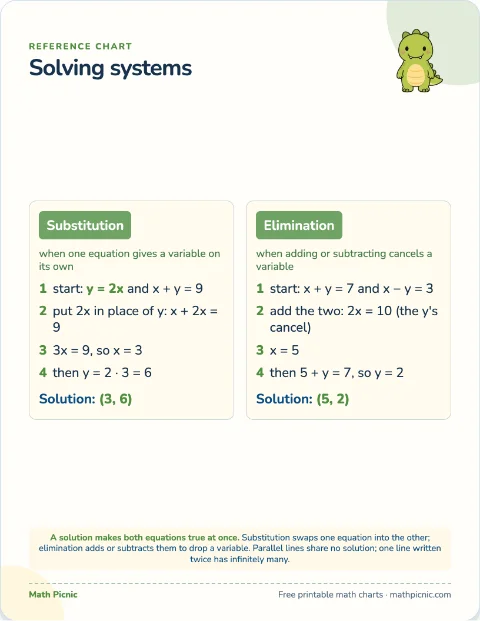 Print Pick the method that fits, then follow the worked steps beside it.
 - Function notation
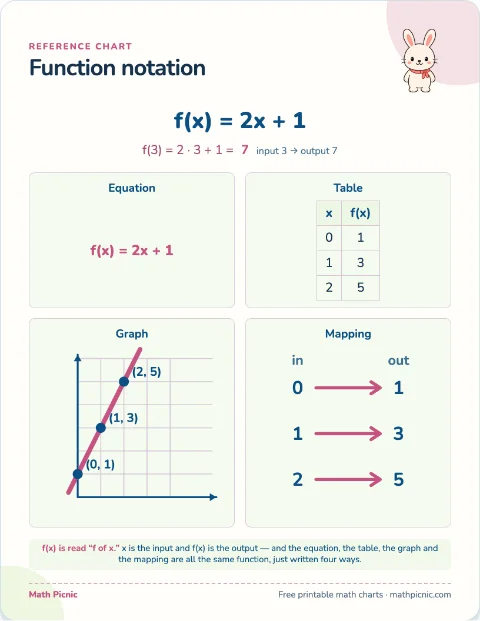 Print Read the same function across its equation, table, graph and mapping.
 - Laws of logarithms
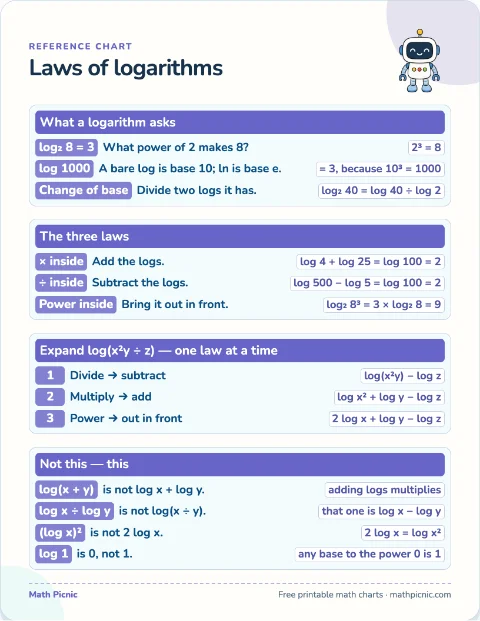 Print Match what is inside the log to a law, then follow the numbered expansion.