
The quadratic formula
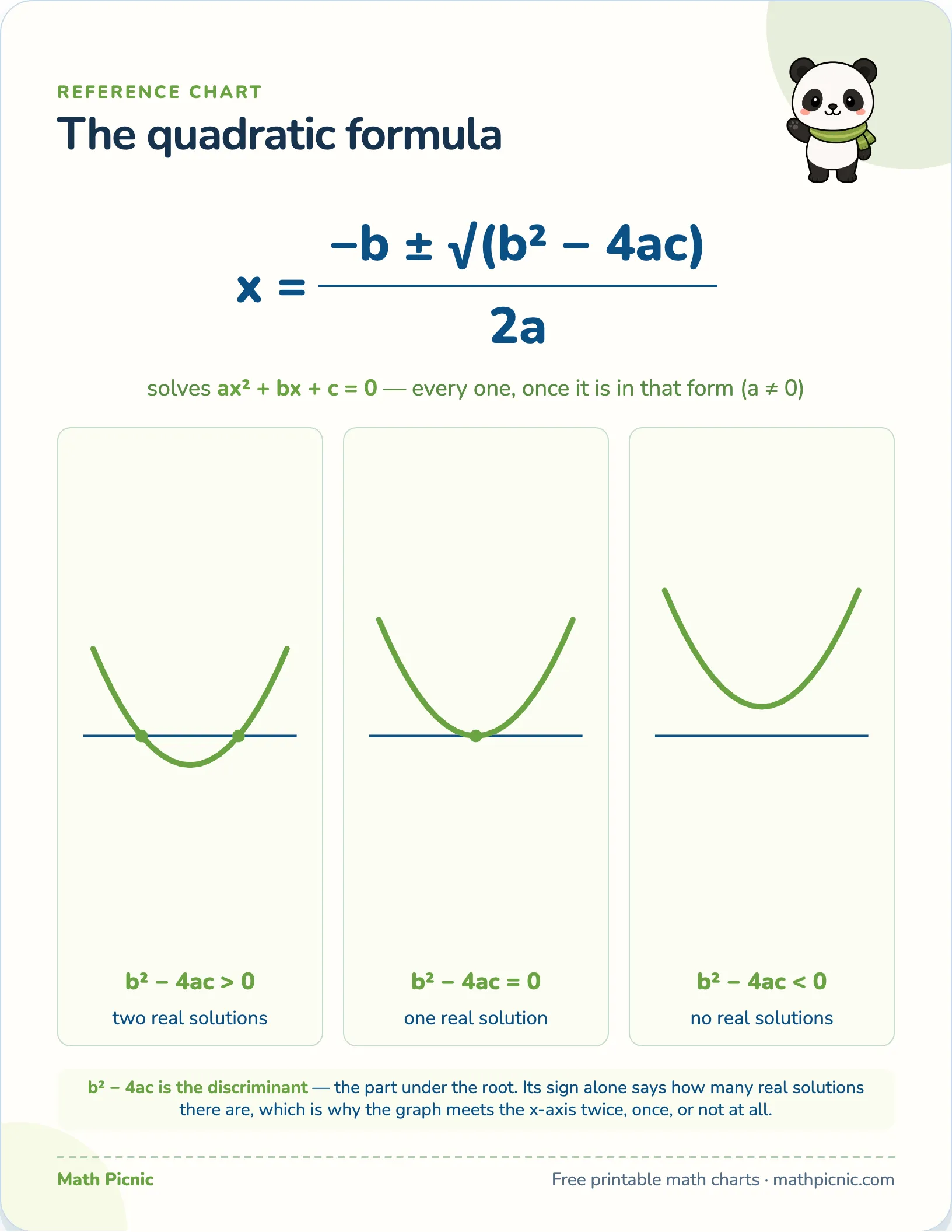
One formula solves every quadratic once it is written as ax² + bx + c = 0. The part under the root — the discriminant — is drawn as what it decides: how many times the parabola meets the x-axis.
Reference chart
The quadratic formula

x = −b ± √(b² − 4ac)2a
solves ax² + bx + c = 0 — every one, once it is in that form (a ≠ 0)
b² − 4ac > 0
two real solutions
b² − 4ac = 0
one real solution
b² − 4ac < 0
no real solutions
b² − 4ac is the discriminant — the part under the root. Its sign alone says how many real solutions there are, which is why the graph meets the x-axis twice, once, or not at all.
What's on this chart
Factoring solves the quadratics that happen to factor neatly; the quadratic formula solves all of them. The one requirement is standard form — ax² + bx + c = 0 — because the formula reads a, b and c straight off it. Get the equation into that shape, name the three numbers, and substitute; the ± sign is what gives a quadratic its two answers.
Why this chart helps
The discriminant, b² − 4ac, is the part under the square root, and its sign answers a question before any arithmetic: how many real solutions there are. Positive and the root is a real number added and subtracted, so there are two; zero and the ± does nothing, so there is one; negative and the root of a negative has no real value, so there are none. This chart draws each case as a parabola meeting the x-axis twice, once, or not at all.
More printable charts
- Factoring patterns
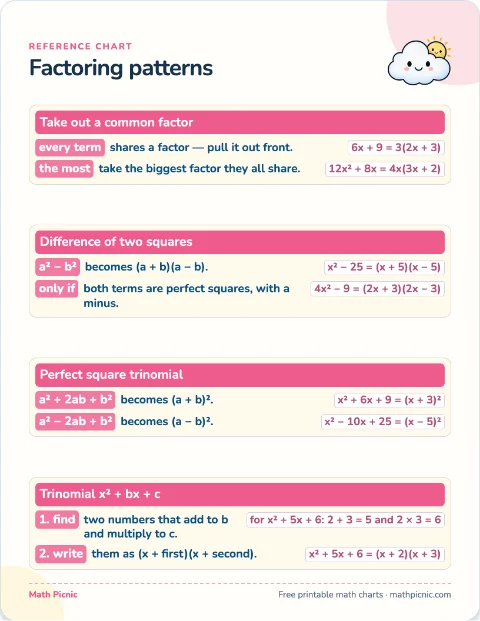 Print Spot which pattern the expression fits, then read the factors off it.
 - Solving systems
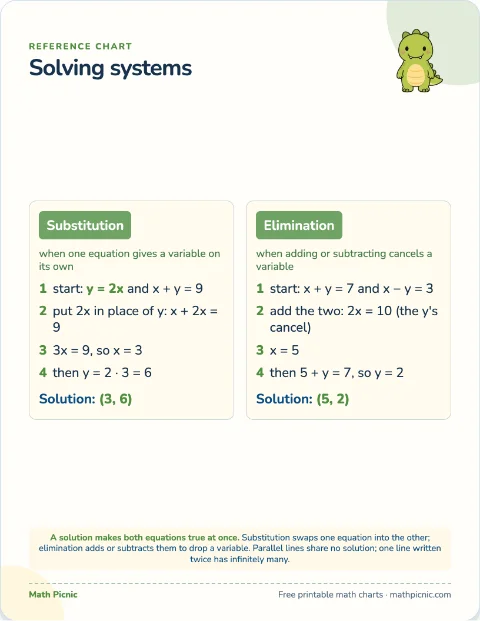 Print Pick the method that fits, then follow the worked steps beside it.
 - Function notation
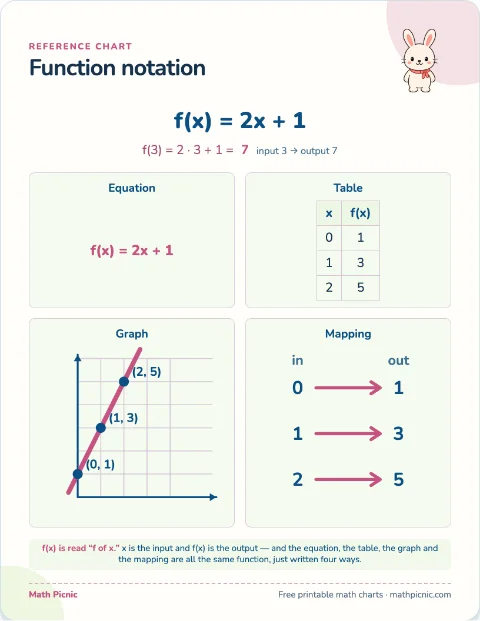 Print Read the same function across its equation, table, graph and mapping.
 - Laws of logarithms
 Print Match what is inside the log to a law, then follow the numbered expansion.