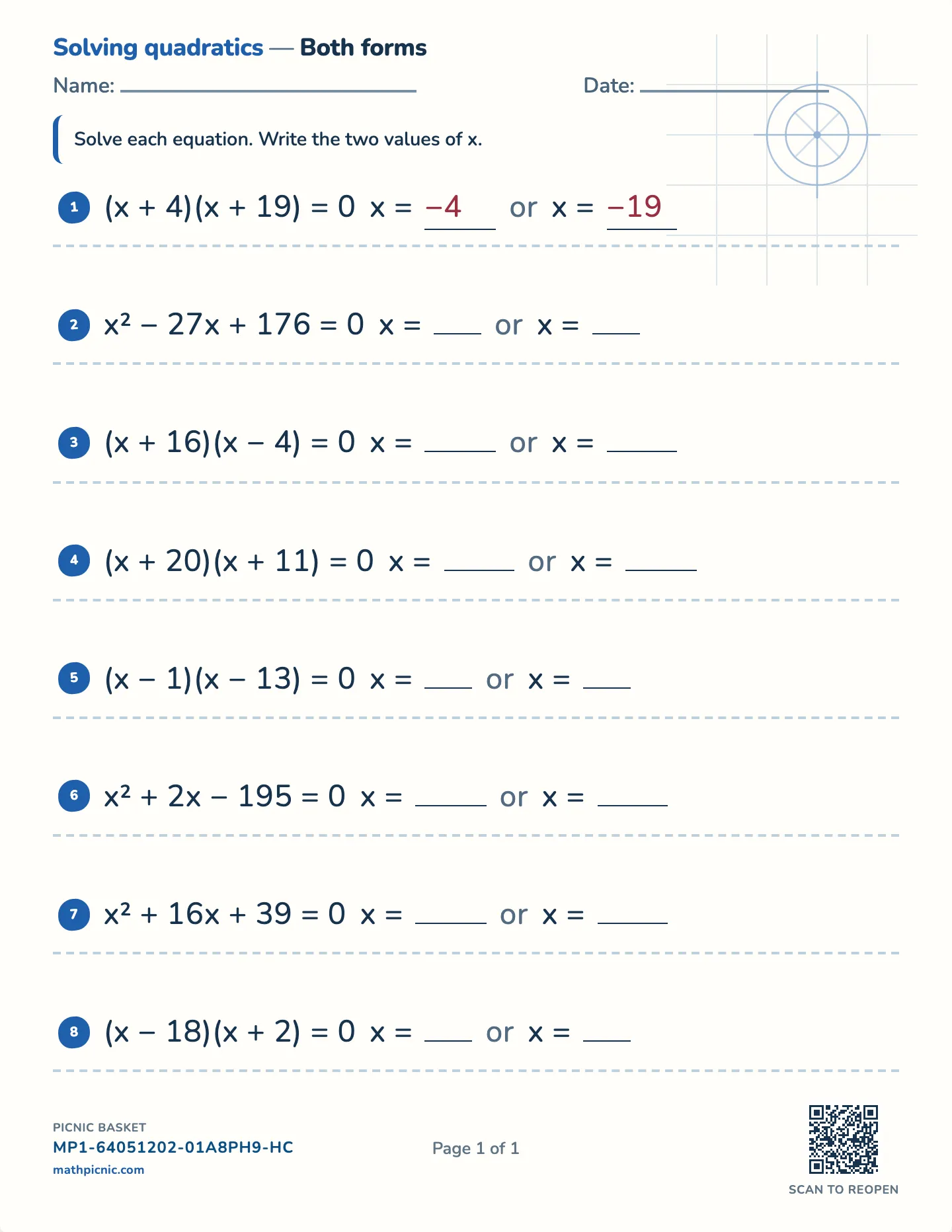
Factor it, then use the one fact that finishes it: a product is zero only when one of its factors is zero. These free printable worksheets put equations already in brackets beside ones that still need factoring, so a student has to see which step is next.
Factoring is the visible work and it is not where the marks go. The step that produces the answers is the sentence after it — a product is zero only when one of the things being multiplied is zero — so each bracket is set to zero and solved on its own.
Why this sheet works
The commonest error on this standard is reading (x − 3)(x + 5) = 0 and writing x = −3, 5: each bracket's number copied out with its sign attached. The sign turns over, and it only turns over when you actually solve the bracket. That is why one setting hands the brackets straight to the student — it isolates the zero-product step from the factoring, and a student can have the second and still get the first wrong.
How this one works
One question from a sheet like this one, worked a step at a time — with a sentence saying what just happened and why.