• Free
  • Grade 9
  • Two, one, or none

How many real solutions? worksheets

One number decides it, and only its sign matters: b² − 4ac. These free printable worksheets ask how many real solutions a quadratic has.

Kid stuck on one? You don’t just get the sheet.

  • Answer key included
  • Reopen this exact sheet
  • Letter & A4 ready
Ready to printHow many real solutions?
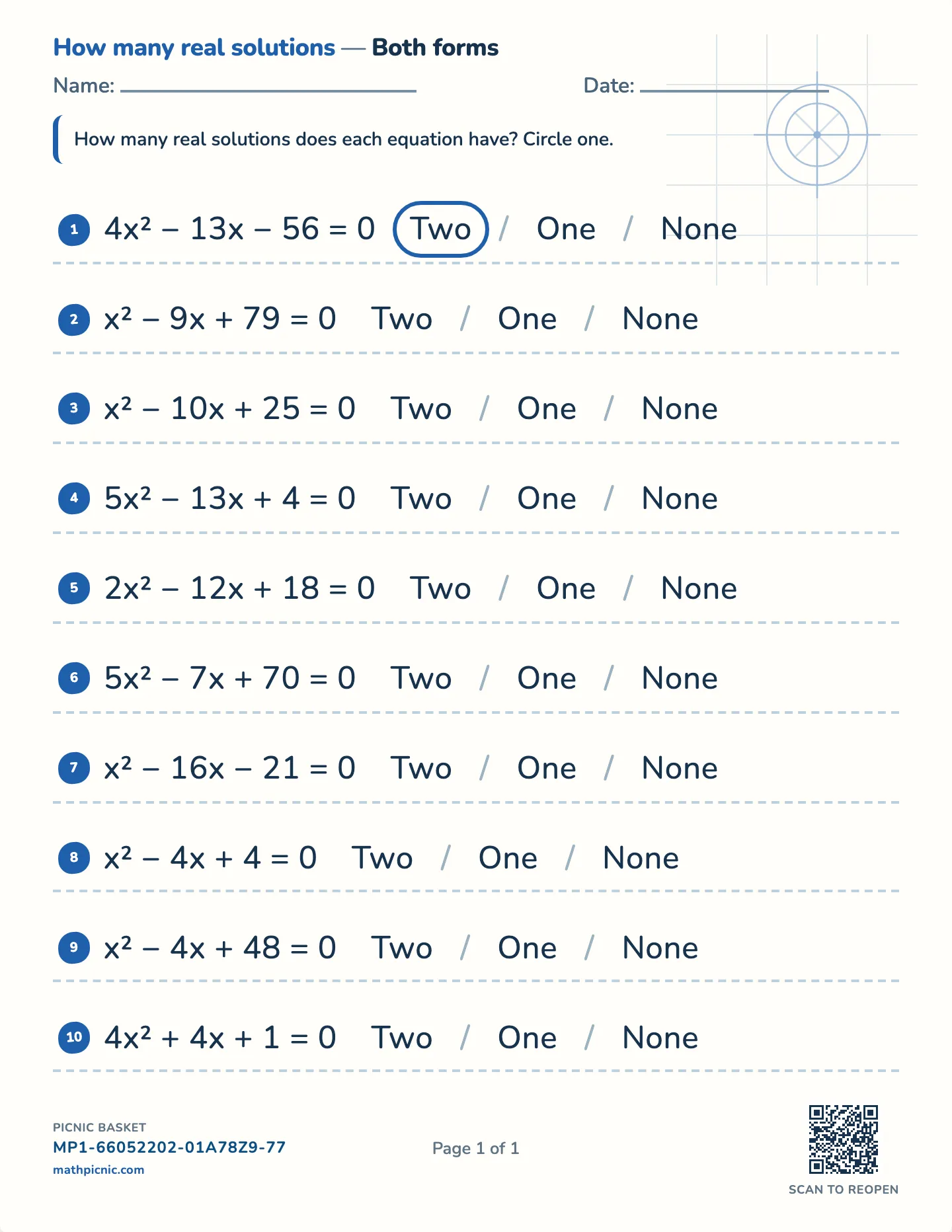
How many real solutions? worksheet — Two, one, or none, free printable with answer key

The answer key prints on a separate page.

What's on this sheet

A student who has only ever solved quadratics that come out meets x² + 2x + 5 = 0, finds no pair of numbers that multiplies to 5 and adds to 2, and assumes they made a mistake. They did not: there is no such pair, and there is no real answer. “None” is a result rather than a failure, and that sentence is the whole reason this sheet exists.

Why this sheet works

There is one fact underneath the three cases, and it is worth having instead of the table. Solving a quadratic ends by taking the square root of b² − 4ac. A positive number has two square roots, so there are two answers. Zero has one, so the two answers land on top of each other. A negative has none, so there is nothing to take the root of. A student who can rebuild that never has to remember which case is which.

How this one works

One question from this sheet, worked through a step at a time.

4x² − 13x − 56 = 0

4x² − 13x − 56 = 0
4ac
a = 4b = −13c = −56
(−13)² − 4 × 4 × −56
169 − −896=1065
b² − 4ac = 1065
How many?Two
  1. You do not have to solve this to answer it. One number decides how many real solutions a quadratic has, and it is b² − 4ac — the part that ends up under the square root sign when you do solve it.
  2. Read off a, b and c from 4x² − 13x − 56 = 0: a = 4, b = −13, c = −56. Write all three in, even the a — on this sheet it is 4, and forgetting it is the mistake that only shows up when it is not 1.
  3. Work it out: (−13)² is 169, and 4 × 4 × −56 is −896. That leaves 169 − −896 = 1065.
  4. 1065 is above zero, and a positive number has two square roots — one either way from the ±. So there are TWO real solutions.