
Laws of logarithms
The product, quotient and power laws with a worked example on each, change of base for the calculator, and one expression expanded a law at a time.
Reference chart
Laws of logarithms

What a logarithm asks
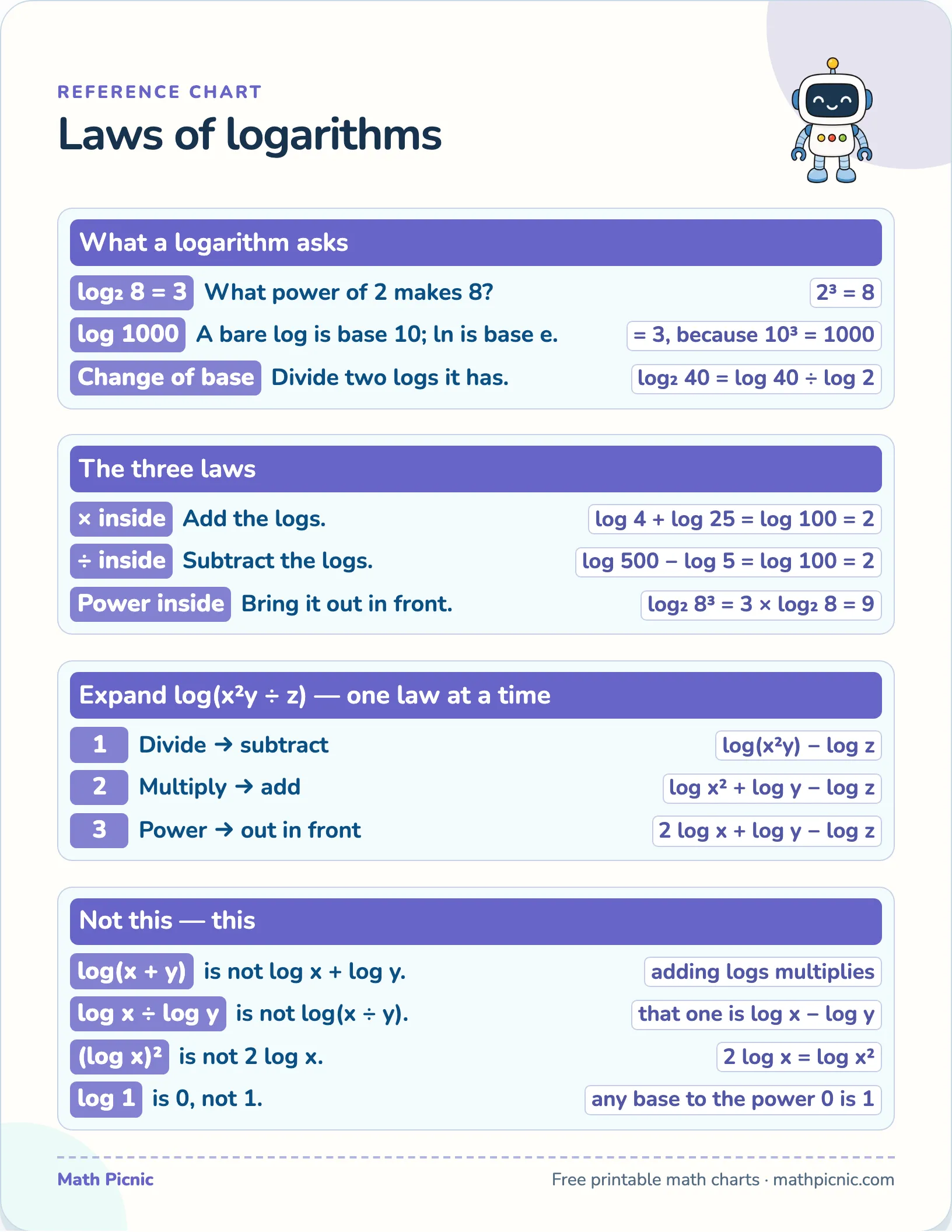
- log₂ 8 = 3What power of 2 makes 8?2³ = 8
- log 1000A bare log is base 10; ln is base e.= 3, because 10³ = 1000
- Change of baseDivide two logs it has.log₂ 40 = log 40 ÷ log 2
The three laws
- × insideAdd the logs.log 4 + log 25 = log 100 = 2
- ÷ insideSubtract the logs.log 500 − log 5 = log 100 = 2
- Power insideBring it out in front.log₂ 8³ = 3 × log₂ 8 = 9
Expand log(x²y ÷ z) — one law at a time
- 1Divide → subtractlog(x²y) − log z
- 2Multiply → addlog x² + log y − log z
- 3Power → out in front2 log x + log y − log z
Not this — this
- log(x + y)is not log x + log y.adding logs multiplies
- log x ÷ log yis not log(x ÷ y).that one is log x − log y
- (log x)²is not 2 log x.2 log x = log x²
- log 1is 0, not 1.any base to the power 0 is 1
What's on this chart
A logarithm is an exponent — log₂ 8 asks what power of 2 makes 8 — which is why these three laws are the exponent laws read backwards. Multiplying inside the log adds the logs, dividing subtracts them, and a power inside comes out in front. If the exponent chart is already on the wall, this one is the same three facts approached from the other side.
Why this chart helps
The examples here are worked in base 10 and base 2 so every line can be checked rather than taken on trust: log 4 + log 25 comes to log 100, which is 2, and a reader who doubts the product law can confirm it in one step. That matters more than usual with logarithms, because the laws are short enough to misremember and the wrong version still produces a tidy-looking answer.
More printable charts
- The quadratic formula
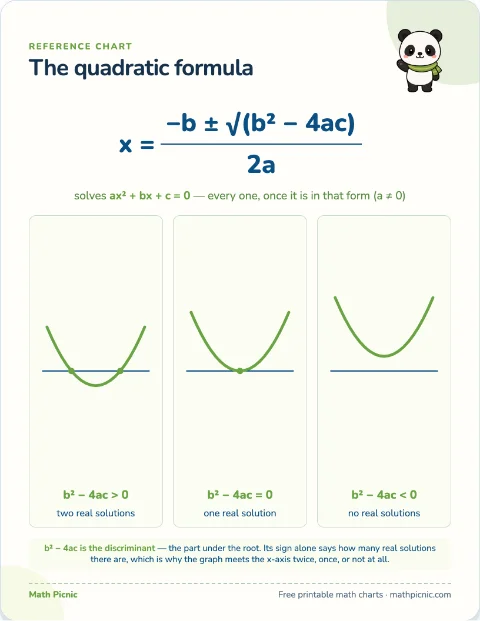 Print Put the equation in standard form, then read a, b and c into the formula.
 - Factoring patterns
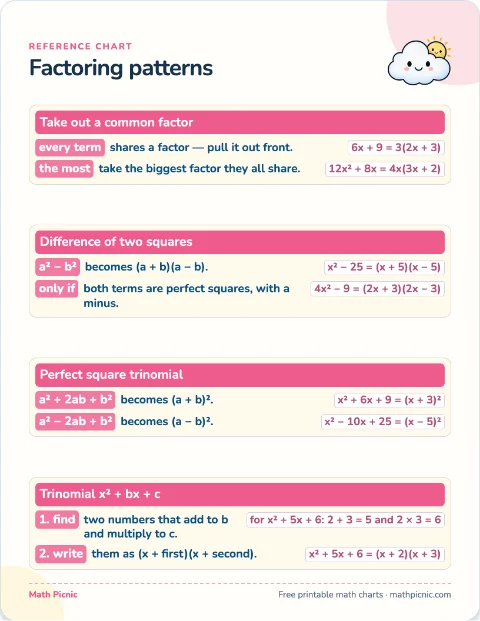 Print Spot which pattern the expression fits, then read the factors off it.
 - Solving systems
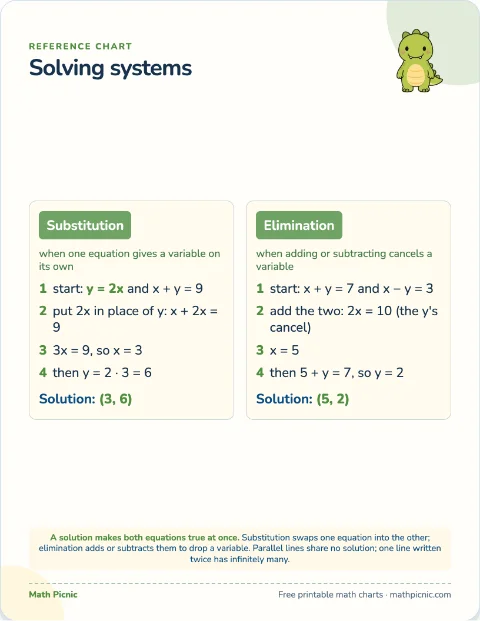 Print Pick the method that fits, then follow the worked steps beside it.
 - Function notation
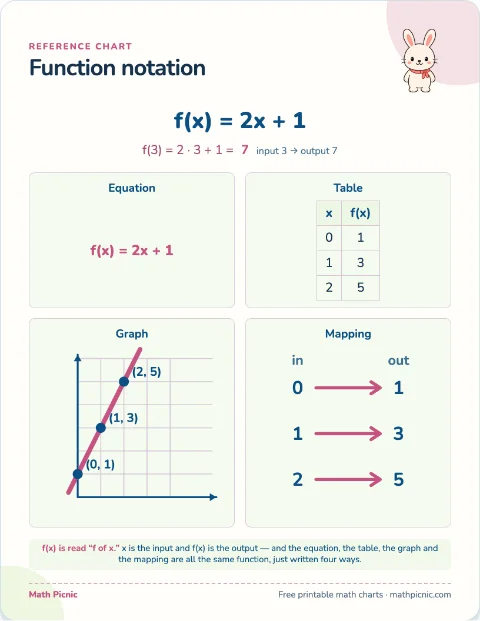 Print Read the same function across its equation, table, graph and mapping.