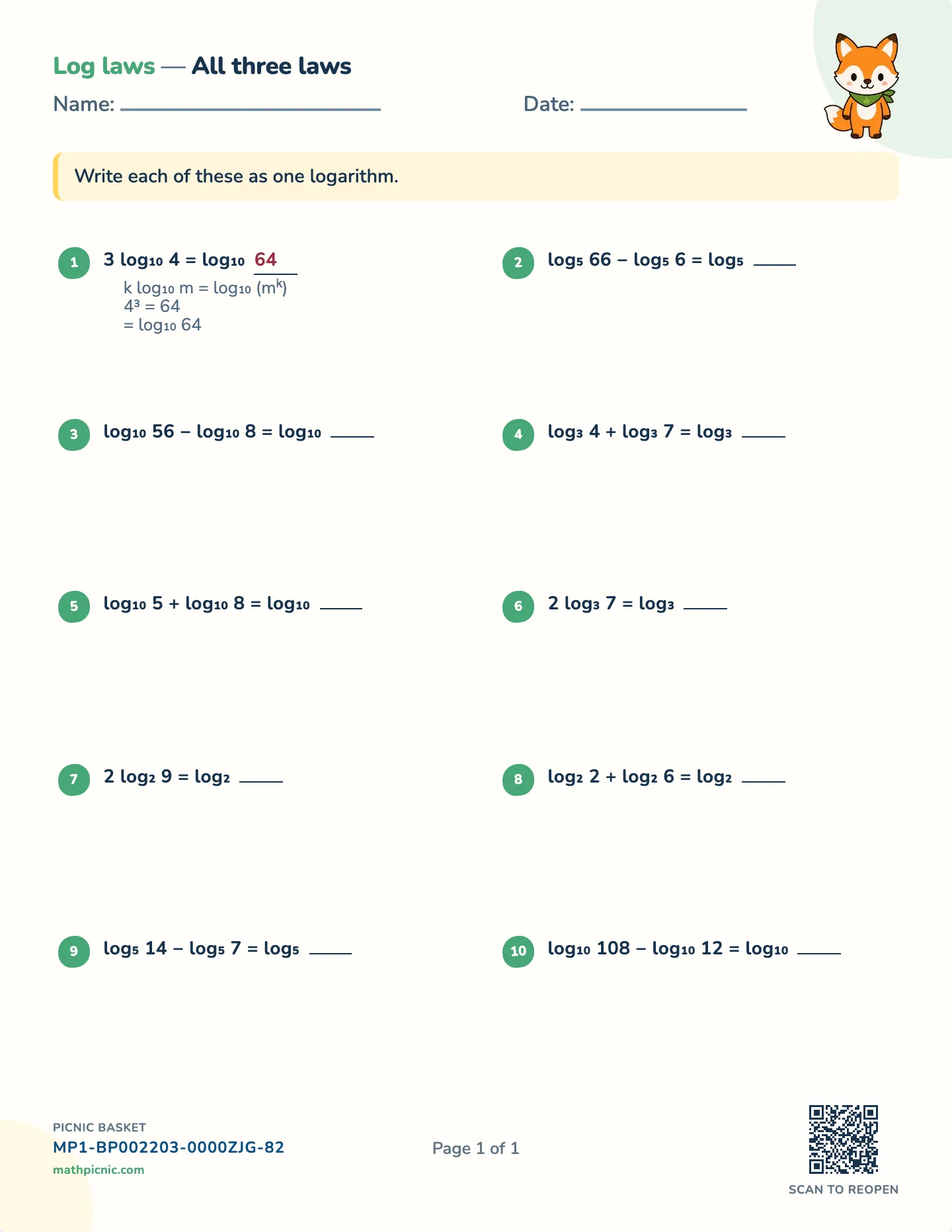
Adding two logarithms multiplies their numbers; subtracting them divides. These free printable worksheets drill the three laws in the direction that gets used most — writing a sum, a difference or a multiple as one logarithm.
The three laws are short enough to memorize and easy enough to mix up, which is exactly why a page of them is worth more than a page of any one. Add and you multiply. Subtract and you divide — first over second, and the order matters. Multiply a logarithm by a number and that number goes up as a power. The mistake is almost never the arithmetic; it is reaching for the wrong law.
Why this sheet works
Nothing here can be finished by evaluating. Every question is built so at least one of its numbers is not a power of the base, so log₂ 6 stays log₂ 6 and the law is the only road to the answer. That is deliberate: a page of log₂ 8 + log₂ 4 can be worked as 3 + 2 = 5 without a law ever being used, which teaches the wrong habit while looking like practice.
How this one works
One question from a sheet like this one, worked a step at a time — with a sentence saying what just happened and why.