
Solving systems
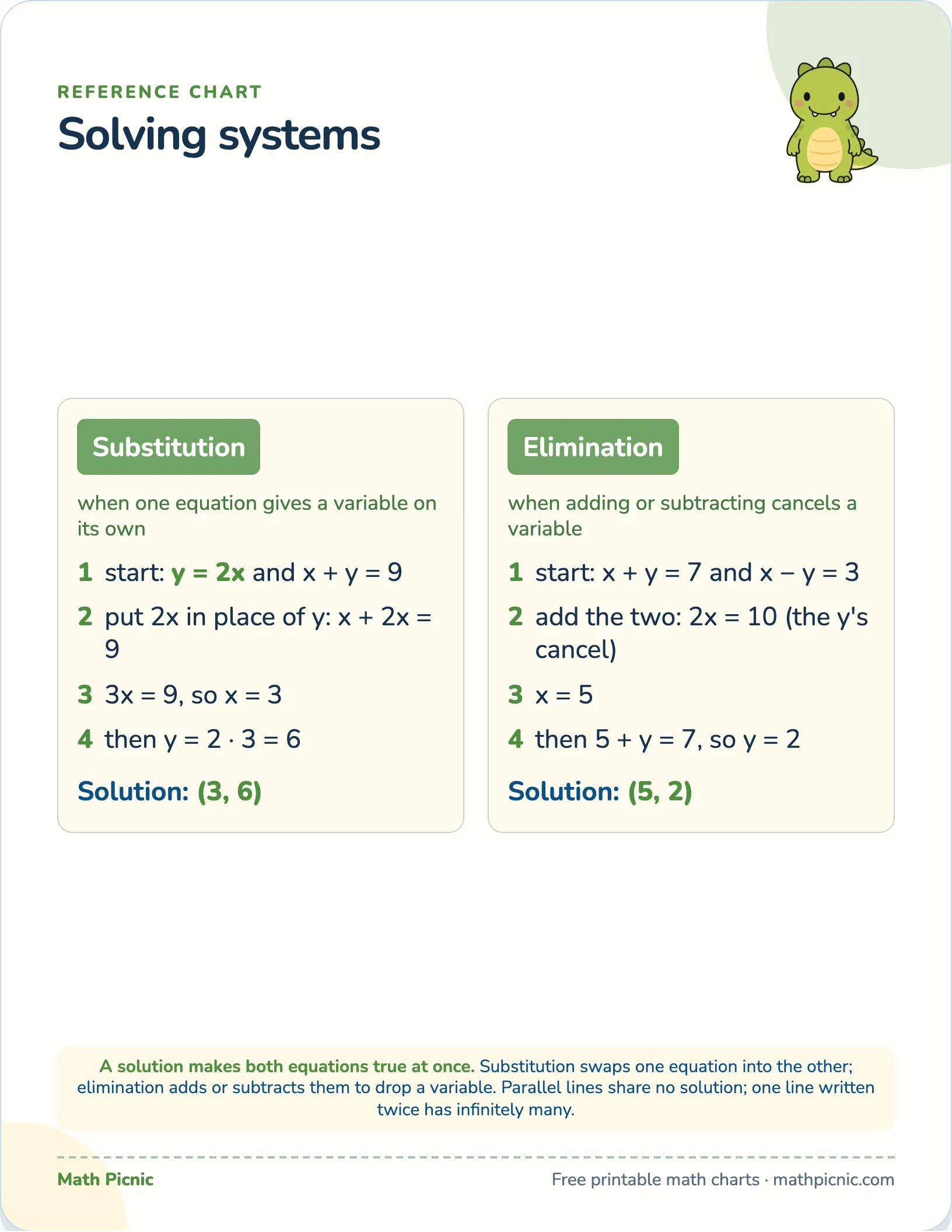
The two algebra methods for a system of two equations — substitution and elimination — each worked all the way through on real numbers, so the steps are something to follow rather than a rule to trust.
Reference chart
Solving systems

Substitution
when one equation gives a variable on its own
- start: y = 2x and x + y = 9
- put 2x in place of y: x + 2x = 9
- 3x = 9, so x = 3
- then y = 2 · 3 = 6
Solution: (3, 6)
Elimination
when adding or subtracting cancels a variable
- start: x + y = 7 and x − y = 3
- add the two: 2x = 10 (the y's cancel)
- x = 5
- then 5 + y = 7, so y = 2
Solution: (5, 2)
A solution makes both equations true at once. Substitution swaps one equation into the other; elimination adds or subtracts them to drop a variable. Parallel lines share no solution; one line written twice has infinitely many.
What's on this chart
A system is two equations that share the same variables, and its solution is the pair of values that makes both true at once. There are two reliable ways to find it by algebra, and this chart walks each one through a small example so the steps are concrete, not abstract.
Why this chart helps
Substitution is the move to reach for when one equation already gives a variable on its own: put that expression in place of the variable in the other equation, and two equations become one you can solve. Elimination is faster when the variables line up: add or subtract the equations so one variable cancels, leaving a single equation in the other. Both arrive at the same pair.
More printable charts
- The quadratic formula
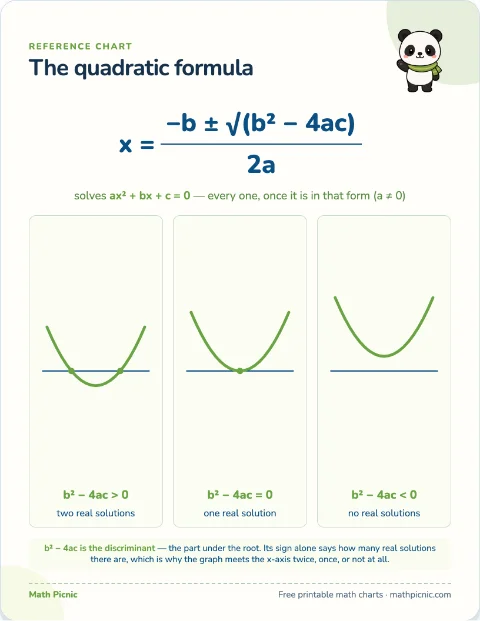 Print Put the equation in standard form, then read a, b and c into the formula.
 - Factoring patterns
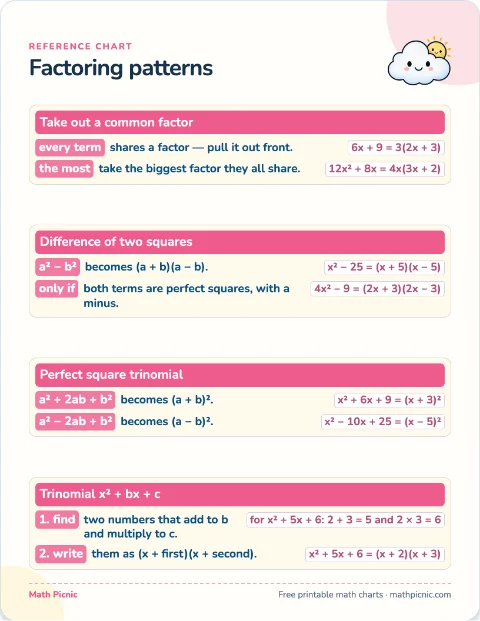 Print Spot which pattern the expression fits, then read the factors off it.
 - Function notation
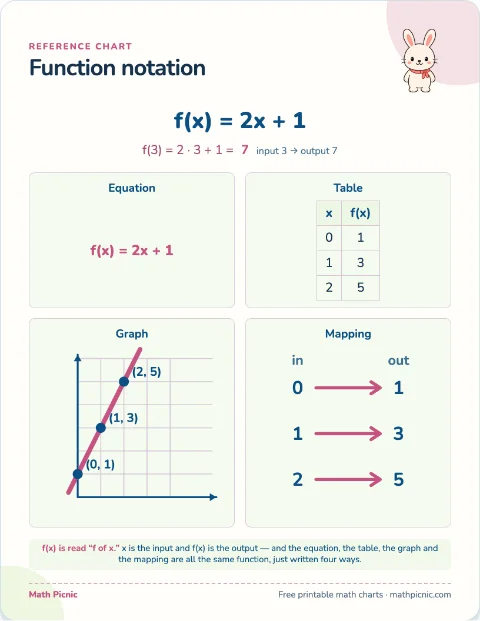 Print Read the same function across its equation, table, graph and mapping.
 - Laws of logarithms
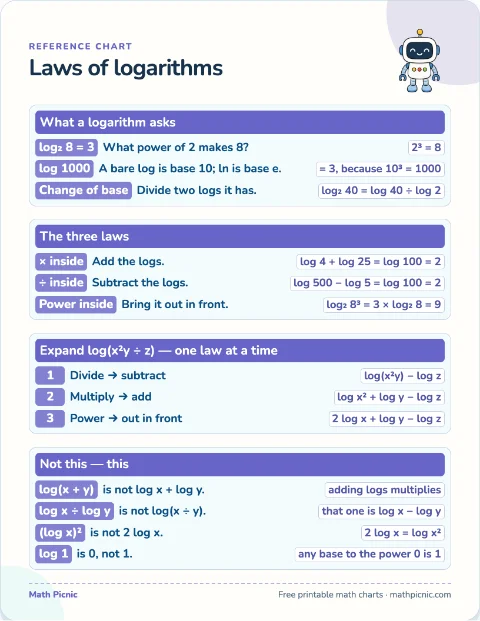 Print Match what is inside the log to a law, then follow the numbered expansion.