Systems of equationsBy substitution
Name: Date:
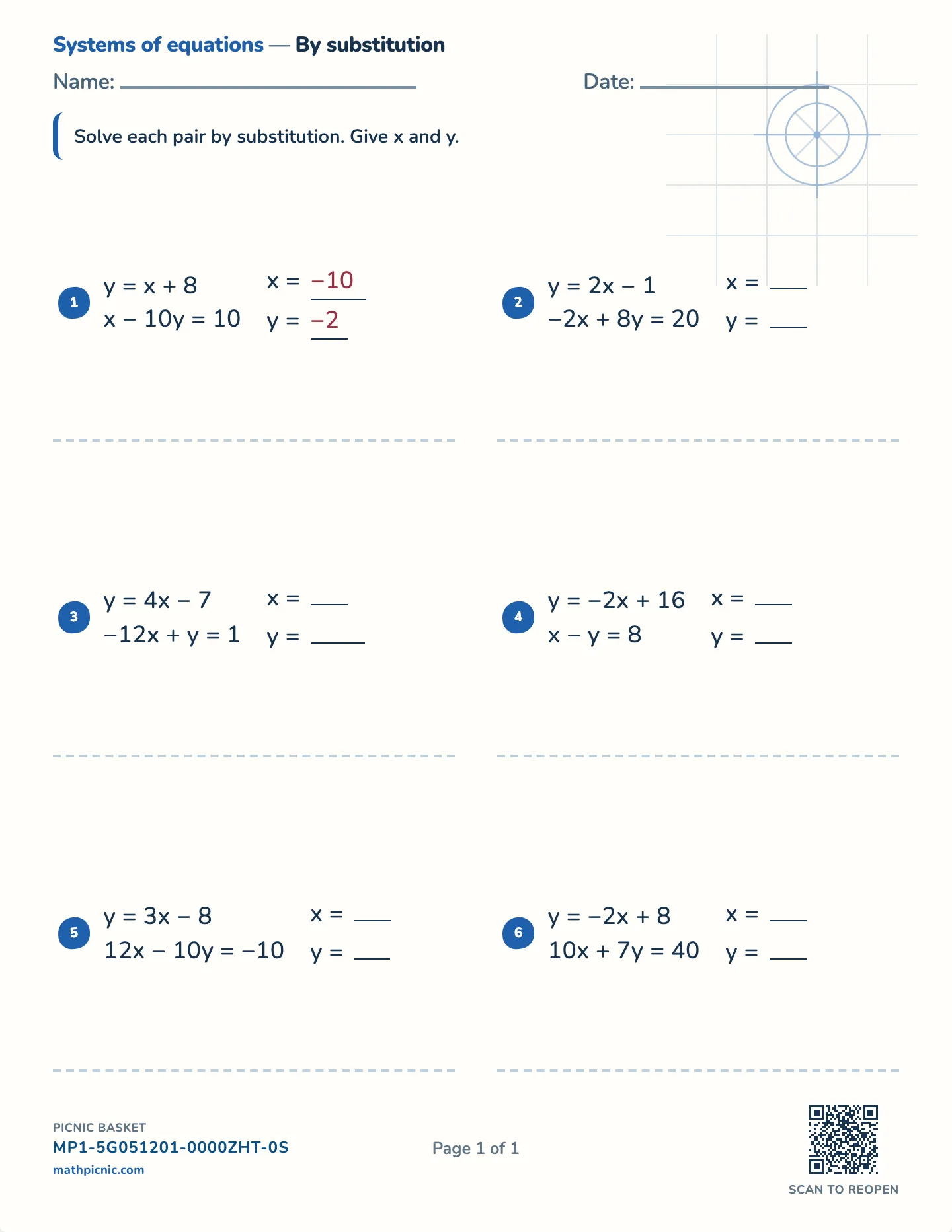
Solve each pair by substitution.
1y = x + 8x − 10y = 10
2y = 2x − 1−2x + 8y = 20
3y = 4x − 7−12x + y = 1
4y = −2x + 16x − y = 8
5y = 3x − 812x − 10y = −10
6y = −2x + 810x + 7y = 40

Substitution rearranges one equation for a single letter and puts that expression into the other. These free printable worksheets give pairs where one equation is already close to that form.
If they get stuck
The answer key prints on a separate page.
If y = 2x + 1, then every y in the other equation can be replaced by 2x + 1. What comes out is one equation in one letter, which is something already familiar. The method is longer to write than elimination and shorter to understand, and it is the one that generalizes to everything that comes after.
Brackets are the thing to insist on. Substituting 2x + 1 into 3y means 3(2x + 1), and a child who writes 3 × 2x + 1 has lost a term before starting. Writing the bracket every time, even where it turns out not to matter, is the habit that prevents it.
One question from a sheet like this one, worked a step at a time — with a sentence saying what just happened and why.
Systems by substitution, step by step