Function?
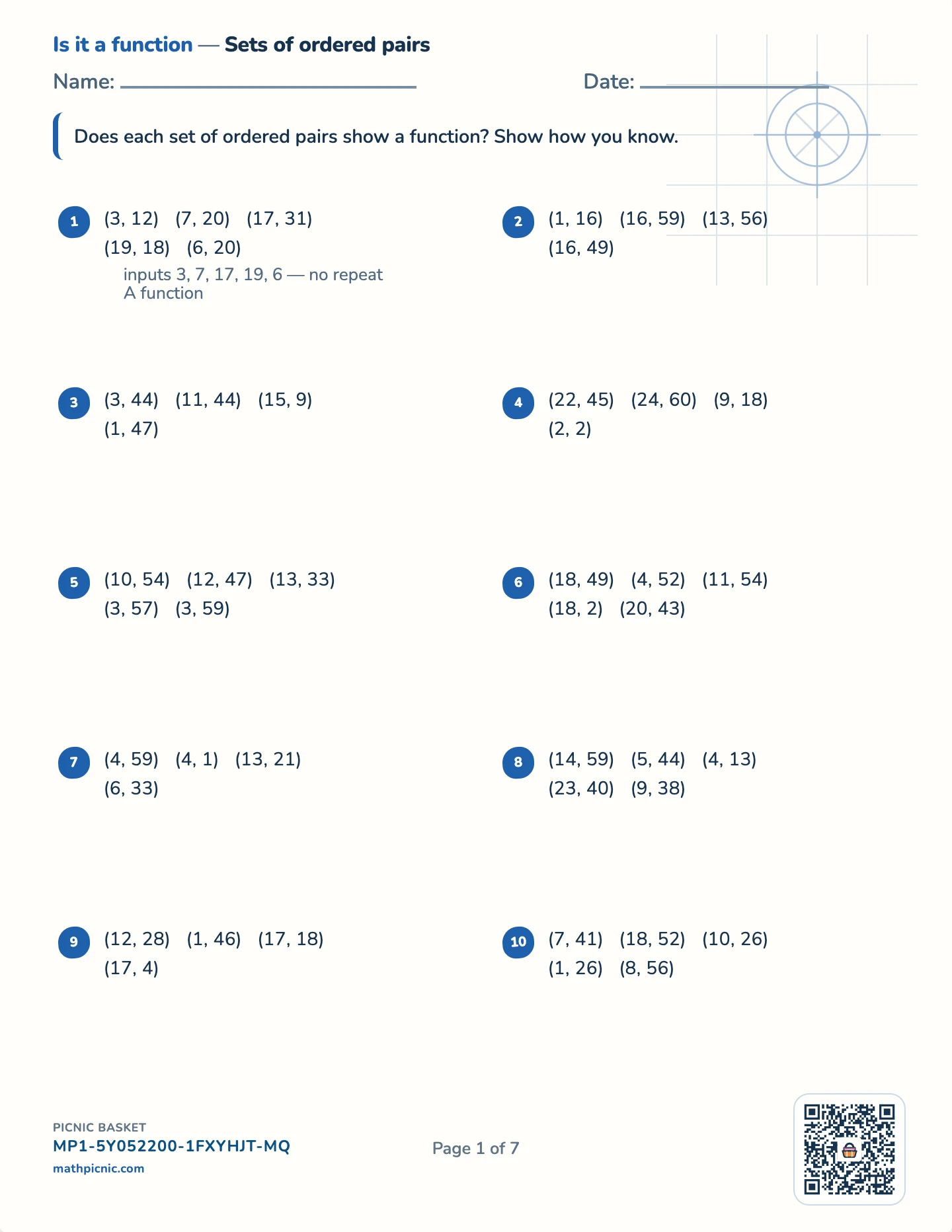
1. (3, 12) (7, 20) (17, 31) (19, 18) (6, 20): Yes — every input appears once — 20 turns up twice, but that is an output, and two inputs may land on the same one2. (1, 16) (16, 59) (13, 56) (16, 49): No — the input 16 goes to 59 and also to 49, and one input may only go to one place3. (3, 44) (11, 44) (15, 9) (1, 47): Yes — every input appears once — 44 turns up twice, but that is an output, and two inputs may land on the same one4. (22, 45) (24, 60) (9, 18) (2, 2): Yes — every input appears once, so no input can go to two places5. (10, 54) (12, 47) (13, 33) (3, 57) (3, 59): No — the input 3 goes to 57 and also to 59, and one input may only go to one place6. (18, 49) (4, 52) (11, 54) (18, 2) (20, 43): No — the input 18 goes to 49 and also to 2, and one input may only go to one place7. (4, 59) (4, 1) (13, 21) (6, 33): No — the input 4 goes to 59 and also to 1, and one input may only go to one place8. (14, 59) (5, 44) (4, 13) (23, 40) (9, 38): Yes — every input appears once, so no input can go to two places9. (12, 28) (1, 46) (17, 18) (17, 4): No — the input 17 goes to 18 and also to 4, and one input may only go to one place10. (7, 41) (18, 52) (10, 26) (1, 26) (8, 56): Yes — every input appears once — 26 turns up twice, but that is an output, and two inputs may land on the same oneLinear?
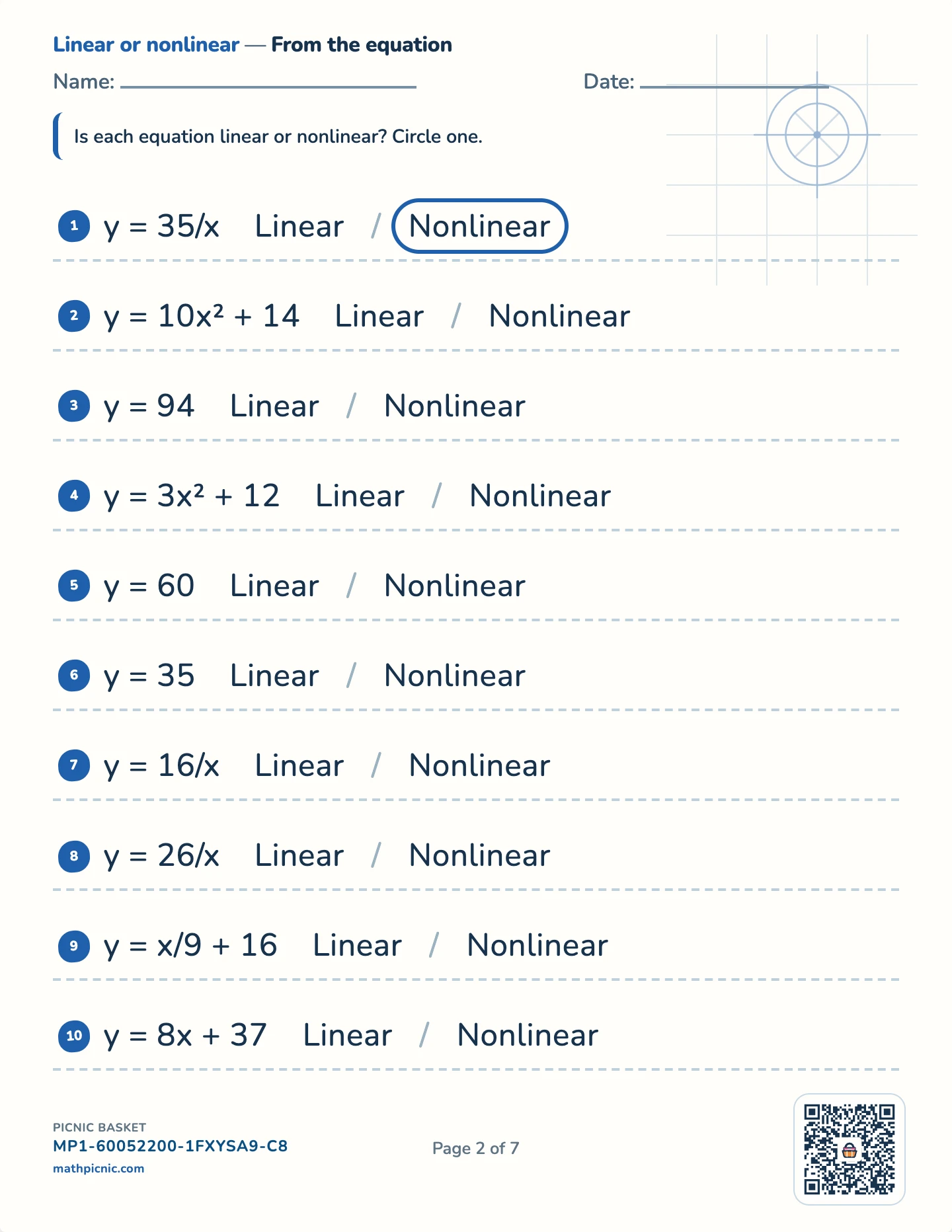
1. y = 35/x: Nonlinear — x is underneath, so doubling x halves y instead of adding the same amount again2. y = 10x² + 14: Nonlinear — x is squared, so the steps in y grow as x grows3. y = 94: Linear — y is always 94 whatever x does — that graph is a flat line, and flat is a slope of zero rather than no slope4. y = 3x² + 12: Nonlinear — x is squared, so the steps in y grow as x grows5. y = 60: Linear — y is always 60 whatever x does — that graph is a flat line, and flat is a slope of zero rather than no slope6. y = 35: Linear — y is always 35 whatever x does — that graph is a flat line, and flat is a slope of zero rather than no slope7. y = 16/x: Nonlinear — x is underneath, so doubling x halves y instead of adding the same amount again8. y = 26/x: Nonlinear — x is underneath, so doubling x halves y instead of adding the same amount again