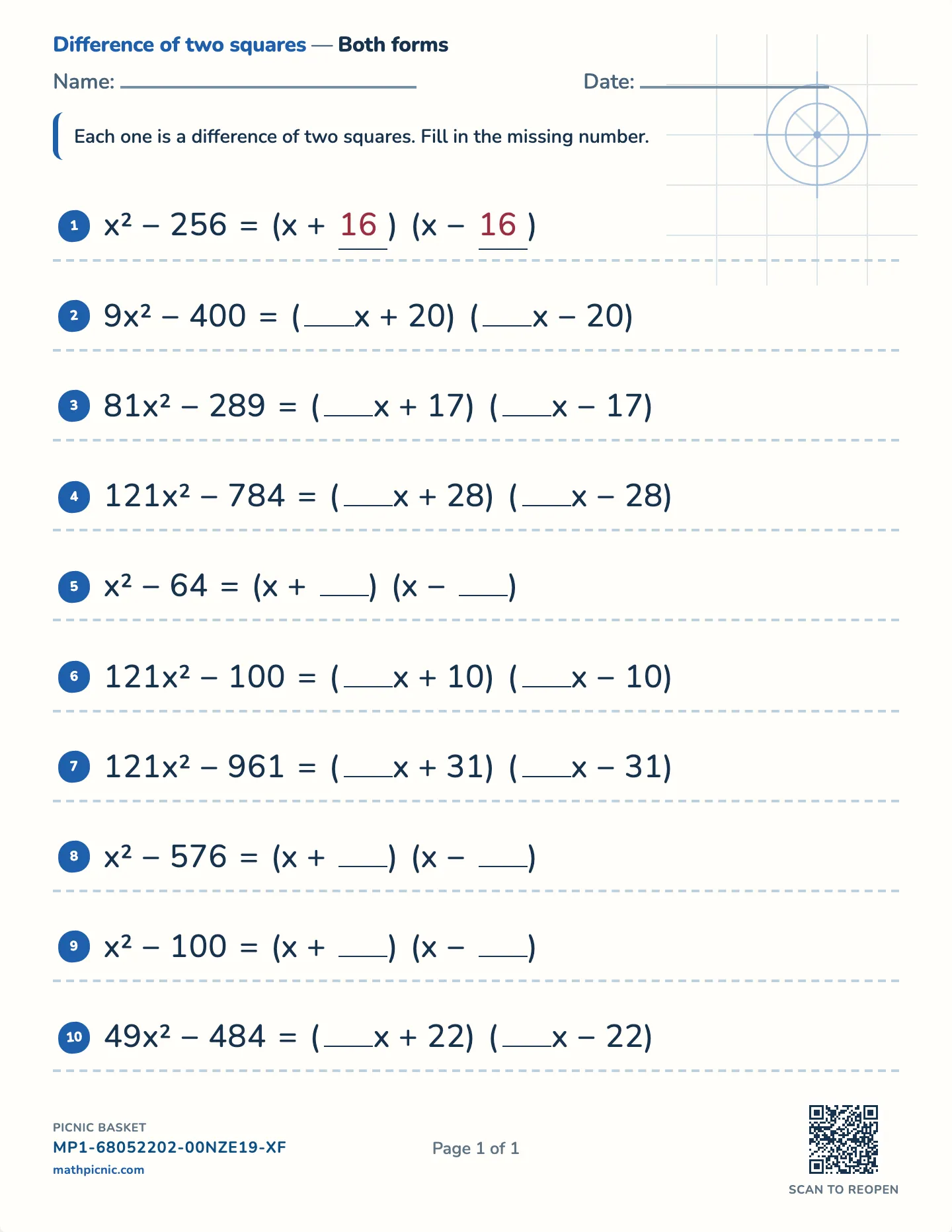
Something squared minus something squared is the sum times the difference — the one factorization with no middle term to hunt for. Free printable worksheets.
Ready for harder? The gap between two squares — the same identity, used to find the two numbers rather than to factorize.
Difference of two squares
The answer key prints on a separate page.
What's on this sheet
The pattern is worth recognizing precisely because it skips the search: no two numbers to find, no middle term to match. But it only works when the expression really is one square minus another, and a student who has learned the shortcut applies it to x² − 20 and to x² + 64 just as happily. So every walk here checks the shape first — is each part a perfect square, and is it a minus — before it factors anything.
Why this sheet works
Multiplying it back out once is the whole proof and it takes two lines: the outer and inner products are +kx and −kx, and they cancel. That is also the answer to “why is there no middle term”, and a student who has watched it disappear does not have to take the rule on trust.
How this one works
One question from a sheet like this one, worked a step at a time — with a sentence saying what just happened and why.
Use the difference of two squares: factor it, or multiply it out.
1144x² − 25
2x² − 36
3x² − 144
4(x + 8)(x − 8) + 15
5(x + 23)(x − 23) − 15
64x² − 361
7x² − 25
8(x + 23)(x − 23) − 7
9x² − 529
10100x² − 9
Difference of two squares · Every formAnswer key
1. 144x² − 25 = (12x + 5)(12x − 5) (144x² is 12x squared, so the two brackets start 12x rather than 144x)2. x² − 36 = (x + 6)(x − 6) (36 is 6 squared, so the two brackets are (x + 6) and (x − 6))3. x² − 144 = (x + 12)(x − 12) (144 is 12 squared, so the two brackets are (x + 12) and (x − 12))4. (x + 8)(x − 8) + 15 = x² − 49 (the brackets multiply to x² − 64, and −64 + 15 is −49)5. (x + 23)(x − 23) − 15 = x² − 544 (the brackets multiply to x² − 529, and −529 − 15 is −544)6. 4x² − 361 = (2x + 19)(2x − 19) (4x² is 2x squared, so the two brackets start 2x rather than 4x)7. x² − 25 = (x + 5)(x − 5) (25 is 5 squared, so the two brackets are (x + 5) and (x − 5))8. (x + 23)(x − 23) − 7 = x² − 536 (the brackets multiply to x² − 529, and −529 − 7 is −536)9. x² − 529 = (x + 23)(x − 23) (529 is 23 squared, so the two brackets are (x + 23) and (x − 23))10. 100x² − 9 = (10x + 3)(10x − 3) (100x² is 10x squared, so the two brackets start 10x rather than 100x)