
Faces, edges and vertices
Nine solids with their three counts, every hidden edge drawn in — and one piece of arithmetic underneath that tells a child whether they counted right.
Reference chart
Faces, edges and vertices

| Solid | Faces | Edges | Vertices | F + V − E |
|---|---|---|---|---|
| Cube | 6 | 12 | 8 | 6 + 8 − 12 = 2 |
| Cuboid | 6 | 12 | 8 | 6 + 8 − 12 = 2 |
| Triangular prism | 5 | 9 | 6 | 5 + 6 − 9 = 2 |
| Hexagonal prism | 8 | 18 | 12 | 8 + 12 − 18 = 2 |
| Square pyramid | 5 | 8 | 5 | 5 + 5 − 8 = 2 |
| Triangular pyramid | 4 | 6 | 4 | 4 + 4 − 6 = 2 |
| Cylinder | 2 flat | 2 curved | 0 | — |
| Cone | 1 flat | 1 curved | 1 point | — |
| Sphere | 0 flat | 0 | 0 | — |
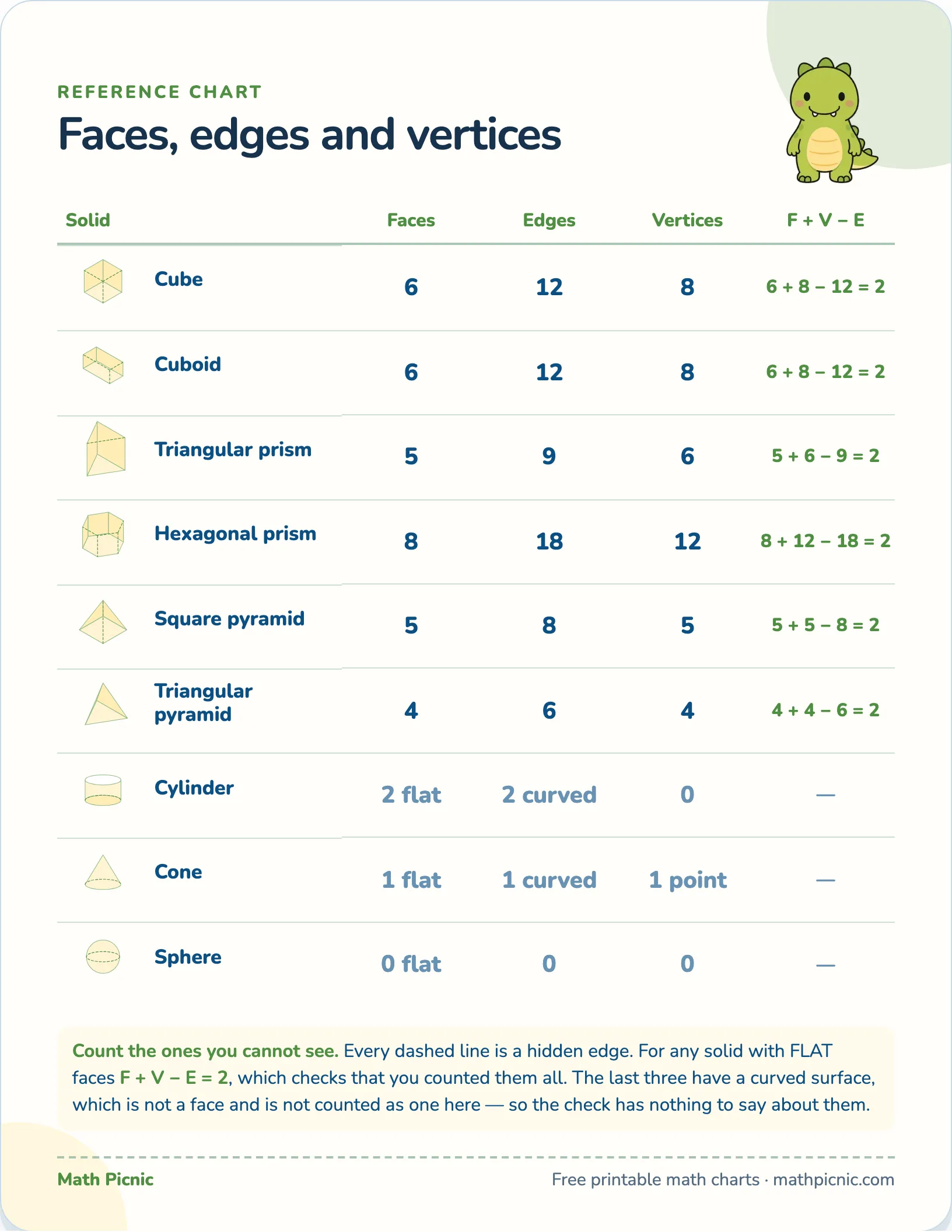
Count the ones you cannot see. Every dashed line is a hidden edge. For any solid with FLAT faces F + V − E = 2, which checks that you counted them all. The last three have a curved surface, which is not a face and is not counted as one here — so the check has nothing to say about them.
What's on this chart
Counting is where this goes wrong, and it goes wrong in a way that a table of numbers cannot fix: a child counts the faces they can see. A drawn cube shows three of them and the answer is six, so a page that hides the back half teaches the mistake it exists to prevent. Every solid here carries its hidden edges as dashed lines, which makes the drawing the method — count what is dashed as well, and the count comes out right.
Why this chart helps
Euler's formula is the reason this chart is worth having on a wall rather than looking up once. Faces plus vertices, take away edges, is 2 for every flat-faced solid on this page and for every other one a child will meet. That makes it the only self-check available at this age: count three numbers and the arithmetic says whether you counted them all. A cube gives 6 + 8 − 12 = 2, a tetrahedron gives 4 + 4 − 6 = 2, and a hexagonal prism — which nobody counts right first time — gives 8 + 12 − 18 = 2.
More printable charts
- Naming 2D shapes
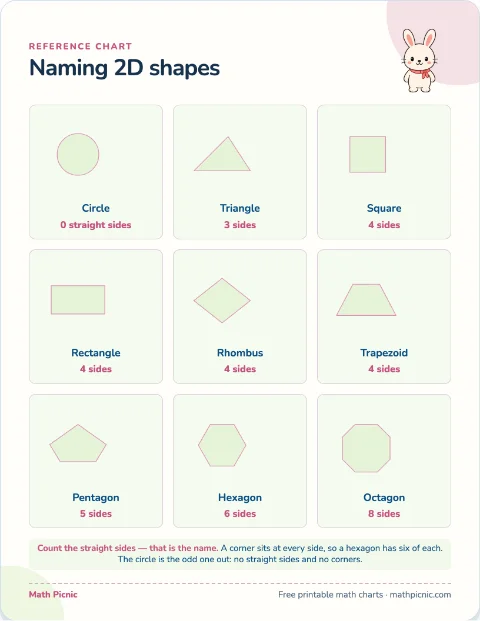 Print Count the straight sides on a shape, then read its name below it.
 - Quadrilateral family
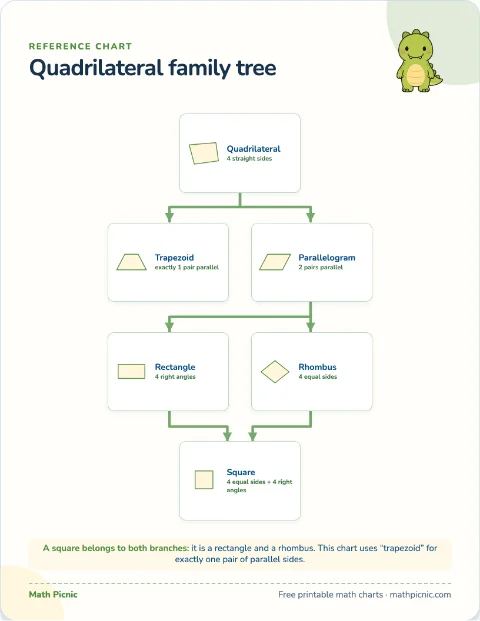 Print Follow the branches to see which names a shape inherits.
 - Lines of symmetry
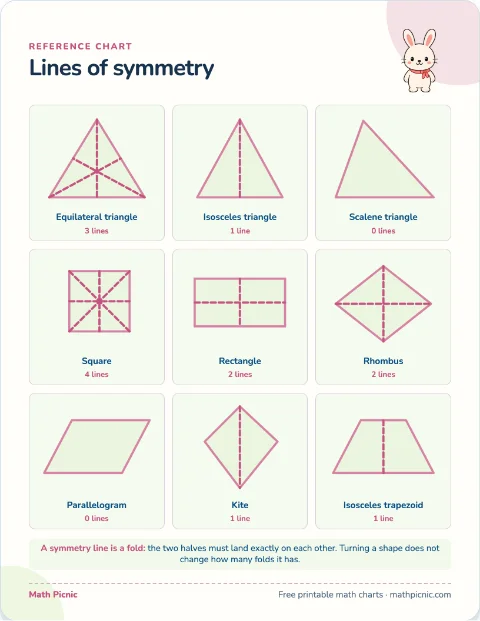 Print Fold each shape in your mind and count the matching halves.
 - Types of angles
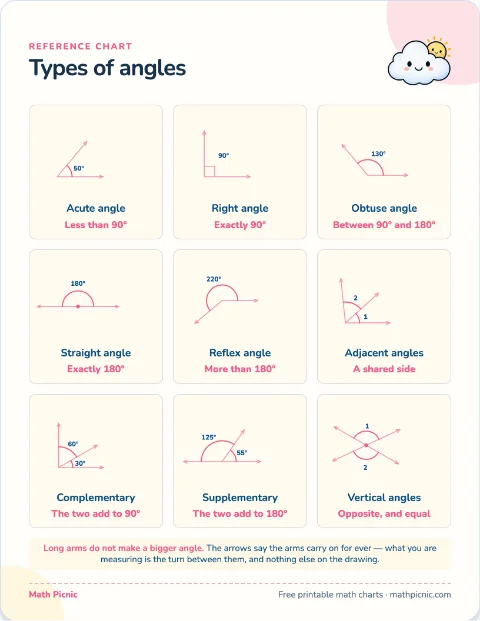 Print Find the picture that matches yours, and the name is under it.
 - Angles in parallel lines
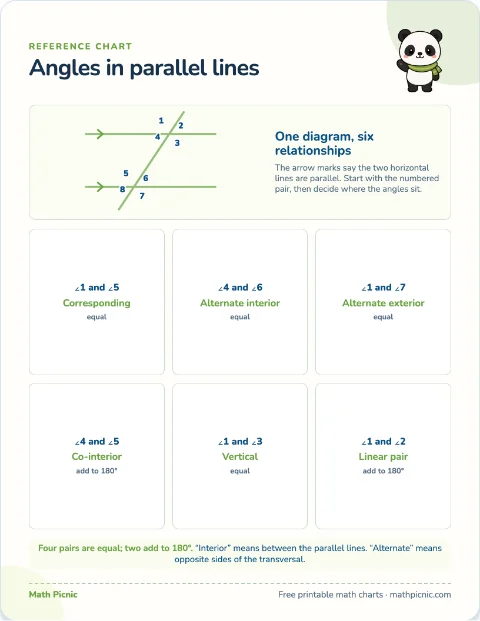 Print Match each numbered pair to its position around the transversal.
 - Perimeter formulas
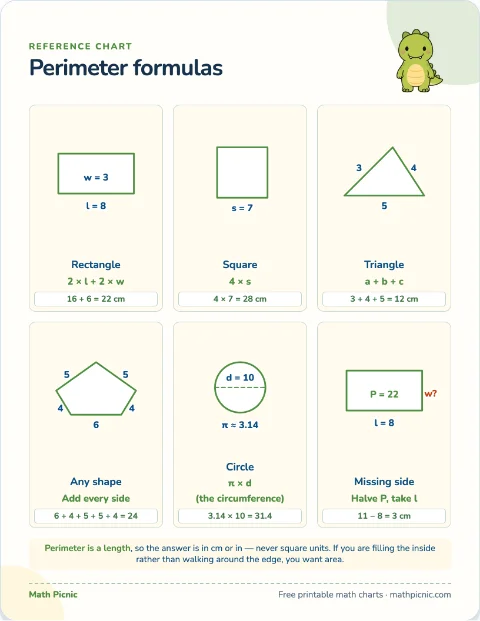 Print Follow the traced edge on the figure, then read the formula under it.
 - Area formulas
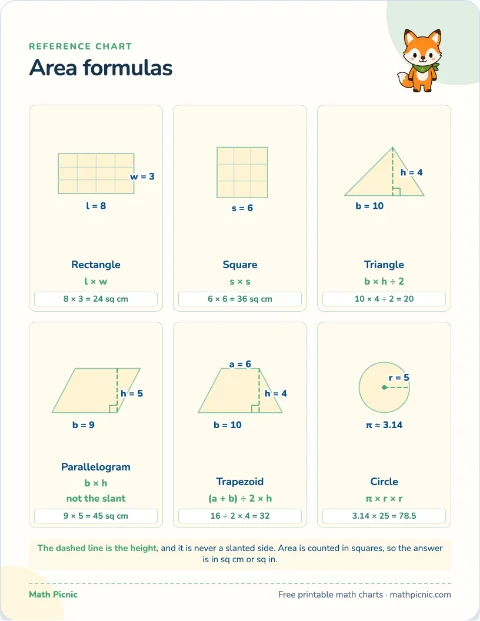 Print Match your shape to a figure and use the letters drawn on it.
 - Volume formulas
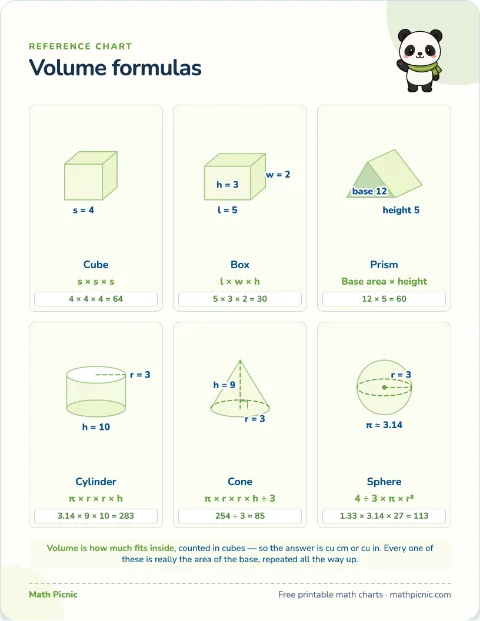 Print Find your solid, then multiply the base area by how tall it stands.