Volume of a rectangular prism worksheets

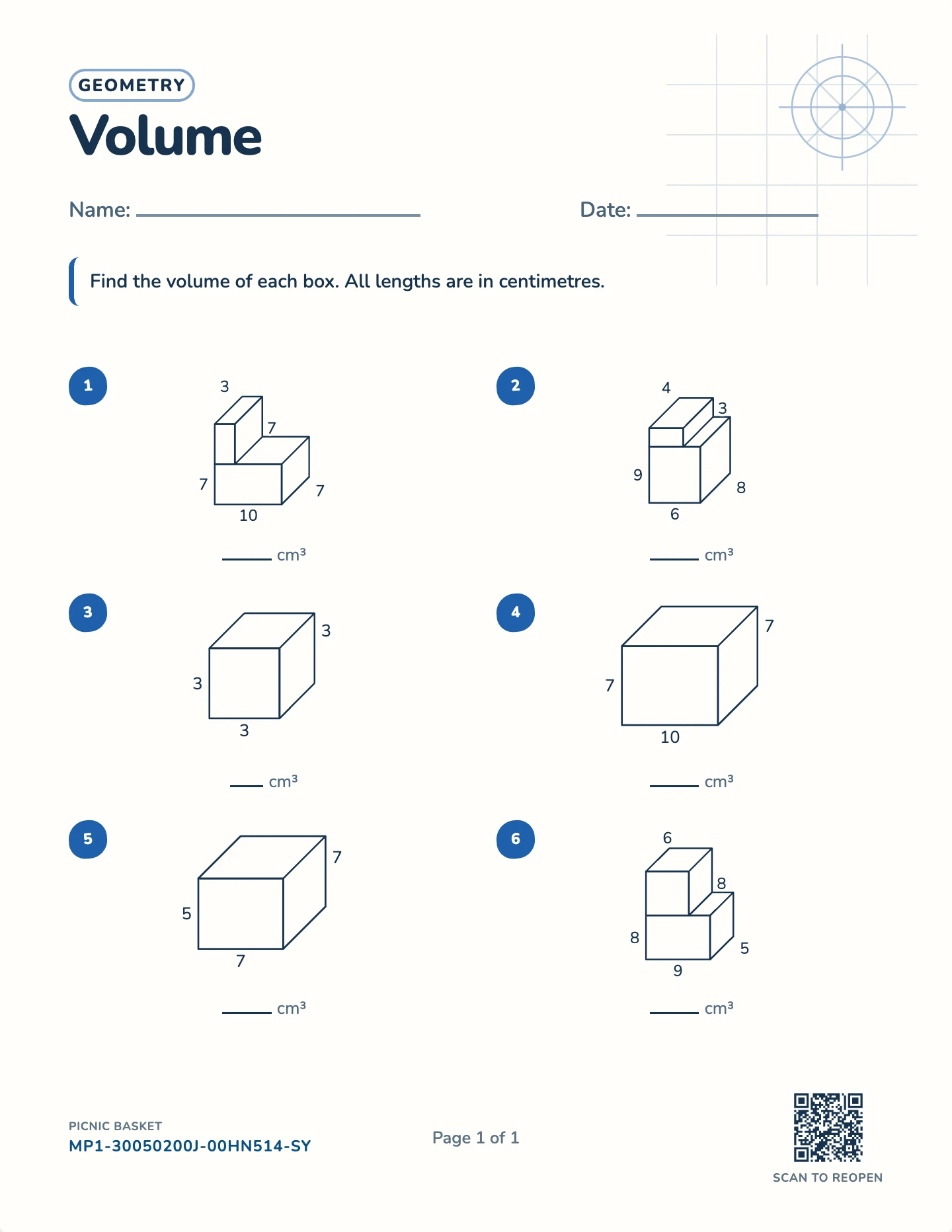
Volume is the third dimension arriving, and the figure has to show it or a child will multiply two numbers and stop. These free printable worksheets draw the box in oblique projection with all three edges labeled.

Volume of a rectangular prism
Volume of a rectangular prism worksheet — Edges to 10 cm, free printable with answer key

The answer key prints on a separate page.

What's on this sheet

The composite sheets are the standard's own next sentence rather than a variation someone invented: the volume of a solid made of two non-overlapping prisms is the sum of their volumes. It is the step that turns a formula into a method, so it sits alongside the plain boxes rather than in a separate place.

Why this sheet works

The two prisms in a composite figure share a depth. That is not a simplification for the drawing's sake — a step that is narrower front-to-back as well as shorter changes two things at once, and the addition is what is being practiced.

How this one works

Volume of a 10 × 7 × 7 stepped solid

10 × 7 × 7with a step on top
slab:10 × 7 × 7 =490
block:3 × 7 × 7 =147
slab:490
block:147
490 + 147 =637 cubic cm
filled box:10 × 7 × 14 =980
notch:7 × 7 × 7 =343
filled box:980
notch:343
980 − 343 =637 cubic cm
  1. A block standing on a slab. There is no formula for this shape — the job is to turn it into boxes, which do have one, and there is more than one way.
  2. First way: cut it into the two boxes it already is. The slab underneath is 10 × 7 × 7 = 490, and the block standing on it is 3 × 7 × 7 = 147.
  3. 490 + 147 = 637 cubic cm.
  4. Second way: fill the notch in to make one big box. That box is 10 × 7 × 14 = 980, and the notch taken back off is 7 × 7 × 7 = 343.
  5. 980 − 343 = 637 cubic cm. Two methods agreeing is how you know.