
Order of operations
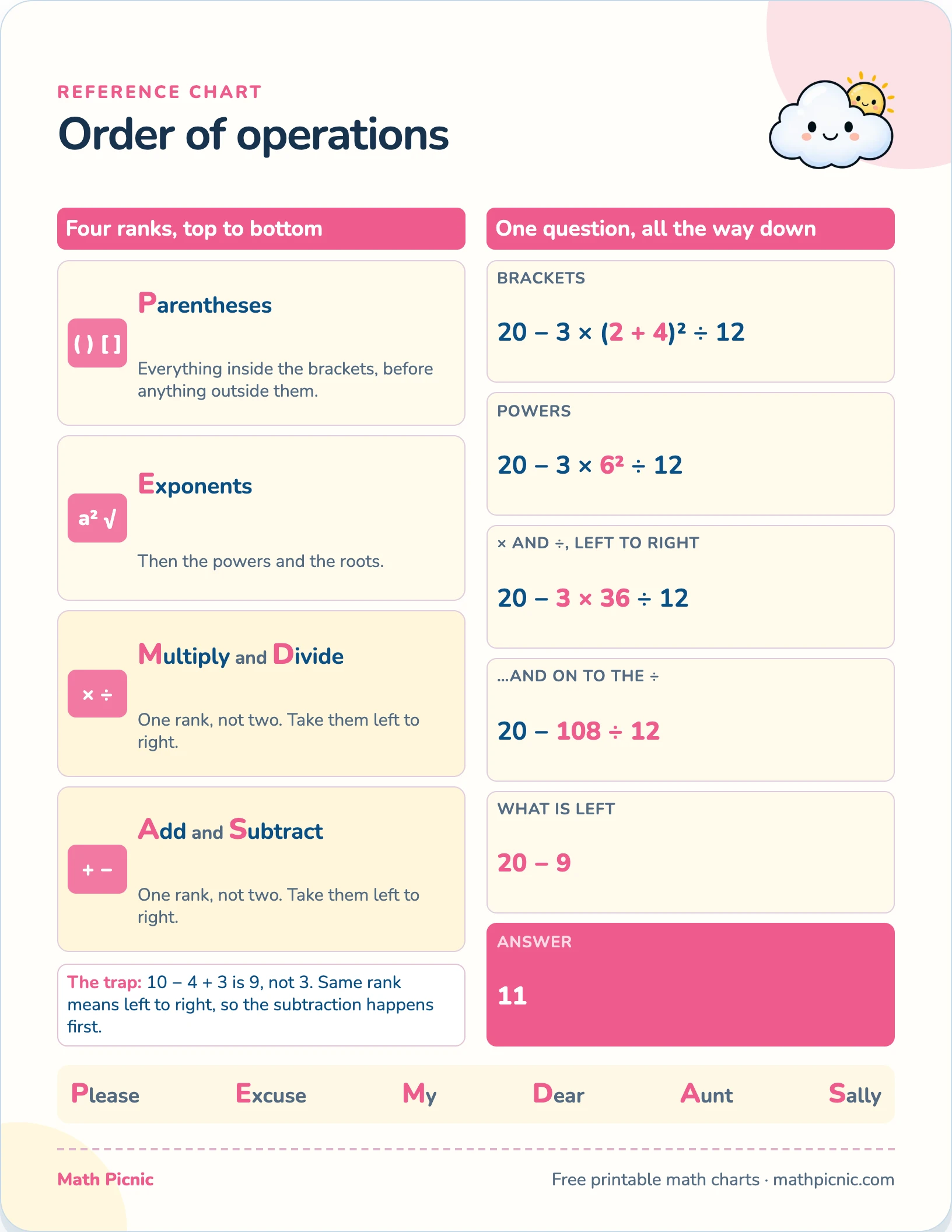
PEMDAS as four ranks rather than six letters, with one question walked all the way down them. Multiply and divide share a rank; add and subtract share a rank; and that is the part the mnemonic hides.
Reference chart
Order of operations

Four ranks, top to bottom
- ParenthesesEverything inside the brackets, before anything outside them.
- ExponentsThen the powers and the roots.
- Multiply and DivideOne rank, not two. Take them left to right.
- Add and SubtractOne rank, not two. Take them left to right.
The trap: 10 − 4 + 3 is 9, not 3. Same rank means left to right, so the subtraction happens first.
One question, all the way down
- Brackets20 − 3 × (2 + 4)² ÷ 12
- Powers20 − 3 × 6² ÷ 12
- × and ÷, left to right20 − 3 × 36 ÷ 12
- …and on to the ÷20 − 108 ÷ 12
- What is left20 − 9
- Answer11
PleaseExcuseMyDearAuntSally
What's on this chart
The mnemonic teaches six things in a row, and two of them are not true. A child who has learned M before D reads 8 ÷ 4 × 2 as 8 ÷ 8 and answers 1, when the answer is 4 — not because they forgot the rule but because they followed it. Multiplication and division are one rank taken left to right, addition and subtraction are another, and every chart that lists six letters down a column is quietly teaching the mistake.
Why this chart helps
So the ranks are paired here, and the right-hand column is where the chart earns its place. A list of rules with a different example beside each one shows a child the letters without ever showing the order doing any work; a single expression losing one piece at a time, with the part being replaced picked out, shows what following the rule actually looks like. That is the difference between a poster and a reference.
More printable charts
- Rounding rules
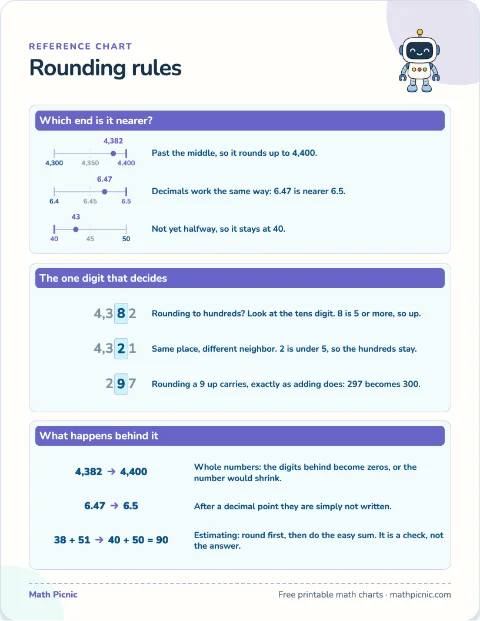 Print Find the place, look at the digit beside it, then decide.
 - Mental math tricks
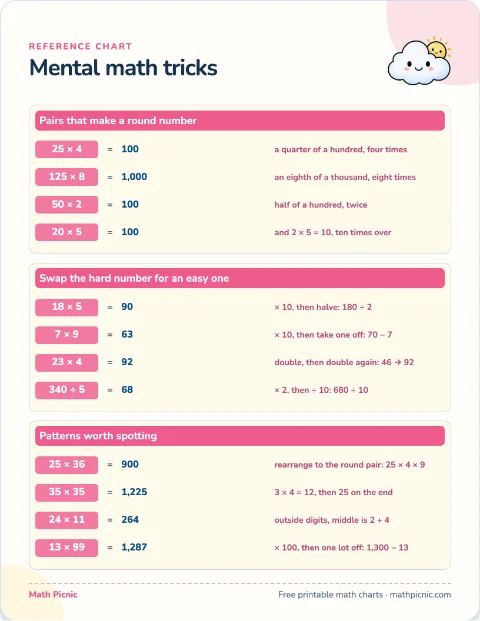 Print Swap the hard number for an easy one before you start calculating.
 - Divisibility rules
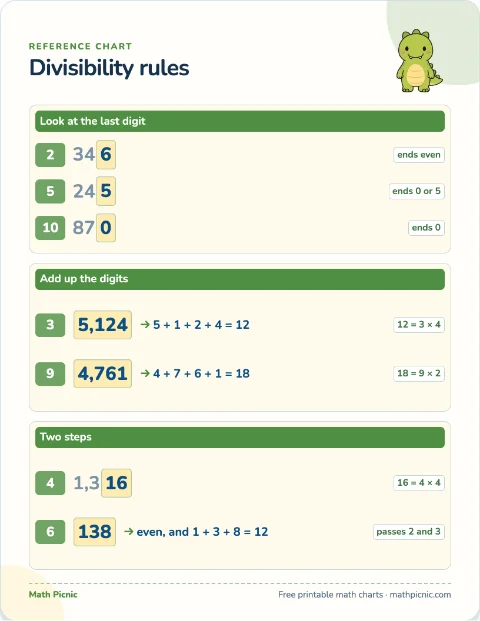 Print Run one quick test in their head instead of starting a division.
 - Fraction rules
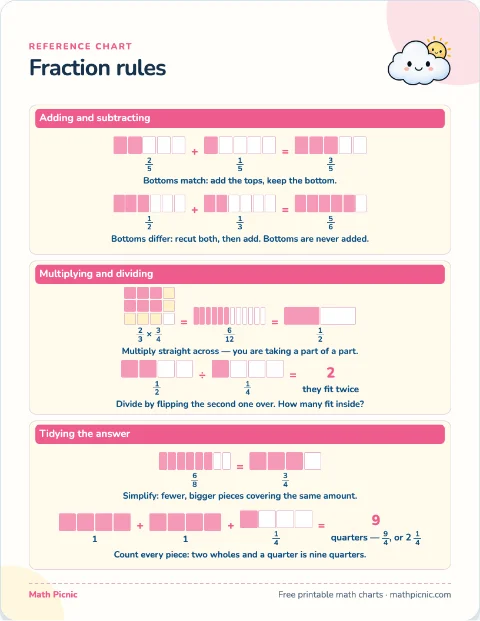 Print Check a fraction answer against the rule before doing the arithmetic.
 - Measurement conversions
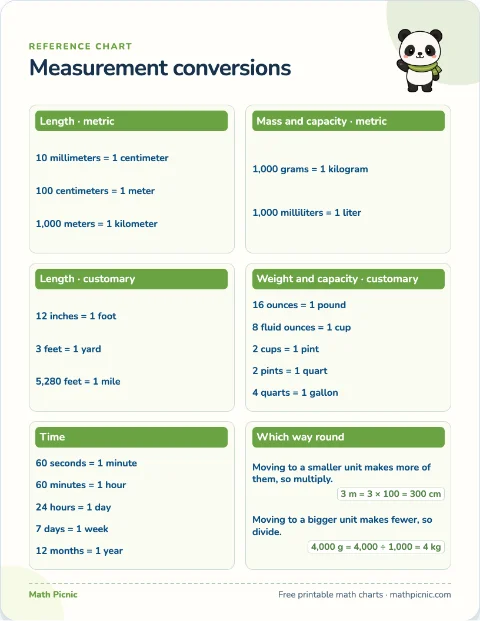 Print Look the conversion up, then decide whether to multiply or divide.
 - Positive and negative numbers
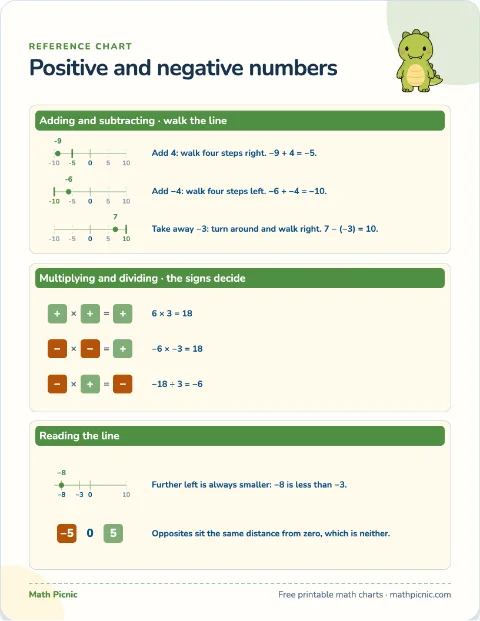 Print Check which operation you are doing before deciding the answer's sign.
 - Laws of exponents
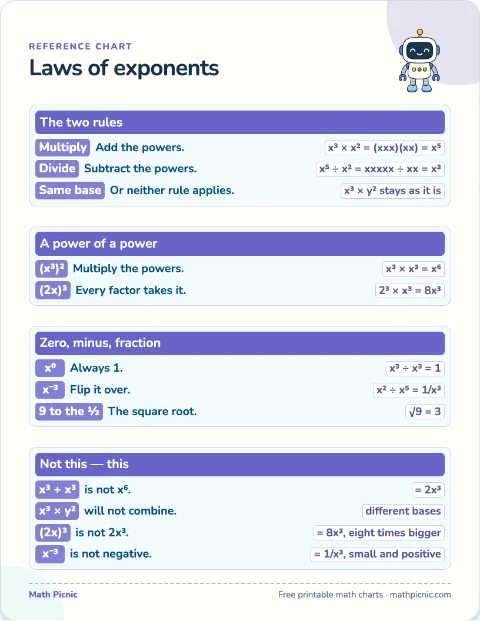 Print Find the operation you have, and the example shows where the rule comes from.
 - Scientific notation
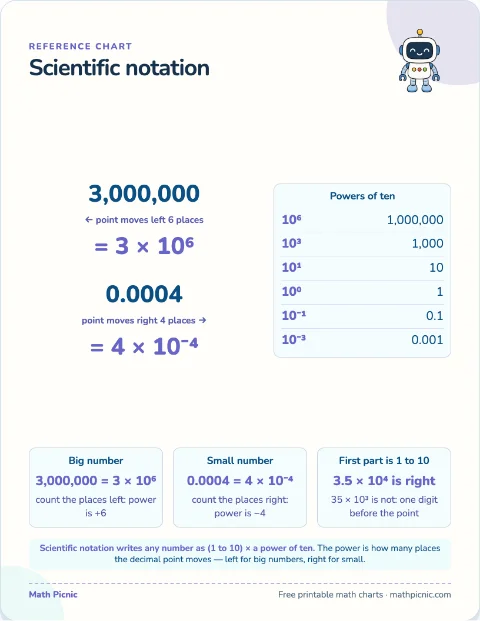 Print Move the decimal point to a number between 1 and 10, then count the places as the power.