Free · Ready to print · Letter & A4
Measurement conversions
Need a measurement conversions within reach? Print it for the wall, or make a fact-list version to fill in.
- Letter & A4 ready
- Nothing to fill in
- Reprint it any time
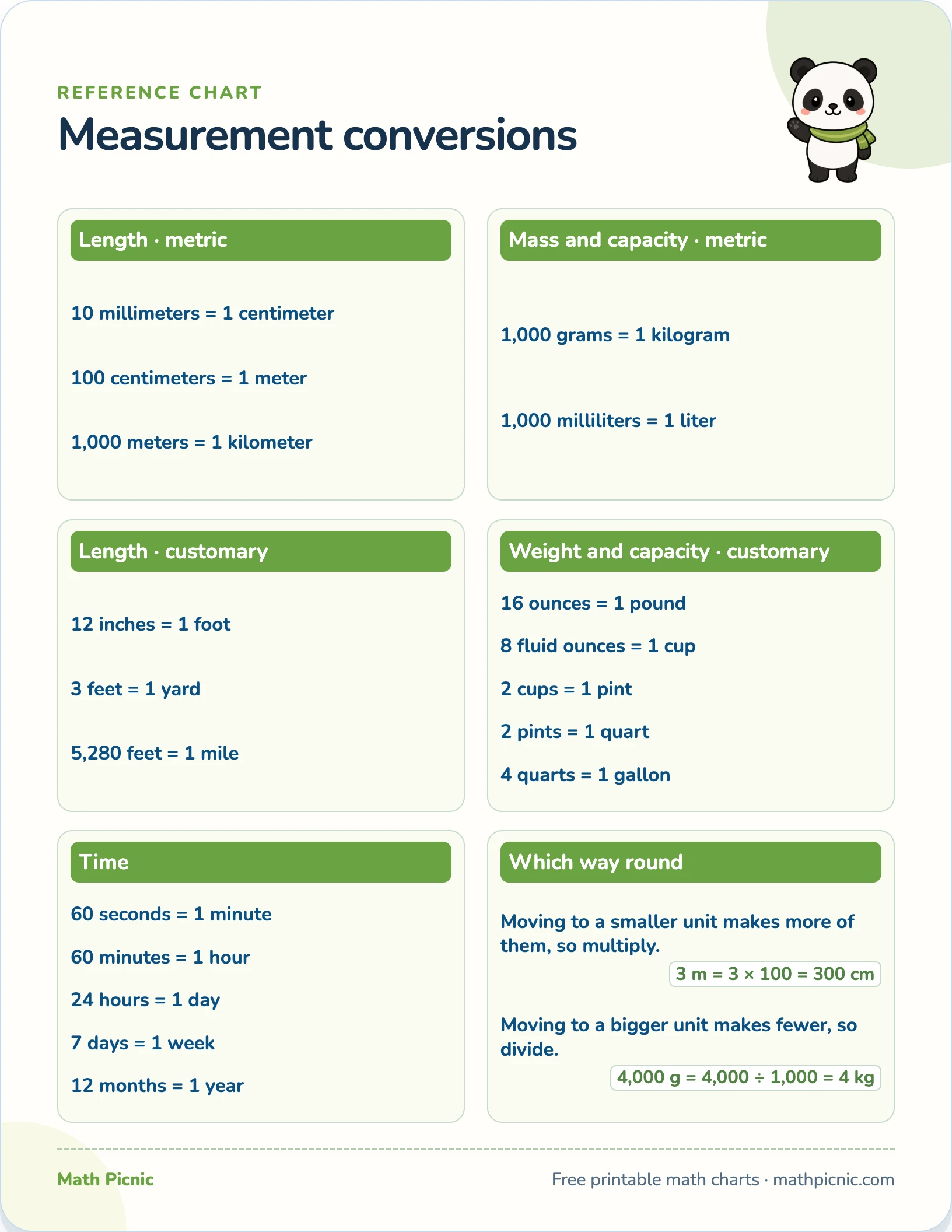
Reference chart
Measurement conversions

Length · metric
- 10 millimeters = 1 centimeter
- 100 centimeters = 1 meter
- 1,000 meters = 1 kilometer
Mass and capacity · metric
- 1,000 grams = 1 kilogram
- 1,000 milliliters = 1 liter
Length · customary
- 12 inches = 1 foot
- 3 feet = 1 yard
- 5,280 feet = 1 mile
Weight and capacity · customary
- 16 ounces = 1 pound
- 8 fluid ounces = 1 cup
- 2 cups = 1 pint
- 2 pints = 1 quart
- 4 quarts = 1 gallon
Time
- 60 seconds = 1 minute
- 60 minutes = 1 hour
- 24 hours = 1 day
- 7 days = 1 week
- 12 months = 1 year
Which way round
- Moving to a smaller unit makes more of them, so multiply.3 m = 3 × 100 = 300 cm
- Moving to a bigger unit makes fewer, so divide.4,000 g = 4,000 ÷ 1,000 = 4 kg
What's on this chart
The metric side of this chart is really the place value chart wearing different labels. Ten, a hundred, a thousand: the same jumps, so a child who can move a number between centimeters and meters is doing exactly what they do when they multiply by a hundred. Saying that out loud tends to make the whole metric system feel like one idea instead of nine facts.
Why this chart helps
The customary units have no such pattern, and it is worth telling a child so. Twelve inches in a foot, three feet in a yard, 5,280 feet in a mile — these are not derivable from anything, they are historical accidents that simply have to be known. A child who thinks they are missing a rule will keep hunting for one; a child who knows there is no rule just learns the numbers.
More printable charts
- Multiplication table The whole times table on one page, from 1×1 to 12×12. Print this chart
- Addition table Every addition fact from 0+0 to 10+10 in one grid. Print this chart
- Subtraction table A subtraction chart built the way children actually read one: find the number you start with on the left, follow the row across to what you are taking away, and the answer is sitting there. Print this chart
- Division table Every division fact to 12, set out as twelve families rather than a grid. Print this chart
- Hundreds chart One hundred numbers in ten neat rows — the most useful single page in early math. Print this chart
- Number bonds to 10 Every pair that makes ten, drawn as counters as well as numbers. Print this chart
- Fraction wall One whole, then the same width cut into halves, thirds, quarters, and on down to twelfths. Print this chart
- Place value chart Every column is worth ten times the one to its right — ones, tens, hundreds, and up to hundred thousands — with the number 453,027 placed in so the columns are more than labels. Print this chart
- Number line 0–20 A clean 0 to 20 number line — the model behind counting on, adding, subtracting, and the first place rounding to the nearest ten makes visual sense. Print this chart
- Prime numbers to 50 The fifteen primes below fifty, marked on a grid of ten. Print this chart
- Prime numbers to 100 All twenty-five primes below a hundred, marked on a grid of ten. Print this chart
- Prime numbers to 150 Every prime up to 150, marked on a grid of ten. Print this chart
- Prime numbers to 200 The full range to 200 on a grid of ten, every prime marked. Print this chart
- Factors chart Every factor of every number up to fifty, written out. Print this chart
- Divisibility rules Seven tests a child can run in their head, so "does 4 go into this?" stops being a long-division problem. Print this chart
- Fraction, decimal & percent The same amount written three ways — as a fraction, a decimal, and a percent — for the values a child meets most. Print this chart
- Fraction rules Six sentences that decide whether a fraction answer is right before any arithmetic happens. Print this chart
- Roman numerals Seven symbols, the numbers they build, and the three rules for putting them together. Print this chart