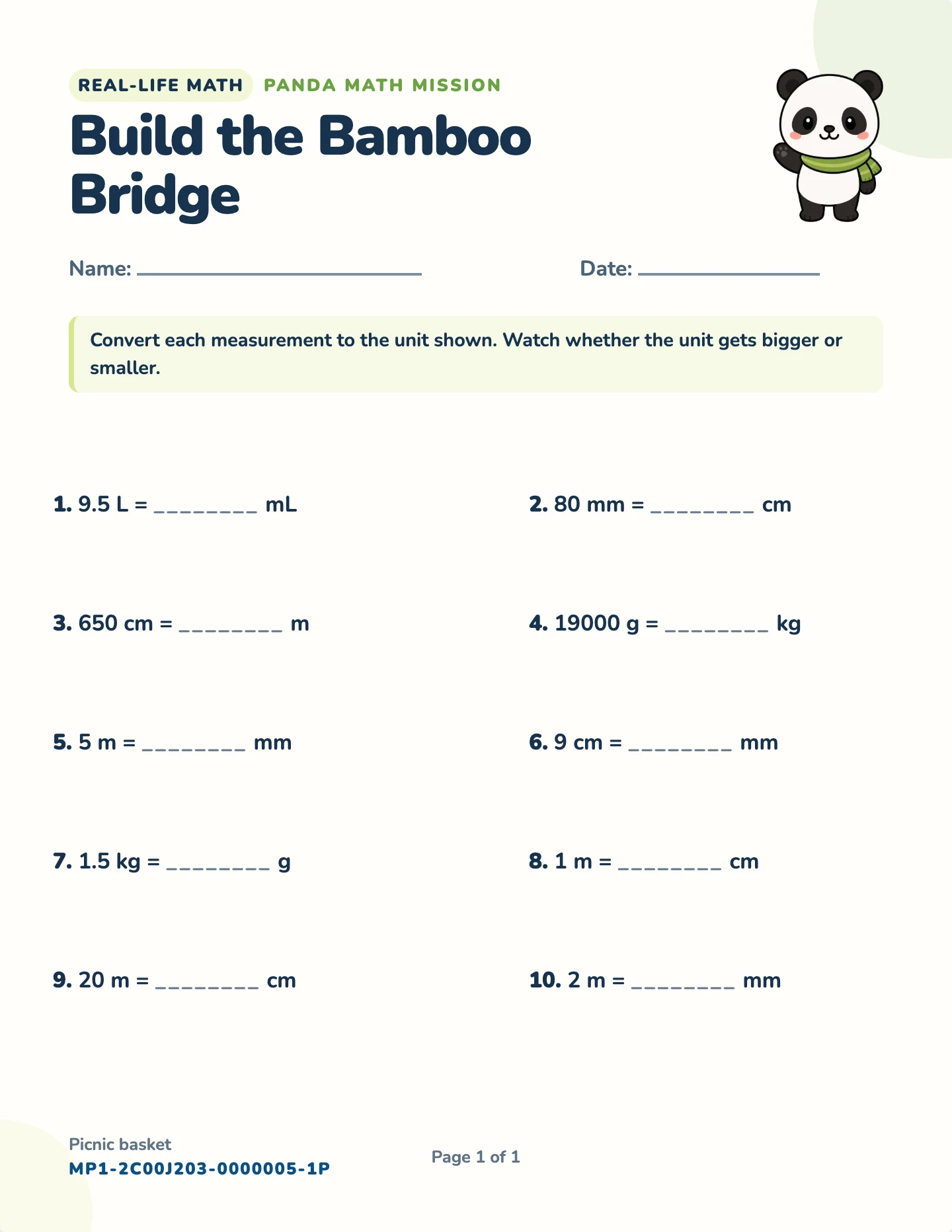
Once a child knows what a meter or a kilogram is, the next skill is moving between the units. These free printable worksheets practice single-step metric conversions — millimeters to centimeters, grams to kilograms, milliliters to liters — the everyday size-changing that measurement depends on.
The whole skill turns on one idea: a bigger unit needs fewer of it, a smaller unit needs more. Going to a smaller unit you multiply (3 m = 300 cm); going to a larger unit you divide (3000 g = 3 kg). Because metric units step by 10, 100, and 1000, every conversion is really a place-value shift — which is why this sits right alongside multiplying and dividing by powers of ten. The numbers stay friendly, with clean whole or half amounts, so the work is choosing the operation and moving the decimal, not wrestling with arithmetic.
Why this sheet works
Each sheet keeps to one family — length, mass, or capacity — or mixes all three so a child has to notice which units are in play before converting. Both directions appear on every page, so a child cannot settle into always multiplying or always dividing; they have to read whether the target unit is bigger or smaller each time.
How this one works
One question from this sheet, worked through a step at a time.
9.5 L = ? mL
L → mLsmaller unit, bigger number
1 L =1000 mL
9.5 × 1000 =9500
9500 mL
One mL is smaller than one L, and it takes MORE of a small thing to make the same amount. So the number has to get bigger — which means multiplying.
There are 1000 mL in one L, so that is the number to multiply by.
9.5 × 1000 = 9500, so 9.5 L is 9500 mL. Check the direction held: the number got bigger, which is what a smaller unit does.