
Positive and negative numbers
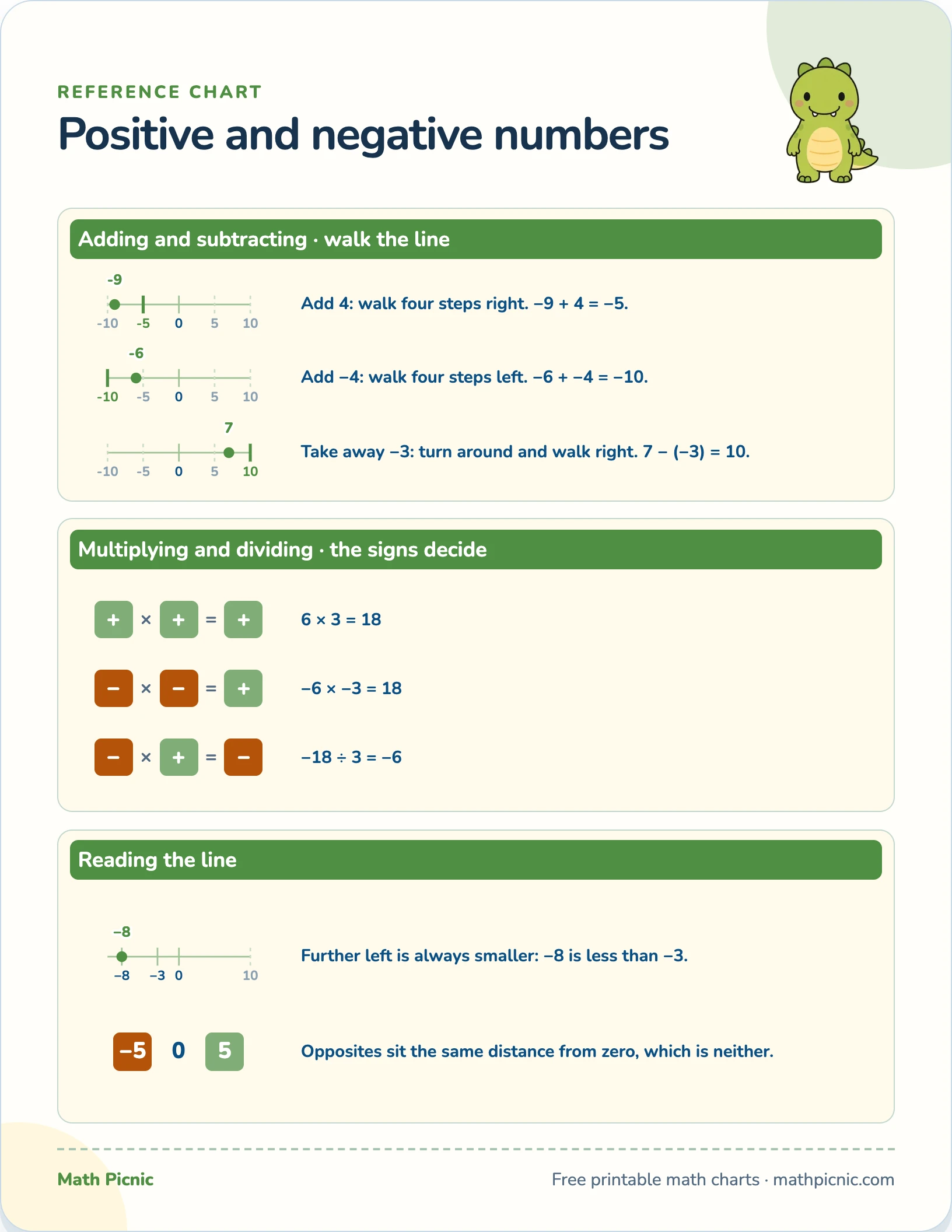
The sign rules, kept in two groups because the two groups genuinely disagree. For times and divide the signs alone decide the answer; for plus and minus the sizes decide it and the signs only say what to do.
Reference chart
Positive and negative numbers

Adding and subtracting · walk the line
- Add 4: walk four steps right. −9 + 4 = −5.
- Add −4: walk four steps left. −6 + −4 = −10.
- Take away −3: turn around and walk right. 7 − (−3) = 10.
Multiplying and dividing · the signs decide
- +×+=+6 × 3 = 18
- −×−=+−6 × −3 = 18
- −×+=−−18 ÷ 3 = −6
Reading the line
- Further left is always smaller: −8 is less than −3.
- −505Opposites sit the same distance from zero, which is neither.
What's on this chart
That difference is why a child who knows these rules still gets them wrong. "Two negatives make a positive" is perfectly true of −6 × −3, and perfectly false of −6 + −3, which is −9. The sentence was learned in one half of the chart and applied in the other, and nothing about the words themselves says which half they belong to. Keeping them under two headings is the whole point of printing this.
Why this chart helps
The addition rules are worth reading as a single idea rather than two. Same signs means the amounts pile up and the sign carries through; different signs means they work against each other, so the bigger one wins by however much it is bigger. A child who has that picture can work out −9 + 4 without a rule at all, which is the state a chart like this is trying to hand them over to.
More printable charts
- Rounding rules
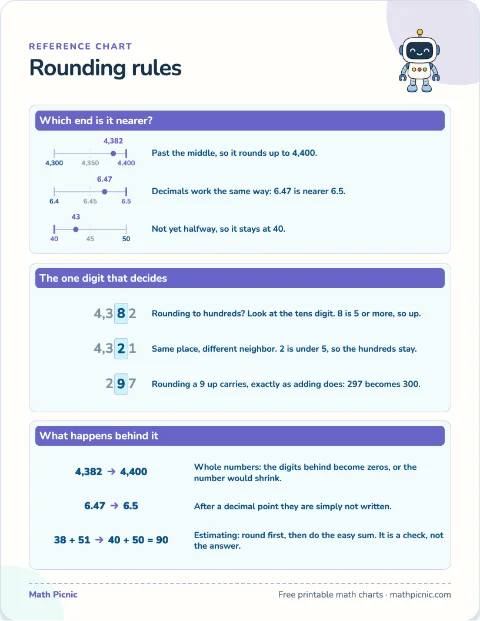 Print Find the place, look at the digit beside it, then decide.
 - Mental math tricks
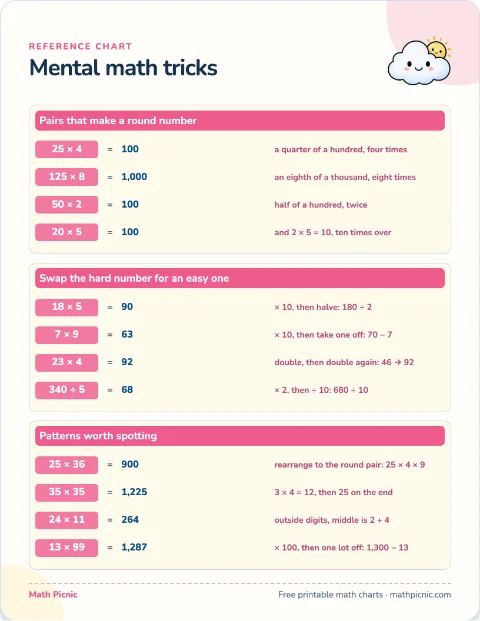 Print Swap the hard number for an easy one before you start calculating.
 - Divisibility rules
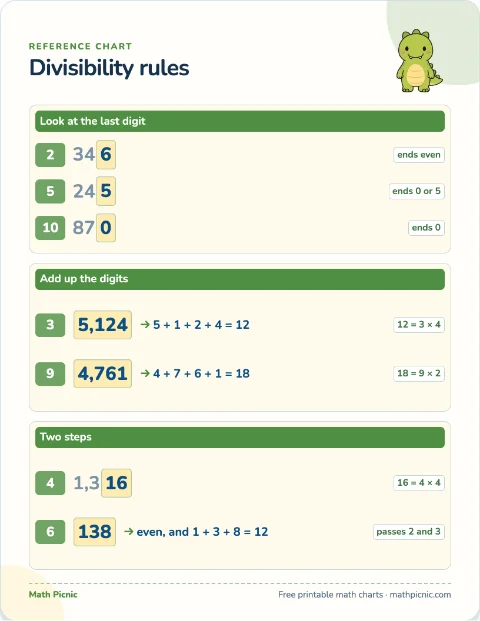 Print Run one quick test in their head instead of starting a division.
 - Fraction rules
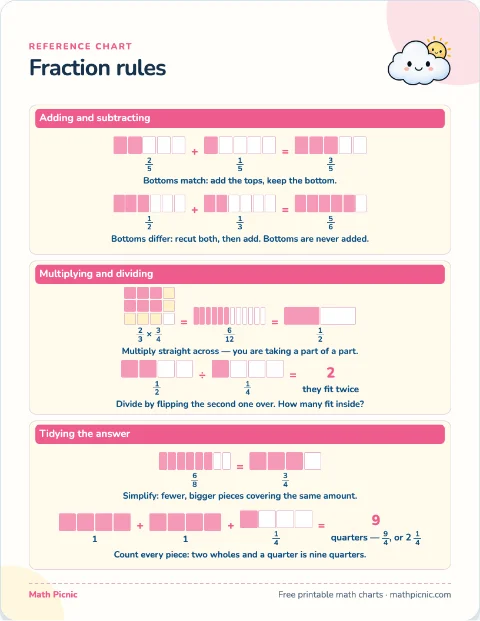 Print Check a fraction answer against the rule before doing the arithmetic.
 - Measurement conversions
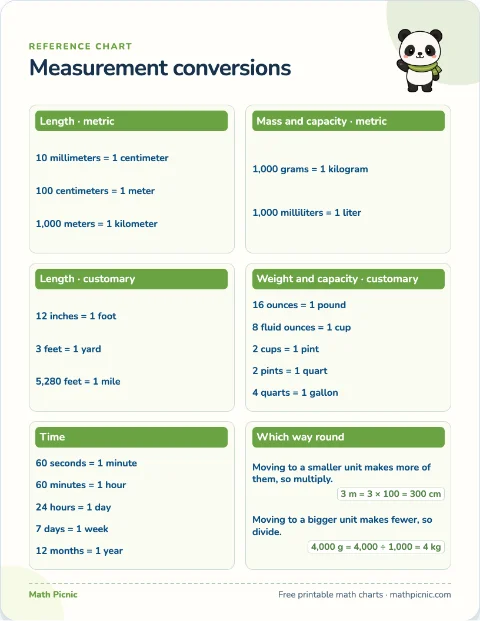 Print Look the conversion up, then decide whether to multiply or divide.
 - Order of operations
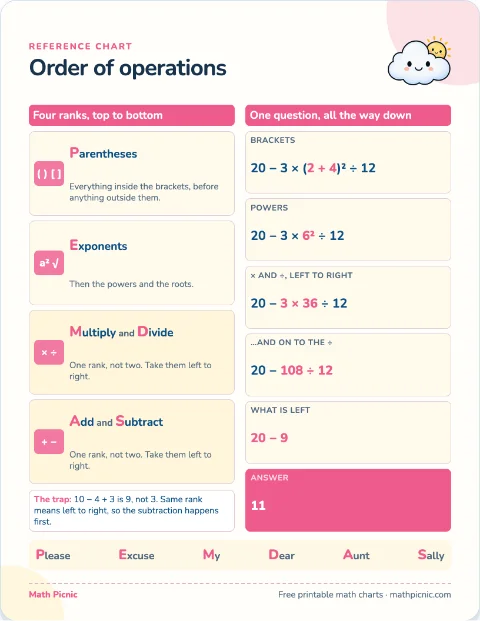 Print Work down the ranks, taking each one left to right before the next.
 - Laws of exponents
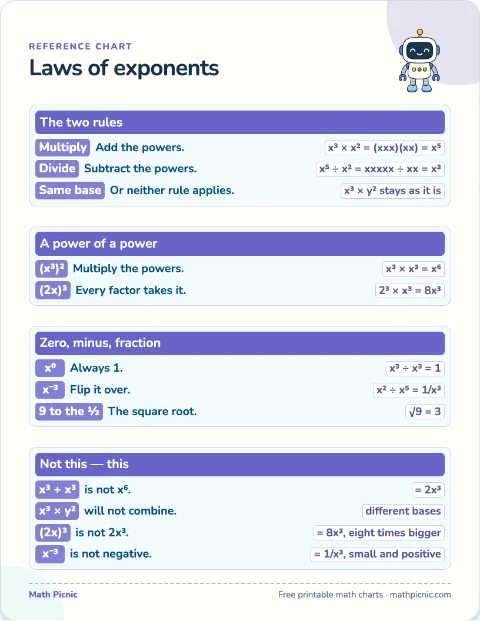 Print Find the operation you have, and the example shows where the rule comes from.
 - Scientific notation
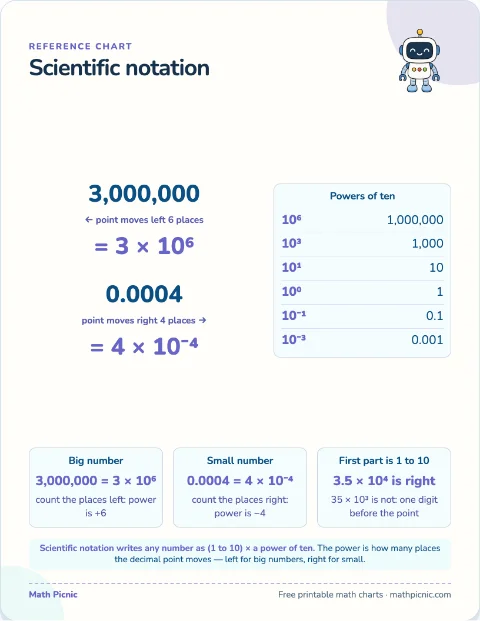 Print Move the decimal point to a number between 1 and 10, then count the places as the power.