
Properties of operations
The properties by name, with the arithmetic that shows each one — plus a sum done in your head to show what the names are actually for.
Reference chart
Properties of operations

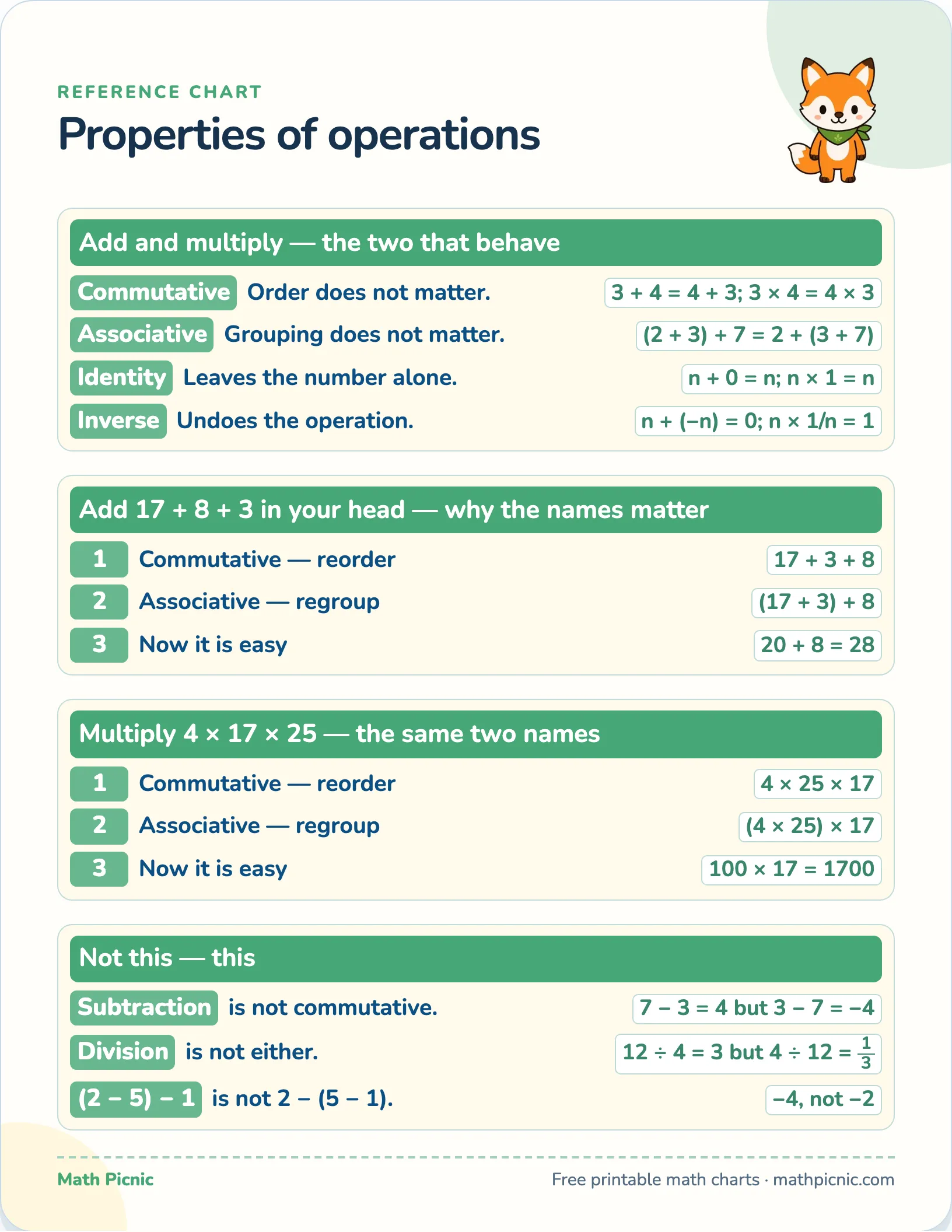
Add and multiply — the two that behave
- CommutativeOrder does not matter.3 + 4 = 4 + 3; 3 × 4 = 4 × 3
- AssociativeGrouping does not matter.(2 + 3) + 7 = 2 + (3 + 7)
- IdentityLeaves the number alone.n + 0 = n; n × 1 = n
- InverseUndoes the operation.n + (−n) = 0; n × 1/n = 1
Add 17 + 8 + 3 in your head — why the names matter
- 1Commutative — reorder17 + 3 + 8
- 2Associative — regroup(17 + 3) + 8
- 3Now it is easy20 + 8 = 28
Multiply 4 × 17 × 25 — the same two names
- 1Commutative — reorder4 × 25 × 17
- 2Associative — regroup(4 × 25) × 17
- 3Now it is easy100 × 17 = 1700
Not this — this
- Subtractionis not commutative.7 − 3 = 4 but 3 − 7 = −4
- Divisionis not either.12 ÷ 4 = 3 but 4 ÷ 12 = 13
- (2 − 5) − 1is not 2 − (5 − 1).−4, not −2
What's on this chart
Children know these long before they can name them: a first grader is already sure that 3 + 4 and 4 + 3 come to the same thing. What homework asks for is the word, so the name leads every row here and the arithmetic sits beside it as the reminder of which is which.
Why this chart helps
The middle group answers the question a reader actually has, which is not what a property is called but what it is for. Adding 17 + 8 + 3 in your head means reordering to 17 + 3 + 8 and regrouping to (17 + 3) + 8 — the commutative and associative properties, doing a job. Every line of working a student writes is one of these being applied.
More printable charts
- Rounding rules
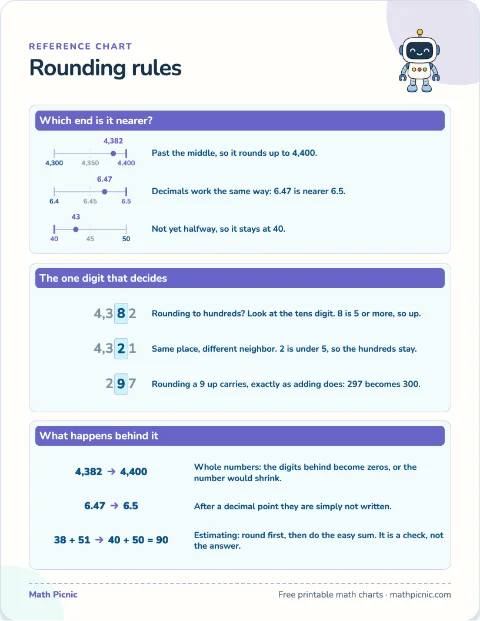 Print Find the place, look at the digit beside it, then decide.
 - The distributive property
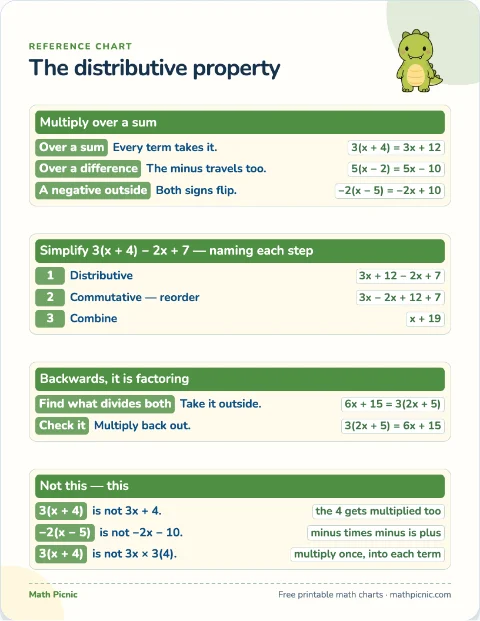 Print Expand a bracket term by term, or read the card backwards to factor.
 - Mental math tricks
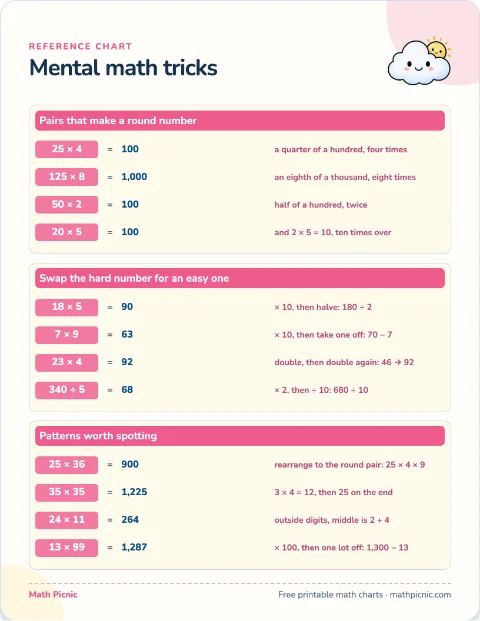 Print Swap the hard number for an easy one before you start calculating.
 - Divisibility rules
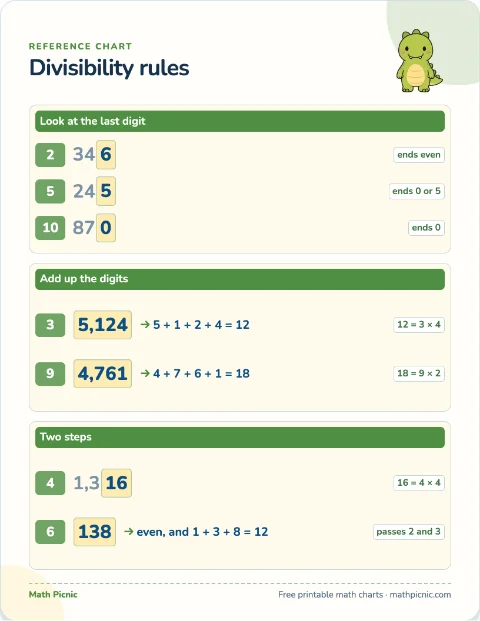 Print Run one quick test in their head instead of starting a division.
 - Fraction rules
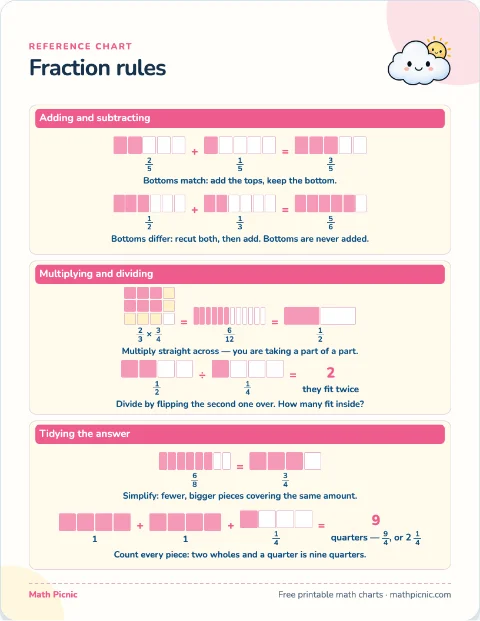 Print Check a fraction answer against the rule before doing the arithmetic.
 - Measurement conversions
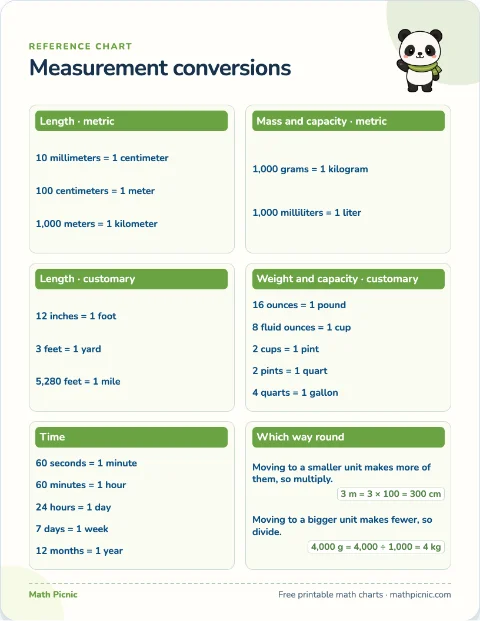 Print Look the conversion up, then decide whether to multiply or divide.
 - Order of operations
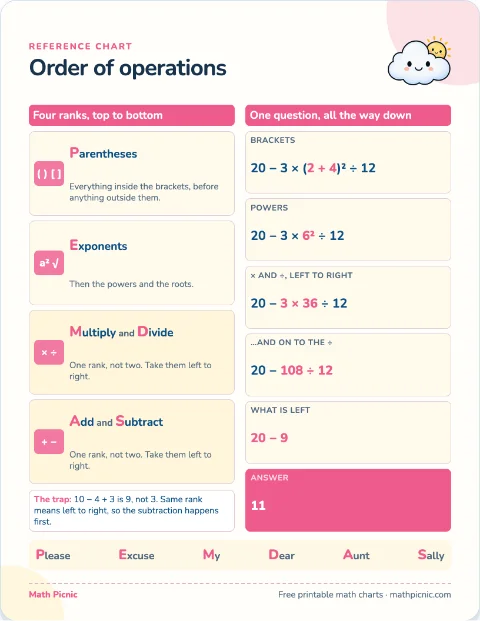 Print Work down the ranks, taking each one left to right before the next.
 - Positive and negative numbers
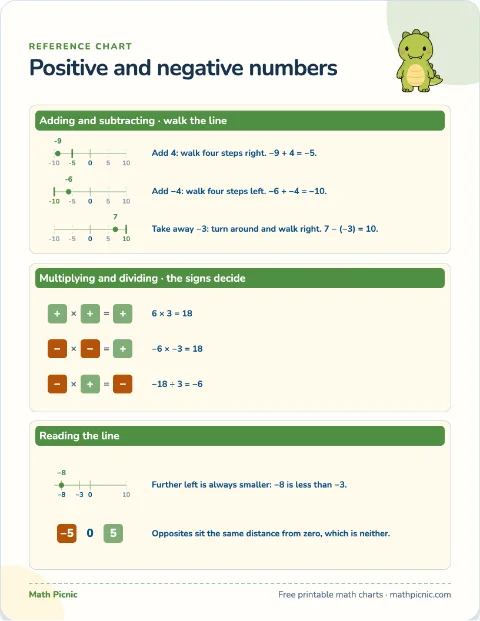 Print Check which operation you are doing before deciding the answer's sign.