
The distributive property
Expanding a bracket term by term, the same rule read backwards as factoring, and one expression simplified all the way down with each step named.
Reference chart
The distributive property

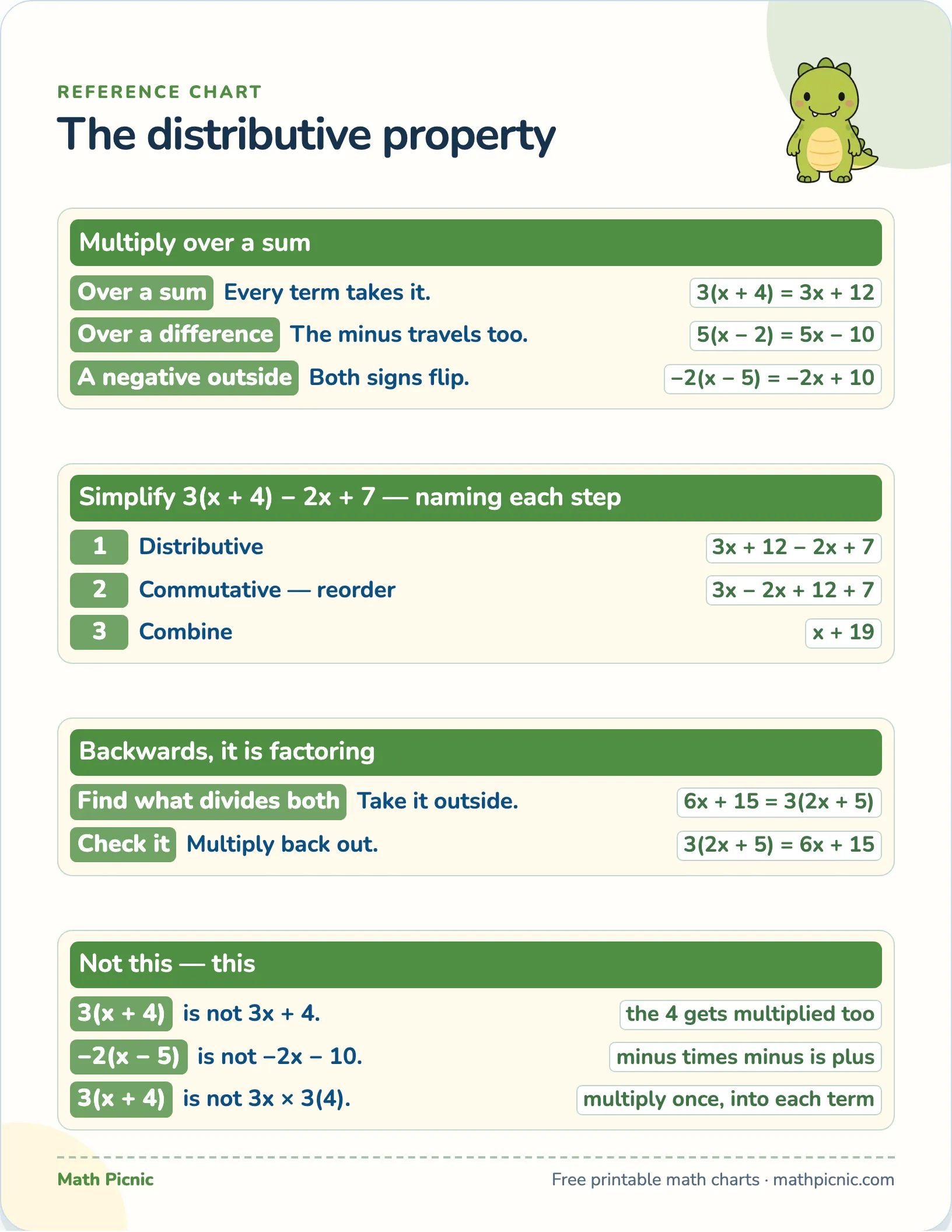
Multiply over a sum
- Over a sumEvery term takes it.3(x + 4) = 3x + 12
- Over a differenceThe minus travels too.5(x − 2) = 5x − 10
- A negative outsideBoth signs flip.−2(x − 5) = −2x + 10
Simplify 3(x + 4) − 2x + 7 — naming each step
- 1Distributive3x + 12 − 2x + 7
- 2Commutative — reorder3x − 2x + 12 + 7
- 3Combinex + 19
Backwards, it is factoring
- Find what divides bothTake it outside.6x + 15 = 3(2x + 5)
- Check itMultiply back out.3(2x + 5) = 6x + 15
Not this — this
- 3(x + 4)is not 3x + 4.the 4 gets multiplied too
- −2(x − 5)is not −2x − 10.minus times minus is plus
- 3(x + 4)is not 3x × 3(4).multiply once, into each term
What's on this chart
The distributive property is the one that joins the two operations: a number outside a bracket multiplies everything inside it, not just the first thing. That is the whole rule, and 3(x + 4) = 3x + 4 is the most common error in a first algebra course — which is why it is on this chart twice, once as what to do and once as what not to.
Why this chart helps
Signs are where it goes wrong after that. The minus in 5(x − 2) travels, and a negative outside flips both signs: −2(x − 5) is −2x + 10, not −2x − 10. Both are on the card with the working, because a rule about signs stated without an example is a rule a reader will apply confidently in the wrong direction.
More printable charts
- Rounding rules
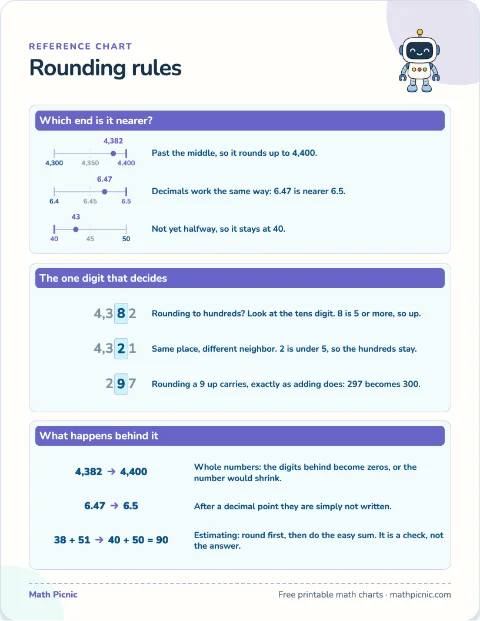 Print Find the place, look at the digit beside it, then decide.
 - Properties of operations
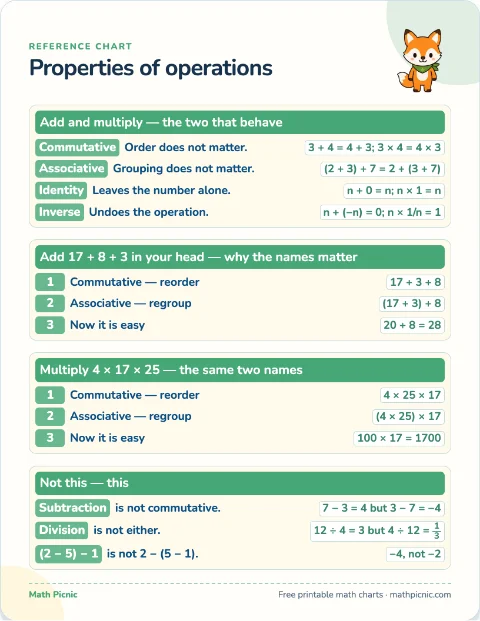 Print Name the property a step used, or find the one that makes a calculation easier.
 - Mental math tricks
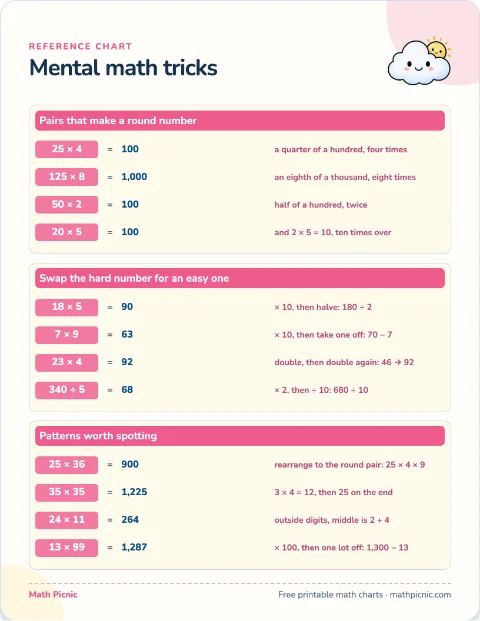 Print Swap the hard number for an easy one before you start calculating.
 - Divisibility rules
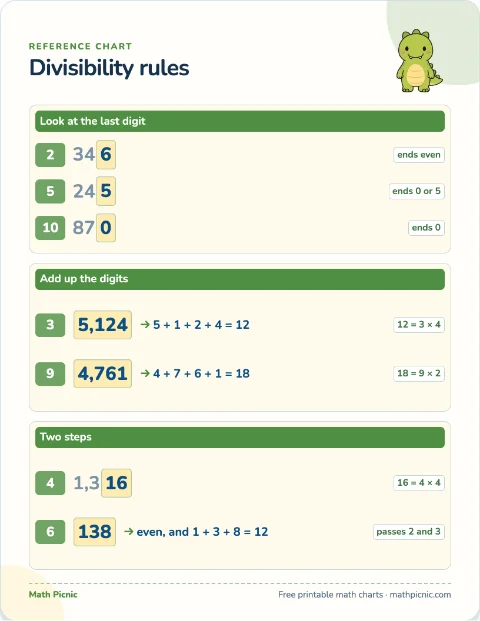 Print Run one quick test in their head instead of starting a division.
 - Fraction rules
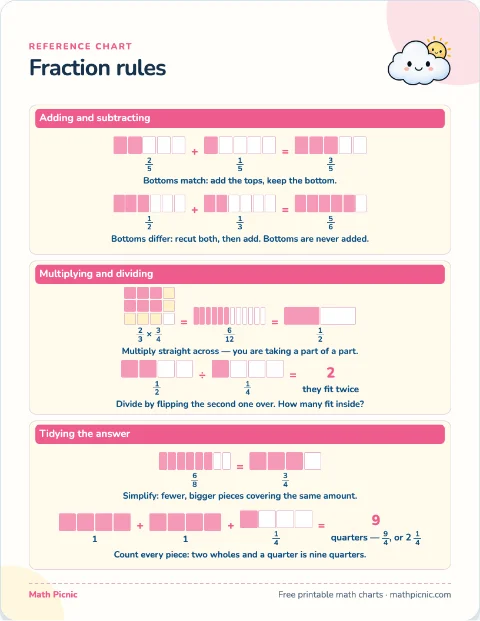 Print Check a fraction answer against the rule before doing the arithmetic.
 - Measurement conversions
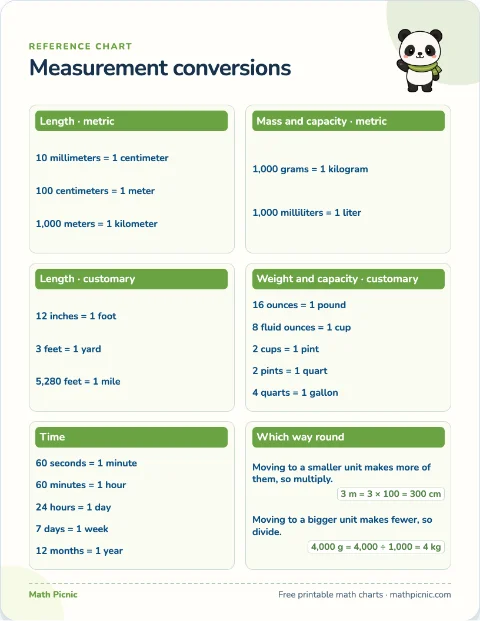 Print Look the conversion up, then decide whether to multiply or divide.
 - Order of operations
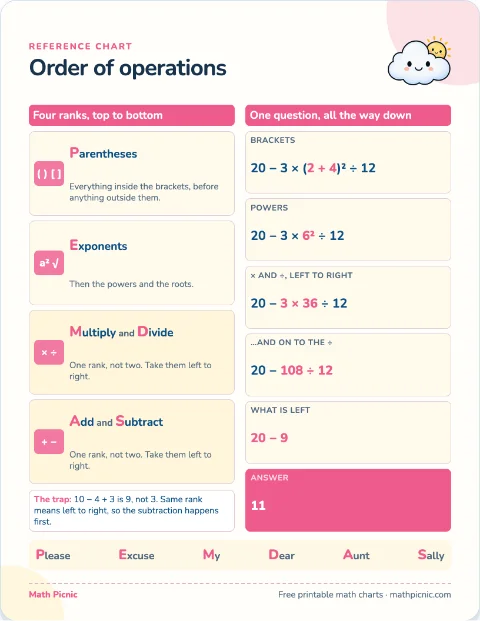 Print Work down the ranks, taking each one left to right before the next.
 - Positive and negative numbers
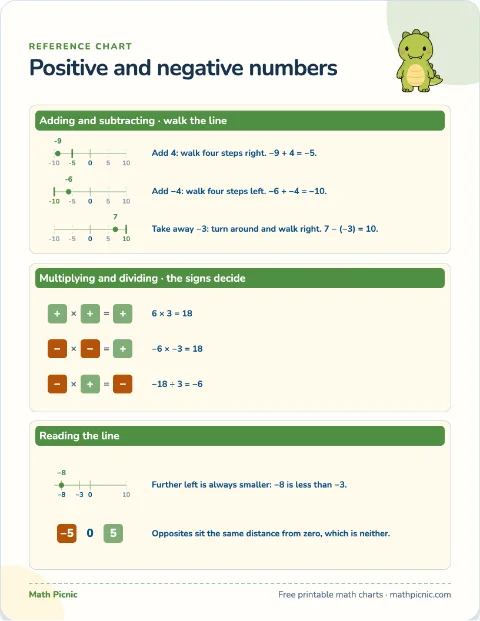 Print Check which operation you are doing before deciding the answer's sign.