
Solving equations
An equation is a balance: the two sides are equal, and they stay equal as long as you do the same thing to both. To get x on its own, undo whatever is happening to it — and undo it on both sides at once.
Reference chart
Solving equations

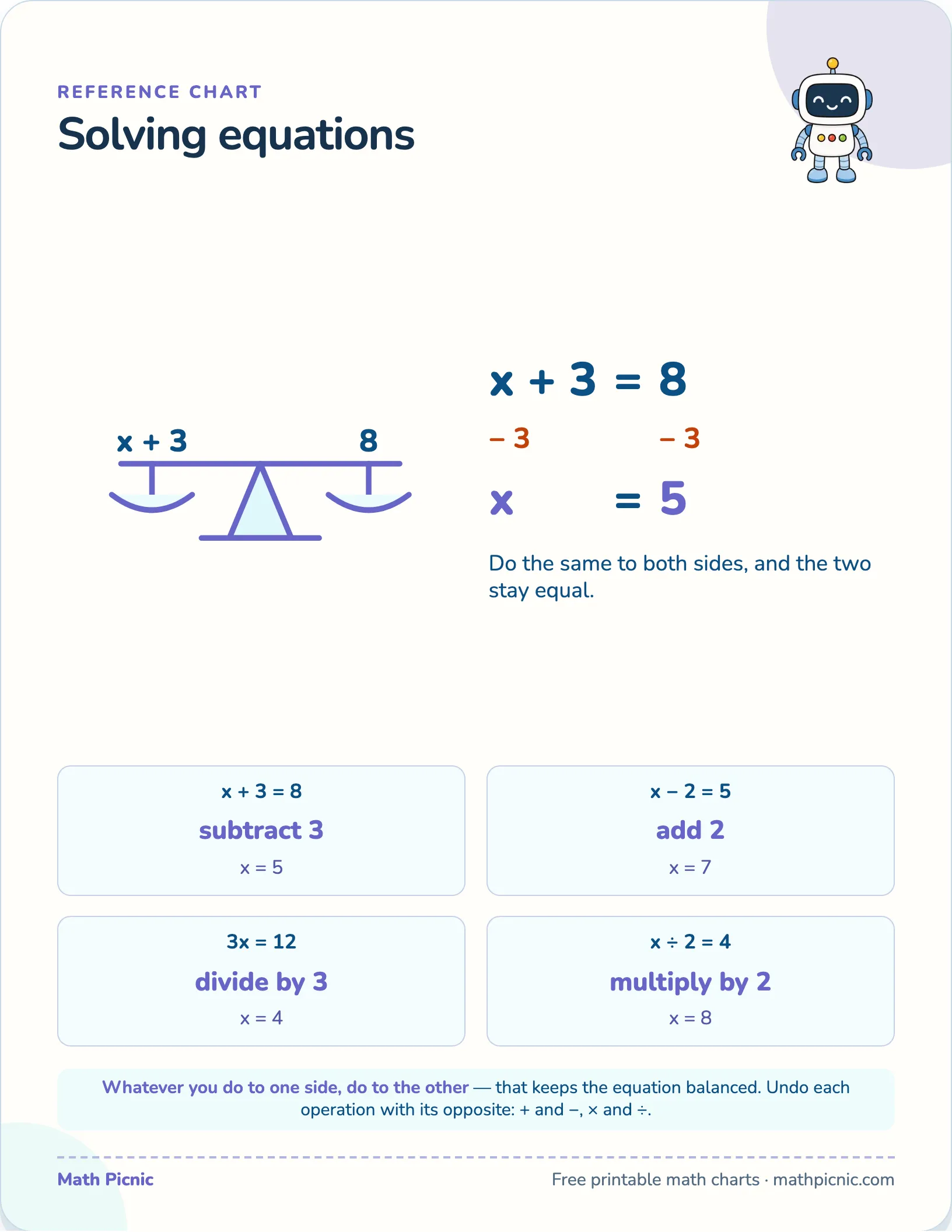
Do the same to both sides, and the two stay equal.
x + 3 = 8
subtract 3
x = 5
x − 2 = 5
add 2
x = 7
3x = 12
divide by 3
x = 4
x ÷ 2 = 4
multiply by 2
x = 8
Whatever you do to one side, do to the other — that keeps the equation balanced. Undo each operation with its opposite: + and −, × and ÷.
What's on this chart
Think of x + 3 = 8 as a scale that balances. The left pan holds x and 3, the right holds 8, and the beam is level because the two are equal. Take 3 off the left pan and it tips — unless you take 3 off the right pan too. Do both and the scale is level again, now reading x = 5. That is the whole method: whatever you do to one side, do to the other, and the equation stays true.
Why this chart helps
Getting x alone means undoing the operation attached to it, and every operation is undone by its opposite. Addition is undone by subtraction, and subtraction by addition; multiplication is undone by division, and division by multiplication. So x + 3 = 8 is solved by subtracting 3, and 3x = 12 by dividing by 3 — the four cards show each pair. Choosing the right inverse is the only decision; the balance rule takes care of the rest.
More printable charts
- Rounding rules
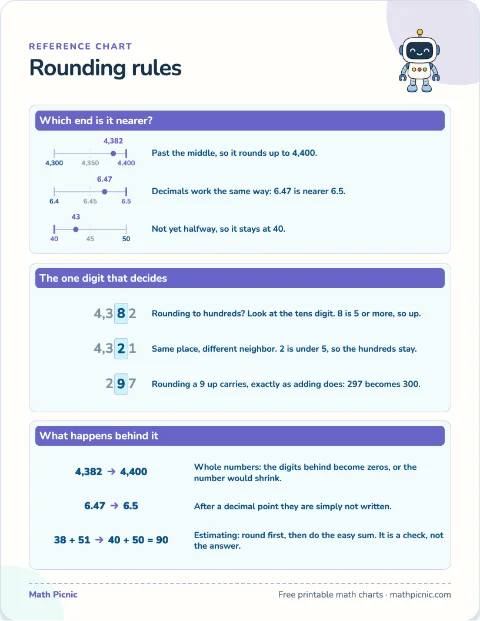 Print Find the place, look at the digit beside it, then decide.
 - Properties of operations
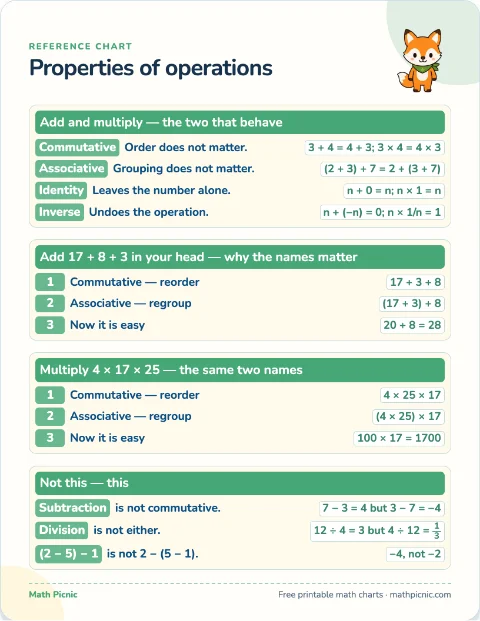 Print Name the property a step used, or find the one that makes a calculation easier.
 - The distributive property
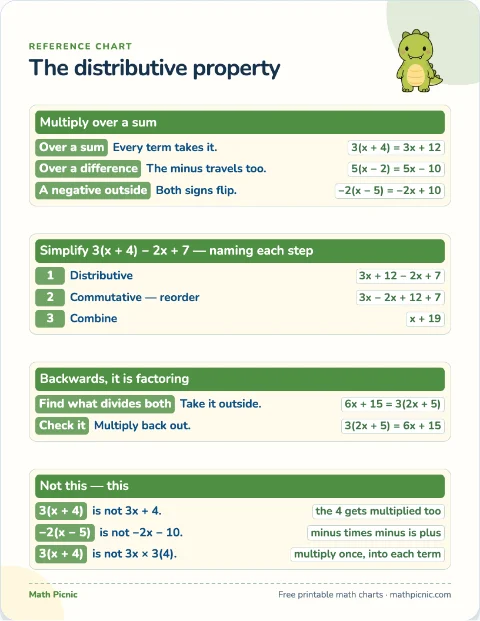 Print Expand a bracket term by term, or read the card backwards to factor.
 - Mental math tricks
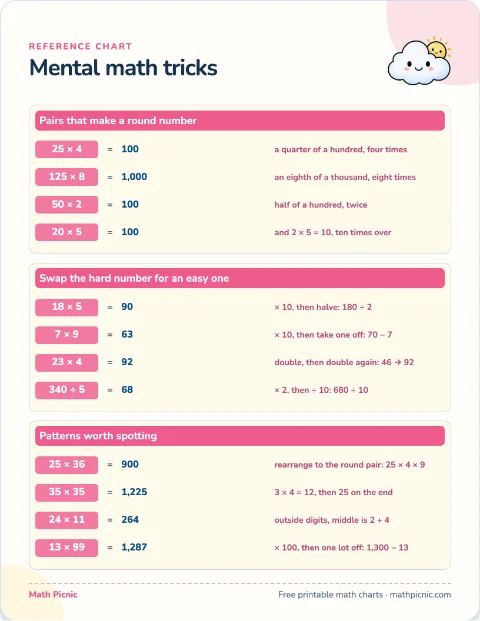 Print Swap the hard number for an easy one before you start calculating.
 - Divisibility rules
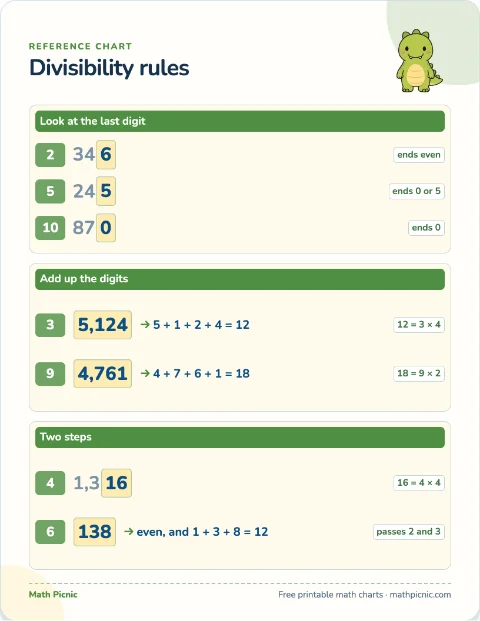 Print Run one quick test in their head instead of starting a division.
 - Fraction rules
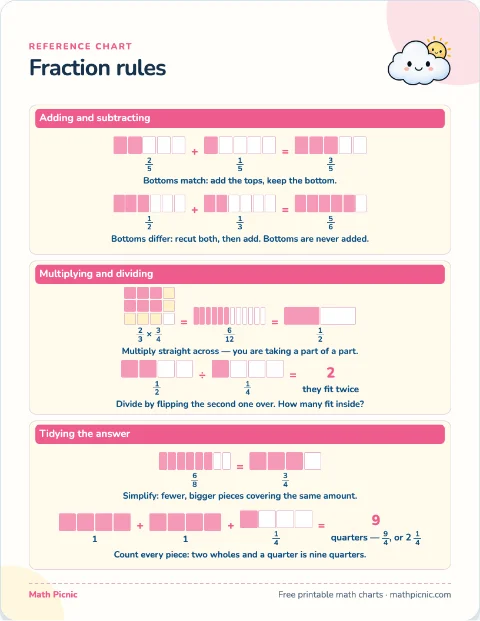 Print Check a fraction answer against the rule before doing the arithmetic.
 - Measurement conversions
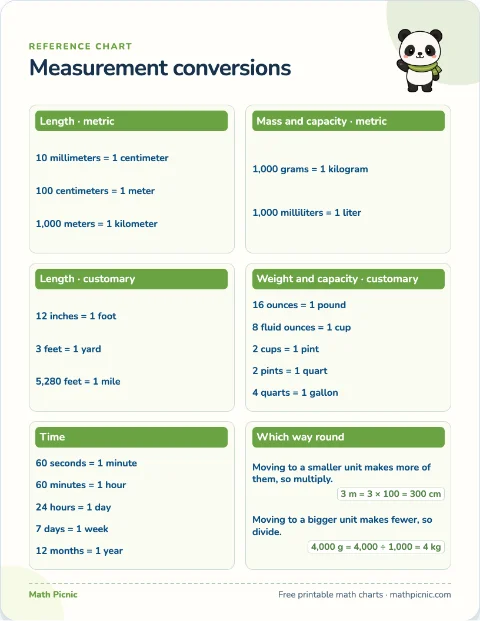 Print Look the conversion up, then decide whether to multiply or divide.
 - Order of operations
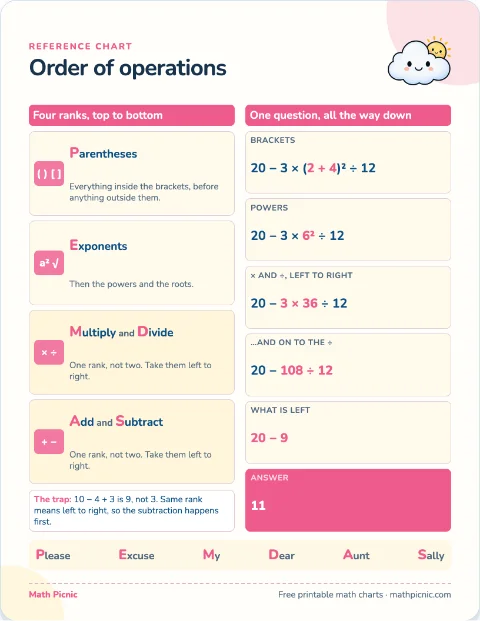 Print Work down the ranks, taking each one left to right before the next.