
Decimal place value
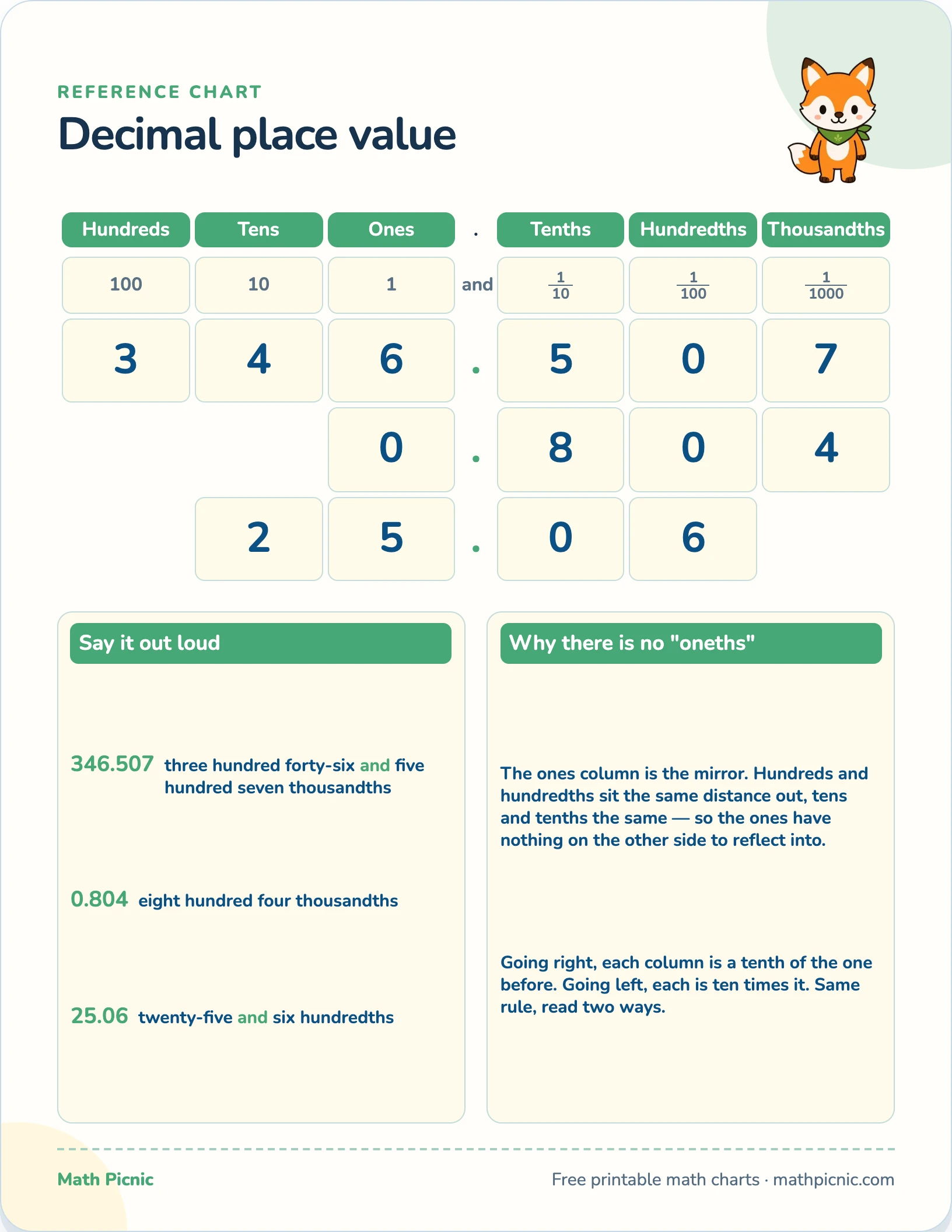
The place value chart carried past the point, from hundreds down to thousandths, with 346.507 placed in the columns so the halves either side of the decimal point can be compared.
Reference chart
Decimal place value

| Hundreds | Tens | Ones | . | Tenths | Hundredths | Thousandths |
|---|---|---|---|---|---|---|
| 100 | 10 | 1 | and | 110 | 1100 | 11000 |
| 3 | 4 | 6 | . | 5 | 0 | 7 |
| 0 | . | 8 | 0 | 4 | ||
| 2 | 5 | . | 0 | 6 |
Say it out loud
- 346.507three hundred forty-six and five hundred seven thousandths
- 0.804eight hundred four thousandths
- 25.06twenty-five and six hundredths
Why there is no "oneths"
- The ones column is the mirror. Hundreds and hundredths sit the same distance out, tens and tenths the same — so the ones have nothing on the other side to reflect into.
- Going right, each column is a tenth of the one before. Going left, each is ten times it. Same rule, read two ways.
What's on this chart
Place value stops being obvious exactly where the decimal point appears. A child reads the whole-number side confidently — each column is ten times the one to its right — and then meets tenths, where the same rule has to be run the other way: each column is a tenth of the one to its left. Those are one rule, and they only look like one when someone shows the columns continuing straight through the point.
Why this chart helps
So the point gets a column of its own here rather than being tucked against a digit. It is the line the chart is symmetrical about: hundreds and hundredths sit the same distance out on either side, tens and tenths the same. That symmetry answers the question every class asks, which is why there is no "oneths" column — the ones column is the axis, so it cannot also be its own reflection.
More printable charts
- Counting to 10
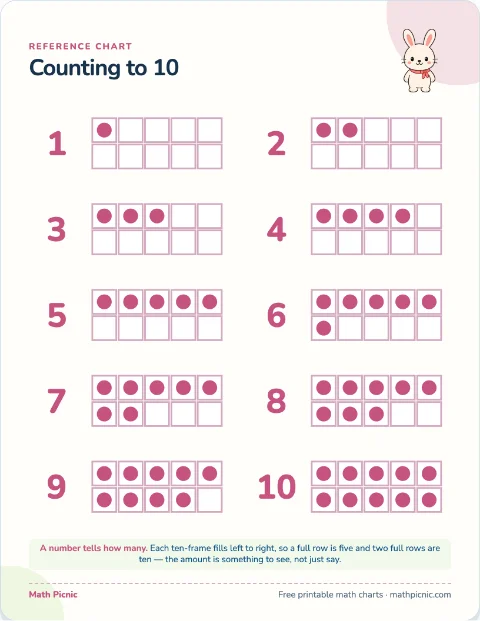 Print Count the dots in each ten-frame and read the number beside it.
 - Number bonds to 10
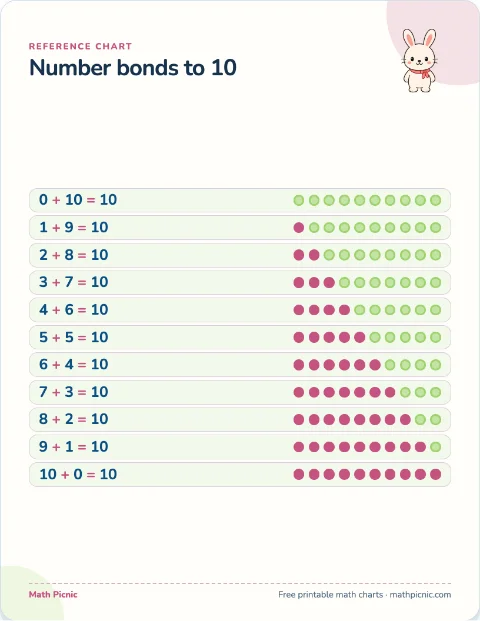 Print Read each row of counters and say the two numbers that make ten.
 - Comparing numbers
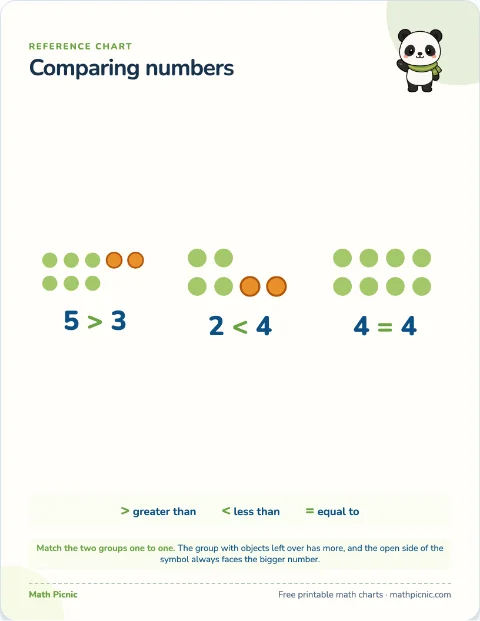 Print Line the two groups up one to one; the group with a leftover has more.
 - Odd and even
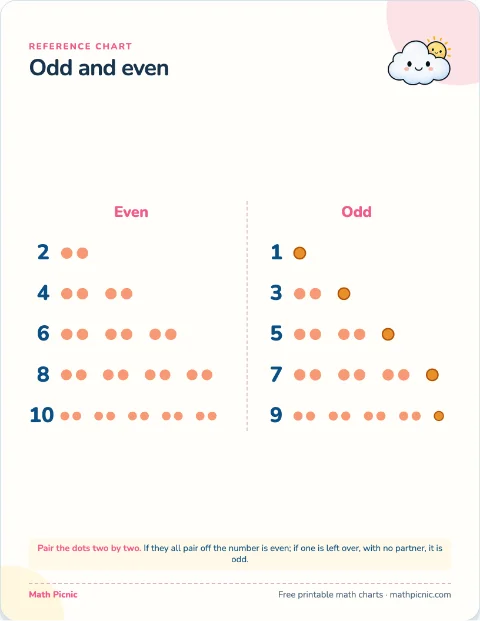 Print Pair the dots two by two; all paired is even, one left over is odd.
 - Number line 0–20
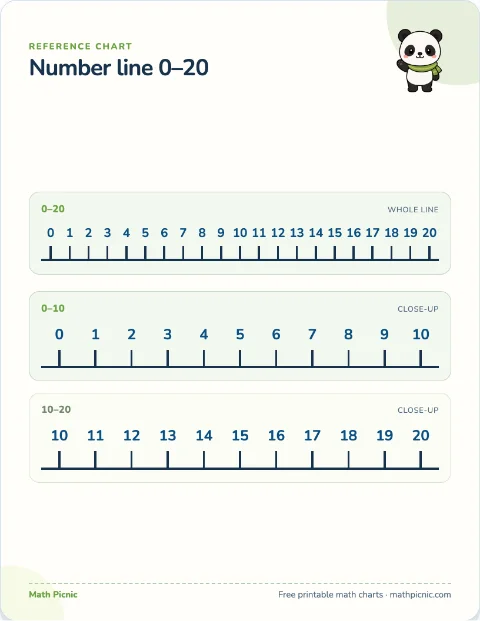 Print Count on or back by hopping along the line one number at a time.
 - Blank number line 0–20
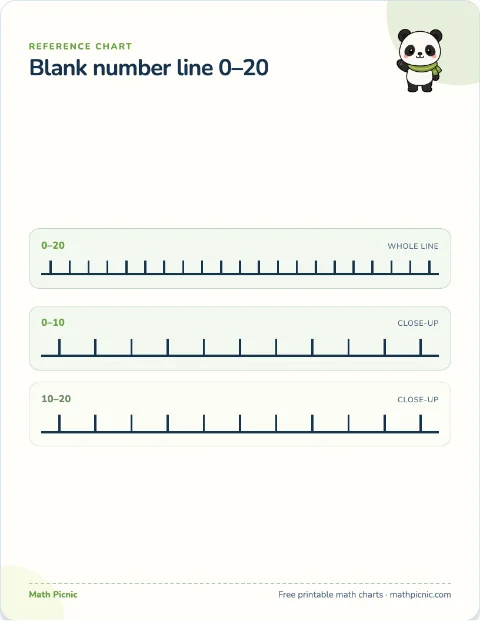 Print Label the ticks, mark a number, or draw equal jumps for an operation.
 - Number bonds to 20
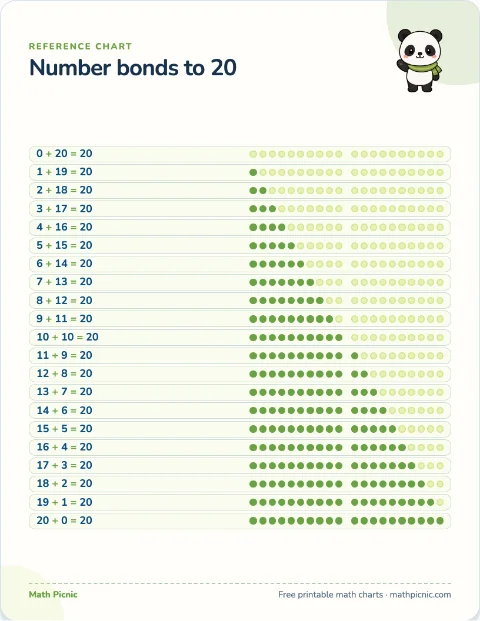 Print Count the two colors in a row and say the pair that makes twenty.
 - Telling the time
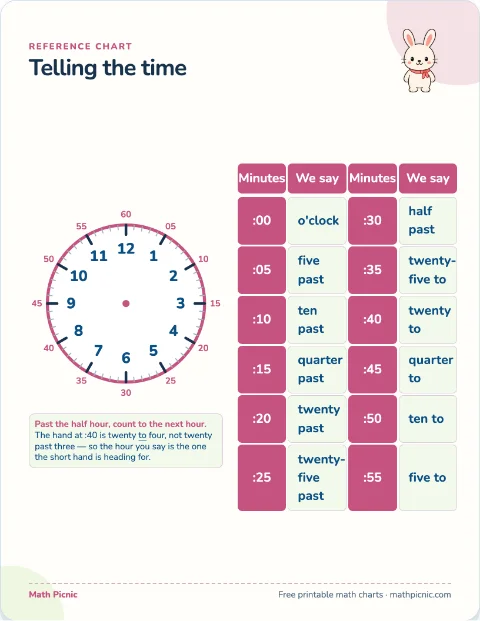 Print Read the hour inside the dial and the minutes printed outside it.