
Transformations
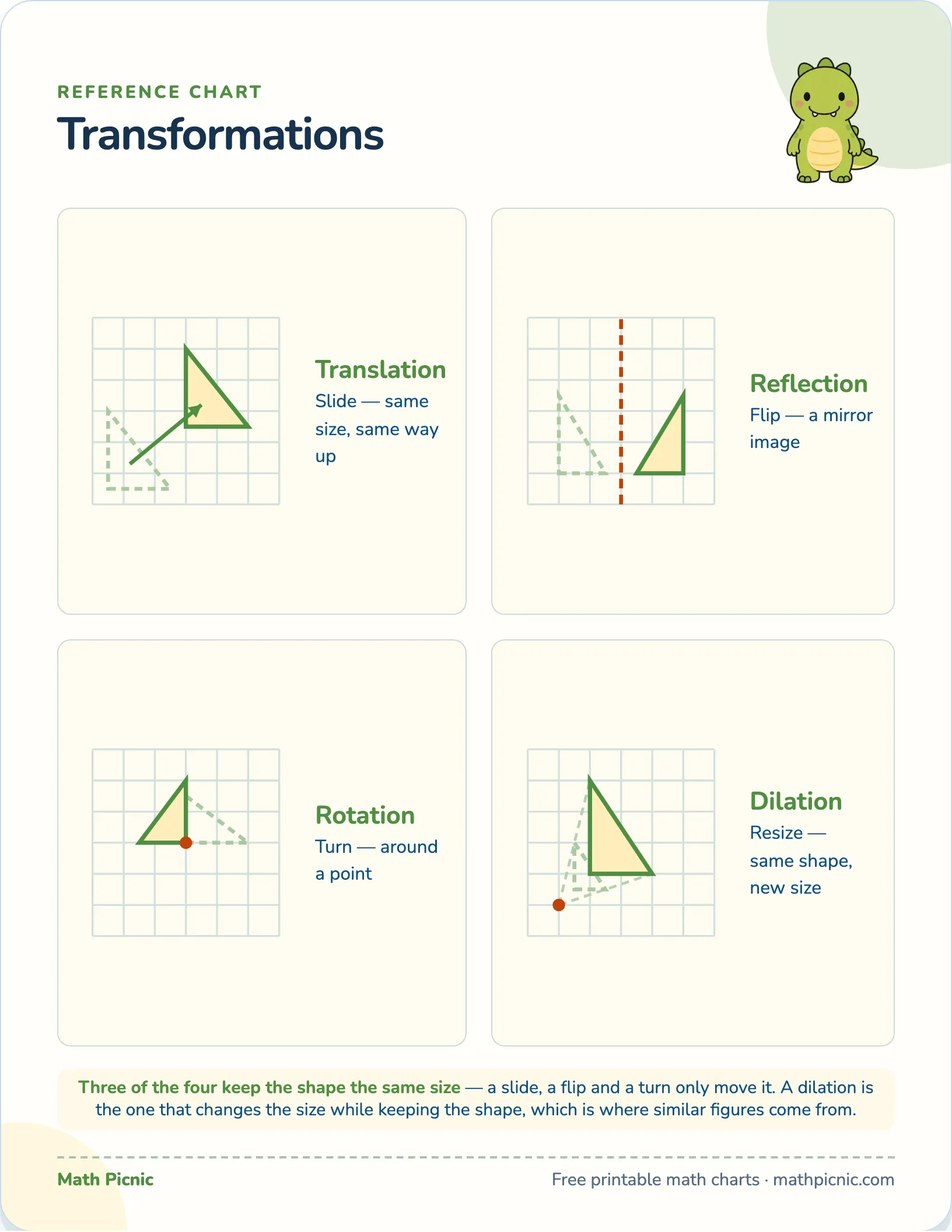
Four ways to move a shape on a grid: slide it, flip it, turn it, or resize it. The first three — translation, reflection, rotation — never change the shape's size; only a dilation does. Each one is drawn here as a before and an after.
Reference chart
Transformations

Three of the four keep the shape the same size — a slide, a flip and a turn only move it. A dilation is the one that changes the size while keeping the shape, which is where similar figures come from.
What's on this chart
A translation is a slide: every point moves the same distance in the same direction, so the shape lands somewhere new the same size and the same way up. Nothing turns, nothing flips — if you can trace the shape and shift your hand without rotating it, you have translated it. It is the plainest of the four and the one the others are measured against.
Why this chart helps
A reflection is a flip across a mirror line, so the image comes out backwards, fitting the original the way a shape meets its reflection folded on the line. A rotation is a turn about a fixed point: the shape spins a quarter, half, or three-quarter turn and keeps its size but faces a new direction. Both keep every length the same; only the position or the facing changes, which is why all three are called rigid motions.
More printable charts
- Naming 2D shapes
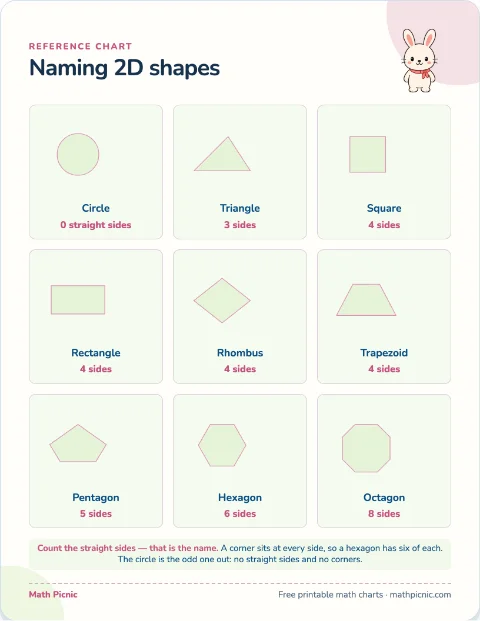 Print Count the straight sides on a shape, then read its name below it.
 - Quadrilateral family
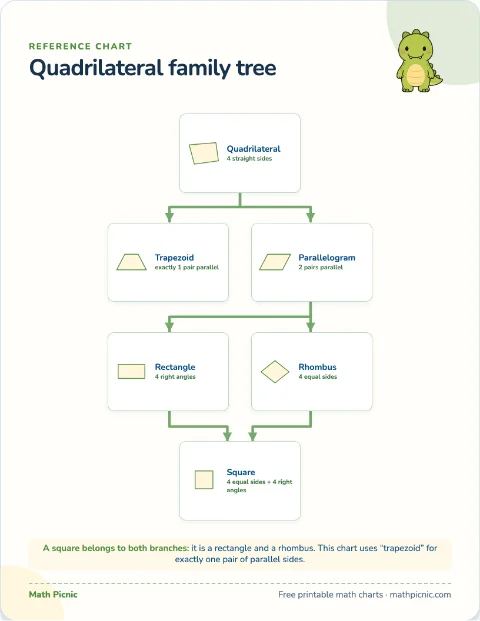 Print Follow the branches to see which names a shape inherits.
 - Lines of symmetry
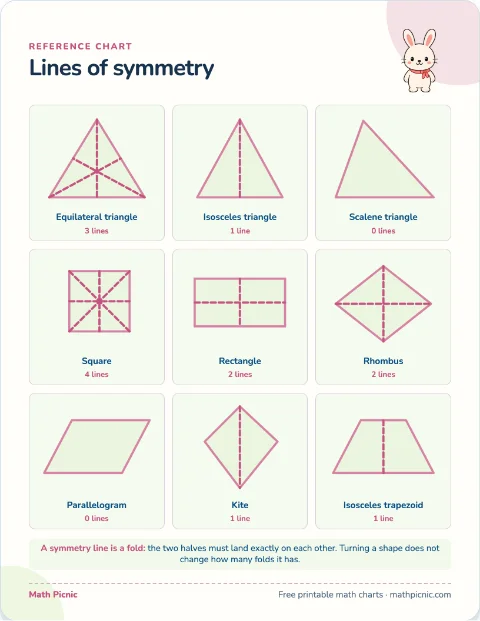 Print Fold each shape in your mind and count the matching halves.
 - Types of angles
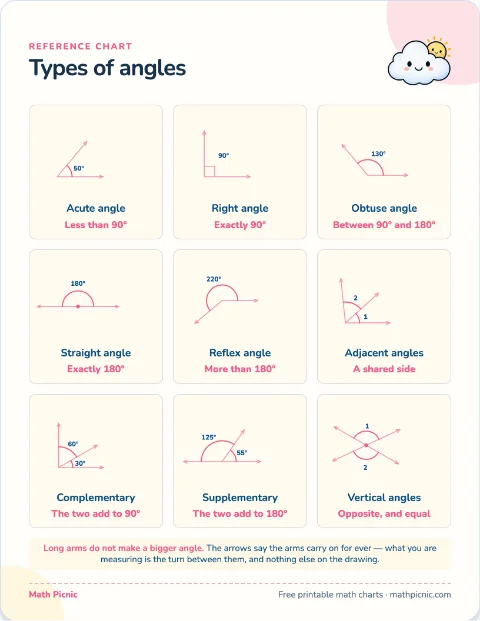 Print Find the picture that matches yours, and the name is under it.
 - Angles in parallel lines
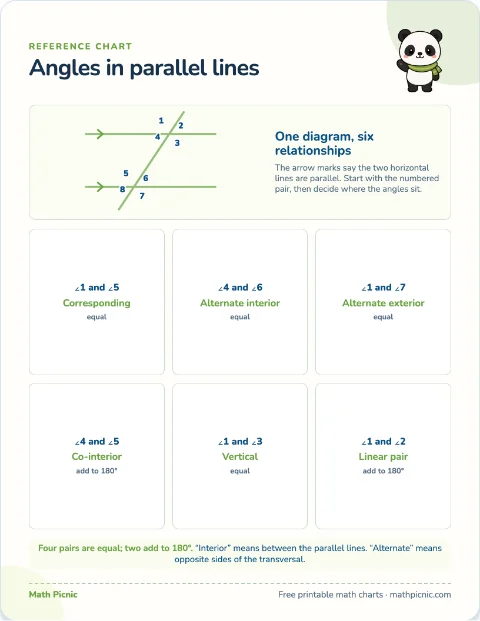 Print Match each numbered pair to its position around the transversal.
 - Perimeter formulas
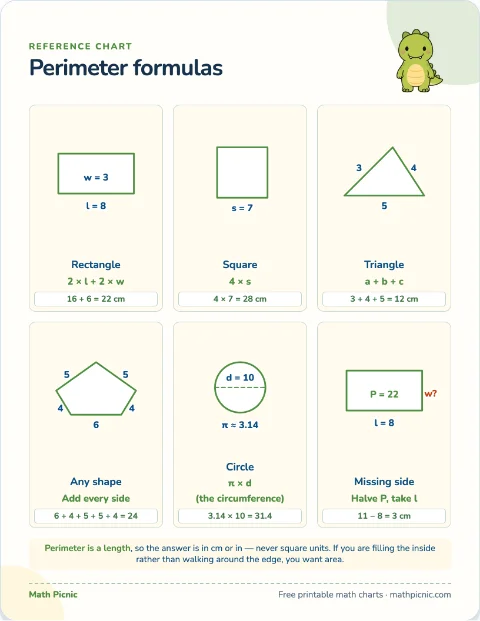 Print Follow the traced edge on the figure, then read the formula under it.
 - Area formulas
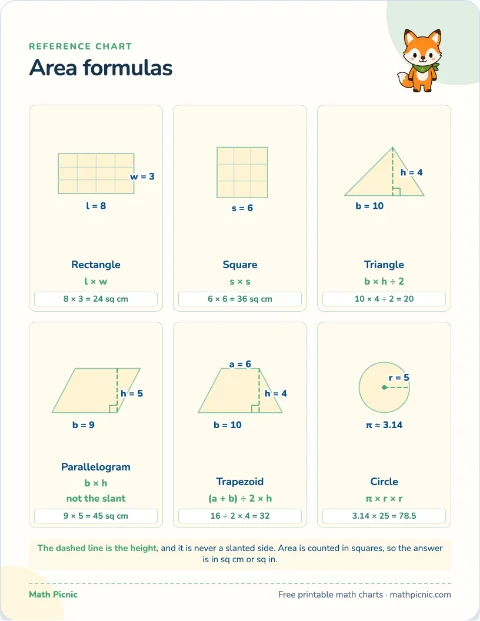 Print Match your shape to a figure and use the letters drawn on it.
 - Volume formulas
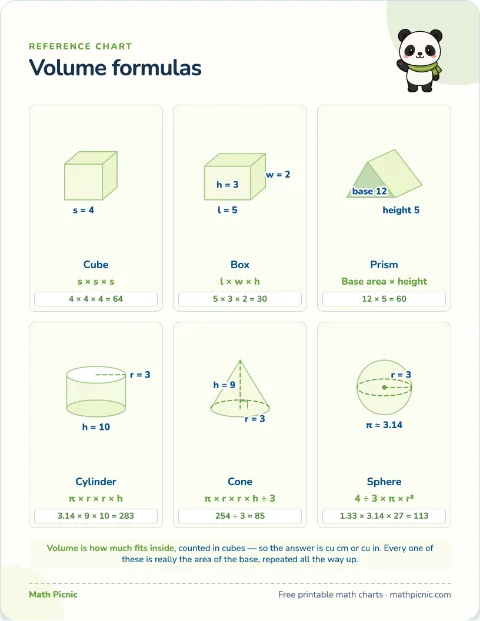 Print Find your solid, then multiply the base area by how tall it stands.